


Differentiation Questions
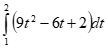
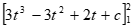
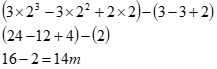
1. A particle moves in a straight line from a fixed point. Its velocity Vm/s after t seconds is given by 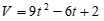 calculate the distance traveled by the particle during the 2nd second. (4 mks)
2. A body moves in a straight line in such a way that at any time, t seconds, its distance S metres from the starting point is given by S = 8t – t2.
(a) How fast is the body moving at (3mks)
(i) t = 1 second
(ii) t = 3 seconds.
(b) What is the maximum displacement from the starting point that the body achieves. (4mks)
(c) Find the acceleration of the body. (1mk)
(d) After how long will the body be back to the starting point? (2mks)
3. Find the equation of the normal to the curve
X2 = 4y at the point (6,9) (3 marks)
4. The acceleration of a particle in M5-2 is given by the expressions 3t –4
Find:-
(i) an expression for velocity Vms1 (1 mark)
(ii) an expression for distance 5 metres from a fixed point O. Given that S=0
when V=3 and t=0 (2 marks)
5. A particle P moves in a straight line such that t seconds after passing a fixed point Q, its velocity is given by the equation
2t2 – 10t + 12. find;
(a) The values of t when p is instantaneously at rest (2 marks)
(b) An expression for the distance moved by P after t seconds. (2 marks)
(c) The total distance traveled by P in the first 3 seconds after passing point O. (3 marks)
(d) The distance of P from O when the acceleration is zero. (3 marks)
6. (a) Find the derivative of
y = (3x – 2x2)(5 + 4x) (3mks)
(b) A diver leaps from a diving board 32m above the surface of a swimming pool. At time t second, his position h, above the surface of the swimming pool is given by h = 32 + 16t – 16t2.
Find:
(i) The time he took to hit the water surface. (4mks)
(ii) The velocity at which he hit the water surface. (3mks)
7. A particle moves such that t seconds after passing a given point O, its distance S metres
from O is given by S= t (t-2) (t-1)
(a) Find its velocity when t = 2 seconds
(b) Find its minimum velocity
(c)Find the time when the particle is momentarily at rest
(d) Find its acceleration when t = 3seconds
8. The table below gives the values of x and y for the curve y=x2 +1
X | 0 | 1 | 2 | 3 | 4 | 5 | 6 | 7 | 8 | 9 | 10 |
y | 1 | 2 | 10 | 17 | 37 | 50 | 82 |
a) Complete the table
b) Use the mid- ordinate rule to estimate the area enclosed by the curve y = x2 + 1.
Use five coordinates
c) Using integration, calculate the actual area in (a) above
d) Calculate the percentage error in the estimated area
9. The gradient function of a curve is given by the expression 2x + 1. If the curve passes
through the point (-4, 6); find the equation of the curve
10. A particle P moves in a straight line so that its velocity, Vm/s at time t seconds where
t 0 is given by v = 28 + t – 2t2
Find;
(a) the time when P is instantaneously at rest
(b) the speed of P at the instant when the acceleration of P is zero
(c) Find the acceleration of P when the article is instantaneously at rest
(d) Find the distance covered by the particle during the 3rd second, when at t = 0 D = 5M
11. A particle K moves a long a straight line 50 cm long. At time t = 0, k is at A and t seconds later its velocity vcm/s is given by v = 15 + 4t – 3t2.
a) Write down the expression for;
i) The acceleration of K at time t seconds.
ii) The distance of K from A at time t seconds.
b) i) Find t when K is instantaneously at rest.
ii) How far is K from A at this time?
c) Find the period of time during which the acceleration of P is positive.
12. The diagram below shows the sketch of the curve y = x2
and y = -x2 + 8 intersecting at A and B:-
(a) Find the value of a and b hence find the coordinates of A and B
(b) Find the area enclosed by x = a, x = b, the axis and:-
(i) the curve y = x2
(ii) the curve y = -x + 8
13. The distance from a fixed point of a particle in motion at any time t seconds is given by :-
S = t3– 5/2t2 + 2t + 5 metres
Find its:
(a) Acceleration after t seconds
(b) Velocity when acceleration is zero
14. A particle moves in a straight line. It passes through point O at t
= 0 with a velocity v = 5 m/s.
The acceleration a m/s2 of the particle at time t seconds after passing through O is given by
a = 6t + 4
(a) Express the velocity v of the particle at time t seconds in terms of t.
(b) Calculate the velocity of the particle when t = 4.
(c) (i) Express the displacement s by the particle after t seconds in terms of t.
(ii) Calculate the distance covered by the particle between t = 1 and t = 4.
15 . The displacement S metres of a particle moving along a straight line after t seconds is given by.
S = 3t + 3t2 – 2t3
2
a) Find its initial acceleration
b) Calculate:
i) The time when the particle was momentarily at rest
ii) Its displacement by the time it came to rest momentarily
c) Calculate the maximum speed attained
16. Find the equation to the tangent to the curve:-
y = 4x3 – 2x2 – 3x + 5 at the point (2, 23)
17. A farmer wanted to make a trough for cows to drink water. He had a metal sheet measuring 240cm by 120cm and 1cm thick. The density of the metal is 2.5g/cm3. A square of sides 30cm
is removed from each corner of the rectangle and the remaining part folded to form an open cuboid.
(a) Sketch the sheet after removing the squares for the four corners, showing all the dimensions
(b) Calculate:-
(i) The area of the metal which forms the cuboid
(ii) The mass of the empty cuboid in Kilograms
- The cuboid is filled with water whose density is 1g/cm3. Calculate the mass of the
cuboid when full of water
18. A rectangular sheet of cardboard is 8cm long and 5cm wide. Equal squares are cut away at
each corner and the remainder is folded so as to form an open box. Find the maximum volume
19. (a) Find the equation of the normal to the curve :- y = x3 – 2x – 1 at ( 1, -2)
(b) Determine the nature of the turning points to the curve y = x3 – 3x + 2; Hence in the
space provided below, sketch the curve
20. A particle moves in a straight line so that its velocity, v/m/s at time t seconds where
t 0 is given by v = 28 + t – 2t2
Find:-
(a) The time when P is instantaneously at rest
(b) The speed of P at the instant when the acceleration of P is zero
(c) Given that P passes through the point O of the line when t = 0;
(i) Find the distance of P from O when P is instantaneously at rest
21. A particle moves such that t seconds after passing a given point O, its distance S metres
from O is given by S= t (t-2) (t-1)
(a) Find its velocity when t = 2 seconds
(b) Find its minimum velocity
(c)Find the time when the particle is momentarily at rest
(d) Find its acceleration when t = 3seconds
63. Differentiation Answers
1 | | M1 M1 A1 | |
2. | (a) V = ds/dt = 8 – 2t (i) At t = 1 V = 8 – 2 = 6m/s (ii) At t = 3 v = 8-6 = 2m/s (b) At maximum ds.dt = 0 8 – 2t = 0 t = 4 secs therefore maximum displacement s = 8t – t2 S = 8 x 4 – 42 = 16m (c) Acceleration = dv/dt = 2m/s-2 (d) At starting point, displacement is zero = 8t – t2 = 0 t(8 – t) = 0 t = 0 or t = 8 body back after 8sec | B1 B1 B1 M1 A1 M1 A1 B1 M1 A1 | |
10 |
1. S = t3 – 3t2 + 2t
(a) V = ds = 3t2 – 6t + 2
dt
When t = 2
V = 3(4) – 6(2) + 2
= 2m/s
(b) At minimum velocity :
dv = 0
dt
dv = 6t – 6
dt
6t – 6 = 0
t = 1
Min-velocity = 3(1)2 – 6(1) + 2
= -1m/s
(c) 3t2 – 6t + 2 = 0
t = 6 (-6) – 4 (3) (2)
6
= 6 5.2
6
t = 1.58 or 0.4sec
(d) acc = dv = 6t -6
dt
a = 6(3) – 6= 12m/s2
2. a)
X | 2 | 5 | 8 | 10 |
y | 5 | 26 | 65 | 101 |
b) A = h (2 + 10 + 26 + 50 + 82)
= 2 x 170
= 34 square units
c) A = (x2 + 1 ) dx
= (1000/3 + 10) – 0
= 333.33 + 10
= 343.33
= 343.33 square units
d) Percentage error = 3.33/343.33 x 100 %
= 0.97%
3. y = 2x2
+ x + c
2
a + x = -4 , y = 6
6 = (-4)2 – 4+c
c = -6
y = x2 + x – 6
4. a) -2t2 + t + 28 = 0
P = -56
S = 8, -7
-2t2 + 8t – 7t + 28 = 0
-2t (t – 4) – 7(t – 4) = 0
t = 3.5
t = 4
b) AC = -4t + 1
– 4t + 1 = 0
T = ¼
V = -2( ¼ )2 + ¼ + 28
V = 28.125
c) Acc = – 4t + 1
At rest t = 3.5, t = 4
Acc = -4 x 4 + 1
= -15m/s2
At t = 3.5
A = -13m/s2
d)(i) D = 2t3 + t2 + 28t + 5
3 2
Distance = -2 x
33/3 + 32/3 + 28 x 3 + 5 = 75.5m
ii) D = 2t3 + t2 + 28t + 5
3 2
D = -2 x
33/3 + 32/3 + 28 x 3 + 5
= -18 + 4.5 + 84 + 5
= 70.5 + 5 = 75.5
5. a i) V = 15 + 4t – 3t2
dv = Acc = 4 – 6t
dt
ii) V = 15 + 4t – 3t2
V = dv = 15 + 4t – 3t2
dt
∴ S = (15 + 4t – 3t2) dt
S = 15t + 4t2 – 3t2 + C
2 3
S = 15t + 2t2 – t3 + C
b) i) Acc = 0 hence dv = 0
dt
4 – 6t = 0
-6 = -4
t = 2/3 sec.

ii) S = 15t + 2t2 – t3 + C


= 15 2/3 + 2 2/3 – 2/3
= 10 + 8 = 8
1 9 27
= 286
27 = 10.5925 ≃ 10.59
c) Acc. 4 – 6t
-4 = -6t
t = 2/3 Acc.= 0
∴ Time is 0 and 2/3
Bth. 0 and 2/3 sec.
6. (a) x2 = -x2 + 8
2x2 = 8
x = 2 a = -2, b = 2


 (b) Area of ∫ x2 = x3
 3
3
= 8 – –8
3
= 16
3
Area =(x2 + 8)dx
= – x3 + 8x
3
= -80 + 16 – –8 – 16
3 3
80 = 26 2
3 3
(c) Area = 80 + 16 = 96
3 3 3
= 32
7. a = d2s = d2
(t3 –5t2 + 2t + 5)
dt2 dt2 2
= d =3t2 – 5t + 2
dt
= 6t -5
If a = 0
6t – 5 = 0
t = 5/6
v = ds = 3t2 – 5t2 = 3 x 25 – 5 x 5 + 2
dt 36 6
= –1m/s
12
8. (a) V = 6t + 4 = 3t2 + 4t + c
5 = 3(0)2 + 4(0) + c
5 = c
V = 3t2 + 4t + 5
(b) V = 3(4)2 + 4 (4) + 5
= 69 m/s
- (i) ∫3t2 + 4t + 5
= t3 + 2t2 + 5t + c
When t = 0 S = 0
S = t3 + 2t2 + 5t

(ii) S = t3 + 2t2 + 5t

= (4)3 + 2 (4)2 + 5(4) – (1)3 + 2(1)3 + 5(1)
= 108 m
9. a) S = 3t + 3t2
– 2t3
2
ds = v = 3 + 3t – 6t2
dt
dv = a = 3 – 12t t = 0
dt
a = 3m/s2
b)i) O = -6t2 = 3t + 3
t = 1
ii) S = 3(1) + 3 (1)2 – 6(1)3
2
= 3 + 3/2 – 2
= 2/2 + 3/2 = 5/2
c) V = 3 + 3(1) -6 (1)
= 3+3 – 6
= 0m/s
10. dy/dx = 12×2 – 4x – 3 at (2,23)
= 12(4) – 4(2) – 3
= 48 – 8 – 3
= 40 – 3
= 37
M = y –y or y = mx + c
= 23 – y
2 – x
23 – y = 37(2-x)
23 – y = 74-x
23 = 37 (2) +c
C = 23 – 74 = -51
Hence equation is y = 37x – 5
11.
(i) (180 x 30 x 2) = 10800
(60 x 30 x 2 ) = 3600
(180 x 60 x 1 = 10800
Total area = 25200cm2
(ii) Volume of the cuboid
= (180 x 60 x 30) cm3= 324,000cm3
Mass = (2.5 x 180 x 60x 30)
= 810000g
1000
= 810kg
Volume of water = (324,000cm3)
Mass of water = (324,000 x 1)
1000
= 324kg
Mass of cuboid = 324 + 810
Full of water = 1,134kg
12. Let length of square cut off be x
Length of box = 8 – 2x
Width of box = 5 – 2x
Height of box = x
V = (8 -2x) (5-2x)x
= 4x3 – 26x2 + 40x
dv = 12x2 – 52x + 40
dx
12x2 – 52 x + 40 = 0
3x2 – 13x + 10 = 0
3x2 – 10x – 3x + 10 = 0
X(3x -10) – 1 (3x-10) = 0
(x -1) (3x -10) = 0
x = 1 x = 10/3
d2/dx2 = 24x – 52
x = 1
d2/dx2 = 24x – 52 = -28
maximum
x = 1cm gives maximum vol
(8-2) (5-2) X 1 = 6 x 3
= 18cm3
13. a) dy = 3x2 – 2
dx
Gradient of the tangent is 1 so, gradient of the normal is -1
y ––2 = -1
x -1 1
y + 2 = -1
x– 1 1
y = -x -1
(b) dy = 3x2 – 3 = 0
3x2 -1) = 0
(x-1) =0
x =1, y = 0 & x = -1, y = 4
Coordinates of turning points
(1,0) and (-1, 4)
For (1,0) x 1 , dy is –ve
dx
x > 1 , dy is +ve
dx
(1,0) is a minimum point for (-1, 4) x < -1, dy is +ve
dx
(1, 0) is a minimum point for (-1, 4) x < -1, dy is +ve
dx
x > -1, dy is –ve
dx
(-1, 4) is a maximum point
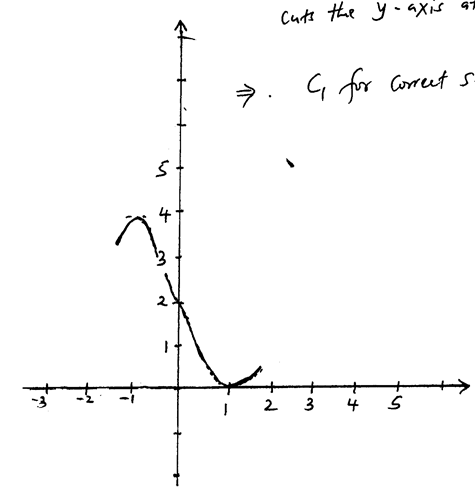
To sketch the curve we
- Its turning points and their nature
- The points the graph cuts the x and y axis i.e the x and y-intercepts
(b) Indicating that the curve turns at (-1, 4) (1, 0) and cuts
the y-axis at (0, 2) B1
C1 for correct sketch
14. a) -2t2 + t + 28 = 0
t2 – t – 28 = 0
2t2 – 8t) + (7t – 28) = 0
+ (t-4) +7(t-4) = 0
t + 7) (t-4) = 0
t = -3.5 or 4
p.B at rest at t= 4seconds
(b) a = 1-4t
1 – 4t = 0
0.25s = t
V = 28 + 25 – 2 (0.25)2
= 28.25 – 0.125
V = 28.125m/s
(c) (i) S = 28t + t2 – 2t3 + C
2 3
when t = 0, s = 0
S = 28t + t2 – 2t
PB at rest after 4s
S = 28 x 4 x 42 – 2 x 43
3
= 112 + 8 – 42.667
= 120 – 42.6667= 77.33m
15. S = t3 – 3t2 + 2t
(a) V = ds = 3t2 – 6t + 2
dt
When t = 2
V = 3(4) – 6(2) + 2
= 2m/s
(b) At minimum velocity :
dv = 0
dt
dv = 6t – 6
dt
6t – 6 = 0
t = 1
Min-velocity = 3(1)2 – 6(1) + 2
= -1m/s
(c) 3t2 – 6t + 2 = 0
t = 6 (-6) – 4 (3) (2)
6
= 6 5.2
6
t = 1.58 or 0.4sec
(d) acc = dv = 6t -6
dt
a = 6(3) – 6= 12m/s2


