


BASIC PRINCIPLES OF CHEMISTRY PRACTICALS
Introduction/Rationale
Chemistry is a science that involves the study of matter, its properties, and the changes it undergoes. Practical work in chemistry is essential for understanding theoretical concepts and developing scientific skills.
Chemistry practicals worldwide are emphasized for all candidates sitting for a Chemistry examination to ensure they gain hands-on experience and mastery of essential techniques.
There are about seven main basic universal emphases for all chemistry candidates sitting for a chemistry paper:
- Titration / volumetric analysis
- Thermochemistry (energy changes)
- Chemical kinetics (rates of reaction)
- Qualitative analysis (organic/inorganic)
- Solubility and solubility curves
- Flame test
- Physical / general chemistry
1. Titration / volumetric analysis
Titration is the process of determining the end point of the reaction between the contents of a burette and a fixed volume (usually 25.0 cm³ from a pipette) of solution in a conical flask.
As evidence of a titration actually performed, candidates are required to record their burette readings before and after the titration.
For KCSE candidates, burette readings must be recorded in a titration table in the format provided by the Kenya National Examination Council.
As evidence of all titrations actually done, the Kenya National Examination Council requires candidates to record their burette readings before and after the titration to complete the titration table in the format provided.
Sample Titration Table Format
| Final burette reading (cm³) | 24.0 | 24.0 | 24.0 |
| Initial burette reading (cm³) | 0.0 | 0.0 | 0.0 |
| Volume of solution used (cm³) | 24.0 | 24.0 | 24.0 |
Calculate the average volume of solution used:
(24.0 + 24.0 + 24.0) / 3 = 24.0 cm³
To demonstrate understanding of the degree of accuracy of burettes, all readings must be recorded to one decimal point.
For accuracy in carrying out the titration, candidates’ values should be within 0.2 cm³ of the school value.
The school value is the teacher’s readings presented to the examining body based on the concentrations of the solutions provided to the candidates.
Bonus marks are awarded for averaged readings within 0.1 cm³ of the school value as the final answer.
Calculations after the titration require candidates to have thorough mastery of the relationships among the mole, molar mass, mole ratios, concentration, and molarity, as well as the mathematical application of first principles.
Important information often appears at the beginning of the paper as:
“You are provided with…”
All calculations must be to the 4th decimal point unless they divide fully to a lesser decimal point.
Never round off answers prematurely.
b) Thermochemistry / energy changes
Energy is the capacity to do work, measured in Joules (J) or kiloJoules (kJ).
Chemical and physical changes involve either absorption (endothermic) or evolution/production (exothermic) of heat.
Practically:
- Endothermic changes show absorption of heat by a fall/drop in temperature and have a +∆H.
- Exothermic changes show evolution/production of heat by a rise in temperature and have a -∆H.
- Temperature is measured using a thermometer.
- A school thermometer is either coloured (alcohol) or colourless (mercury).
- For accuracy, candidates in the same practical session should use the same type of thermometer.
- Fall/drop (+∆H) in temperature is movement of thermometer level downward.
- Rise (-∆H) in temperature is movement of thermometer level upwards.
Physical changes mainly involve melting/freezing/fusion and boiling/vapourization.
Chemical changes mainly involve displacement, dissolving, and neutralization.
a) Energy changes in physical processes
Melting/freezing/fusion/solidification and boiling/vaporization/evaporation are the two main physical processes.
The melting/freezing point of pure substances is fixed/constant.
The boiling point of pure substances depends on external atmospheric pressure.
Melting/fusion is the physical change of a solid to a liquid. Freezing/solidification is the physical change of a liquid to a solid.
Melting/freezing/fusion/solidification are therefore two opposite but reversible physical processes, i.e.
A (s) ======== A (l)
Boiling/vaporization/evaporation is the physical change of a liquid to gas/vapour. Condensation/liquidification is the physical change of gas/vapour to liquid. Boiling/vaporization/evaporation and condensation/liquidification are therefore two opposite but reversible physical processes, i.e.
B (l) ======== B (g)
Practically:
- Melting/liquidification/fusion involves heating a solid to weaken the strong bonds holding the solid particles together.
Solids are made up of very strong bonds holding the particles very close to each other (Kinetic Theory of Matter).
On heating, these particles gain energy/heat from the surrounding heat source to form a liquid with weaker bonds holding the particles close together but with some degree of freedom.
Melting/fusion is an endothermic (+∆H) process that requires/absorbs energy from the surroundings.
(ii) Freezing/solidification involves cooling a liquid to reform/rejoin the very strong bonds to hold the particles very close to each other as solid and thus lose their degree of freedom (Kinetic Theory of Matter).
Freezing/solidification is an exothermic (-∆H) process where particles lose energy to the surroundings.
(iii) Boiling/vaporization/evaporation involves heating a liquid to completely break/free the bonds holding the liquid particles together.
Gaseous particles have a high degree of freedom (Kinetic Theory of Matter). Boiling/vaporization/evaporation is an endothermic (+∆H) process that requires/absorbs energy from the surroundings.
(iv) Condensation/liquidification is the reverse process of boiling/vaporization/evaporation.
It involves gaseous particles losing energy to the surroundings to form a liquid. It is an exothermic (-∆H) process.
The quantity of energy required to change one mole of a solid to liquid or to form one mole of a solid from liquid at constant temperature is called molar enthalpy/latent heat of fusion, e.g.
H2O(s) → H2O(l) ∆H = +6.0 kJ mole-1 (endothermic process)
H2O(l) → H2O(s) ∆H = -6.0 kJ mole-1 (exothermic process)
The quantity of energy required to change one mole of a liquid to gas/vapour or to form one mole of a liquid from gas/vapour at constant temperature is called molar enthalpy/latent heat of vaporization, e.g.
H2O(l) → H2O(g) ∆H = +44.0 kJ mole-1 (endothermic process)
H2O(g) → H2O(l) ∆H = -44.0 kJ mole-1 (exothermic process)
- To determine the boiling point of water
Procedure:
Measure 20 cm³ of tap water into a 50 cm³ glass beaker. Determine and record its temperature. Heat the water on a strong Bunsen burner flame and record its temperature every thirty seconds for four minutes.
Sample results
| Time (seconds) | 0 | 30 | 60 | 90 | 120 | 150 | 180 | 210 | 240 |
| Temperature (°C) | 25.0 | 45.0 | 85.0 | 95.0 | 96.0 | 96.0 | 96.0 | 97.0 | 98.0 |
Questions
1. Plot a graph of temperature against time (y-axis). Sketch the graph of temperature against time.
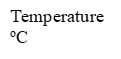

2. From the graph, show and determine the boiling point of water.
Note:
Water boils at 100°C at sea level/one atmosphere pressure/101300 Pa but boils below 100°C at higher altitudes.
The sample results above are from Kiriari Girls High School, Embu County on the slopes of Mt Kenya in Kenya. Water here boils at 96°C.
3. Calculate the molar heat of vaporization of water. (H=1.0, O=16.0)
Working:
Mass of water = density × volume = (20 × 1) / 1000 = 0.02 kg
Quantity of heat produced = mass of water × specific heat capacity of water × temperature change
= 0.02 kg × 4.2 × (96 – 25) = 5.964 kJ
Heat of vaporization of one mole H2O = Quantity of heat / Molar mass of H2O
= 5.964 kJ / 18 = 0.3313 kJ mole-1
- To determine the melting point of candle wax
Procedure:
Weigh exactly 5.0 g of candle wax into a boiling tube. Heat it on a strong Bunsen burner flame until it completely melts.
Insert a thermometer and remove the boiling tube from the flame. Stir continuously. Determine and record the temperature every 30 seconds for four minutes.
Sample results
| Time (seconds) | 0 | 30 | 60 | 90 | 120 | 150 | 180 | 210 | 240 | 240 |
| Temperature (°C) | 93.0 | 85.0 | 78.0 | 70.0 | 69.0 | 69.0 | 69.0 | 69.0 | 67.0 | 65.0 |
Questions
1. Plot a graph of temperature against time (y-axis).

b) Energy changes in chemical processes
(i) Standard enthalpy/heat of displacement ∆Hᶿd
(ii) Standard enthalpy/heat of neutralization ∆Hᶿn
(iii) Standard enthalpy/heat of solution/dissolution ∆Hᶿs
1. Standard enthalpy/heat of displacement ∆Hᶿd
The molar standard enthalpy/heat of displacement is defined as the energy/heat change when one mole of a substance is displaced/removed from its solution at standard conditions.
Some displacement reactions:
(i) Zn(s) + CuSO4(aq) → Cu(s) + ZnSO4(aq)
Ionically: Zn(s) + Cu2+(aq) → Cu(s) + Zn2+(aq)
(ii) Fe(s) + CuSO4(aq) → Cu(s) + FeSO4(aq)
Ionically: Fe(s) + Cu2+(aq) → Cu(s) + Fe2+(aq)
(iii) Pb(s) + CuSO4(aq) → Cu(s) + PbSO4(s)
This reaction stops after some time as insoluble PbSO4(s) coats unreacted lead.
(iv) Cl2(g) + 2NaBr(aq) → Br2(aq) + 2NaCl(aq)
Ionically:
Cl2(g) + 2Br–(aq) → Br2(aq) + 2Cl–(aq)
To determine the molar standard enthalpy/heat of displacement (∆Hᶿd) of copper:
Procedure
Place 20 cm³ of 0.2 M copper(II) sulphate(VI) solution into a 50 cm³ plastic beaker/calorimeter.
Determine and record the temperature of the solution T1.
Add all the zinc powder provided into the plastic beaker. Stir the mixture using the thermometer.
Determine and record the highest temperature change to the nearest 0.5°C – T2.
Repeat the experiment to complete Table 1 below.
Sample results Table 1
| Experiment | I | II |
| Final temperature of solution (T2) | 30.0°C | 31.0°C |
| Initial temperature of solution (T1) | 25.0°C | 24.0°C |
| Change in temperature (∆T) | 5.0 | 6.0 |
Questions
1. (a) Calculate:
(i) Average ∆T
Average ∆T = (5.0 + 6.0) / 2 = 5.5°C
(ii) The number of moles of solution used
Moles used = molarity × volume of solution = 0.2 × 20 / 1000 = 0.004 moles
(iii) The enthalpy change ∆H for the reaction
Heat produced ∆H = mass of solution (m) × specific heat capacity (c) × ∆T
= 20 × 4.2 × 5.5 = 462 J = –0.462 kJ
(iv) State two assumptions made in the above calculations.
- Density of solution = density of water = 1 g cm-3
- Specific heat capacity of solution = specific heat capacity of water = 4.2 kJ kg-1 K-1
This is because the solution is assumed to be infinitely dilute.
2. Calculate the enthalpy change for one mole of displacement of Cu2+ (aq) ions.
Molar heat of displacement ∆Hd = Heat produced ∆H / Number of moles of solution
= 0.462 kJ / 0.004 = –115.5 kJ mole-1
3. Write an ionic equation for the reaction taking place.
Zn(s) + Cu2+(aq) → Cu(s) + Zn2+(aq)
4. State the observation made during the reaction.
- Blue colour of copper(II) sulphate(VI) fades/becomes less blue/colourless.
- Brown solid deposits are formed at the bottom of the reaction vessel/beaker.
5. Illustrate the above reaction using an energy level diagram.

8. The enthalpy of displacement ∆Hd of copper(II) sulphate (VI) solution is 126 kJ mole-1. Calculate the molarity of the solution given that 40 cm³ of this solution produces 2.204 kJ of energy during a displacement reaction with excess iron filings.
Number of moles = Heat produced ∆H / Molar heat of displacement ∆Hd
= 2.204 kJ / 126 kJ mole-1 = 0.0206 moles
Molarity of the solution = moles × 1000 / Volume of solution used
= 0.0206 × 1000 / 40 = 0.5167 M
Graphical determination of the molar enthalpy of displacement of copper
Procedure:
Place 20 cm³ of 0.2 M copper(II) sulphate (VI) solution into a calorimeter/50 cm³ plastic beaker wrapped in cotton wool/tissue paper.
Record its temperature at time T=0. Stir the solution with the thermometer carefully and continue recording the temperature every 30 seconds.
Place all the (1.5 g) zinc powder provided after 1 ½ minutes.
Stir the solution with the thermometer carefully and continue recording the temperature every 30 seconds for five minutes.
Determine the highest temperature change to the nearest 0.5°C.

Questions
1. Show and determine the change in temperature ∆T
From a well-constructed graph ∆T = T2 – T1 at 150 seconds by extrapolation
∆T = 36.5 – 25.0 = 11.5°C
2. Calculate the number of moles of copper(II) sulphate(VI) used given the molar heat of displacement of Cu2+ (aq) ions is 125 kJ mole-1
Heat produced ∆H = mass of solution (m) × specific heat capacity (c) × ∆T
= 20 × 4.2 × 11.5 = 966 J = –0.966 kJ
Number of moles = Heat produced ∆H / Molar heat of displacement ∆Hd
= 0.966 kJ / 125 kJ mole-1 = 7.728 × 10⁻³ moles
3. What was the concentration of copper(II) sulphate(VI) in moles per litre?
Molarity = moles × 1000 / Volume used
= 7.728 × 10-3 × 1000 / 20 = 0.3864 M
4. The actual concentration of copper(II) sulphate (VI) solution was 0.4 M. Explain the differences between the two.
The practical value is lower than the theoretical.
Heat/energy loss to the surroundings and absorption by the reaction vessel decreases ∆T, hence lowering the practical number of moles and molarity compared to the theoretical value.
(c) Standard enthalpy/heat of neutralization ∆Hᶿn
The molar standard enthalpy/heat of neutralization ∆Hᶿn is defined as the energy/heat change when one mole of H+ (H3O+) ions react completely with one mole of OH– ions to form one mole of H2O/water.
Neutralization is thus a reaction of an acid / H+ (H3O+) ions with a base/alkali/ OH– ions to form salt and water only.
Strong acids/bases/alkalis are completely dissociated to many free ions (H+ / H3O+ and OH– ions).
For strong acid/base/alkali neutralization, no energy is used to dissociate/ionize since the molecule is wholly dissociated into free ions.
The overall energy evolved is comparatively higher than weak acid-base/alkali neutralizations.
For strong acid-base/alkali neutralization, the enthalpy of neutralization is constant at about 57.3 kJ mole-1 irrespective of the acid-base used.
This is because ionically:
OH–(aq) + H+(aq) → H2O(l)
for all fully dissociated acid/base/alkali.
Weak acids/bases/alkalis are partially dissociated to few free ions and exist more as molecules.
Neutralization is an exothermic (-∆H) process.
The energy produced during neutralization depends on the amount of free ions (H+, H3O+, and OH–) in the acid/base/alkali reactant:
- For weak acid-base/alkali neutralization, some of the energy is used to dissociate/ionize the molecule into free ions; therefore, the overall energy evolved is comparatively lower than strong acid/base/alkali neutralizations.
Practically, ∆Hᶿn can be determined as in the examples below:
To determine the molar enthalpy of neutralization ∆Hn of Hydrochloric acid
Procedure
Place 50 cm³ of 2 M hydrochloric acid into a calorimeter/200 cm³ plastic beaker wrapped in cotton wool/tissue paper.
Record its temperature T1.
Using a clean measuring cylinder, measure another 50 cm³ of 2 M sodium hydroxide.
Rinse the bulb of the thermometer in distilled water.
Determine the temperature of the sodium hydroxide T2.
Average T2 and T1 to get the initial temperature of the mixture T3.
Carefully add all the alkali into the calorimeter containing the acid.
Stir vigorously the mixture with the thermometer.
Determine the highest temperature change to the nearest 0.5°C T4 as the final temperature of the mixture.
Repeat the experiment to complete Table 1.
(ii) Enthalpy change ∆H of neutralization.
∆H = (m) mass of solution (acid + base) × (c) specific heat capacity of solution × ∆T (T6)
= (50 + 50) × 4.2 × 13.5 = 5670 J = 5.67 kJ
(iii) The molar heat of neutralization of the acid.
∆Hn = Enthalpy change ∆H / Number of moles
= 5.67 kJ / 0.1 moles = 56.7 kJ mole-1
(c) Write the ionic equation for the reaction that takes place:
OH–(aq) + H+(aq) → H2O(l)
(d) The theoretical enthalpy change is 57.4 kJ. Explain the difference with the results above.
The theoretical value is higher.
Heat/energy loss to the surroundings lowers ∆T / T6 and thus ∆Hn.
Heat/energy is absorbed by the reaction vessel/calorimeter/plastic cup, lowering ∆T and hence ∆Hn.
Sample results
| Experiment | I | II |
| Temperature of acid T1 (°C) | 22.5 | 22.5 |
| Temperature of base T2 (°C) | 22.0 | 23.0 |
| Final temperature of solution T4 (°C) | 35.5 | 36.0 |
| Initial temperature of solution T3 (°C) | 22.25 | 22.75 |
| Temperature change (T5) | 13.25 | 13.75 |
(a) Calculate T6 the average temperature change:
T6 = (13.25 + 13.75) / 2 = 13.5°C
(b) Why should the apparatus be very clean?
Impurities present in the apparatus react with acid/base lowering the overall temperature change and hence ∆Hᶿn.
(c) Calculate the:
(i) number of moles of the acid used:
Number of moles = molarity × volume = 2 × 50 / 1000 = 0.1 moles
(e) Compare the ∆Hn of the experiment above with a similar experiment repeated with neutralization of a solution of:
(i) Potassium hydroxide with nitric(V) acid
The results would be the same/similar.
Both are neutralization reactions of strong acids and bases/alkalis that are fully dissociated into many free ions.
(ii) Ammonia with ethanoic acid
The results would be lower/∆Hn would be less.
Both are neutralization reactions of weak acids and bases/alkalis that are partially dissociated into few free ions. Some energy is used to ionize the molecule.
(f) Draw an energy level diagram to illustrate the energy changes.
Theoretical examples
1. The molar enthalpy of neutralization was experimentally shown to be 51.5 kJ per mole of 0.5 M hydrochloric acid and 0.5 M sodium hydroxide. If the volume of sodium hydroxide was 20 cm³, what was the volume of hydrochloric acid used if the reaction produced a 5.0°C rise in temperature?
Working:
Moles of sodium hydroxide = molarity × volume / 1000
= 0.5 × 20 / 1000 = 0.01 moles
Enthalpy change ∆H = ∆Hn = 51.5 kJ = 0.515 kJ
Moles sodium hydroxide = 0.01 moles
Mass of base + acid = Enthalpy change ∆H in Joules / (Specific heat capacity × ∆T)
= 0.515 kJ × 1000 / (4.2 × 5) = 24.5238 g
Mass / volume of HCl = Total volume – volume of NaOH
= 24.5238 – 20.0 = 4.5238 cm³
Graphically ∆Hn can be determined as in the example below:
Procedure
Place 8 test tubes in a test tube rack.
Put 5 cm³ of 2 M sodium hydroxide solution into each test tube. Measure 25 cm³ of 1 M hydrochloric acid into a 100 cm³ plastic beaker.
Record its initial temperature at volume of base = 0.
Put one portion of the base into the beaker containing the acid.
Stir carefully with the thermometer and record the highest temperature change to the nearest 0.5°C.
Repeat the procedure above with other portions of the base to complete Table 1 below.
| Volume of acid (cm³) | 25.0 | 25.0 | 25.0 | 25.0 | 25.0 | 25.0 | 25.0 | 25.0 | 25.0 | 25.0 | 25.0 | 25.0 |
| Volume of alkali (cm³) | 0 | 5.0 | 10.0 | 15.0 | 20.0 | 25.0 | 30.0 | 35.0 | 40.0 | 35.0 | 40.0 | 40.0 |
| Final temperature (°C) | 22.0 | 24.0 | 26.0 | 28.0 | 28.0 | 27.0 | 26.0 | 25.0 | 24.0 | 25.0 | 24.0 | 24.0 |
| Initial temperature (°C) | 22.0 | 22.0 | 22.0 | 22.0 | 22.0 | 22.0 | 22.0 | 22.0 | 22.0 | 22.0 | 22.0 | 22.0 |
| Change in temperature | 0.0 | 2.0 | 4.0 | 6.0 | 6.0 | 5.0 | 4.0 | 3.0 | 2.0 | 3.0 | 2.0 | 2.0 |
Complete the table to determine the change in temperature.
Plot a graph of volume of sodium hydroxide against temperature change.
From the graph show and determine:
(i) The highest temperature change ∆T
∆T = T2 – T1: highest temperature – T1 (from extrapolating a correctly plotted graph) less lowest temperature at volume of base = 0 – T1
= 28.7 – 22.0 = 6.7°C

(ii) The volume of sodium hydroxide used for complete neutralization
From correctly plotted graph = 16.75 cm³
(iii) Calculate the number of moles of the alkali used
Moles NaOH = molarity × volume / 1000
= 2 × 16.75 / 1000 = 0.0335 moles
(iv) Calculate ∆H for the reaction.
∆H = mass of solution mixture × c × ∆T
= (25.0 + 16.75) × 4.2 × 6.7 = 1174.845 J = 1.174845 kJ
(iii) Calculate the molar enthalpy of the alkali:
∆Hn = Heat change / number of moles
= 1.174845 kJ / 0.0335 moles = 35.0699 kJ mole-1
(i) Standard enthalpy/heat of solution/dissolution ∆Hᶿs
The standard enthalpy of solution ∆Hᶿs is defined as the energy change when one mole of a substance is dissolved in excess distilled water to form an infinitely dilute solution.
An infinitely dilute solution is one which is too dilute to be diluted further.
Practically, the heat of solution is determined by dissolving a known mass / volume of a solute in known mass / volume of water/solvent and determining the temperature change.
To determine the heat of dissolution of ammonium nitrate(V)
Place 100 cm³ of distilled water into a plastic cup/beaker/calorimeter.
Put all the 5.0 g of ammonium nitrate(V)/potassium nitrate(V)/ ammonium chloride into the water.
Stir the mixture using the thermometer and record the temperature change every ½ minute to complete Table 1.
Continue stirring throughout the experiment.

(a) From the graph show and determine:
(i) The highest temperature change ∆T
∆T = T2 – T1: highest temperature – T1 (from extrapolating a correctly plotted graph) less lowest temperature at volume of base = 0 – T1
= 18.7 – 22.0 = 3.3°C (not -3.3°C)
(b) Calculate the total energy change ∆H during the reaction
∆H = mass of water × c × ∆T
= 100 × 4.2 × 3.3 = +1386 J = +1.386 kJ
(c) Calculate the number of moles of ammonium nitrate (V) used
Moles = mass / molar mass = 5.0 / 80 = 0.0625 moles
(d) What is the molar heat of dissolution of ammonium nitrate(V)?
∆H = Heat change / number of moles
= +1.386 kJ / 0.0625 moles = +22.176 kJ mole-1
(e) What would happen if the distilled water is heated before the experiment was performed?
The ammonium nitrate(V) would take less time to dissolve.
Increase in temperature reduces lattice energy causing endothermic dissolution to be faster.
(e) Illustrate the above process on an energy level diagram.

c) Chemical Kinetics / Rate of reaction
The rate of a chemical reaction can be defined as the time taken for a known amount of reactants to form a known amount of products.
Some reactions are too slow to be determined, e.g., weathering; others are instantaneous.
The SI unit of time is seconds. Minutes and hours are also common.
Time is determined using a stopwatch/clock.
Candidates using stopwatch/clock should learn to:
- Press start button concurrently with starting off determination of a reaction using one hand each.
- Press stop button when the reaction is over.
- Record all times in seconds unless specified.
- Press reset button to begin another timing.
- Ignore time beyond seconds for stopwatch/clock beyond this accuracy.
- Avoid accidental pressing of any button before recording.
It can be very frustrating repeating a whole procedure.
The following factors theoretically and practically alter/influence/affect/determine the rate of a chemical reaction:
(a) Concentration
(b) Temperature
(a) Concentration
An increase in concentration increases the rate of reaction by reducing the time taken to completion.
Theoretically, increase in concentration is a decrease in distance between reacting particles which increases their collision frequency.
Practically, decreasing concentration is diluting/adding water.
To demonstrate the effect of concentration on reaction rate:
You are provided with:
- (i) Sodium thiosulphate containing 40 g dm-3 solution labeled A
- (ii) 2 M hydrochloric acid labeled solution B
You are required to determine the rate of reaction between solution A and B.
Procedure
Measure 40 cm³ of solution A into a 100 cm³ glass beaker. Place it on top of a pen-mark “X”. Measure another 40 cm³ of solution B. Simultaneously put solution B into solution A and start a stopwatch/clock. Determine the time taken for the pen-mark “X” to be invisible/obscured from above. Repeat the procedure by measuring 35 cm³ of solution B and adding 5 cm³ of water. Complete Table 1 below by using other values of solution B and water.


Sample questions
(i) Explain the shape of the graph
(Straight line graph from the origin)
Decrease in concentration decreases the rate of reaction. The higher the concentration of solution B, the less time taken for mark X to be obscured/invisible due to increased collision frequency between the reacting particles.
(ii) From the graph determine the time taken for the mark to be invisible at 37 cm³
At 37 cm³ then 1/t = 1/37 = 0.027
From a well-plotted graph:
1/t = 0.027 → 16.2602 seconds
(ii) From the graph determine the volume of solution B at 100 seconds
100 seconds → 1/t = 1/100 = 0.01
From a well-plotted graph:
At 1/t = 0.01 → the volume of B = 17.0 cm³
(iii) State another factor that would alter the rate of the above reaction.
Temperature
(iii) State another factor that would not alter the rate of the above reaction.
Surface area
Pressure
Catalyst
(b) Temperature
An increase in temperature increases the rate of reaction.
An increase of 10°C/10 K practically doubles the rate of a chemical reaction/reduces time of completion by 1/2.
An increase in temperature increases the kinetic energy of reacting particles increasing their collision frequency.
Practically, increase in temperature involves heating the reactants.
The results and presentation should be as in the effect of concentration.
Increased temperature reverses the Table 1 time results, i.e., less time as temperature increases.
d) Qualitative analysis
Process of identifying unknown compounds.
Compounds may be:
- Inorganic
- Organic
Inorganic analysis:
This involves mainly identification of ionic compounds containing cations and anions.
Cations present in ionic compounds are identified by adding a precipitating reagent that forms a precipitate unique to the cation(s) in the compound.
The main precipitating reagents used are:
2 M NaOH and/or 2 M NH3(aq)
When using 2 M sodium hydroxide:
- No white precipitate is formed if K+ and Na+ ions are present.
- No white precipitate is formed if NH4+ ions are present but a colourless gas with pungent smell of urine is produced which may not be recognized in a school laboratory examination setting.
- White precipitate that dissolves/soluble in excess if Zn2+, Pb2+, Al3+ ions are present.
- White precipitate that does not dissolve/insoluble in excess if Ba2+, Mg2+, Ca2+ ions are present.
- Blue precipitate that does not dissolve/insoluble in excess if Cu2+ ions are present.
- Green precipitate that does not dissolve/insoluble in excess if Fe2+ ions are present.
- Brown precipitate that does not dissolve/insoluble in excess if Fe3+ ions are present.
When using 2 M aqueous ammonia:
- No white precipitate is formed if K+, NH4+, Na+ ions are present.
- White precipitate that dissolves/soluble in excess if Zn2+ ions are present.
- White precipitate that does not dissolve/insoluble in excess if Ba2+, Mg2+, Ca2+, Pb2+, Al3+ ions are present.
- Blue precipitate that dissolves/soluble in excess to form a deep/royal blue solution in excess if Cu2+ ions are present.
- Green precipitate that does not dissolve/insoluble in excess if Fe2+ ions are present.
- Brown precipitate that does not dissolve/insoluble in excess if Fe3+ ions are present.
Anions present in ionic compounds are identified by adding a specific precipitating reagent that forms a precipitate unique to the specific anion(s) in the compound.
(i) Lead(II) nitrate(V) solution
Lead forms insoluble PbSO4, PbSO3, PbCO3, PbS, PbI2, PbCl2.
PbS is a black precipitate.
PbI2 is a yellow precipitate.
All the others are white precipitates.
(a) If a Lead(II) nitrate(V) solution is added to a substance/solution/compound:
- A yellow ppt shows presence of I– ions.
- A black ppt shows presence of S2- ions.
- A white ppt shows presence of SO42-, SO32-, CO32-, Cl–.
(b) If the white precipitate is added dilute nitric(V) acid:
- It dissolves to show presence of SO32-, CO32-.
- It persists/remains to show presence of SO42-, Cl–.
(c) If the white precipitate in b(i) is added acidified potassium manganate(VII)/dichromate(VI):
- Acidified potassium manganate(VII) is decolorized / orange colour of acidified potassium dichromate(VI) turns to green to show presence of SO32-.
- Acidified potassium manganate(VII) is not decolorized / orange colour of acidified potassium dichromate(VI) does not turn to green/remains orange to show absence of SO32- / presence of CO32-.
(c) If the white precipitate in b(ii) is boiled:
- It dissolves to show presence of Cl–.
- It persists/remains to show presence of SO42-.
(ii) Barium(II) nitrate(V)/Barium chloride solution
Barium(II) nitrate(V)/Barium chloride solution precipitates BaSO4, BaSO3, BaCO3 from SO42-, SO32-, CO32- ions.
Inorganic qualitative analysis requires continuous practice and discussion.
Sample presentation of results
You are provided with solid Y (aluminium (III) sulphate(VI) hexahydrate). Carry out the following tests and record your observations and inferences in the space provided.
1(a) Appearance
Observations | Inference (1 mark)
White crystalline solid | Coloured ions Cu2+, Fe2+, Fe3+ absent
(b) Place about a half spatula full of the solid into a clean dry boiling tube. Heat gently then strongly.
Observations | Inference (1 mark)
Colourless droplets formed on the cooler part of the test tube | Hydrated compound/compound containing water of crystallization
Solid remains a white residue
(c) Place all the remaining portion of the solid in a test tube. Add about 10 cm³ of distilled water. Shake thoroughly. Divide the mixture into five portions.
Observation | Inference (1 mark)
Solid dissolves to form a colourless solution | Polar soluble compound; Cu2+, Fe2+, Fe3+ absent
(i) To the first portion, add three drops of sodium hydroxide then add excess of the alkali.
Observation | Inference (1 mark)
White ppt, soluble in excess | Zn2+, Pb2+, Al3+
(ii) To the second portion, add three drops of aqueous ammonia then add excess of the alkali.
Observation | Inference (1 mark)
White ppt, insoluble in excess | Pb2+, Al3+
(iii) To the third portion, add three drops of sodium sulphate(VI) solution.
Observation | Inference (1 mark)
No white ppt | Al3+
(iv) To the fourth portion, add three drops of Lead(II) nitrate(IV) solution. Preserve
Observation | Inference (1 mark)
White ppt | CO32-, SO42-, SO32-, Cl–
To the portion in (iv) I above, add five drops of dilute hydrochloric acid.
Observation | Inference (1 mark)
White ppt persists/remains | SO42-, Cl–
To the portion in (iv) II above, heat to boil.
Observation | Inference (1 mark)
White ppt persists/remains | SO42-
Organic analysis:
This involves mainly identification of the functional group:
- (i) -C=C- / =C=C= / C-C
- (iii) R-COOH / H+
These functional groups can be identified by:
- (i) Burning – a substance which “catches fire” must reduce in amount.
- Candidates should not confuse burning with flame coloration/test.
- (ii) Decolorization of bromine water/chlorine water/acidified KMnO4 to show presence of C=C- / -C=C- and R–OH.
- (iii) Turning orange acidified K2Cr2O7 to green to show presence as in above.
- (iii) pH 1/2/3 for strongly acidic solutions. pH 4/5/6 for weakly acidic solutions.
- (iv) Turning blue litmus paper red. Red litmus paper remaining red shows presence of H+ ions.
d) Flame test
The colour change on a clear colourless Bunsen flame is useful in identifying some cations/metals.
A very clean metallic spatula is recommended since dirt obscures/changes the correct distinct flame coloration of some compounds.
| Barium/barium salts | Orange |
| Sodium/sodium salts | Yellow |
| Potassium/potassium salts | Purple/lilac |
| Lithium/lithium salts | Deep red/crimson |
| Calcium/calcium salts | Red |
| Copper/copper salts | Blue/green |
(e) Physical chemistry
Chemistry is a science subject that incorporates many scientific techniques.
Examining bodies/councils require tabulated results/data from the candidate.
This tabulated results is usually then put in a graph.
The general philosophy of methods of presentation of chemistry practical data is therefore availability of evidence showing:
- Practical done (complete table)
- Accuracy of apparatus used (decimal point)
- Accuracy/care in doing experiment to get correct trend (against teacher’s results)
- Graphical work (use of mathematical science)
- Calculations (scientific mathematical integration)
(f) Sample practicals
Name ………………..…………………. Class………….. Index No……………..
Candidate’s signature………………………………..
Date done……………… Date marked………… Date revised…………….…..
233/3
CHEMISTRY Paper 3
PRACTICAL.
Pre-KCSE Practice 1: 2013
MARKS SCHEME
Instruction to Candidate
Write your name and index number in the spaces provided above.
Sign and write the date of examination in the spaces provided above.
Answer all questions in the spaces provided.
Mathematical tables and electronic calculators may be used.
All working must be clearly shown where necessary.
This paper consists of 8 printed pages.
Candidates should check the question paper to ascertain that all the pages are printed and indicated and that no questions are missing.
For examiners use only
| Question | Maximum score | Candidates score |
|---|---|---|
| 1 | 20 | 20 |
| 2 | 10 | 10 |
| 3 | 10 | 10 |
| Total score | 40 | 40 |
1. You are provided with:
- Solution L containing 5.0 g per litre of a dibasic organic acid H2X.2H2O.
- Solution M which is acidified potassium manganate(VII).
- Solution N a mixture of sodium ethanedioate and ethanedioic acid.
- 0.1 M sodium hydroxide solution P.
- 1.0 M sulphuric(VI) acid.
You are required to:
- Standardize solution M using solution L.
- Use standardized solution M and solution P to determine the % of sodium ethanedioate in the mixture.
Procedure 1

Fill the burette with solution M. Pipette 25.0 cm³ of solution L into a conical flask. Heat this solution to about 70°C (but not to boil). Titrate the hot solution L with solution M until a permanent pink colour just appears. Shake thoroughly during the titration. Repeat this procedure to complete Table 1.
Table 1
| 1 | 2 | 3 | |
| Final burette reading (cm³) | 20.0 | 20.0 | 20.0 |
| Initial burette reading (cm³) | 0.0 | 0.0 | 0.0 |
| Volume of N used (cm³) | 20.0 | 20.0 | 20.0 |
(2 marks)
(a) Calculate the average volume of solution L used (1 mark)
(20.0 + 20.0 + 20.0) / 3 = 20.0 cm³
(b) Given that the concentration of the dibasic acid is 0.05 moles dm-3, determine the value of x in the formula H2X.2H2O (H=1.0, O=16.0) (1 mark)
Molar mass H2X.2H2O = mass / litre = moles / litre
5.0 g/litre = 100 g / 0.05 moles dm-3
H2X.2H2O = 100
X = 100 – ((2 × 1) + 2 × (2 × 1) + (2 × 16)) = 100 – 34 = 62
(c) Calculate the number of moles of the dibasic acid H2X.2H2O (1 mark)
Moles = molarity × pipette volume / 1000
= 0.05 × 25 / 1000 = 0.00125 / 1.25 × 10⁻³ moles
(d) Given the mole ratio manganate(VII) (MnO4–): acid H2X is 2:5, calculate the number of moles of manganate(VII) (MnO4–) in the average titre (1 mark)
Moles H2X = 2/5 moles of MnO4–
= 2/5 × 0.0125 / 1.25 × 10⁻² moles = 0.0005 / 5.0 × 10⁻⁴ moles
(e) Calculate the concentration of the manganate(VII) (MnO4–) in moles per litre (1 mark)
Moles per litre/molarity = moles × 1000 / average burette volume
= 0.0005 / 5.0 × 10⁻⁴ moles × 1000 = 0.02083 moles l-1 / M
24.0
Procedure 2

With solution M still in the burette, pipette 25.0 cm³ of solution N into a conical flask. Heat the conical flask containing solution N to about 70°C. Titrate while hot with solution M. Repeat the experiment to complete Table 2.
Table 2 (2 marks)
| 1 | 2 | 3 | |
| Final burette reading (cm³) | 12.5 | 12.5 | 12.5 |
| Initial burette reading (cm³) | 0.0 | 0.0 | 0.0 |
| Volume of N used (cm³) | 12.5 | 12.5 | 12.5 |
(2 marks)
(a) Calculate the average volume of solution L used (1 mark)
12.5 + 12.5 + 12.5 = 12.5 cm³
(b) Calculations:
(i) How many moles of manganate(VII) ions are contained in the average volume of solution M used? (1 mark)
Moles = molarity of solution M × average burette volume / 1000
= 0.02083 moles l-1 / M × 12.5 / 1000 = 0.00026 / 2.6 × 10⁻⁴ moles
(ii) The reaction between manganate(VII) ions and ethanedioate ions that reacted with is as in the equation:
2MnO4–(aq) + 5C2O42-(aq) + 16H+(aq) → 2Mn2+(aq) + 10CO2(g) + 8H2O(l)
Calculate the number of moles of ethanedioate ions that reacted with manganate (VII) ions in the average volume of solution M. (1 mark)
From the stoichiometric/ionic equation:
Mole ratio MnO4–(aq): C2O42-(aq) = 2:5
moles C2O42- = 5/2 moles MnO4–
= 5/2 × 0.00026 / 2.5 × 10⁻³ moles = 0.00065 / 6.5 × 10⁻⁴ moles
(iii) Calculate the number of moles of ethanedioate ions contained in 250 cm³ solution N. (1 mark)
25 cm³ pipette volume → 0.00065 / 6.5 × 10⁻⁴
250 cm³ → 0.0065 / 6.5 × 10⁻³ moles × 250 / 25 = 0.0065 / 6.5 × 10⁻³ moles
Procedure 3

Remove solution M from the burette and rinse it with distilled water. Fill the burette with sodium hydroxide solution P. Pipette 25 cm³ of solution N into a conical flask and add 2-3 drops of phenolphthalein indicator. Titrate this solution N with solution P from the burette. Repeat the procedure to complete Table 3.
Table 3
| 1 | 2 | 3 | |
| Final burette reading (cm³) | 12.5 | 12.5 | 12.5 |
| Initial burette reading (cm³) | 0.0 | 0.0 | 0.0 |
| Volume of N used (cm³) | 12.5 | 12.5 | 12.5 |
(2 marks)
(a) Calculate the average volume of solution L used (1 mark)
12.5 + 12.5 + 12.5 = 12.5 cm³
(b) Calculations:
(i) How many moles of sodium hydroxide solution P were contained in the average volume? (1 mark)
Moles = molarity of solution P × average burette volume / 1000
= 0.1 moles l-1 × 24.9 / 1000 = 0.00249 / 2.49 × 10⁻³ moles
(ii) Given that NaOH solution P reacted with the ethanedioate ions from the acid only and the equation for the reaction is:
2NaOH(aq) + H2C2O4(aq) → Na2C2O4(g) + 2H2O(l)
Calculate the number of moles of ethanedioic acid that were used in the reaction. (1 mark)
From the stoichiometric equation, mole ratio NaOH(aq): H2C2O4(aq) = 2:1
moles H2C2O4 = 1/2 moles NaOH
= 1/2 × 0.00249 / 2.49 × 10⁻³ moles = 0.001245 / 1.245 × 10⁻³ moles.
(iii) How many moles of ethanedioic acid were contained in 250 cm³ of solution N? (1 mark)
25 cm³ pipette volume → 0.001245 / 1.245 × 10⁻³
250 cm³ → 0.001245 / 1.245 × 10⁻³ moles × 250 / 25 = 0.01245 / 1.245 × 10⁻² moles
(iii) Determine the % by mass of sodium ethanedioate in the mixture
(H=1.0, O=16.0, C=12.0 and total mass of mixture = 2.0 g in 250 cm³ solution) (1 mark)
Molar mass H2C2O4 = 90.0 g
Mass of H2C2O4 in 250 cm³ = moles in 250 cm³ × molar mass H2C2O4
= 0.01245 / 1.245 × 10⁻² moles × 90.0 = 1.1205 g
% by mass of sodium ethanedioate = (Mass of mixture – mass of H2C2O4) × 100% / Mass of mixture
= (2.0 – 1.1205) / 2.0 = 43.975%
2. You are provided with 5.0 g solid B. You are to determine the molar mass of solid B.
Procedure

Place 100 cm³ of liquid L into a plastic beaker. Determine its temperature and record it at time = 0 in Table 2 below. Stir continuously using the thermometer and record the highest temperature change to the nearest 0.5°C every 30 seconds. After 120 seconds, add all solid B. Continue stirring and recording the temperature to complete Table 2.
Table 2
| Time (seconds) | 0 | 30 | 60 | 90 | 120 | 150 | 180 | 210 | 240 | 270 | 300 |
| Temperature (°C) | 20 | 20 | 20 | 20 | 18 | 16 | 14 | 14 | 15 | 16 |
(2 marks)
(a) Plot a graph of temperature against time (x-axis) (3 marks)

(b) From the graph show and determine (2 marks):
(i) The highest temperature change ∆T
∆T = T2 – T1 = 13.4 – 20 = 6.6°C
Note: ∆T is not -6.6°C
(ii) The temperature of the mixture at 130 seconds
From extrapolation at 130 seconds = 19.2°C
(iii) The time when all the solid first dissolved
From extrapolation of the lowest temperature = 220 seconds
(d) Calculate the heat change for the reaction. (Assume density of liquid L is 1.0 g cm-3, specific heat capacity is 4.2 J kg-1 K-1) (1 mark)
∆H = mass of liquid L × c × ∆T = 100 × 4.2 × 6.6 = +2772 J = +2.772 kJ
(e) Given the molar enthalpy of dissolution of Solid B in liquid L is +22.176 kJ mole-1, determine the number of moles of B used (1 mark)
Moles of B = ∆H / ∆Hs = +2.772 kJ / +22.176 kJ mole-1 = 0.125 moles
(f) Calculate the molar mass of B (1 mark)
Molar mass of B = Mass used / Moles used = 5.0 / 0.125 = 40 g
3(a) You are provided with solid Y. Carry out the following tests and record your observations and inferences in the space provided.
(i) Appearance
Observations | Inference (1 mark)
White crystalline solid | Coloured Fe2+, Fe3+, Cu2+ ions absent
(ii) Place about a half spatula full of the solid into a clean dry boiling tube. Heat gently then strongly.
Observations | Inference (1 mark)
Colourless droplets form on the cooler parts of the test tube | Hydrated compound/salt
Solid remains white
(ii) Place all the remaining portion of the solid in a test tube. Add about 10 cm³ of distilled water and shake thoroughly. Divide the mixture into five portions.
Observation | Inference (1 mark)
Solid dissolves to a colourless solution | Polar compound; coloured Fe2+, Fe3+, Cu2+ ions absent
I. To the first portion add three drops of universal indicator. (1/2 mark)
Observation | Inference
pH = 4 weakly acidic solution
II. To the second portion, add three drops of aqueous ammonia then add excess of the alkali.
Observation | Inference (1 mark)
White ppt, insoluble in excess | Al3+, Pb2+
III. To the third portion, add three drops of sodium sulphide solution.
Observation | Inference (1 mark)
No black ppt | Al3+
IV. To the fourth portion, add three drops of acidified Lead(II) nitrate(IV) solution. Heat to boil.
Observation | Inference (1 mark)
White ppt, persists/remains on boiling | SO42-
(b) You are provided with solid P. Carry out the following tests and record your observations and inferences in the space provided.
(i) Place a portion of solid P on a clean metallic spatula and introduce it on a Bunsen flame.
(1/2 mark)
Solid burns with a yellow sooty flame | C=C // C=C bonds
(ii) Add all the remaining solid to about 10 cm³ of water in a test tube and shake well. Divide the mixture into 4 portions. (1/2 mark)
Solid dissolves to form a colourless solution | Polar organic compound
I. To the 1st portion, test with litmus papers (1/2 mark)
Red litmus paper remains red (H+ ions) | Blue litmus paper turns blue
II. To the 2nd portion, add a little sodium hydrogen carbonate (1/2 mark)
Effervescence/fizzing/bubbles (H+ ions) | Colourless gas produced
III. To the 3rd portion, add three drops of solution M. Warm (1/2 mark)
Acidified KMnO4 is decolorized | R-OH, C=C // C=C bonds
IV. To the 4th portion, add three drops of bromine water (1/2 marks)
Bromine water is decolorized | C=C // C=C bonds


