


Chemistry of Sulphur
A. Sulphur (S)
Sulphur is an element in Group VI (Group 16) of the Periodic Table. It has atomic number 16 and electronic configuration 1s2 2s2 2p6 3s2 3p4. It has valency 2 (divalent) and thus forms the ion S2-.
A. Occurrence
Sulphur mainly occurs:
- As a free element in Texas and Louisiana in the USA and Sicily in Italy.
- As hydrogen sulphide gas in active volcanic areas, e.g., Olkaria near Naivasha in Kenya.
- As copper pyrites (CuFeS2), galena (PbS), zinc blende (ZnS), and iron pyrites (FeS2) in other parts of the world.
B. Extraction of Sulphur by Frasch Process
Sulphur occurs about 200 metres underground. The soil structure in these areas is usually weak and can easily cave in. Digging tunnels is thus discouraged in trying to extract the mineral.
Sulphur is extracted by drilling three concentric round pipes of diameters in the ratio 2:8:18 centimeters.
Superheated water at 170°C and 10 atmospheres pressure is forced through the outermost pipe. The high pressure ensures the water remains liquid at high temperatures instead of vapor/gas.
The superheated water melts the sulphur because the melting point of sulphur is about 115°C.
Compressed air at 15 atmospheres is forced/pumped through the innermost pipe. The hot air forces the molten sulphur up the middle pipe where it is collected and solidifies in a large tank. It is about 99% pure.
Diagram showing extraction of Sulphur from Frasch Process:

C. Allotropes of Sulphur
1. Sulphur exists as two crystalline allotropic forms:
- Rhombic sulphur
- Monoclinic sulphur
| Rhombic sulphur | Monoclinic sulphur |
|---|---|
|
|
Rhombic sulphur and Monoclinic sulphur have a transition temperature of 96°C. This is the temperature at which one allotrope changes to the other.

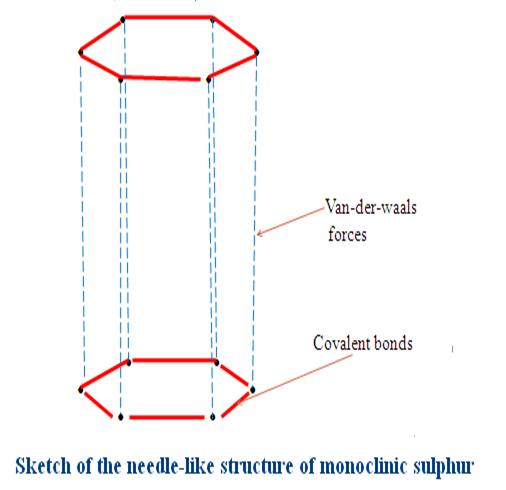
2. Sulphur exists in non-crystalline forms as:
- Plastic sulphur – prepared by heating powdered sulphur to boiling, then pouring a thin continuous stream into a beaker with cold water. A long thin elastic yellow thread of plastic sulphur is formed. If left for long, it turns to bright yellow crystalline rhombic sulphur.
- Colloidal sulphur – formed when sodium thiosulphate (Na2S2O3) is added to hydrochloric acid to form a yellow precipitate.
D. Heating Sulphur
A molecule of sulphur exists as a puckered ring of eight atoms joined by covalent bonds as S8.

On heating, yellow sulphur powder melts at 113°C to a clear amber liquid with low viscosity and flows easily.
On further heating to 160°C, the molten liquid darkens to a brown very viscous liquid that does not flow easily. This is because the S8 rings break into S8 chains that join together to form very long chains made of over 100,000 atoms of sulphur.
The long chains entangle each other, reducing their mobility/flow and hence increasing viscosity.
On continued heating above 160°C, the viscous liquid darkens but becomes more mobile/flows easily and thus less viscous. This is because the long chains break into smaller/shorter chains.
At 444°C, the liquid boils and forms brown vapour of a mixture of S8, S6, S2 molecules that solidify to S8 rings of “flowers of sulphur” on cooler parts.
Summary of changes on heating sulphur
| Observation on heating | Explanation/structure of Sulphur |
|---|---|
|
|
E. Physical and Chemical Properties of Sulphur (Questions)
1. State three physical properties unique to Sulphur
Sulphur is a yellow solid, insoluble in water, soluble in carbon disulphide, tetrachloromethane, and benzene. It is a poor conductor of heat and electricity. It has a melting point of 115°C and a boiling point of 444°C.
2. Moist/damp/wet blue and red litmus papers were put in a gas jar containing air/oxygen. Burning sulphur was then lowered into the gas jar. State and explain the observation made.
Observations:
- Sulphur melts then burns with a blue flame.
- Colourless gas produced that has a pungent smell.
- Red litmus paper remains red. Blue litmus paper turns red.
Explanation:
Sulphur burns in air and faster in oxygen to form Sulphur(IV) Oxide gas and traces/small amounts of Sulphur(VI) Oxide gas. Both oxides react with water to form the corresponding acidic solutions:
- Sulphur(IV) Oxide gas reacts with water to form sulphurous acid (H2SO3).
- Sulphur(VI) Oxide gas reacts with water to form sulphuric acid (H2SO4).
Chemical equations:
S(s) + O2(g) → SO2(g) (Sulphur(IV) Oxide gas)
2S(s) + 3O2(g) → 2SO3(g) (Sulphur(VI) Oxide gas traces)
SO2(g) + H2O(l) → H2SO3(aq) (sulphurous acid)
SO3(g) + H2O(l) → H2SO4(aq) (sulphuric acid)
3. Iron filings were put in a test tube containing powdered sulphur then heated on a Bunsen flame. Stop heating when reaction starts. State and explain the observations made. Test the effects of a magnet on the mixture before and after heating. Explain.
Observations:
- Before heating, the magnet attracts iron filings leaving sulphur.
- After heating, the magnet does not attract the mixture.
- After heating, a red glow is observed that continues even when heating is stopped.
- Black solid is formed.
Explanation:
Iron is attracted to a magnet because it is ferromagnetic. When a mixture of iron and sulphur is heated, the reaction is exothermic giving out heat energy that makes the mixture continue glowing even after stopping heating. Black Iron(II) sulphide is formed which is a compound and thus not ferromagnetic.
Chemical equation: Fe(s) + S(s) → FeS(s) (Exothermic reaction, -∆H)
Heated powdered heavy metals combine with sulphur to form black sulphides:
- Cu(s) + S(s) → CuS(s)
- Zn(s) + S(s) → ZnS(s)
- Pb(s) + S(s) → PbS(s)
4. The setup below shows the reaction of sulphur on heated concentrated sulphuric(VI) acid.
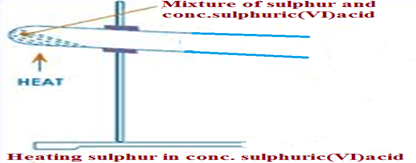
(i) State and explain the observation made.
Observation:
- Yellow colour of sulphur fades.
- Orange colour of potassium dichromate(VI) paper turns green.
Explanation:
Hot concentrated sulphuric(VI) acid oxidizes sulphur to sulphur (IV) oxide gas. The oxide is also reduced to water. Traces of sulphur (VI) oxide are formed.
Chemical equation:
S(s) + 3H2SO4(l) → 3SO2(g) + 3H2O(l) + SO3(g)
Sulphur (IV) oxide gas turns orange potassium dichromate(VI) paper to green.
(ii) State and explain the observation made if concentrated sulphuric (VI) acid is replaced with concentrated nitric (V) acid in the above setup.
Observation:
- Yellow colour of sulphur fades.
- Colourless solution formed.
- Brown fumes/gas produced.
Explanation:
Hot concentrated nitric(V) acid oxidizes sulphur to sulphuric (VI) acid. The nitric (V) acid is reduced to brown nitrogen(IV) oxide gas.
Chemical equation:
S(s) + 6HNO3(l) → 6NO2(g) + 2H2O(l) + H2SO4(l)
Note: Hydrochloric acid is a weaker oxidizing agent and thus cannot oxidize sulphur like the other mineral acids.
5. State three main uses of sulphur.
Sulphur is mainly used in:
- Contact process for the manufacture/industrial/large scale production of concentrated sulphuric(VI) acid.
- Vulcanization of rubber to make it harder, tougher, stronger, and more durable.
- Making gunpowder and matchstick heads.
- As ointments to treat fungal infections.
6. Revision Practice
The diagram below represents the extraction of sulphur by Frasch process. Use it to answer the questions that follow.


(a) Name the substances that pass through:
- M – Superheated water at 170°C and 10 atmosphere pressure
- L – Hot compressed air
- N – Molten sulphur
(b) What is the purpose of the substances that pass through L and M?
- M – Superheated water at 170°C and 10 atmosphere pressure is used to melt the sulphur.
- L – Hot compressed air is used to force up the molten sulphur.
(c) The properties of the two main allotropes of sulphur represented by letters A and B are given in the table below. Use it to answer the questions that follow.
| A | B | |
|---|---|---|
| Appearance | Bright yellow | Pale yellow |
| Density (g/cm3) | 1.93 | 2.08 |
| Melting point (°C) | 119 | 113 |
| Stability | Above 96°C | Below 96°C |
I. What are allotropes?
Different forms of the same element existing at the same temperature and pressure without change of state.
II. Identify allotrope:
- Monoclinic sulphur – A
B – Rhombic sulphur
III. State two main uses of sulphur.
- Manufacture of sulphuric(VI) acid.
- As fungicide.
- In vulcanization of rubber to make it harder, tougher, stronger.
- Manufacture of dyes/fibres.
(d) Calculate the volume of sulphur (IV) oxide produced when 0.4 g of sulphur is completely burnt in excess air. (S = 32.0, 1 mole of a gas occupies 24 dm3 at room temperature)
Chemical equation:
S(s) + O2(g) → SO2(g)
Mole ratio S : SO2 = 1 : 1
Method 1
32.0 g of sulphur → 24 dm3 of SO2(g)
0.4 g of sulphur → 0.4 × 24 / 32.0 = 0.3 dm3
Method 2
Moles of sulphur used = Mass of sulphur / Molar mass = 0.4 / 32 = 0.0125 moles
Moles of sulphur used = Moles of sulphur(IV) oxide produced = 0.0125 moles
Volume of sulphur(IV) oxide produced = Moles × volume of one mole of gas = 0.0125 × 24 = 0.3 dm3
B. Compounds of Sulphur
The following are the main compounds of sulphur:
- Sulphur(IV) oxide
- Sulphur(VI) oxide
- Sulphuric(VI) acid
- Hydrogen sulphide
- Sulphite (IV) / SO32- and Sulphate (VI) / SO42- salts
(i) Sulphur(IV) oxide (SO2)
(a) Occurrence
Sulphur(IV) oxide is found in volcanic areas as a gas or dissolved in water from geysers and hot springs in active volcanic areas of the world, e.g., Olkaria and Hells Gate near Naivasha in Kenya.
(b) School laboratory preparation
In a Chemistry school laboratory, Sulphur(IV) oxide is prepared from the reaction of:
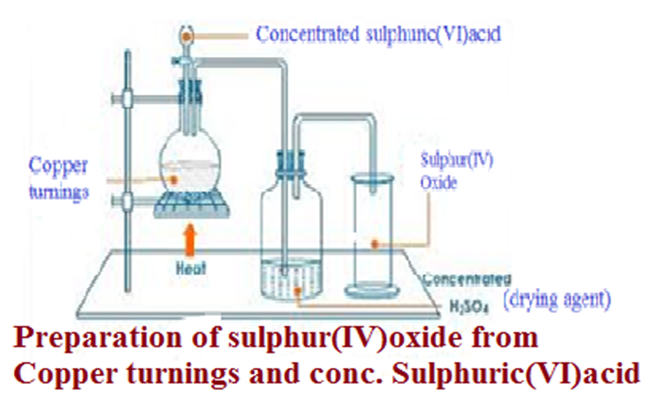
Method 1: Using Copper and Sulphuric(VI) acid
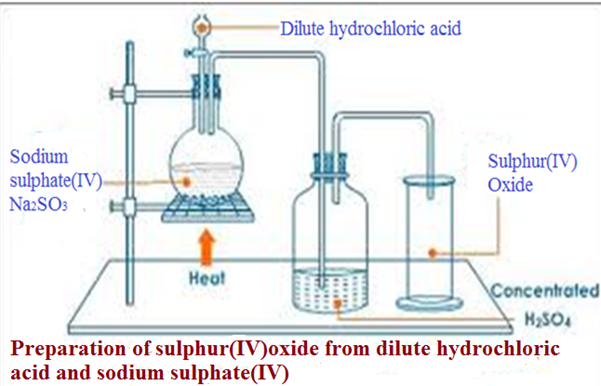
Method 2: Using Sodium Sulphite and Hydrochloric acid
(c) Properties of Sulphur(IV) oxide (Questions)
1. Write the equations for the reaction for the formation of sulphur (IV) oxide using:
(i) Method 1
Cu(s) + 2H2SO4(l) → CuSO4(aq) + SO2(g) + 2H2O(l)
Zn(s) + 2H2SO4(l) → ZnSO4(aq) + SO2(g) + 2H2O(l)
Mg(s) + 2H2SO4(l) → MgSO4(aq) + SO2(g) + 2H2O(l)
Fe(s) + 2H2SO4(l) → FeSO4(aq) + SO2(g) + 2H2O(l)
Calcium, Lead, and Barium will form insoluble sulphate(VI) salts that will cover unreacted metals stopping further reaction, thus producing very small amounts of sulphur (IV) oxide gas.
(ii) Method 2
Na2SO3(aq) + 2HCl(aq) → 2NaCl(aq) + SO2(g) + H2O(l)
K2SO3(aq) + 2HCl(aq) → 2KCl(aq) + SO2(g) + H2O(l)
BaSO3(s) + 2HCl(aq) → BaCl2(aq) + SO2(g) + H2O(l)
CaSO3(s) + 2HCl(aq) → CaCl2(aq) + SO2(g) + H2O(l)
PbSO3(s) + 2HCl(aq) → PbCl2(s) + SO2(g) + H2O(l)
Lead(II) chloride is soluble on heating; thus, reactants should be heated to prevent it coating/covering unreacted PbSO3(s).
2. State the physical properties unique to sulphur (IV) oxide gas.
Sulphur (IV) oxide gas is a colourless gas with a pungent, irritating, and choking smell which liquefies easily. It is about two times denser than air.
3. The diagram below shows the solubility of sulphur (IV) oxide gas. Explain.
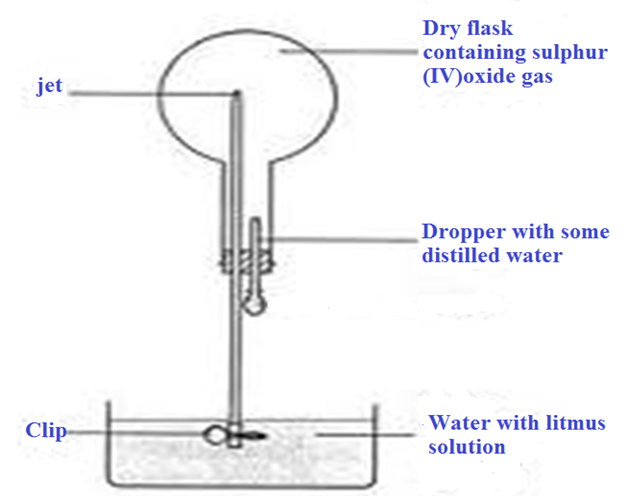
Sulphur(IV) oxide is very soluble in water. One drop of water dissolves all the sulphur (IV) oxide in the flask leaving a vacuum. If the clip is removed, atmospheric pressure forces the water up through the narrow tube to form a fountain to occupy the vacuum.
An acidic solution of sulphurous acid (H2SO3) is formed which turns litmus solution red.
Chemical equation:
SO2(g) + H2O(l) → H2SO3(aq) (sulphurous acid turns litmus red)
4. Dry litmus papers and wet/damp/moist litmus papers were put in a gas jar containing sulphur(IV) oxide gas. State and explain the observations made.
Observations:
- Dry blue litmus paper remains blue.
- Dry red litmus paper remains red.
- Wet/damp/moist blue litmus paper turns red.
- Moist/damp/wet red litmus paper remains red.
- Both litmus papers are then bleached/decolorized.
Explanation:
Dry sulphur(IV) oxide gas is a molecular compound that does not dissociate/ionize to release H+ ions and thus has no effect on dry blue/red litmus papers.
Wet/damp/moist litmus papers contain water that dissolves/reacts with dry sulphur(IV) oxide gas to form a solution of weak sulphurous acid (H2SO3).
Weak sulphurous acid dissociates/ionizes into free H+ ions:
H2SO3(aq) → 2H+(aq) + SO32-(aq)
The free H+ ions are responsible for turning blue litmus paper red, showing the gas is acidic.
The SO32- ions in wet/damp/moist sulphur(IV) oxide gas are responsible for many reactions of the gas.
It is easily oxidized to sulphate(VI) SO42- ions, making sulphur(IV) oxide gas act as a reducing agent as in the following examples:
(a) Bleaching agent
Wet/damp/moist coloured flowers/litmus papers are bleached/decolorized when put in sulphur(IV) oxide gas. This is because sulphur(IV) oxide removes atomic oxygen from the coloured dye/material to form sulphuric(VI) acid.
Chemical equations:
(i) Formation of sulphurous acid:
SO2(g) + H2O(l) → H2SO3(aq)
(ii) Decolorization/bleaching of the dye/removal of atomic oxygen:
Method I: H2SO3(aq) + (dye + O) → H2SO4(aq) + dye (coloured → colourless)
Method II: H2SO3(aq) + (dye) → H2SO4(aq) + (dye – O) (coloured → colourless)
Sulphur(IV) oxide gas therefore bleaches by reduction/removing oxygen from a dye, unlike chlorine that bleaches by oxidation/adding oxygen.
The bleaching by removing oxygen from sulphur(IV) oxide gas is temporary because the bleached dye regains the atomic oxygen from the atmosphere/air in presence of sunlight as catalyst, thus regaining/restoring its original colour. For example, old newspapers turn brown on exposure to air on regaining the atomic oxygen.
The bleaching through adding oxygen by chlorine gas is permanent.
(b) Turns orange acidified potassium dichromate(VI) to green
Experiment:
- Pass a stream of sulphur(IV) oxide gas in a test tube containing acidified potassium dichromate(VI) solution; or
- Dip a filter paper soaked in acidified potassium dichromate(VI) into a gas jar containing sulphur(IV) oxide gas.
Observation: Orange acidified potassium dichromate(VI) turns to green.
Explanation: Sulphur(IV) oxide gas reduces acidified potassium dichromate(VI) from orange Cr2O72- ions to green Cr3+ ions without leaving a residue, itself oxidized from SO32- ions in sulphurous acid to SO42- ions in sulphuric acid.
Chemical/ionic equations:
(i) Reaction of sulphur(IV) oxide gas with water:
SO2(g) + H2O(l) → H2SO3(aq)
(ii) Dissociation/ionization of sulphurous acid:
H2SO3(aq) → 2H+(aq) + SO32-(aq)
(iii) Oxidation of SO32- and reduction of Cr2O72-:
3SO32-(aq) + Cr2O72-(aq) + 8H+(aq) → 3SO42-(aq) + 2Cr3+(aq) + 4H2O(l)
This is a confirmatory test for the presence of sulphur(IV) oxide gas.
Hydrogen sulphide also reduces acidified potassium dichromate(VI) from orange Cr2O72- ions to green Cr3+ ions leaving a yellow residue.
(c) Decolorizes acidified potassium manganate(VII)
Experiment:
- Pass a stream of sulphur(IV) oxide gas in a test tube containing acidified potassium manganate(VII) solution; or
- Dip a filter paper soaked in acidified potassium manganate(VII) into a gas jar containing sulphur(IV) oxide gas.
Observation: Purple acidified potassium manganate(VII) turns colourless/acidified potassium manganate(VII) is decolorized.
Explanation: Sulphur(IV) oxide gas reduces acidified potassium manganate(VII) from purple MnO4– ions to green Mn2+ ions without leaving a residue, itself oxidized from SO32- ions in sulphurous acid to SO42- ions in sulphuric acid.
Chemical/ionic equations:
(i) Reaction of sulphur(IV) oxide gas with water:
SO2(g) + H2O(l) → H2SO3(aq)
(ii) Dissociation/ionization of sulphurous acid:
H2SO3(aq) → 2H+(aq) + SO32-(aq)
(iii) Oxidation of SO32- and reduction of MnO4–:
5SO32-(aq) + 2MnO4–(aq) + 6H+(aq) → 5SO42-(aq) + 2Mn2+(aq) + 3H2O(l)
This is another test for the presence of sulphur(IV) oxide gas.
Hydrogen sulphide also decolorizes acidified potassium manganate(VII) from purple MnO4– ions to colourless Mn2+ ions leaving a yellow residue.
(d) Decolorizes bromine water
Experiment:
- Pass a stream of sulphur(IV) oxide gas in a test tube containing bromine water; or
- Put three drops of bromine water into a gas jar containing sulphur(IV) oxide gas. Swirl.
Observation: Yellow bromine water turns colourless/bromine water is decolorized.
Explanation: Sulphur(IV) oxide gas reduces yellow bromine water to colourless hydrobromic acid (HBr) without leaving a residue, itself oxidized from SO32- ions in sulphurous acid to SO42- ions in sulphuric acid.
Chemical/ionic equation:
(i) Reaction of sulphur(IV) oxide gas with water:
SO2(g) + H2O(l) → H2SO3(aq)
(ii) Dissociation/ionization of sulphurous acid:
H2SO3(aq) → 2H+(aq) + SO32-(aq)
(iii) Oxidation of SO32- and reduction of Br2:
SO32-(aq) + Br2(aq) + H2O(l) → SO42-(aq) + 2HBr(aq)
This can also be used as another test for the presence of sulphur(IV) oxide gas.
Hydrogen sulphide also decolorizes yellow bromine water to colourless leaving a yellow residue.
(e) Reduces Iron(III) Fe3+ salts to Iron(II) Fe2+
Experiment:
- Pass a stream of sulphur(IV) oxide gas in a test tube containing about 3 cm3 of Iron (III) chloride solution; or
- Place about 3 cm3 of Iron (III) chloride solution into a gas jar containing sulphur(IV) oxide gas. Swirl.
Observation: Yellow/brown Iron (III) chloride solution turns green.
Explanation: Sulphur(IV) oxide gas reduces Iron (III) chloride solution from yellow/brown Fe3+ ions to green Fe2+ ions without leaving a residue, itself oxidized from SO32- ions in sulphurous acid to SO42- ions in sulphuric acid.
Chemical/ionic equations:
(i) Reaction of sulphur(IV) oxide gas with water:
SO2(g) + H2O(l) → H2SO3(aq)
(ii) Dissociation/ionization of sulphurous acid:
H2SO3(aq) → 2H+(aq) + SO32-(aq)
(iii) Oxidation of SO32- and reduction of Fe3+:
SO32-(aq) + 2Fe3+(aq) + 3H2O(l) → SO42-(aq) + 2Fe2+(aq) + 2H+(aq)
(f) Reduces Nitric(V) acid to Nitrogen(IV) oxide gas
Experiment:
- Pass a stream of sulphur(IV) oxide gas in a test tube containing about 3 cm3 of concentrated nitric(V) acid; or
- Place about 3 cm3 of concentrated nitric(V) acid into a gas jar containing sulphur(IV) oxide gas. Swirl.
Observation: Brown fumes of a gas evolved/produced.
Explanation: Sulphur(IV) oxide gas reduces concentrated nitric(V) acid to brown nitrogen(IV) oxide gas, itself oxidized from SO32- ions in sulphurous acid to SO42- ions in sulphuric acid.
Chemical/ionic equation:
SO2(g) + 2HNO3(l) → H2SO4(l) + NO2(g)
(g) Reduces Hydrogen peroxide to water
Experiment:
- Pass a stream of sulphur(IV) oxide gas in a test tube containing about 3 cm3 of 20 volume hydrogen peroxide. Add four drops of Barium nitrate(V) or Barium chloride followed by five drops of 2M hydrochloric acid/2M nitric(V) acid.
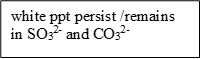
Observation: A white precipitate is formed that persists/remains on adding 2M hydrochloric acid/2M nitric(V) acid.
Explanation: Sulphur(IV) oxide gas reduces 20 volume hydrogen peroxide and itself oxidized from SO32- ions in sulphurous acid to SO42- ions in sulphuric acid.
When Ba2+ ions in Barium nitrate(V) or Barium chloride solution are added, a white precipitate of insoluble Barium salts is formed showing the presence of either SO32-, SO42-, or CO32- ions.
Chemical/ionic equations:
SO32-(aq) + Ba2+(aq) → BaSO3(s) (white precipitate)
SO42-(aq) + Ba2+(aq) → BaSO4(s) (white precipitate)
CO32-(aq) + Ba2+(aq) → BaCO3(s) (white precipitate)
If nitric(V)/hydrochloric acid is added to the three suspected insoluble white precipitates above, the white precipitate:
- Persists/remains if SO42- ions (BaSO4(s)) are present.
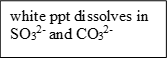
- Dissolves if SO32- ions (BaSO3(s)) and CO32- ions (BaCO3(s)) are present. This is because:
I. BaSO3(s) reacts with nitric(V)/hydrochloric acid to produce acidic SO2 gas that turns orange moist filter paper dipped in acidified potassium dichromate to green.
Chemical equation:
BaSO3(s) + 2H+(aq) → Ba2+(aq) + SO2(g) + H2O(l)
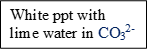
II. BaCO3(s) reacts with nitric(V)/hydrochloric acid to produce acidic CO2 gas that forms a white precipitate when bubbled in lime water.
Chemical equation:
BaCO3(s) + 2H+(aq) → Ba2+(aq) + CO2(g) + H2O(l)
5. Sulphur(IV) oxide also acts as an oxidizing agent as in the following examples.
(a) Reduction by burning Magnesium
Experiment: Lower a burning magnesium ribbon into a gas jar containing sulphur(IV) oxide gas.
Observation: Magnesium ribbon continues to burn with difficulty. White ash and yellow powder/specks form.
Explanation: Sulphur(IV) oxide does not support burning/combustion. Magnesium burns to produce enough heat energy to decompose sulphur(IV) oxide to sulphur and oxygen. The metal continues to burn on oxygen forming white magnesium oxide solid/ash. Yellow specks of sulphur residue form on the sides of the reaction flask/gas jar. During the reaction, sulphur(IV) oxide is reduced (oxidizing agent) while the metal is oxidized (reducing agent).
Chemical equation:
SO2(g) + 2Mg(s) → 2MgO(s) + S(s)
(white ash/solid) (yellow speck/powder)
(b) Reduction by Hydrogen sulphide gas
Experiment: Put two drops of water into a gas jar containing dry sulphur(IV) oxide gas. Bubble hydrogen sulphide gas into the gas jar containing sulphur(IV) oxide gas. Or invert a gas jar full of hydrogen sulphide gas over the gas jar containing sulphur(IV) oxide gas. Swirl.
Observation: Yellow powder/specks form.
Explanation: Sulphur(IV) oxide oxidizes hydrogen sulphide to yellow specks of sulphur residue and is itself reduced to sulphur that forms on the sides of the reaction flask/gas jar. A little moisture/water acts as a catalyst/speeds up the reaction.
Chemical equation:
SO2(g) + 2H2S(g) → 2H2O(l) + 3S(s)
(yellow speck/powder)
6. Sulphur(IV) oxide has many industrial uses. State three.
- In the contact process for the manufacture of sulphuric(VI) acid.
- As a bleaching agent of pulp and paper.
- As a fungicide to kill microbes.
- As a preservative of jam, juices to prevent fermentation.
(ii) Sulphur(VI) oxide (SO3)
(a) Occurrence
Sulphur(VI) oxide does not occur free in nature/atmosphere.
(b) Preparation
In a Chemistry school laboratory, sulphur(VI) oxide may be prepared from:
Method 1: Catalytic oxidation of sulphur(IV) oxide gas
Sulphur(IV) oxide gas and oxygen mixture are first dried by being passed through concentrated sulphuric(VI) acid. The dry mixture is then passed through platinised asbestos to catalyse/speed up the combination to form sulphur(VI) oxide gas.
Sulphur(VI) oxide gas readily solidifies as silky white needles if passed through a freezing mixture/ice cold water. The solid fumes out on heating to a highly acidic poisonous gas.
Chemical equation:
2SO2(g) + O2(g) –platinised asbestos–> 2SO3(g)
Method 2: Heating Iron(II) sulphate(VI) heptahydrate
When green hydrated Iron(II) sulphate(VI) heptahydrate crystals are heated in a boiling tube, it loses the water of crystallization and colour changes from green to white.
Chemical equation:
FeSO4.7H2O(s) → FeSO4(s) + 7H2O(l)
(green solid) (white solid)
On further heating, the white anhydrous Iron(II) sulphate(VI) solid decomposes to a mixture of sulphur(VI) oxide and sulphur(IV) oxide gas. Sulphur(VI) oxide readily solidifies as white silky needles when the mixture is passed through a freezing mixture/ice cold water. Iron(III) oxide is left as a brown residue/solid.
Chemical equation:
2FeSO4(s) → Fe2O3(s) + SO2(g) + SO3(g)
(green solid) (brown solid)
Caution: On exposure to air, sulphur(VI) oxide gas produces highly corrosive poisonous fumes of concentrated sulphuric(VI) acid and thus its preparation in a school laboratory is very risky.
(c) Uses of sulphur(VI) oxide
One of the main uses of sulphur(VI) oxide gas is as an intermediate product in the contact process for industrial/manufacture/large scale production of sulphuric(VI) acid.
(iii) Sulphuric(VI) acid (H2SO4)
(a) Occurrence
Sulphuric(VI) acid is one of the three mineral acids. The three mineral acids are:
- Nitric(V) acid
- Sulphuric(VI) acid
- Hydrochloric acid
Mineral acids do not occur naturally but are prepared in a school laboratory and manufactured at industrial level.
(b) The Contact process for industrial manufacture of H2SO4
I. Raw materials
The main raw materials for industrial preparation of sulphuric(VI) acid include:
- Sulphur from Frasch process or from heating metal sulphide ores like Galena (PbS), Zinc blende (ZnS).
- Oxygen from fractional distillation of air.
- Water from rivers/lakes.
II. Chemical processes
The contact process involves four main chemical processes:
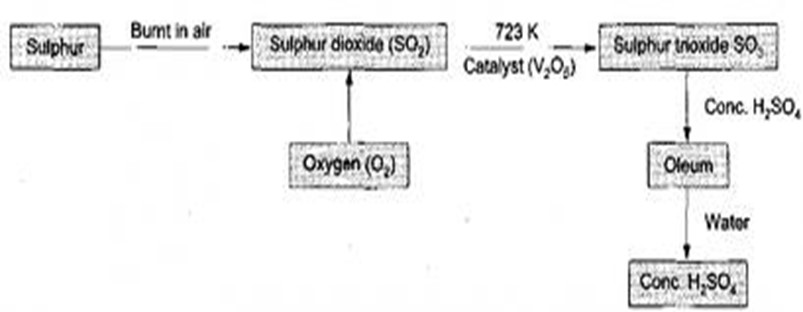
(i) Production of Sulphur(IV) oxide
As one of the raw materials, sulphur(IV) oxide gas is obtained from the following sources:
- Burning/roasting sulphur in air.
- Burning/roasting sulphide ores in air.
Sulphur from Frasch process is roasted/burnt in air to form sulphur(IV) oxide gas in the burners.
Chemical equation:
S(s) + O2(g) → SO2(g)
Sulphur(IV) oxide gas is produced as a by-product in extraction of some metals like:
- Lead from Lead(II) sulphide/Galena (PbS)
- Zinc from Zinc(II) sulphide/Zinc blende (ZnS)
- Copper from Copper iron sulphide/Copper pyrites (CuFeS2)
On roasting/burning, large quantities of sulphur(IV) oxide are generated/produced.
Chemical equations:
2PbS(s) + 3O2(g) → 2PbO(s) + 2SO2(g)
2ZnS(s) + 3O2(g) → 2ZnO(s) + 2SO2(g)
2CuFeS2(s) + 4O2(g) → 2FeO(s) + 3SO2(g) + Cu2O(s)
Sulphur(IV) oxide easily liquefies and thus can be transported safely over long distances.
(ii) Purification of Sulphur(IV) oxide
Sulphur(IV) oxide gas contains dust particles and Arsenic(IV) oxide as impurities. These impurities “poison”/impair the catalyst by adhering to/covering its surface.
The impurities are removed by electrostatic precipitation method.
In the contact process, Platinum or Vanadium(V) oxide may be used. Vanadium(V) oxide is preferred because it is:
- Cheaper/less expensive.
- Less easily poisoned by impurities.
(iii) Catalytic conversion of Sulphur(IV) oxide to Sulphur(VI) oxide
Pure and dry mixture of sulphur(IV) oxide gas and oxygen is heated to 450°C in a heat exchanger. The heated mixture is passed through long pipes coated with pellets of Vanadium(V) oxide catalyst.
The close “contact” between the reacting gases and catalyst gives the process its name.
Vanadium(V) oxide catalyses the conversion/oxidation of sulphur(IV) oxide to sulphur(VI) oxide gas.
Chemical equation:
2SO2(g) + O2(g) –V2O5–> 2SO3(g)
This reaction is exothermic (-∆H) and the temperature needs to be maintained at around 450°C to ensure that:
- The reaction rate/time taken for the formation of sulphur(VI) oxide is not too slow/long at lower temperatures below 450°C.
- Sulphur(VI) oxide gas does not decompose back to sulphur(IV) oxide gas and oxygen gas at higher temperatures than 450°C.
(iv) Conversion of Sulphur(VI) oxide to Sulphuric(VI) acid
Sulphur(VI) oxide is the acid anhydride of concentrated sulphuric(VI) acid. Sulphur(VI) oxide reacts with water to form a thick mist of fine droplets of very/highly corrosive concentrated sulphuric(VI) acid because the reaction is highly exothermic.
To prevent this, sulphur(VI) oxide is passed up to meet downward flow of 98% sulphuric(VI) acid in the absorption chamber/tower.
The reaction forms a very viscous oily liquid called Oleum/fuming sulphuric(VI) acid/pyrosulphuric(VI) acid.
Chemical equation:
H2SO4(aq) + SO3(g) → H2S2O7(l)
Oleum/fuming sulphuric(VI) acid/pyrosulphuric(VI) acid is diluted carefully with distilled water to give concentrated sulphuric(VI) acid.
Chemical equation:
H2S2O7(l) + H2O(l) → 2H2SO4(l)
The acid is stored ready for market/sale.
III. Environmental effects of contact process
Sulphur(VI) oxide and sulphur(IV) oxide gases are atmospheric pollutants that form acid rain if they escape to the atmosphere.
In the contact process, about 2% of these gases do not form sulphuric(VI) acid.
The following precautions prevent/minimize pollution from the contact process:
- Recycling back any unreacted sulphur(IV) oxide gas back to the heat exchangers.
- Dissolving sulphur(VI) oxide gas in concentrated sulphuric(VI) acid instead of water. This prevents the formation of fine droplets of corrosive/toxic/poisonous fumes of concentrated sulphuric(VI) acid.
- Scrubbing – passing the exhaust gases through very tall chimneys lined with quicklime/calcium hydroxide solid. This reacts with sulphur(VI) oxide gas forming harmless calcium(II) sulphite (CaSO3).
Chemical equation:
Ca(OH)2(aq) + SO2(g) → CaSO3(aq) + H2O(g)
IV. Uses of Sulphuric(VI) acid
Sulphuric(VI) acid is used:
- In making dyes and paint.
- As acid in lead-acid accumulator/battery.
- For making soapless detergents.
- For making sulphate agricultural fertilizers.
VI. Sketch chart diagram showing the Contact process
(c) Properties of Concentrated sulphuric (VI) acid
- Concentrated sulphuric (VI) acid is a colourless oily liquid with a density of 1.84 g/cm3. It has a boiling point of 338°C.
- It is very soluble in water. The solubility/dissolution of the acid is highly exothermic. The concentrated acid should thus be diluted slowly in excess water. Water should never be added to the acid because the hot acid scatters highly corrosive fumes out of the container.
- Concentrated sulphuric (VI) acid is a covalent compound. It has no free H+ ions. Free H+ ions are responsible for turning blue litmus paper red. Concentrated sulphuric (VI) acid thus does not change blue litmus paper red.
- It is hygroscopic. It absorbs water from the atmosphere and does not form a solution. This makes concentrated sulphuric (VI) acid very suitable as a drying agent during preparation of gases.
- Chemical properties of concentrated sulphuric (VI) acid include:
I. As a dehydrating agent
Experiment I:
Put about four spatula end full of brown sugar and glucose in separate 10 cm3 beakers. Carefully add about 10 cm3 of concentrated sulphuric (VI) acid. Allow to stand for about 10 minutes.
Observation:
- Colour in brown sugar changes from brown to black.
- Colour in glucose changes from white to black.
- 10 cm3 beaker becomes very hot.
Explanation: Concentrated sulphuric (VI) acid is a strong dehydrating agent. It removes chemically and physically combined elements of water (hydrogen and oxygen in ratio 2:1) from compounds. When added to sugar/glucose, a vigorous reaction that is highly exothermic takes place. The sugar/glucose is charred to a black mass of carbon because the acid dehydrates the sugar/glucose leaving carbon.
Caution: This reaction is highly exothermic that starts slowly but produces fine particles of carbon that if inhaled cause quick suffocation by blocking the lung villi.
Chemical equations:
Glucose: C6H12O6(s) –conc. H2SO4–> 6C(s) + 6H2O(l)
Sugar: C12H22O11(s) –conc. H2SO4–> 12C(s) + 11H2O(l)
Experiment II:
Put about two spatula end full of hydrated copper(II) sulphate(VI) crystals in a boiling tube. Carefully add about 10 cm3 of concentrated sulphuric (VI) acid. Warm.
Observation: Colour changes from blue to white.
Explanation: Concentrated sulphuric (VI) acid is a strong dehydrating agent. It removes physically combined elements of water (hydrogen and oxygen in ratio 2:1) from hydrated compounds. The acid dehydrates blue copper(II) sulphate to white anhydrous copper(II) sulphate.
Chemical equation:
CuSO4.5H2O(s) –conc. H2SO4–> CuSO4(s) + 5H2O(l)
Experiment III:
Put about 4 cm3 of absolute ethanol in a boiling tube. Carefully add about 10 cm3 of concentrated sulphuric (VI) acid. Place moist/damp/wet filter paper dipped in acidified potassium dichromate(VI) solution on the mouth of the boiling tube. Heat strongly.
Caution: Absolute ethanol is highly flammable.
Observation: Colourless gas produced. Orange acidified potassium dichromate (VI) paper turns green.
Explanation: Concentrated sulphuric (VI) acid is a strong dehydrating agent. It removes chemically combined elements of water (hydrogen and oxygen in ratio 2:1) from compounds. The acid dehydrates ethanol to ethene gas at about 170°C. Ethene with =C=C= double bond turns orange acidified potassium dichromate (VI) paper green.
Chemical equation:
C2H5OH(l) –conc. H2SO4/170°C–> C2H4(g) + H2O(l)
Note: This reaction is used for the school laboratory preparation of ethene gas.
Experiment IV:
Put about 4 cm3 of methanoic acid in a boiling tube. Carefully add about 6 cm3 of concentrated sulphuric (VI) acid. Heat gently.
Caution: This should be done in a fume chamber/open.
Observation: Colourless gas produced.
Explanation: Concentrated sulphuric (VI) acid is a strong dehydrating agent. It removes chemically combined elements of water (hydrogen and oxygen in ratio 2:1) from compounds. The acid dehydrates methanoic acid to poisonous/toxic carbon(II) oxide gas.
Chemical equation:
HCOOH(l) –conc. H2SO4–> CO(g) + H2O(l)
Note: This reaction is used for the school laboratory preparation of small amounts of carbon (II) oxide gas.
Experiment V:
Put about 4 cm3 of ethan-1,2-dioic/oxalic acid in a boiling tube. Carefully add about 6 cm3 of concentrated sulphuric (VI) acid. Pass any gaseous product through lime water. Heat gently.
Caution: This should be done in a fume chamber/open.
Observation: Colourless gas produced. Gas produced forms a white precipitate with lime water.
Explanation: Concentrated sulphuric (VI) acid is a strong dehydrating agent. It removes chemically combined elements of water (hydrogen and oxygen in ratio 2:1) from compounds. The acid dehydrates ethan-1,2-dioic/oxalic acid to a mixture of poisonous/toxic carbon(II) oxide and carbon(IV) oxide gases.
Chemical equation:
HOOCCOOH(l) –conc. H2SO4–> CO(g) + CO2(g) + H2O(l)
Note: This reaction is also used for the school laboratory preparation of small amounts of carbon (II) oxide gas. Carbon (IV) oxide gas is removed by passing the mixture through concentrated sodium/potassium hydroxide solution.
II. As an Oxidizing agent
Experiment I
Put about 2 cm3 of concentrated sulphuric (VI) acid into three separate boiling tubes. Place a thin moist/damp/wet filter paper dipped in acidified potassium dichromate (VI) solution on the mouth of each boiling tube. Put about 0.5 g of copper turnings, zinc granules, and iron filings to each boiling tube separately.
Observation:
- Effervescence/fizzing/bubbles.
- Blue solution formed with copper.
- Green solution formed with iron.
- Colourless solution formed with zinc.
- Colourless gas produced that has a pungent irritating choking smell.
- Gas produced turns orange moist/damp/wet filter paper dipped in acidified potassium dichromate (VI) solution to green.
Explanation: Concentrated sulphuric (VI) acid is a strong oxidizing agent. It oxidizes metals to metallic sulphate(VI) salts and itself is reduced to sulphur(IV) oxide gas. Sulphur(IV) oxide gas turns orange moist/damp/wet filter paper dipped in acidified potassium dichromate (VI) solution to green. CuSO4(aq) is a blue solution. ZnSO4(aq) is a colourless solution. FeSO4(aq) is a green solution.
Chemical equations:
Cu(s) + 2H2SO4(aq) → CuSO4(aq) + SO2(g) + 2H2O(l)
Zn(s) + 2H2SO4(aq) → ZnSO4(aq) + SO2(g) + 2H2O(l)
Fe(s) + 2H2SO4(aq) → FeSO4(aq) + SO2(g) + 2H2O(l)
Experiment II
Put about 2 cm3 of concentrated sulphuric (VI) acid into two separate boiling tubes. Place a thin moist/damp/wet filter paper dipped in acidified potassium dichromate (VI) solution on the mouth of each boiling tube. Put about 0.5 g of powdered charcoal and sulphur powder to each boiling tube separately. Warm.
Observation:
- Black solid charcoal dissolves/decreases.
- Yellow solid sulphur dissolves/decreases.
- Colourless gas produced that has a pungent irritating choking smell.
- Gas produced turns orange moist/damp/wet filter paper dipped in acidified potassium dichromate (VI) solution to green.
Explanation: Concentrated sulphuric (VI) acid is a strong oxidizing agent. It oxidizes non-metals to non-metallic oxides and itself is reduced to sulphur(IV) oxide gas. Sulphur(IV) oxide gas turns orange moist/damp/wet filter paper dipped in acidified potassium dichromate (VI) solution to green. Charcoal is oxidized to carbon(IV) oxide. Sulphur is oxidized to sulphur(IV) oxide.
Chemical equations:
C(s) + 2H2SO4(aq) → CO2(g) + 2SO2(g) + 2H2O(l)
S(s) + 2H2SO4(aq) → 3SO2(g) + 2H2O(l)
III. As the least volatile acid
Study the table below showing a comparison in boiling points of the three mineral acids:
| Mineral acid | Relative molecular mass | Boiling point (°C) |
|---|---|---|
| Hydrochloric acid (HCl) | 36.5 | 35.0 |
| Nitric(V) acid (HNO3) | 63.0 | 83.0 |
| Sulphuric(VI) acid (H2SO4) | 98.0 | 333 |
1. Which is the least volatile acid? Explain.
Sulphuric(VI) acid (H2SO4) because it has the largest molecule and is joined by hydrogen bonds, making it have the highest boiling point/least volatile.
2. Using chemical equations, explain how sulphuric(VI) acid displaces the less volatile mineral acids.
(i) Chemical equations:
KNO3(s) + H2SO4(aq) → KHSO4(l) + HNO3(g)
NaNO3(s) + H2SO4(aq) → NaHSO4(l) + HNO3(g)
This reaction is used in the school laboratory preparation of Nitric(V) acid (HNO3).
(ii) Chemical equations:
KCl(s) + H2SO4(aq) → KHSO4(s) + HCl(g)
NaCl(s) + H2SO4(aq) → NaHSO4(s) + HCl(g)
This reaction is used in the school laboratory preparation of Hydrochloric acid (HCl).
(d) Properties of dilute sulphuric(VI) acid
Dilute sulphuric(VI) acid is made when about 10 cm3 of concentrated sulphuric(VI) acid is carefully added to about 90 cm3 of distilled water.
Diluting concentrated sulphuric(VI) acid should be done carefully because the reaction is highly exothermic. Diluting concentrated sulphuric(VI) acid decreases the number of moles present in a given volume of solution which makes the acid less corrosive.
On diluting concentrated sulphuric(VI) acid, water ionizes/dissociates the acid fully/wholly into two (dibasic) free H+ and SO42- ions:
H2SO4(aq) → 2H+(aq) + SO42-(aq)
The presence of free H+ ions is responsible for:
- Turning litmus red because of the presence of free H+ ions.
- Having pH 1/2/3 because of the presence of many free H+ ions, hence a strongly acidic solution.
- Reaction with metals.
Experiment:
Place 5 cm3 of 0.2M dilute sulphuric(VI) acid into four separate clean test tubes. Add about 0.1 g of magnesium ribbon to one test tube. Cover the mixture with a finger as stopper. Introduce a burning splint on top of the finger and release the finger “stopper”. Repeat by adding zinc, copper, and iron instead of the magnesium ribbon.
Observation:
- No effervescence/bubbles/fizzing with copper.
- Effervescence/bubbles/fizzing with iron, zinc, and magnesium.
- Colourless gas produced that extinguishes burning splint with a “pop” sound.
- Colourless solution formed with zinc and magnesium.
- Green solution formed with iron.
Explanation:
When a metal higher than hydrogen in the reactivity/electrochemical series is put in a test tube containing dilute sulphuric(VI) acid, effervescence/bubbling/fizzing takes place with evolution of hydrogen gas. Impure hydrogen gas extinguishes burning splint with a “pop” sound. A sulphate(VI) salt is formed. Iron, zinc, and magnesium are higher than hydrogen in the reactivity/electrochemical series. They form iron(II) sulphate(VI), magnesium sulphate(VI), and zinc sulphate(VI).
When a metal lower than hydrogen in the reactivity/electrochemical series is put in a test tube containing dilute sulphuric(VI) acid, there is no effervescence/bubbling/fizzing that takes place. Copper thus does not react with dilute sulphuric(VI) acid.
Chemical/ionic equations:
Mg(s) + H2SO4(aq) → MgSO4(aq) + H2(g)
Mg(s) + 2H+(aq) → Mg2+(aq) + H2(g)
Zn(s) + H2SO4(aq) → ZnSO4(aq) + H2(g)
Zn(s) + 2H+(aq) → Zn2+(aq) + H2(g)
Fe(s) + H2SO4(aq) → FeSO4(aq) + H2(g)
Fe(s) + 2H+(aq) → Fe2+(aq) + H2(g)
Note:
- Calcium, lead, and barium form insoluble sulphate(VI) salts that cover/coat the unreacted metals.
- Sodium and potassium react explosively with dilute sulphuric(VI) acid.
(iv) Reaction with metal carbonates and hydrogen carbonates
Experiment:
Place 5 cm3 of 0.2M dilute sulphuric(VI) acid into four separate clean boiling tubes. Add about 0.1 g of sodium carbonate to one boiling tube. Introduce a burning splint on top of the boiling tube. Repeat by adding zinc carbonate, copper(II) carbonate, and iron(II) carbonate in place of sodium hydrogen carbonate.
Observation:
- Effervescence/bubbles/fizzing.
- Colourless gas produced that extinguishes burning splint.
- Colourless solution formed with zinc carbonate, sodium hydrogen carbonate, and sodium carbonate.
- Green solution formed with iron(II) carbonate.
- Blue solution formed with copper(II) carbonate.
Explanation:
When a metal carbonate or a hydrogen carbonate is put in a test tube containing dilute sulphuric(VI) acid, effervescence/bubbling/fizzing takes place with evolution of carbon(IV) oxide gas. Carbon(IV) oxide gas extinguishes a burning splint and forms a white precipitate when bubbled in lime water. A sulphate(VI) salt is formed.
Chemical/ionic equations:
ZnCO3(s) + H2SO4(aq) → ZnSO4(aq) + H2O(l) + CO2(g)
ZnCO3(s) + 2H+(aq) → Zn2+(aq) + H2O(l) + CO2(g)
CuCO3(s) + H2SO4(aq) → CuSO4(aq) + H2O(l) + CO2(g)
CuCO3(s) + 2H+(aq) → Cu2+(aq) + H2O(l) + CO2(g)
FeCO3(s) + H2SO4(aq) → FeSO4(aq) + H2O(l) + CO2(g)
FeCO3(s) + 2H+(aq) → Fe2+(aq) + H2O(l) + CO2(g)
2NaHCO3(s) + H2SO4(aq) → Na2SO4(aq) + 2H2O(l) + 2CO2(g)
NaHCO3(s) + H+(aq) → Na+(aq) + H2O(l) + CO2(g)
Na2CO3(s) + H2SO4(aq) → Na2SO4(aq) + H2O(l) + CO2(g)
NaHCO3(s) + H+(aq) → Na+(aq) + H2O(l) + CO2(g)
(NH4)2CO3(s) + H2SO4(aq) → (NH4)2SO4(aq) + H2O(l) + CO2(g)
(NH4)2CO3(s) + 2H+(aq) → NH4+(aq) + H2O(l) + CO2(g)
2NH4HCO3(aq) + H2SO4(aq) → (NH4)2SO4(aq) + H2O(l) + CO2(g)
NH4HCO3(aq) + H+(aq) → NH4+(aq) + H2O(l) + CO2(g)
Note: Calcium, lead, and barium carbonates form insoluble sulphate(VI) salts that cover/coat the unreacted metals.
(v) Neutralization – reaction of metal oxides and alkalis/bases
Experiment I:
Place 5 cm3 of 0.2M dilute sulphuric(VI) acid into four separate clean boiling tubes. Add about 0.1 g of copper(II) oxide to one boiling tube. Stir. Repeat by adding zinc oxide, calcium carbonate, and sodium oxide in place of the copper(II) oxide.
Observation:
- Blue solution formed with copper(II) oxide.
- Colourless solution formed with other oxides.
Explanation: When a metal oxide is put in a test tube containing dilute sulphuric(VI) acid, the oxide dissolves forming a sulphate(VI) salt.
Chemical/ionic equations:
ZnO(s) + H2SO4(aq) → ZnSO4(aq) + H2O(l)
ZnO(s) + 2H+(aq) → Zn2+(aq) + H2O(l)
CuO(s) + H2SO4(aq) → CuSO4(aq) + H2O(l)
CuO(s) + 2H+(aq) → Cu2+(aq) + H2O(l)
MgO(s) + H2SO4(aq) → MgSO4(aq) + H2O(l)
MgO(s) + 2H+(aq) → Mg2+(aq) + H2O(l)
Na2O(s) + H2SO4(aq) → Na2SO4(aq) + H2O(l)
Na2O(s) + 2H+(aq) → 2Na+(aq) + H2O(l)
K2CO3(s) + H2SO4(aq) → K2SO4(aq) + H2O(l)
K2O(s) + 2H+(aq) → 2K+(aq) + H2O(l)
Note: Calcium, lead, and barium oxides form insoluble sulphate(VI) salts that cover/coat the unreacted metal oxides.
Experiment II:
Fill a burette with 0.1M dilute sulphuric(VI) acid. Pipette 20.0 cm3 of 0.1M sodium hydroxide solution into a 250 cm3 conical flask. Add three drops of phenolphthalein indicator. Titrate the acid to get a permanent colour change. Repeat with 0.1M potassium hydroxide solution in place of 0.1M sodium hydroxide solution.
Observation: Colour of phenolphthalein changes from pink to colourless at the end point.
Explanation: Like other mineral acids, dilute sulphuric(VI) acid neutralizes bases/alkalis to a sulphate salt and water only. Colour of the indicator used changes when a slight excess of acid is added to the base at the end point.
Chemical equations:
2NaOH(aq) + H2SO4(aq) → Na2SO4(aq) + 2H2O(l)
OH–(aq) + H+(aq) → H2O(l)
2KOH(aq) + H2SO4(aq) → K2SO4(aq) + 2H2O(l)
OH–(aq) + H+(aq) → H2O(l)
2NH4OH(aq) + H2SO4(aq) → (NH4)2SO4(aq) + 2H2O(l)
OH–(aq) + H+(aq) → H2O(l)
(iv) Hydrogen sulphide (H2S)
(a) Occurrence
Hydrogen sulphide is found in volcanic areas as a gas or dissolved in water from geysers and hot springs in active volcanic areas of the world, e.g., Olkaria and Hells Gate near Naivasha in Kenya. It is present in rotten eggs and human excreta.
(b) Preparation
Hydrogen sulphide is prepared in a school laboratory by heating iron(II) sulphide with dilute hydrochloric acid.
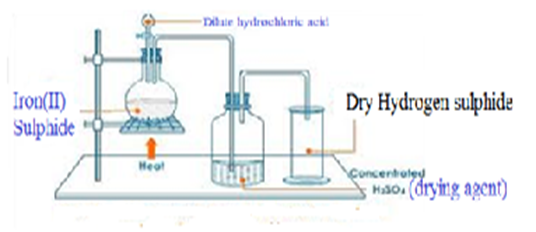
(c) Properties of Hydrogen sulphide (Questions)
1. Write the equation for the reaction for the school laboratory preparation of Hydrogen sulphide.
Chemical equation: FeS(s) + 2HCl(aq) → H2S(g) + FeCl2(aq)
2. State three physical properties unique to Hydrogen sulphide.
Hydrogen sulphide is a colourless gas with a characteristic pungent poisonous smell of rotten eggs. It is soluble in cold water but insoluble in warm water. It is denser than water and turns blue litmus paper red.
3. Hydrogen sulphide exists as a dibasic acid when dissolved in water. Using a chemical equation, show how it ionizes in aqueous state.
H2S(aq) → H+(aq) + HS–(aq)
H2S(aq) → 2H+(aq) + S2-(aq)
Hydrogen sulphide therefore can form both normal and acid salts, e.g., sodium hydrogen sulphide and sodium sulphide both exist.
4. State and explain one gaseous impurity likely to be present in the gas jar containing hydrogen sulphide above.
Hydrogen (H2)
Iron(II) sulphide contains iron as impurity. The iron will react with dilute hydrochloric acid to form iron(II) chloride and produce hydrogen gas that mixes with hydrogen sulphide gas.
5. State and explain the observations made when a filter paper dipped in Lead(II) ethanoate / Lead(II) nitrate(V) solution is put in a gas jar containing hydrogen sulphide gas.
Observations:
- Moist Lead(II) ethanoate / Lead(II) nitrate(V) paper turns black.
Explanation:
When hydrogen sulphide is bubbled in a metallic salt solution, a metallic sulphide is formed. All sulphides are insoluble black salts except sodium sulphide, potassium sulphide, and ammonium sulphides. Hydrogen sulphide gas blackens moist Lead(II) ethanoate / Lead(II) nitrate(V) paper. The gas reacts with Pb2+ in the paper to form black Lead(II) sulphide. This is the chemical test for the presence of H2S other than the physical smell of rotten eggs.
Chemical equations:
Pb2+(aq) + H2S → PbS(s) + 2H+(aq)
Fe2+(aq) + H2S → FeS(s) + 2H+(aq)
Zn2+(aq) + H2S → ZnS(s) + 2H+(aq)
Cu2+(aq) + H2S → CuS(s) + 2H+(aq)
2Cu+(aq) + H2S → Cu2S(s) + 2H+(aq)
6. Dry hydrogen sulphide was ignited as below.


(i) State the observations made in flame A
Hydrogen sulphide burns in excess air with a blue flame to form sulphur(IV) oxide gas and water.
Chemical equation: 2H2S(g) + 3O2(g) → 2H2O(l) + 2SO2(g)
Hydrogen sulphide burns in limited air with a blue flame to form sulphur solid and water.
Chemical equation: 2H2S(g) + O2(g) → 2H2O(l) + 2S(s)
7. Hydrogen sulphide is a strong reducing agent that is oxidized to yellow solid sulphur as precipitate. The following experiments illustrate the reducing properties of Hydrogen sulphide.
(a) Turns orange acidified potassium dichromate(VI) to green
Experiment:
- Pass a stream of hydrogen sulphide gas in a test tube containing acidified potassium dichromate (VI) solution; or
- Dip a filter paper soaked in acidified potassium dichromate (VI) into a gas jar containing hydrogen sulphide gas.
Observation: Orange acidified potassium dichromate (VI) turns to green. Yellow solid residue.
Explanation: Hydrogen sulphide gas reduces acidified potassium dichromate(VI) from orange Cr2O72- ions to green Cr3+ ions leaving a yellow solid residue as itself is oxidized to sulphur.
Chemical/ionic equation:
4H2S(aq) + Cr2O72-(aq) + 6H+(aq) → 4S(s) + 2Cr3+(aq) + 7H2O(l)
This test is used for differentiating hydrogen sulphide and sulphur(IV) oxide gas.
Sulphur(IV) oxide also reduces acidified potassium dichromate(VI) from orange Cr2O72- ions to green Cr3+ ions without leaving a yellow residue.
(b) Decolorizes acidified potassium manganate(VII)
Experiment:
- Pass a stream of hydrogen sulphide gas in a test tube containing acidified potassium manganate(VII) solution; or
- Dip a filter paper soaked in acidified potassium manganate(VII) into a gas jar containing hydrogen sulphide gas.
Observation: Purple acidified potassium manganate(VII) turns colourless/acidified potassium manganate(VII) is decolorized. Yellow solid residue.
Explanation: Hydrogen sulphide gas reduces acidified potassium manganate(VII) from purple MnO4– ions to green Mn2+ ions leaving a residue as the gas itself is oxidized to sulphur.
Chemical/ionic equation:
5H2S(g) + 2MnO4–(aq) + 6H+(aq) → 5S(s) + 2Mn2+(aq) + 8H2O(l)
(purple) (colourless)
This is another test for differentiating hydrogen sulphide and sulphur(IV) oxide gas.
Sulphur(IV) oxide also decolorizes acidified potassium manganate(VII) from purple MnO4– ions to colourless Mn2+ ions leaving no yellow residue.
(c) Decolorizes bromine water
Experiment:
- Pass a stream of hydrogen sulphide gas in a test tube containing bromine water; or
- Put three drops of bromine water into a gas jar containing hydrogen sulphide gas. Swirl.
Observation: Yellow bromine water turns colourless/bromine water is decolorized. Yellow solid residue.
Explanation: Hydrogen sulphide gas reduces yellow bromine water to colourless hydrobromic acid (HBr) leaving a yellow residue as the gas itself is oxidized to sulphur.
Chemical/ionic equation:
H2S(g) + Br2(aq) → S(s) + 2HBr(aq)
(yellow solution) (yellow solid) (colourless)
This is another test for differentiating hydrogen sulphide and sulphur(IV) oxide gas.
Sulphur(IV) oxide also decolorizes acidified potassium manganate(VII) from purple MnO4– ions to colourless Mn2+ ions leaving no yellow residue.
(d) Reduces Iron(III) Fe3+ salts to Iron(II) Fe2+
Experiment:
- Pass a stream of hydrogen sulphide gas in a test tube containing about 3 cm3 of Iron (III) chloride solution; or
- Place about 3 cm3 of Iron (III) chloride solution into a gas jar containing hydrogen sulphide gas. Swirl.
Observation: Yellow/brown Iron (III) chloride solution turns green. Yellow solid.
Explanation: Hydrogen sulphide gas reduces Iron (III) chloride solution from yellow/brown Fe3+ ions to green Fe2+ ions leaving a yellow residue. The gas is itself oxidized to sulphur.
Chemical/ionic equation:
H2S(aq) + 2Fe3+(aq) → S(s) + 2Fe2+(aq) + 2H+(aq)
(yellow solution) (yellow residue) (green)
(e) Reduces Nitric(V) acid to Nitrogen(IV) oxide gas
Experiment:
- Pass a stream of hydrogen sulphide gas in a test tube containing about 3 cm3 of concentrated nitric(V) acid; or
- Place about 3 cm3 of concentrated nitric(V) acid into a gas jar containing hydrogen sulphide gas. Swirl.
Observation: Brown fumes of a gas evolved/produced. Yellow solid residue.
Explanation: Hydrogen sulphide gas reduces concentrated nitric(V) acid to brown nitrogen(IV) oxide gas, itself oxidized to yellow sulphur.
Chemical/ionic equation:
H2S(g) + 2HNO3(l) → 2H2O(l) + S(s) + 2NO2(g)
(yellow residue) (brown fumes)
(f) Reduces sulphuric(VI) acid to sulphur
Experiment:
- Pass a stream of hydrogen sulphide gas in a test tube containing about 3 cm3 of concentrated sulphuric(VI) acid; or
- Place about 3 cm3 of concentrated sulphuric(VI) acid into a gas jar containing hydrogen sulphide gas. Swirl.
Observation: Yellow solid residue.
Explanation: Hydrogen sulphide gas reduces concentrated sulphuric(VI) acid to yellow sulphur.
Chemical/ionic equation:
3H2S(g) + H2SO4(l) → 4H2O(l) + 4S(s)
(yellow residue)
(g) Reduces Hydrogen peroxide to water
Experiment:
- Pass a stream of hydrogen sulphide gas in a test tube containing about 3 cm3 of 20 volume hydrogen peroxide.
Observation: Yellow solid residue.
Explanation: Hydrogen sulphide gas reduces 20 volume hydrogen peroxide to water and itself oxidized to yellow sulphur.
Chemical/ionic equation:
H2S(g) + H2O2(l) → 2H2O(l) + S(s)
(yellow residue)
8. Name the salt formed when:
(i) Equal volumes of equimolar hydrogen sulphide neutralizes sodium hydroxide solution:
Sodium hydrogen sulphide.
Chemical/ionic equation:
H2S(g) + NaOH(aq) → H2O(l) + NaHS(aq)
(ii) Hydrogen sulphide neutralizes excess concentrated sodium hydroxide solution:
Sodium sulphide.
Chemical/ionic equation:
H2S(g) + 2NaOH(aq) → 2H2O(l) + Na2S(aq)
Practice
Hydrogen sulphide gas was bubbled into a solution of metallic nitrate(V) salts as in the flow chart below:

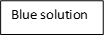
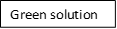

(a) Name the black solid
Copper(II) sulphide.
(b) Identify the cation responsible for the formation of:
- Blue solution: Cu2+(aq)
- Green solution: Fe2+(aq)
- Brown solution: Fe3+(aq)
(c) Using acidified potassium dichromate(VI), describe how you would differentiate between sulphur(IV) oxide and hydrogen sulphide.
- Bubble the gases in separate test tubes containing acidified potassium dichromate(VI) solution.
- Both change the orange colour of acidified potassium dichromate(VI) solution to green.
- Yellow solid residue/deposit is formed with hydrogen sulphide.
Chemical/ionic equations:
4H2S(aq) + Cr2O72-(aq) + 6H+(aq) → 4S(s) + 2Cr3+(aq) + 7H2O(l)
3SO32-(aq) + Cr2O72-(aq) + 8H+(aq) → 3SO42-(aq) + 2Cr3+(aq) + 4H2O(l)
(d) State and explain the observations made if a burning splint is introduced at the mouth of a hydrogen sulphide generator.
Observation: Gas continues burning with a blue flame.
Explanation: Hydrogen sulphide burns in excess air with a blue flame to form sulphur(IV) oxide gas and water.
Chemical equation: 2H2S(g) + 3O2(g) → 2H2O(l) + 2SO2(g)
(v) Sulphite (IV) (SO32-) and Sulphate (VI) (SO42-) salts
1. Sulphate (VI) (SO42-) salts are normal and acid salts derived from sulphuric (VI) acid H2SO4.
2. Sulphite (IV) (SO32-) salts are normal and acid salts derived from sulphurous acid H2SO3.
3. Sulphuric (VI) acid H2SO4 is formed when sulphur(VI) oxide gas is bubbled in water. The acid exists as a dibasic acid with two ionisable hydrogens. It forms therefore the sulphate (VI) (SO42-) and hydrogen sulphate (VI) (HSO4–) salts.
i.e.,
H2SO4(aq) → 2H+(aq) + SO42-(aq)
H2SO4(aq) → H+(aq) + HSO4–(aq)
All sulphate (VI) (SO42-) salts dissolve in water/are soluble except calcium (II) sulphate (VI) (CaSO4), barium (II) sulphate (VI) (BaSO4), and lead (II) sulphate (VI) (PbSO4).
All hydrogen sulphate (VI) (HSO4–) salts exist in solution/dissolved in water. Sodium (I) hydrogen sulphate (VI) (NaHSO4), potassium (I) hydrogen sulphate (VI) (KHSO4), and ammonium hydrogen sulphate (VI) (NH4HSO4) also exist as solids.
Other hydrogen sulphate (VI) (HSO4–) salts do not exist except those of calcium (II) hydrogen sulphate (VI) (Ca(HSO4)2) and magnesium (II) hydrogen sulphate (VI) (Mg(HSO4)2).
4. Sulphurous acid H2SO3 is formed when sulphur(IV) oxide gas is bubbled in water. The acid exists as a dibasic acid with two ionisable hydrogens. It forms therefore the sulphite (IV) (SO32-) and hydrogen sulphite (IV) (HSO3–) salts.
i.e.,
H2SO3(aq) → 2H+(aq) + SO32-(aq)
H2SO3(aq) → H+(aq) + HSO3–(aq)
All sulphite (IV) (SO32-) salts dissolve in water/are soluble except calcium (II) sulphite (IV) (CaSO3), barium (II) sulphite (IV) (BaSO3), and lead (II) sulphite (IV) (PbSO3).
All hydrogen sulphite (IV) (HSO3–) salts exist in solution/dissolved in water. Sodium (I) hydrogen sulphite (IV) (NaHSO3), potassium (I) hydrogen sulphite (IV) (KHSO3), and ammonium hydrogen sulphite (IV) (NH4HSO3) also exist as solids.
Other hydrogen sulphite (IV) (HSO3–) salts do not exist except those of calcium (II) hydrogen sulphite (IV) (Ca(HSO3)2) and magnesium (II) hydrogen sulphite (IV) (Mg(HSO3)2).
5. The following experiments show the effect of heat on sulphate(VI) (SO42-) and sulphite (IV) (SO32-) salts:
Experiment:
In a clean dry test tube, place separately about 1.0 g of zinc(II) sulphate (VI), iron(II) sulphate (VI), copper(II) sulphate (VI), sodium (I) sulphate (VI), sodium (I) sulphite (IV). Heat gently then strongly. Test any gases produced using litmus papers.
Observations:
- Colourless droplets of liquid form on the cooler parts of the test tube in all cases.
- White solid residue is left in case of zinc(II) sulphate (VI), sodium (I) sulphate (VI), and sodium (I) sulphite (IV).
- Colour changes from green to brown/yellow in case of iron(II) sulphate (VI).
- Colour changes from blue to white then black in case of copper(II) sulphate (VI).
- Blue litmus paper remains blue and red litmus paper remains red in case of zinc(II) sulphate (VI), sodium (I) sulphate (VI), and sodium (I) sulphite (IV).
- Blue litmus paper turns red and red litmus paper remains red in case of iron(II) sulphate (VI) and copper(II) sulphate (VI).
Explanation:
(i) All sulphate (VI) (SO42-) salts exist as hydrated salts with water of crystallization that condenses and collects on cooler parts of test tube as a colourless liquid on gentle heating, e.g.,
K2SO4.10H2O(s) → K2SO4(s) + 10H2O(l)
Na2SO4.10H2O(s) → Na2SO4(s) + 10H2O(l)
MgSO4.7H2O(s) → MgSO4(s) + 7H2O(l)
CaSO4.7H2O(s) → CaSO4(s) + 7H2O(l)
ZnSO4.7H2O(s) → ZnSO4(s) + 7H2O(l)
FeSO4.7H2O(s) → FeSO4(s) + 7H2O(l)
Al2(SO4)3.6H2O(s) → Al2(SO4)3(s) + 6H2O(l)
CuSO4.5H2O(s) → CuSO4(s) + 5H2O(l)
All sulphate (VI) (SO42-) salts do not decompose on heating except iron(II) sulphate (VI) and copper(II) sulphate (VI).
(ii) Iron(II) sulphate (VI) decomposes on strong heating to produce acidic sulphur(IV) oxide and sulphur(VI) oxide gases. Iron(III) oxide is formed as a brown/yellow residue.
Chemical equation:
2FeSO4(s) → Fe2O3(s) + SO2(g) + SO3(g)
This reaction is used for the school laboratory preparation of small amounts of sulphur(VI) oxide gas.
Sulphur(VI) oxide readily solidifies as white silky needles when the mixture is passed through freezing mixture/ice cold water. Sulphur(IV) oxide does not.
(iii) Copper(II) sulphate (VI) decomposes on strong heating to black copper(II) oxide and sulphur(VI) oxide gas.
Chemical equation:
2CuSO4(s) → CuO(s) + SO3(g)
This reaction is used for the school laboratory preparation of small amounts of sulphur(VI) oxide gas.
6. The following experiments show the test for the presence of sulphate (VI) (SO42-) and sulphite (IV) (SO32-) ions in a sample of a salt/compound:
Experiments/Observations:
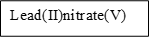
(a) Using Lead(II) nitrate(V)
I. To about 5 cm3 of a salt solution in a test tube add four drops of Lead(II) nitrate(V) solution. Preserve.
| Observation | Inference |
|---|---|
| White precipitate/ppt | SO42-, SO32-, CO32-, Cl– ions |
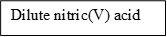
II. To the preserved sample in (I) above, add six drops of 2M nitric(V) acid. Preserve.
Observation 1
| Observation | Inference |
|---|---|
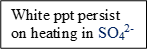
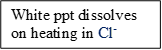
| White precipitate/ppt persists | SO42-, Cl– ions |
Observation 2
| Observation | Inference |
|---|---|
| White precipitate/ppt dissolves | SO32-, CO32- ions |
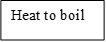
III. (a) To the preserved sample observation 1 in (II) above, heat to boil.
Observation 1
| Observation | Inference |
|---|---|
| White precipitate/ppt persists on boiling | SO42- ions |
Observation 2
| Observation | Inference |
|---|---|
| White precipitate/ppt dissolves on boiling | Cl– ions |
(b) To the preserved sample observation 2 in (II) above, add 4 drops of acidified potassium manganate(VII)/dichromate(VI).
Observation 1
| Observation | Inference |
|---|---|
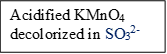
| (i) Acidified potassium manganate(VII) decolorized | SO32- ions |
| (ii) Orange colour of acidified potassium dichromate(VI) turns to green |
Observation 2
| Observation | Inference |
|---|---|
| (i) Acidified potassium manganate(VII) not decolorized | CO32- ions |
| (ii) Orange colour of acidified potassium dichromate(VI) does not turn to green |
Explanations
Using Lead(II) nitrate(V)
(i) Lead(II) nitrate(V) solution reacts with chlorides (Cl–), sulphate (VI) salts (SO42-), sulphite (IV) salts (SO32-), and carbonates (CO32-) to form the insoluble white precipitate of Lead(II) chloride, Lead(II) sulphate(VI), Lead(II) sulphite(IV), and Lead(II) carbonate(IV).
Chemical/ionic equations:
Pb2+(aq) + Cl–(aq) → PbCl2(s)
Pb2+(aq) + SO42-(aq) → PbSO4(s)
Pb2+(aq) + SO32-(aq) → PbSO3(s)
Pb2+(aq) + CO32-(aq) → PbCO3(s)
(ii) When the insoluble precipitates are acidified with nitric(V) acid:
- Lead(II) chloride and Lead(II) sulphate(VI) do not react with the acid and thus their white precipitates remain/persist.
- Lead(II) sulphite(IV) and Lead(II) carbonate(IV) react with the acid to form soluble Lead(II) nitrate(V) and produce/effervesce/fizz/bubble out sulphur(IV) oxide and carbon(IV) oxide gases respectively.
Chemical/ionic equations:
PbSO3(s) + 2H+(aq) → H2O(l) + Pb2+(aq) + SO2(g)
PbCO3(s) + 2H+(aq) → H2O(l) + Pb2+(aq) + CO2(g)
(iii) When Lead(II) chloride and Lead(II) sulphate(VI) are heated/warmed:
- Lead(II) chloride dissolves in hot water/on boiling (recrystallizes on cooling).
- Lead(II) sulphate(VI) does not dissolve in hot water; thus, its white precipitate persists/remains on heating/boiling.
(iv) When sulphur(IV) oxide and carbon(IV) oxide gases are produced:
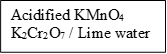
- Sulphur(IV) oxide will decolorize acidified potassium manganate(VII) and/or orange colour of acidified potassium dichromate(VI) will turn to green. Carbon(IV) oxide will not.
Chemical equations:
5SO32-(aq) + 2MnO4–(aq) + 6H+(aq) → 5SO42-(aq) + 2Mn2+(aq) + 3H2O(l)
3SO32-(aq) + Cr2O72-(aq) + 8H+(aq) → 3SO42-(aq) + 2Cr3+(aq) + 4H2O(l)
Carbon(IV) oxide forms an insoluble white precipitate of calcium carbonate if three drops of lime water are added into the reaction test tube when effervescence is taking place. Sulphur(IV) oxide will not.
Chemical equation:
Ca(OH)2(aq) + CO2(g) → CaCO3(s) + H2O(l)
These tests should be done immediately after acidifying to ensure the gases produced react with the oxidizing agents/lime water.
Using Barium(II) nitrate(V)/ Barium(II) chloride
(i) Barium(II) nitrate(V) and/or Barium(II) chloride solution reacts with sulphate (VI) salts (SO42-), sulphite (IV) salts (SO32-), and carbonates (CO32-) to form the insoluble white precipitate of Barium(II) sulphate(VI), Barium(II) sulphite(IV), and Barium(II) carbonate(IV).
Chemical/ionic equations:
Ba2+(aq) + SO42-(aq) → BaSO4(s)
Ba2+(aq) + SO32-(aq) → BaSO3(s)
Ba2+(aq) + CO32-(aq) → BaCO3(s)
(ii) When the insoluble precipitates are acidified with nitric(V) acid:
- Barium(II) sulphate(VI) does not react with the acid and thus its white precipitate remains/persists.
- Barium(II) sulphite(IV) and Barium(II) carbonate(IV) react with the acid to form soluble Barium(II) nitrate(V) and produce/effervesce/fizz/bubble out sulphur(IV) oxide and carbon(IV) oxide gases respectively.
Chemical/ionic equations:
BaSO3(s) + 2H+(aq) → H2O(l) + Ba2+(aq) + SO2(g)
BaCO3(s) + 2H+(aq) → H2O(l) + Ba2+(aq) + CO2(g)
(iii) When sulphur(IV) oxide and carbon(IV) oxide gases are produced:
- Sulphur(IV) oxide will decolorize acidified potassium manganate(VII) and/or orange colour of acidified potassium dichromate(VI) will turn to green. Carbon(IV) oxide will not.
Chemical equations:
5SO32-(aq) + 2MnO4–(aq) + 6H+(aq) → 5SO42-(aq) + 2Mn2+(aq) + 3H2O(l)
3SO32-(aq) + Cr2O72-(aq) + 8H+(aq) → 3SO42-(aq) + 2Cr3+(aq) + 4H2O(l)
Carbon(IV) oxide forms an insoluble white precipitate of calcium carbonate if three drops of lime water are added into the reaction test tube when effervescence is taking place. Sulphur(IV) oxide will not.
Chemical equation:
Ca(OH)2(aq) + CO2(g) → CaCO3(s) + H2O(l)
These tests should be done immediately after acidifying to ensure the gases produced react with the oxidizing agents/lime water.
Summary test for Sulphate (VI) (SO42-) and Sulphite (IV) (SO32-) salts
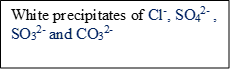
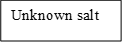
Practice revision question
1. Study the flow chart below and use it to answer the questions that follow
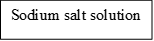
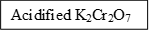
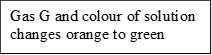

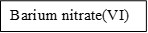
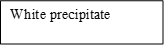

(a) Identify the:
- I: Sodium salt solution – Sodium sulphite (IV) / Na2SO3
- II: White precipitate – Barium sulphite (IV) / BaSO3
- III: Gas G – Sulphur (IV) Oxide / SO2
- IV: Colourless solution H – Barium chloride / BaCl2
(b) Write an ionic equation for the formation of:
- I. White precipitate
Ionic equation: Ba2+(aq) + SO32-(aq) → BaSO3(s)
- II. Gas G
Ionic equation: BaSO3(s) + 2H+(aq) → SO2(g) + H2O(l) + Ba2+(aq)
- III. Green solution from the orange solution
3SO32-(aq) + Cr2O72-(aq) + 8H+(aq) → 3SO42-(aq) + 2Cr3+(aq) + 4H2O(l)
(Orange) (green)
2. Study the flow chart below and answer the questions that follow.
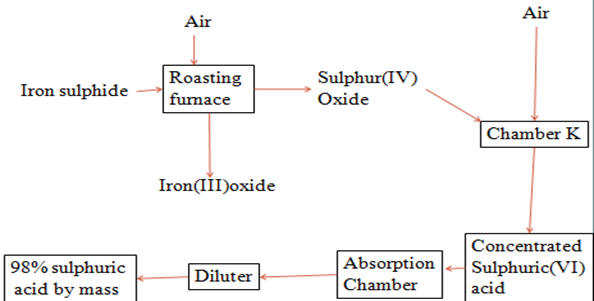
(i) Write equation for the reaction taking place at:
I. The roasting furnace (1 mark)
2FeS2(s) + 5O2(g) → 2FeO(s) + 4SO2(g)
II. The absorption tower (1 mark)
H2SO4(l) + SO3(g) → H2S2O7(l)
III. The diluter (1 mark)
H2S2O7(l) + H2O(l) → 2H2SO4(l)
(ii) The reaction taking place in chamber K is:
SO2(g) + 1/2 O2(g) → SO3(g)
I. Explain why it is necessary to use excess air in chamber K
To ensure all the SO2 reacts.
II. Name another substance used in chamber K
Vanadium(V) oxide.
3. (a) Describe a chemical test that can be used to differentiate between sodium sulphite (IV) and sodium sulphate (VI).
Add acidified Barium nitrate(V)/chloride.
White precipitate formed with sodium sulphate (VI).
No white precipitate formed with sodium sulphite (IV).
(b) Calculate the volume of sulphur (IV) oxide formed when 120 kg of copper is reacted with excess concentrated sulphuric(VI) acid. (Cu = 63.5, 1 mole of a gas at s.t.p = 22.4 dm3)
Chemical equation:
Cu(s) + 2H2SO4(l) → CuSO4(aq) + H2O(l) + SO2(g)
Mole ratio Cu : SO2 = 1 : 1
Method 1
1 mole Cu = 63.5 g → 1 mole SO2 = 22.4 dm3
(120 × 1000) g → (120 × 1000) × 22.4 / 63.5 dm3
= 42330.71 dm3
Method 2
Moles of Cu = (120 × 1000) / 63.5 = 1889.76 moles
Moles SO2 = Moles of Cu = 1889.76 moles
Volume of SO2 = Moles × molar gas volume = 1889.76 × 22.4 = 42330.71 dm3
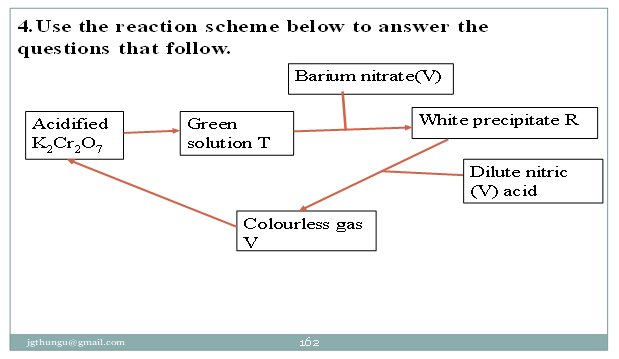
(a) Identify the:
(i) Cation responsible for the green solution T
Cr3+
(ii) Possible anions present in white precipitate R
CO32-, SO32-, SO42-
(b) Name gas V
Sulphur (IV) oxide
(c) Write a possible ionic equation for the formation of white precipitate R.
Ba2+(aq) + CO32-(aq) → BaCO3(s)
Ba2+(aq) + SO32-(aq) → BaSO3(s)
Ba2+(aq) + SO4


