

Chemistry of Nitrogen
A. Nitrogen
a) Occurrence:
Nitrogen is found in the atmosphere, occupying about 78% by volume of air. It is a major component of the Earth’s atmosphere and plays a vital role in the environment.
Proteins, amino acids, and polypeptides in living things contain nitrogen, making it essential for life processes such as growth and repair.
b) Isolation of nitrogen from the air
Nitrogen can be isolated from other gases present in air such as oxygen, water vapor, carbon (IV) oxide, and noble gases in the school laboratory as shown in the flow chart below:

Water is added slowly into an “empty flask,” which forces the air out into another flask containing concentrated sulphuric (VI) acid. Concentrated sulphuric (VI) acid is hygroscopic, meaning it absorbs/removes water present in the air sample.
More water forces the air into a flask containing either concentrated sodium hydroxide or potassium hydroxide solution. These alkalis react with carbon (IV) oxide to form carbonates, thus absorbing/removing carbon (IV) oxide from the air sample.
Chemical equations:
2NaOH (aq) + CO2 (g) → Na2CO3 (aq) + H2O (l)
2KOH (aq) + CO2 (g) → K2CO3 (aq) + H2O (l)
More water forces the air through a glass tube packed with copper turnings. Heated brown copper turnings react with oxygen to form black copper (II) oxide.
Chemical equation:
2Cu (s) + O2 (g) → 2CuO (s)
(brown) (black)
The remaining gas mixture is collected by upward delivery or downward displacement of water. It contains about 99% nitrogen and 1% noble gases.
On a large scale for industrial purposes, nitrogen is obtained from fractional distillation of air.
c) Nitrogen from fractional distillation of air
For commercial purposes, nitrogen is obtained from the fractional distillation of air. The process involves several steps to purify and separate nitrogen from other gases.
Air is first passed through a dust precipitator or filter to remove dust particles.
The air is then bubbled through either concentrated sodium hydroxide or potassium hydroxide solution to remove carbon (IV) oxide gas.
Chemical equations:
2NaOH (aq) + CO2 (g) → Na2CO3 (aq) + H2O (l)
2KOH (aq) + CO2 (g) → K2CO3 (aq) + H2O (l)
The air mixture is then cooled to -25oC. At this temperature, water vapor liquefies and then solidifies to ice, which is removed.
The air is further cooled to -200oC, forming a blue liquid.
The liquid is then heated. Nitrogen, with a boiling point of -196oC, distills first, followed by Argon at -186oC, and finally Oxygen at -183oC.

d) School laboratory preparation of Nitrogen
The diagram below shows the setup for the school laboratory preparation of nitrogen gas.

e) Properties of Nitrogen gas (Questions)
- Write the equation for the reaction for the school laboratory preparation of nitrogen gas.
Chemical equations:
NH4Cl (s) + NaNO2 (s) → NaCl (s) + NH4NO2 (s)
NH4NO2 (s) → N2 (g) + 2H2O (l)
- State three physical properties of nitrogen gas.
- Colourless and odourless.
- Less dense than air.
- Neutral and slightly soluble in water.
- State and explain the observation made when a burning magnesium ribbon is lowered in a gas jar containing nitrogen gas.
Observation: The magnesium continues burning with a bright, blinding flame, forming white ash.
Explanation: Magnesium burns with enough heat to react with nitrogen, forming white magnesium nitride.
Chemical equation:
3Mg (s) + N2 (g) → Mg3N2 (s)
(white ash/solid)
- State two main uses of nitrogen gas.
- Manufacture of ammonia via the Haber process.
- Used as a refrigerant in the storage of semen for artificial insemination.
B. Oxides of Nitrogen
Nitrogen forms three main oxides:
- Nitrogen(I) oxide (N2O)
- Nitrogen(II) oxide (NO)
- Nitrogen(IV) oxide (NO2)
i) Nitrogen (I) oxide (N2O)
a) Occurrence
Nitrogen (I) oxide does not occur naturally but is prepared in a laboratory.
b) Preparation
The setup below shows the apparatus used to prepare Nitrogen (I) oxide in a school laboratory.

c) Properties of nitrogen (I) oxide (Questions)
- Write the equation for the reaction for the school laboratory preparation of Nitrogen (I) oxide.
Chemical equation:
NH4NO2 (s) → H2O (l) + N2O (g)
- a) State and explain three errors made in the above setup.
- Oxygen is being generated instead of Nitrogen (I) oxide.
- Ammonium nitrate (V) should be used instead of potassium manganate (VI) and manganese (IV) oxide.
- b) State three physical properties of Nitrogen (I) oxide.
- Slightly soluble in water.
- Colourless.
- Odourless.
- Less dense than air.
- Slightly sweet smell.
- State and explain the observation made when a burning magnesium ribbon is lowered in a gas jar containing Nitrogen (I) oxide.
Observation: Continues to burn with a bright flame; white solid/residue is formed.
Explanation: Magnesium burns with enough heat to split Nitrogen (I) oxide into nitrogen and oxygen, then continues to burn in oxygen to form white magnesium oxide.
Chemical equation:
Mg (s) + N2O (g) → MgO (s) + N2 (g)
- State and explain the observation made when the following non-metals are burnt then lowered in a gas jar containing Nitrogen (I) oxide.
a) Carbon/charcoal
Observation: Continues to burn with an orange glow; colourless gas is formed that produces a white precipitate with lime water.
Explanation: Carbon burns with enough heat to split Nitrogen (I) oxide into nitrogen and oxygen, then continues to burn in oxygen to form carbon (IV) oxide gas, which reacts with lime water to form a white precipitate.
Chemical equation:
C (s) + 2N2O (g) → CO2 (g) + 2N2 (g)
b) Sulphur powder
Observation: Continues to burn with a blue flame; colourless gas is formed that turns orange acidified potassium dichromate (VI) to green.
Explanation: Sulphur burns with enough heat to split Nitrogen (I) oxide into nitrogen and oxygen, then continues to burn in oxygen to form sulphur (IV) oxide gas, which reduces orange acidified potassium dichromate (VI) to green.
Chemical equation:
S (s) + 2N2O (g) → SO2 (g) + 2N2 (g)
- State two uses of nitrogen (I) oxide.
- Used as laughing gas because as an anaesthetic the patient regains consciousness laughing hysterically after surgery.
- Improves engine efficiency.
- State three differences between nitrogen (I) oxide and oxygen.
- Oxygen is odourless, while nitrogen (I) oxide has a faint sweet smell.
- Both relight a glowing wooden splint, but oxygen can relight a feeble glowing splint, while nitrogen (I) oxide relights a well-lit splint.
- Both are slightly soluble in water, but nitrogen (I) oxide is more soluble.
ii) Nitrogen (II) oxide (NO)
a) Occurrence
Nitrogen (II) oxide does not occur naturally but is prepared in a laboratory.
b) Preparation
The setup below shows the apparatus used to prepare Nitrogen (II) oxide in a school laboratory.

c) Properties of nitrogen (II) oxide (Questions)
- Write the equation for the reaction for the school laboratory preparation of Nitrogen (II) oxide.
Chemical equations:
- 3Cu (s) + 8HNO3 (aq) → 4H2O (l) + 2NO (g) + 2Cu(NO3)2 (aq)
- 3Zn (s) + 8HNO3 (aq) → 4H2O (l) + 2NO (g) + 2Zn(NO3)2 (aq)
- 3Mg (s) + 8HNO3 (aq) → 4H2O (l) + 2NO (g) + 2Mg(NO3)2 (aq)
- State three physical properties of Nitrogen (II) oxide.
- Insoluble in water.
- Colourless.
- Odourless.
- Denser than air.
- Has no effect on both blue and red litmus papers.
- State and explain the observation made when a burning magnesium ribbon is lowered in a gas jar containing Nitrogen (II) oxide.
Observation: Continues to burn with a bright flame; white solid/residue is formed.
Explanation: Magnesium burns with enough heat to split Nitrogen (II) oxide into nitrogen and oxygen, then continues to burn in oxygen to form white magnesium oxide.
Chemical equation:
2Mg (s) + 2NO (g) → 2MgO (s) + N2 (g)
- State and explain the observation made when the following non-metals are burnt then lowered in a gas jar containing Nitrogen (II) oxide.
a) Carbon/charcoal
Observation: Continues to burn with an orange glow; colourless gas is formed that produces a white precipitate with lime water.
Explanation: Carbon burns with enough heat to split Nitrogen (II) oxide into nitrogen and oxygen, then continues to burn in oxygen to form carbon (IV) oxide gas, which reacts with lime water to form a white precipitate.
Chemical equation:
C (s) + 2NO (g) → CO2 (g) + N2 (g)
b) Sulphur powder
Observation: Continues to burn with a blue flame; colourless gas is formed that turns orange acidified potassium dichromate (VI) to green.
Explanation: Sulphur burns with enough heat to split Nitrogen (II) oxide into nitrogen and oxygen, then continues to burn in oxygen to form sulphur (IV) oxide gas, which reduces orange acidified potassium dichromate (VI) to green.
Chemical equation:
S (s) + N2O (g) → SO2 (g) + N2 (g)
c) Phosphorus
Observation: Continues to produce dense white fumes.
Explanation: Phosphorus burns with enough heat to split Nitrogen (II) oxide into nitrogen and oxygen, then continues to burn in oxygen to form dense white fumes of phosphorus (V) oxide gas.
Chemical equation:
4P (s) + 10NO (g) → 2P2O5 (g) + 5N2 (g)
- State one use of nitrogen (II) oxide.
Used as an intermediate gas in the Ostwald process for the manufacture of nitric (V) acid.
- State and explain the observation made when nitrogen (II) oxide is exposed to the atmosphere.
Observation: Brown fumes are produced that turn blue litmus paper red.
Explanation: Nitrogen (II) oxide gas on exposure to air is quickly oxidized by oxygen to brown nitrogen (IV) oxide gas, which is acidic.
Chemical equation:
2NO (g) + O2 (g) → 2NO2 (g)
(colourless) (brown)
iii) Nitrogen (IV) oxide (NO2)
a) Occurrence
- Occurs naturally from active volcanic areas.
- Formed from incomplete combustion of motor vehicle exhaust fumes.
- Produced by lightning.
b) Preparation
The setup below shows the apparatus used to prepare Nitrogen (IV) oxide in a school laboratory.

c) Properties of nitrogen (IV) oxide (Questions)
- Write the equation for the reaction for the school laboratory preparation of Nitrogen (IV) oxide.
Chemical equations:
- Cu (s) + 4HNO3 (aq) → 2H2O (l) + 2NO2 (g) + Cu(NO3)2 (aq)
- Zn (s) + 4HNO3 (aq) → 2H2O (l) + 2NO2 (g) + Zn(NO3)2 (aq)
- Fe (s) + 4HNO3 (aq) → 2H2O (l) + 2NO2 (g) + Fe(NO3)2 (aq)
- State three physical properties of Nitrogen (IV) oxide.
- Soluble in water.
- Brown in colour.
- Has a pungent, irritating, poisonous odour.
- Denser than air.
- Turns blue litmus paper red.
- State and explain the observation made when Nitrogen (IV) oxide gas is bubbled in water.
Observation: The gas dissolves, the brown colour fades, and a colourless solution is formed. The solution turns blue litmus paper red but has no effect on red litmus paper.
Explanation: Nitrogen (IV) oxide dissolves and reacts with water to form an acidic mixture of nitric (V) acid and nitric (III) acid.
Chemical equation:
H2O (l) + 2NO2 (g) → HNO3 (aq) + HNO2 (aq)
(nitric (V) acid) (nitric (III) acid)
- State and explain the observation made when a test tube containing Nitrogen (IV) oxide is cooled then heated gently then strongly.
Observation on cooling: Brown colour fades; yellow liquid formed.
Observation on gentle heating: Brown colour reappears; yellow liquid changes to brown fumes/gas.
Observation on strong heating: Brown colour fades; brown fumes/gas changes to a colourless gas.
Explanation: Brown nitrogen (IV) oxide gas liquefies easily to yellow dinitrogen tetraoxide liquid. Gentle heating converts the yellow liquid back to brown nitrogen (IV) oxide gas. Strong heating decomposes brown nitrogen (IV) oxide gas to a colourless mixture of nitrogen (II) oxide gas and oxygen.
Chemical equation:
O2 (s) + 2NO (g) ⇌ 2NO2 (g) ⇌ N2O4 (l)
(colourless gases) (brown gas) (yellow liquid)
- State and explain the observation made when a burning magnesium ribbon is lowered in a gas jar containing Nitrogen (IV) oxide.
Observation: Continues to burn with a bright flame; white solid/residue is formed; brown fumes/colour fades.
Explanation: Magnesium burns with enough heat to split brown nitrogen (IV) oxide gas into colourless nitrogen and oxygen, then continues to burn in oxygen to form white magnesium oxide.
Chemical equation:
4Mg (s) + 2NO2 (g) → 4MgO (s) + N2 (g)
- State and explain the observation made when the following non-metals are burnt then lowered in a gas jar containing Nitrogen (IV) oxide.
a) Carbon/charcoal
Observation: Continues to burn with an orange glow; brown fumes/colour fades; colourless gas is formed that produces a white precipitate with lime water.
Explanation: Carbon burns with enough heat to split brown nitrogen (IV) oxide gas into colourless nitrogen and oxygen, then continues to burn in oxygen to form carbon (IV) oxide gas, which reacts with lime water to form a white precipitate.
Chemical equation:
2C (s) + 2NO2 (g) → 2CO2 (g) + N2 (g)
b) Sulphur powder
Observation: Continues to burn with a blue flame; brown fumes/colour fades; colourless gas is formed that turns orange acidified potassium dichromate (VI) to green.
Explanation: Sulphur burns with enough heat to split brown nitrogen (IV) oxide gas into colourless nitrogen and oxygen, then continues to burn in oxygen to form sulphur (IV) oxide gas, which reduces orange acidified potassium dichromate (VI) to green.
Chemical equation:
2S (s) + 2NO2 (g) → 2SO2 (g) + N2 (g)
c) Phosphorus
Observation: Continues to produce dense white fumes; brown fumes/colour fades.
Explanation: Phosphorus burns with enough heat to split brown nitrogen (IV) oxide gas into colourless nitrogen and oxygen, then continues to burn in oxygen to form dense white fumes of phosphorus (V) oxide gas.
Chemical equation:
8P (s) + 10NO2 (g) → 4P2O5 (g) + 5N2 (g)
- State two uses of nitrogen (IV) oxide.
- Used in the Ostwald process for industrial manufacture of nitric (V) acid.
- Used in the manufacture of TNT explosives.
- State and explain the observation made when nitrogen (II) oxide is exposed to the atmosphere.
Observation: Brown fumes are produced that turn blue litmus paper red.
Explanation: Nitrogen (II) oxide gas on exposure to air is quickly oxidized by oxygen to brown nitrogen (IV) oxide gas, which is acidic.
Chemical equation:
2NO (g) + O2 (g) → 2NO2 (g)
(colourless) (brown)
C. Ammonia (NH3)
Ammonia is a compound of nitrogen and hydrogen only. It is therefore a hydride of nitrogen.
a) Occurrence
- Ammonia gas occurs naturally from the urine of mammals and excretion of birds.
- It is formed in the kidney of human beings as part of nitrogen metabolism.
b) Preparation
The setup below shows the apparatus used to prepare dry ammonia gas in a school laboratory.
Set up method 1

1. Write the equation for the reaction taking place in:
- Method 1
Chemical equation:
Ca(OH)2 (s) + 2NH4Cl (s) → CaCl2 (aq) + 2H2O (l) + 2NH3 (g)
b) Method 2
Chemical equation:
NaOH (aq) + NH4Cl (aq) → NaCl (aq) + H2O (l) + NH3 (g)
2. State three physical properties of ammonia.
- Has a pungent, choking smell similar to urine.
- Colourless.
- Less dense than air; hence collected by upward delivery.
- Turns blue litmus paper blue; it is the only naturally occurring basic gas at this level.
3. Calcium oxide is used as the drying agent. Explain why calcium chloride and concentrated sulphuric (VI) acid cannot be used to dry the gas.
- Calcium chloride reacts with ammonia forming the complex compound CaCl2.8NH3.
- Chemical equation: CaCl2 (s) + 8NH3 (g) → CaCl2.8NH3 (g)
- Concentrated sulphuric (VI) acid reacts with ammonia forming ammonium sulphate (VI) salt.
- Chemical equation: 2NH3 (g) + H2SO4 (l) → (NH4)2SO4 (aq)
4. Describe the test for the presence of ammonia gas.
Using litmus paper:
Dip moist blue and red litmus papers in a gas jar containing a gas suspected to be ammonia. The blue litmus paper remains blue, and the red litmus paper turns blue. Ammonia is the only basic gas at this level.
Using hydrogen chloride gas:
Dip a glass rod in concentrated hydrochloric acid. Bring the glass rod near the mouth of a gas jar suspected to contain ammonia. White fumes of ammonium chloride are produced.
5. Describe the fountain experiment to show the solubility of ammonia.
Ammonia is very soluble in water.
When a drop of water is introduced into a flask containing ammonia, it dissolves all the ammonia in the flask. If water is subsequently allowed into the flask through a small inlet, atmospheric pressure forces it very fast to occupy the vacuum, forming a fountain. If the water contains a few drops of litmus solution, the litmus solution turns blue because ammonia is an alkaline/basic gas. If the water contains a few drops of phenolphthalein indicator, the indicator turns pink because ammonia is alkaline/basic. Sulphur (IV) oxide and hydrogen chloride gas can also produce the fountain experiment. If the water contains phenolphthalein, the indicator turns colourless because both sulphur (IV) oxide and hydrogen chloride gas are acidic gases.

6. State and explain the observation made when hot platinum/nichrome wire is placed over concentrated ammonia solution with oxygen gas bubbled into the mixture.
Observations:
- Hot platinum/nichrome wire continues to glow red hot.
- Brown fumes of a gas are produced.
Explanation:
Ammonia reacts with oxygen on the surface of the wire. This exothermic reaction produces enough heat to keep the platinum wire glowing red hot. Ammonia is oxidized to nitrogen (II) oxide gas and water. The wire acts as a catalyst to speed up the reaction. Nitrogen (II) oxide gas is further oxidized to brown nitrogen (IV) oxide gas on exposure to air.
Chemical equations:
4NH3 (g) + 5O2 (g) —Pt→ 4NO (g) + 6H2O (l)
2NO (g) + O2 (g) → 2NO2 (g)
7. Ammonia gas was ignited in air enriched with oxygen gas. State and explain the observations made.
Observations:
- Ammonia gas burns with a green flame.
- Colourless gas produced.
Explanation:
Ammonia gas burns with a green flame in oxygen-enriched air to form nitrogen gas and water.
Chemical equation:
2NH3 (g) + O2 (g) → N2 (g) + 3H2O (l)
8. Dry ammonia was passed through heated copper(II) oxide as in the setup below.

(a) State the observations made in tube K
- Colour changes from black to brown.
- Colourless liquid droplets form on the cooler parts of tube K.
(b)(i) Identify liquid L.
Water (H2O (l))
(ii) Explain a chemical and physical test that can be used to identify liquid L.
Chemical test:
- Add a few drops of liquid L into anhydrous copper(II) sulphate (VI). Colour changes from white to blue.
- Explanation: Water hydrates white anhydrous copper(II) sulphate (VI) to blue hydrated copper(II) sulphate (VI).
- Add a few drops of liquid L into anhydrous cobalt(II) chloride. Colour changes from blue to pink.
- Explanation: Water hydrates blue anhydrous cobalt(II) chloride to pink hydrated cobalt(II) chloride.
Physical test:
- Heat the liquid. It boils at 100oC at sea level (1 atmosphere pressure).
- Cool the liquid. It freezes at 0.0oC.
- Determine the density. It is 1.0 g cm-3.
(c) Write the equation for the reaction that takes place.
2NH3 (g) + 3CuO (s) → N2 (g) + 3H2O (l) + 3Cu (s)
(black) (brown)
2NH3 (g) + 3PbO (s) → N2 (g) + 3H2O (l) + 3Pb (s)
(brown when hot) (grey)
8.(a) What is aqueous ammonia?
Aqueous ammonia is formed when ammonia gas dissolves in water.
NH3 (g) + H2O (l) → NH3 (aq)
A little NH3 (aq) reacts with water to form ammonia solution (NH4OH).
NH3 (aq) + H2O (l) → OH– (aq) + NH4+ (aq)
This makes aqueous ammonia a weak base/alkali, unlike other alkalis.
9. Using dot and cross to represent outer electrons show the bonding in:
(a) NH3

(b) NH4+

(c) NH4Cl

10. Name four uses of ammonia
- In the manufacture of nitrogenous fertilizers.
- In the manufacture of nitric (V) acid via Ostwald’s process.
- As a refrigerant in ships and warehouses.
- In softening hard water.
- In the Solvay process for the manufacture of sodium carbonate.
- In the removal of grease and stains.
11.(a) Calculate the percentage of Nitrogen in the following fertilizers:
(i) (NH4)2SO4
Molar mass of (NH4)2SO4 = 132 g
Mass of N in (NH4)2SO4 = 28 g
% of N = (28 / 132) × 100 = 21.21%
(ii) (NH4)3PO4
Molar mass of (NH4)3PO4 = 149 g
Mass of N in (NH4)3PO4 = 42 g
% of N = (42 / 149) × 100 = 28.19%
(b) State two advantages of fertilizer (i) over (ii) above.
- Has higher % of Nitrogen.
- Contains phosphorus, which is necessary for plant growth.
(c) Calculate the mass of Nitrogen in a 50 kg bag of:
(i) (NH4)2SO4
% of N in (NH4)2SO4 = 21.21%
Mass of N in 50 kg (NH4)2SO4 = (21.21 × 50) / 100 = 10.6 kg
(ii) NH4NO3
Molar mass of NH4NO3 = 80 g
Mass of N in NH4NO3 = 28 g
% of N = (28 / 80) × 100 = 35%
Mass of N in 50 kg NH4NO3 = (35 × 50) / 100 = 17.5 kg
NH4NO3 therefore has a higher mass of nitrogen than (NH4)2SO4.
(d) Manufacture of Ammonia / Haber process
Most industrial ammonia production uses the Haber process developed by Fritz Haber.
(i) Raw materials
The raw materials include:
- Nitrogen from fractional distillation of air.
- Hydrogen from:
- Water gas – passing steam through heated charcoal:
- Passing natural gas/methane through steam:
C (s) + H2O (g) → CO (g) + H2 (g)
CH4 (g) + H2O (g) → CO (g) + 3H2 (g)
(ii) Chemical process
Hydrogen and nitrogen are passed through a purifier to remove unwanted gases like carbon (IV) oxide, oxygen, sulphur (IV) oxide, dust, and smoke which would poison the catalyst.
Hydrogen and nitrogen are then mixed in a 3:1 ratio, compressed to 200-250 atmospheres, and heated to 400-450oC. The hot compressed gases pass over a finely divided iron catalyst promoted with Al2O3/K2O to increase efficiency.
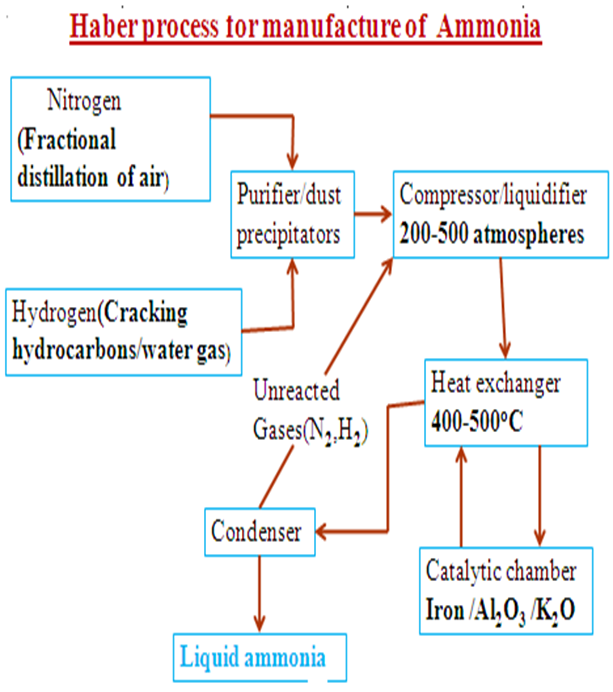

Optimum conditions in Haber process
Chemical equation:
N2 (g) + 3H2 (g) —Fe/Pt→ 2NH3 (g) ΔH = -92 kJ
Equilibrium and reaction rate considerations:
- Removing ammonia gas once formed shifts the equilibrium forward, increasing ammonia yield.
- Increasing pressure shifts equilibrium forward where there are fewer molecules, increasing yield. Very high pressures are costly; about 200 atmospheres is optimal.
- Increasing temperature shifts equilibrium backward because the reaction is exothermic, reducing yield. Very low temperatures slow the reaction rate. About 450oC is optimal.
- Iron and platinum can be used as catalysts. Platinum is better but more expensive and easily poisoned. Iron is promoted with aluminium oxide to increase surface area. Catalysts speed up the reaction but do not increase yield.
e) Nitric (V) acid (HNO3)
a) Introduction
Nitric (V) acid is one of the mineral acids, along with sulphuric (VI) acid and hydrochloric acid. Mineral acids do not occur naturally but are prepared in laboratories and manufactured industrially.
b) School laboratory preparation
Nitric (V) acid is prepared in the laboratory by reacting concentrated sulphuric (VI) acid with potassium nitrate (V).

c) Properties of Concentrated Nitric (V) acid (Questions)
- Write an equation for the school laboratory preparation of nitric (V) acid.
KNO3 (s) + H2SO4 (l) → KHSO4 (s) + HNO3 (l)
- State two reasons why potassium nitrate (V) is preferred over sodium nitrate (V) for preparation of nitric (V) acid.
- Potassium nitrate (V) is more volatile and readily displaced from less volatile concentrated sulphuric (VI) acid.
- Sodium nitrate (V) is hygroscopic and absorbs water, which dilutes the acid and causes exothermic dissolution.
- Explain why an all-glass apparatus is used during preparation.
Hot concentrated nitric (V) acid vapour is highly corrosive and attacks rubber corks.
- Explain why the prepared nitric (V) acid appears yellow.
Hot concentrated nitric (V) acid decomposes to brown nitrogen (IV) oxide and oxygen gases. The brown nitrogen (IV) oxide dissolves in the acid, forming a yellow solution.
4HNO3 (l/g) → 4NO2 (g) + H2O (l) + O2 (g)
- State and explain the observation made when concentrated nitric (V) acid is heated.
Observation: Brown fumes and colourless gas that relights a glowing splint are produced.
Explanation: Concentrated nitric (V) acid decomposes to water, brown nitrogen (IV) oxide, and oxygen gases. Oxygen relights the glowing splint.
4HNO3 (g) → 4NO2 (g) + H2O (l) + O2 (g)
- Explain the observations made when:
(a) Iron (II) sulphate (VI) solution is added to concentrated nitric (V) acid and warmed.
Observation:
- Colour changes from green to brown.
- Brown fumes produced.
Explanation: Concentrated nitric (V) acid oxidizes green Fe2+ ions to brown/yellow Fe3+ ions and is reduced to colourless nitrogen (II) oxide.
Chemical equation:
6FeSO4 (aq) + 3H2SO4 (aq) + 2HNO3 (aq) → 3Fe2(SO4)3 (aq) + 4H2O + 2NO (g)
NO is further oxidized to brown NO2 by atmospheric oxygen.
2NO (g) + O2 (g) → 2NO2 (g)
(b) Sulphur powder is added to concentrated nitric (V) acid and warmed.
Observation:
- Yellow colour of sulphur fades.
- Brown fumes produced.
Explanation: Concentrated nitric (V) acid oxidizes sulphur to sulphuric acid and is reduced to brown nitrogen (IV) oxide gas.
Chemical equation:
S (s) + 6HNO3 (l) → 4NO2 (g) + H2O (l) + H2SO4 (l)
(c) Copper turnings, zinc granules, or magnesium ribbon are added to concentrated nitric (V) acid.
Observation:
- Brown fumes produced.
- Blue solution with copper turnings.
- Colourless solution with zinc or magnesium.
Explanation: Concentrated nitric (V) acid oxidizes metals to metal nitrate salts and is reduced to brown nitrogen (IV) oxide gas.
Chemical equations:
Cu (s) + 4HNO3 (l) → 2NO2 (g) + H2O (l) + Cu(NO3)2 (aq)
Zn (s) + 4HNO3 (l) → 2NO2 (g) + H2O (l) + Zn(NO3)2 (aq)
Mg (s) + 4HNO3 (l) → 2NO2 (g) + H2O (l) + Mg(NO3)2 (aq)
Pb (s) + 4HNO3 (l) → 2NO2 (g) + H2O (l) + Pb(NO3)2 (aq)
Ag (s) + 2HNO3 (l) → NO2 (g) + H2O (l) + AgNO3 (aq)
(d) Properties of Dilute Nitric (V) acid (Questions)
(i) What is dilute nitric (V) acid?
When concentrated nitric (V) acid is mixed with a large amount of water, it becomes dilute. A dilute solution has more solvent than solute, resulting in low molarity (e.g., 0.02 M). Infinite dilution occurs when the acid is diluted as much as possible.
(ii) Observation when magnesium ribbon is placed in 0.2 M dilute nitric (V) acid.
Observation:
- Effervescence/bubbling.
- Colourless gas produced that extinguishes a burning splint with a pop sound.
- Colourless solution formed.
- Magnesium ribbon dissolves.
Explanation: Dilute nitric (V) acid reacts with magnesium to form hydrogen gas.
Chemical equation:
Mg (s) + 2HNO3 (aq) → H2 (g) + Mg(NO3)2 (aq)
Hydrogen gas is usually not prepared in school laboratories using dilute nitric (V) acid because it is rapidly oxidized to water.
(iii) Reaction of dilute nitric (V) acid with sodium hydrogen carbonate and copper (II) carbonate.
Observation:
- Effervescence/bubbling.
- Colourless gas produced that forms a white precipitate with lime water.
- Colourless solution with sodium hydrogen carbonate.
- Blue solution with copper (II) carbonate.
Explanation: Dilute nitric (V) acid reacts with carbonates and hydrogen carbonates to form carbon (IV) oxide, water, and nitrate (V) salts.
Chemical equations:
CuCO3 (s) + 2HNO3 (aq) → H2O (l) + Cu(NO3)2 (aq) + CO2 (g)
ZnCO3 (s) + 2HNO3 (aq) → H2O (l) + Zn(NO3)2 (aq) + CO2 (g)
CaCO3 (s) + 2HNO3 (aq) → H2O (l) + Ca(NO3)2 (aq) + CO2 (g)
PbCO3 (s) + 2HNO3 (aq) → H2O (l) + Pb(NO3)2 (aq) + CO2 (g)
FeCO3 (s) + 2HNO3 (aq) → H2O (l) + Fe(NO3)2 (aq) + CO2 (g)
NaHCO3 (s) + HNO3 (aq) → H2O (l) + NaNO3 (aq) + CO2 (g)
KHCO3 (s) + HNO3 (aq) → H2O (l) + KNO3 (aq) + CO2 (g)
NH4HCO3 (aq) + HNO3 (aq) → H2O (l) + NH4NO3 (aq) + CO2 (g)
Ca(HCO3)2 (aq) + 2HNO3 (aq) → 2H2O (l) + Ca(NO3)2 (aq) + 2CO2 (g)
Mg(HCO3)2 (aq) + 2HNO3 (aq) → 2H2O (l) + Mg(NO3)2 (aq) + 2CO2 (g)
(iii) Titration of 25.0 cm3 of 0.1 M Nitric (V) acid with 0.2 M sodium hydroxide using phenolphthalein indicator.
I. State the colour change at the end point
Colourless.
II. What was the pH of the solution at the end point? Explain.
pH 1/2/3. The end point is acidic because nitric (V) acid is a strong acid with low pH.
III. Calculate the number of moles of acid used.
Number of moles = molarity × volume = 0.1 × 25 / 1000 = 2.5 × 10⁻³ moles
IV. Calculate the volume of sodium hydroxide used.
Volume of sodium hydroxide in cm3 = (1000 × number of moles) / molarity = (1000 × 2.5 × 10-3) / 0.2 = 12.5 cm3
(e) Industrial large scale manufacture of Nitric (V) acid
(i) Raw materials
- Air/oxygen obtained from fractional distillation of air.
- Ammonia from Haber process.
2. Chemical processes
Air is passed through electrostatic precipitators to remove unwanted gases like nitrogen, carbon (IV) oxide, dust, and smoke which may poison the catalyst. The ammonia-air mixture is compressed to 9 atmospheres to reduce the distance between reacting gases.
The mixture is passed through heat exchangers maintaining 850-900oC.
The first reaction occurs in the catalytic chamber where ammonia reacts with air to form nitrogen (II) oxide and water.
Optimum condition in Ostwald’s process
Chemical equation:
4NH3 (g) + 5O2 (g) —Pt/Rh→ 4NO (g) + 6H2O (g) ΔH = -950 kJ
The reaction is reversible and exists in dynamic equilibrium. Factors to increase nitrogen (II) oxide yield include:
- Removing nitrogen (II) oxide gas once formed shifts equilibrium forward, increasing yield.
- Increasing pressure shifts equilibrium backward, decreasing yield. Optimum pressure is about 9 atmospheres.
- Cooling condenses water vapor to liquid.
- Increasing temperature shifts equilibrium backward, decreasing yield. Optimum temperature is about 900oC.
- Platinum catalyst promoted with rhodium and coated on asbestos increases efficiency. Catalyst speeds up reaction but does not increase yield.
Nitrogen (II) oxide is oxidized to nitrogen (IV) oxide in an oxidation chamber:
2NO (g) + O2 (g) → 2NO2 (g)
Nitrogen (IV) oxide reacts with water in the absorption chamber to form nitric (III) and nitric (V) acids:
2NO2 (g) + H2O (l) → HNO2 (aq) + HNO3 (aq)
Excess air oxidizes nitric (III) acid to nitric (V) acid:
O2 (g) + 2HNO2 (aq) → 2HNO3 (aq)
Overall reaction in absorption chamber:
O2 (g) + 4NO2 (g) + 2H2O (l) → 4HNO3 (aq)
The acid is 65% concentrated and can be made 100% by fractional distillation or by adding concentrated sulphuric (VI) acid to remove water.

Calculation Example
A factory uses 63.0 kg of 68% pure nitric (V) acid per day to produce ammonium fertilizer. The density of the acid is 1.42 g cm-3. Calculate:
(i) The concentration of the acid in moles per litre.
Molar mass HNO3 = 63
Method 1:
Moles of HNO3 in 1 cm3 = 1.42 / 63 = 0.0225 moles
Molarity = 0.0225 × 1000 = 22.5 moles dm-3
68% concentration = (68 × 22.5) / 100 = 15.3 M
Method 2:
Moles of HNO3 in 1000 cm3 = (1.42 × 1000) / 63 = 22.54 moles dm-3
68% concentration = (68 × 22.54) / 100 = 15.33 moles dm-3
(ii) The volume of ammonia gas at r.t.p used.
Chemical equation:
HNO3 (aq) + NH3 (g) → NH4NO3 (aq)
Mole ratio HNO3 : NH3 = 1 : 1
1 mole HNO3 produces 24 dm3 NH3 at r.t.p.
15.33 moles HNO3 produce 15.33 × 24 = 367.92 dm3 NH3
(iii) The number of crops that can be applied the fertilizer if each crop requires 4.0 g.
Chemical equation:
HNO3 (aq) + NH3 (g) → NH4NO3 (aq)
Molar mass NH4NO3 = 80 g
Mole ratio HNO3 : NH4NO3 = 1 : 1
Mass of HNO3 in 63.0 kg = 68% × 63 = 42.84 kg
42.84 × 1000 g HNO3 produces (42.84 × 1000) × 80 / 63 = 54400 g NH4NO3
Number of crops = 54400 / 4.0 = 13600 crops
E. Nitrate (V) NO3– and Nitrate (III) NO2– Salts
Nitrate (V) / NO3– and Nitrate (III) / NO2– are salts derived from nitric (V) acid (HNO3) and nitric (III) acid (HNO2). Both acids are monobasic with one ionizable hydrogen.
Only KNO2, NaNO2, and NH4NO2 exist among nitrate (III) salts. All metallic nitrate (V) salts exist.
All nitrate (V) and nitrate (III) salts are soluble in water.
(a) Effect of heat on Nitrate (V) and Nitrate (III) salts (Test for nitrate (V) ions in solid state)
1. All nitrate (III) salts are not affected by heating except ammonium nitrate (III) NH4NO2, which decomposes to nitrogen gas and water.
Chemical equation:
NH4NO2 (s) → H2O (l) + N2 (g)
This reaction is used to prepare small amounts of nitrogen in the laboratory.
2. All nitrate (V) salts decompose on strong heating:
Experiment:
Heat sodium nitrate (V) in a test tube with moist litmus papers at the mouth. Test gases with a glowing splint.
Caution: Wear safety gear. Lead (II) nitrate decomposes to lead (II) oxide, which fuses with the test tube.
Repeat with potassium nitrate (V), copper (II) nitrate (V), lead (II) nitrate (V), silver nitrate (V), zinc nitrate (V), magnesium nitrate (V), and ammonium nitrate (V).
Observations:
- Cracking sound.
- Brown fumes produced except in potassium and sodium nitrate (V).
- Glowing splint relights, but feebly in ammonium nitrate (V).
- Black residue with copper (II) nitrate (V).
- White residue with sodium, potassium, silver, and magnesium nitrates (V).
- Yellow residue when hot but white on cooling with zinc nitrate (V).
- Brown residue when hot but yellow on cooling with lead (II) nitrate (V).
Explanation:
Potassium and sodium nitrate (V) decompose to nitrate (III) salts and oxygen gas, which relights a glowing splint.
Chemical equations:
2KNO3 (s) → 2KNO2 (s) + O2 (g)
2NaNO3 (s) → 2NaNO2 (s) + O2 (g)
Heavy metal nitrate (V) salts decompose to metal oxides, brown nitrogen (IV) oxide, and oxygen gas.
Copper (II) oxide is black; zinc oxide is yellow when hot and white when cool; lead (II) oxide is yellow when cold and brown when hot.
Chemical equations:
2Cu(NO3)2 (s) → 2CuO (s) + 4NO2 (g) + O2 (g)
2Ca(NO3)2 (s) → 2CaO (s) + 4NO2 (g) + O2 (g)
2Zn(NO3)2 (s) → 2ZnO (s) + 4NO2 (g) + O2 (g)
2Mg(NO3)2 (s) → 2MgO (s) + 4NO2 (g) + O2 (g)
2Pb(NO3)2 (s) → 2PbO (s) + 4NO2 (g) + O2 (g)
2Fe(NO3)2 (s) → 2FeO (s) + 4NO2 (g) + O2 (g)
Silver nitrate (V) and mercury (II) nitrate decompose to metal and a mixture of brown nitrogen (IV) oxide and oxygen gases.
Chemical equations:
2AgNO3 (s) → 2Ag (s) + 2NO2 (g) + O2 (g)
Hg(NO3)2 (s) → Hg (l) + 2NO2 (g) + O2 (g)
Evolution of brown nitrogen (IV) oxide fumes on heating confirms the presence of nitrate (V) ions in heavy metal salts.
(b) Brown ring test (Test for nitrate (V) ions in aqueous solution)
Experiment:
Place 5 cm3 of potassium nitrate (V) solution in a test tube. Add 8 drops of freshly prepared iron (II) sulphate (VI) solution and swirl. Carefully add 5 cm3 concentrated sulphuric (VI) acid down the side of the test tube without shaking.
Caution: Concentrated sulphuric (VI) acid is highly corrosive.
Observation:
- Two layers form.
- A brown ring forms at the interface.

Explanation:
Nitrate (V) salts are soluble and mix with iron (II) sulphate (VI) solution. Concentrated sulphuric (VI) acid, being denser, settles at the bottom. At the interface, nitrate (V) ions react to form nitric (V) acid, which is reduced by iron (II) sulphate to nitrogen (II) oxide, forming the brown nitroso-iron (II) sulphate complex (FeSO4.NO), which forms the brown ring.
Chemical equation:
FeSO4 (aq) + NO (g) → FeSO4.NO (aq)
The brown ring disappears if shaken because heat decomposes the complex back to iron (II) sulphate and nitrogen (II) oxide.
Chemical equation:
FeSO4.NO (aq) → FeSO4 (aq) + NO (g)
Freshly prepared iron (II) sulphate solution is required because it oxidizes easily to iron (III) sulphate on exposure to air.
(c) Devarda’s alloy test (Test for nitrate (V) ions in aqueous solution)
Experiment:
Place 5 cm3 of potassium nitrate (V) solution in a test tube. Add 5 drops of sodium hydroxide solution and swirl. Add aluminium foil and heat. Test any gases produced with blue and red litmus papers.
Observation and Inference:
- Effervescence/bubbling.
- Colourless gas with pungent smell of ammonia.
- Blue litmus paper remains blue.
- Red litmus paper turns blue.
Explanation:
The Devarda’s alloy test, developed by Arturo Devarda, confirms nitrate (V) ions by producing ammonia gas when nitrate reacts with sodium hydroxide and aluminium foil.


