

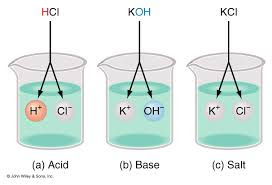
ACIDS, BASES AND SALT
BASE
A base is a substance that contains the oxide ion or hydroxide ion and reacts with acid to give salt and water only.

Or
A base is a soluble substance that accepts a proton.

A soluble base is called an alkali.
The alkalis are:

The solution of Ca(OH)2 in water is called lime water.

Magnesium hydroxide (milk of magnesia) Mg(OH)2 is also sparingly soluble.
The soluble bases, when in solution, produce OH– as their only negative ion.

PROPERTIES OF BASES
- Alkalis have a soapy feeling (slippery).
- Alkalis have a bitter taste.
- Alkalis turn red litmus paper blue.
- They react with acids to form salt and water only.
- Alkalis yield ammonia when warmed with ammonium salts.
Question: Which bases combine to form NaCl?

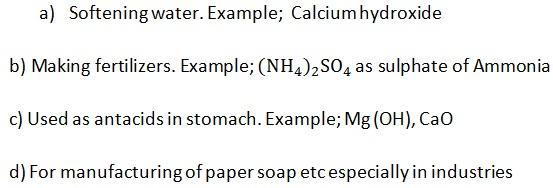
USES OF BASES
QUESTION:
Calculate the percentage of hydrogen in the compound HCl.
H + Cl
1 + 35.5 = 36.5 (atomic masses)
H% = (1 / 36.5) × 100%
Cl% = (35.5 / 36.5) × 100%
What kind of equation is this?

Answer: Special case reaction.
ACIDS
These are substances which, when in solution, produce hydrogen ions as their only positive ions.

An acid is a substance which turns blue litmus red and contains hydrogen replaceable by a metal.
TYPES OF ACIDS
There are two types of acids:
- Mineral acids
- Organic acids
A: Mineral Acids
These are derived from substances formed from minerals.
| Acid | Formula | Source | Formula |
|---|---|---|---|
| Hydrochloric acid | HCl | Common salt | NaCl |
| Sulphuric acid | H2SO4 | Sulphur | S |
| Nitric acid | HNO3 | Chilean salt petre | NaNO3 |
| Carbonic acid | H2CO3 | Limestone | CaCO3 |
The mineral salts that can be derived from the oxides are called oxy-acids (from the acidic/non-metal oxides).
B. Organic Acids
These are derived from plant and animal sources.
| Acid | Source |
|---|---|
| Lactic acid | Sour milk |
| Acetic acid | Vinegar |
| Tartaric acid | Grapes |
| Citric acid | Citrus fruits |
STRENGTH OF ACIDS
Strength of acids is classified into two:
- Strong acids
- Weak acids
STRONG ACIDS
These are acids which ionize completely in aqueous solution.

WEAK ACIDS
These are acids which ionize partially in aqueous solution.

All organic acids are weak.
QUESTION
Is phosphoric acid a strong or weak acid? What are strong bases or weak bases?
PROPERTIES OF ACIDS
- Have sour taste.
- Action on indicators.
Indicator is a substance which changes color in acids or bases.
Example: litmus, methyl orange, phenolphthalein, etc.
| Indicators | Color in acids | Color in alkali |
|---|---|---|
| Methyl orange | Pink | Yellow |
| Phenolphthalein | Colorless | Pink |
| Bromothymol blue | Yellow | Blue |
| Litmus | Red | Blue |
- Corrosive action: A concentrated acid is a water molecule aspirant. Acid dries any substance of water content in vigorous action, thus burns skin of animals, leaves, and stems of plants.

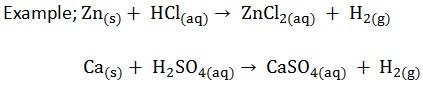
- Action with metal: Any metal which is above hydrogen in the activity series will replace hydrogen from the acid. The products of these reactions are salt and hydrogen gas.

- Action with metal oxides and hydroxides to form salt and water only.

- Action with carbonates and hydrogen carbonates (bicarbonates): Acids react with carbonates and bicarbonates producing salt, water, and CO2.

- Action with sulphates: When acids react with sulphates, SO2, water, and salts are produced.

BASICITY OF ACIDS
The basicity of an acid is the number of hydrogen ions (H+) produced by one mole of an acid in aqueous solution.


NB: All organic acids are monobasic.
PH SCALE
It isn’t possible to know exactly how strong an acid or base is by using indicators. The term pH is used to describe or show the exact strength of an acid or base. It shows the number of hydrogen ion concentration.
The pH scale can be represented diagrammatically as shown below:

- 1-4 Strong acid
- 5-6 Weak acid
- 7 Neutral
- 8-9 Weak alkali
- 10-14 Strong alkali
USES OF ACIDS
Acids have the following uses:
- Preparation of salts, for example from fertilizers, from bases/metals.
Ca(OH)2 + 2HCl → CaCl2 + 2H2O - Preparation of other acids:
Pb(NO3)2 + H2SO4 → PbSO4 + 2HNO3 - Manufacture of artificial silk.
- Cleaning of metals: acids can combine with metals to form salts which can be easily removed.
- Necessary for digestion of protein in the stomach.
SALTS
A salt is a compound consisting of a positive metallic ion and a negative ion derived from an acid.
Types of salts:
- Acidic salts
- Normal salts
- Basic salts
Acidic salts
This is the salt which contains part of the hydrogen ions of an acid.
Example: Sodium hydrogen sulphate, Calcium hydrogen carbonate.
Normal salts
These are salts which contain neither H+ ions from the acid nor O2- or OH– ions from the base.
Example: NaCl, MgCl2, MgSO4, FeCl2, CaCO3.
Basic salts
These are salts containing OH– ions from the base.
Example: MgOHCl, ZnOHCl (Magnesium hydroxyl chloride and zinc hydroxyl chloride).
Note: O is incorrect because oxygen exists in molecular state but not atomic.
Salts can also be classified by solubility into:
- Soluble salts
- Insoluble salts
SOLUBILITY RULES
Soluble salts are:
- All salts of K, Na, and NH4+. Example: KNO3, KCl, K2SO4, K3PO4, K2CO3, NaHCO3.
- All nitrates.
- All hydrogen carbonates. Example: NaHCO3.
- All chlorides except AgCl, HgCl, PbCl2 (which is soluble in hot water).
- All sulphates except barium sulphate, lead (II) sulphate, and calcium sulphate (slightly soluble).
Insoluble salts are:
- All carbonates except those of K, Na, NH4+.
- All hydroxides except those of K, Na, and Ca (which is slightly soluble in water).
Salts of strong acids and bases do not react with water.
METHODS OF PREPARING SALTS
A: Soluble Salts
- Direct combination of elements.
Example: Burning Mg in chlorine gas.
Mg + Cl2 → MgCl2
Pass hot Al in chlorine gas.
2Al (hot) + 3Cl2 → 2AlCl3 - Addition of a metal to a dilute acid (restricted to metals above hydrogen in the reactivity series).
Example:
Zn + 2HCl → ZnCl2 + H2(g) - Addition of carbonates to a dilute acid.
Products = salt, water, and carbon dioxide.
CaCO3(s) + 2HCl → CaCl2(aq) + H2O(l) + CO2(g) - Addition of an oxide to a dilute acid.
CaO + H2SO4 → CaSO4 + H2O - Crystallization: The general method for preparing soluble salts.
Example: Preparation of ZnSO4.
Procedure
- Add excess Zn to dilute acid in a beaker. Add few crystals of salt and few drops of concentrated acid to speed up the reaction rate. If the reaction is slow, warm the mixture.
- When the reaction is over, filter and put the filtrate in an evaporating dish.
- Evaporate the filtrate and cool. When crystals form, stop evaporating and leave it to dry.
The water attached to the crystals is called water of crystallization.
Example: ZnSO4.7H2O is called zinc sulphate heptahydrate.
B: Insoluble Salts
Insoluble salts are prepared by ionic precipitation (double decomposition).
Two soluble salts are mixed and react by interchanging their ions forming both soluble and insoluble salts.
Example:
BaCl2(aq) + Na2SO4(aq) → BaSO4(s) + 2NaCl
PROPERTIES OF SALTS
- Colour: Some salts are coloured.
- Iron (II) salts are green.
- Iron (III) salts are yellow.
- Iron (II) salts are pale blue.
- Nickel (II) salts are green.
- Cobalt (II) salts are pink.
The colours are due to the colour of hydrated ions. Coloured salts are formed only in transition elements. Elements in the first 20 elements are not coloured. Other salts such as Na, K, Ca, Pb, Zn, Al, Mg are not coloured.
- Hydrolysis: This is the reaction of salts and water giving an acid or alkaline solution.
Example:
NH4Cl(aq) + H2O → NH4OH(aq) + HCl(aq)
a) All salts of weak bases and strong acids hydrolyze to give acidic solutions.
Example: NH4Cl, FeCl2, CuCl2, Al2(SO4)3, etc.
b) All salts of strong bases and weak acids hydrolyze to give alkaline solutions.
Example: Na2CO3, CH3COONa, etc.
NB: Salts of strong bases and strong acids do not undergo hydrolysis; they only ionize in solution.
Example: NaCl + H2O → No reaction.
EXPOSURE TO AIR
When salts are exposed to air, they either lose water of crystallization or absorb water from the atmosphere.
a) Hygroscopic
Absorbing water from the atmosphere without changing into solution.
Examples: NaCl, anhydrous copper (II) sulphate (CuSO4), NaNO3.
b) Deliquescent
Absorbing water from the atmosphere by a solid to form a solution.
Examples: MgCl2, CaCl2, FeCl3, Ca(NO3)2.
c) Fluorescence
Giving up water of crystallization of the solid to the atmosphere.
Examples:
- Hydrated sodium carbonate Na2CO3.10H2O → Na2CO3.H2O + 9H2O
- Hydrated sodium sulphate Na2SO4.10H2O → Na2SO4 + 10H2O
- Hydrated magnesium sulphate MgSO4.7H2O → MgSO4.H2O + 6H2O
HEAT EFFECTS ON SALTS
Different salts behave differently on heating. Most hydrated salts lose water of crystallization when heated. The anhydrous salts undergo chemical change when heated.

- When iron (II) sulphate is heated strongly, it decomposes to form black iron (III) oxide and SO3 and SO2(g).
2FeSO4 → Fe2O3(s) + SO3(g) + SO2(g) - Iron (III) sulphate when heated strongly decomposes to form black iron (III) oxide and SO3 only.
Fe2(SO4)3(s) → Fe2O3(s) + 3SO3(g)
II) Chlorides
All chlorides of metals are hydrated except those of K, Na, Pb, Hg, and Ag. When heated, chlorides undergo a chemical change called hydrolysis (i.e., they don’t form anhydrous chlorides), in which hydrogen chloride gas and water are involved, and a basic salt of chloride or oxide is formed.
Example:
MgCl2.6H2O(s) → MgOHCl(s) + HCl(g) + 5H2O(g)
AlCl3.6H2O(s) → AlO3(s) + 8H2O(g) + 6HCl(g)
ZnCl2.6H2O(s) → ZnOHCl(s) + HCl + 5H2O
Ammonium chloride sublimes when heated:
NH4Cl(s) → NH3(g) + HCl(g)
III) Carbonates and hydrogen carbonates
Carbonates of sodium and potassium are unaffected by heat (even at very high temperature).
Ammonium carbonate decomposes readily on heating to form NH3(g), CO2(g), and H2O(g).
2NH3CO3(s) → 2NH3(g) + CO2(g) + H2O(g)
All other carbonates decompose to give oxide and CO2 on heating.
Al2(CO3)3 → Al2O3 + CO2
K2CO3 → No reaction
All hydrogen carbonates decompose to give metal carbonates, water, and CO2 on heating.
Mg(HCO3)2 → MgCO3 + H2O + CO2
2NaHCO3 → Na2CO3 + H2O + CO2
IV) Nitrates
Na and K nitrates decompose when heated to give corresponding nitrite and oxygen.
2NaNO3 → 2NaNO2 + O2
2KNO3 → 2KNO2 + O2
Ammonium nitrate decomposes on heating to give dinitrogen oxide and water.
NH4NO3 → N2O + 2H2O
The metal nitrates (Ca, Mg, Al, Zn, Fe, Pb, Cu) decompose on heating to give the corresponding oxide, nitrogen dioxide, and oxygen.
Ca(NO3)2(s) → CaO(s) + 2NO2(g) + O2(g)
Mg(NO3)2(s) → MgO(s) + 2NO2(g) + O2(g)
Nitrates of heavy metals (Ag and Hg) decompose to give metal, NO2, and O2 on heating.
AgNO3 → Ag + NO2 + O2
Hg(NO3)2 → Hg + 2NO2 + O2
V) Hydroxides
The hydroxides of Na and K are stable to heat; they don’t decompose on heating even at very high temperature.
All other metal hydroxides decompose on heating to give the corresponding oxides and water vapor.
KOH → No reaction
Mg(OH)2 → MgO + H2O
SOLUBILITY AND SOLUBILITY CURVES
Solubility of a salt in a liquid is the maximum amount of the salt that will dissolve in 100 cm3 of a liquid at any given temperature.
Solubility curves are graphs which show the variation of solubility with temperature.
Solubility of a salt increases with the increase in temperature.
The steeper the solubility curve, the more soluble the salt and the easier it is to crystallize that salt.
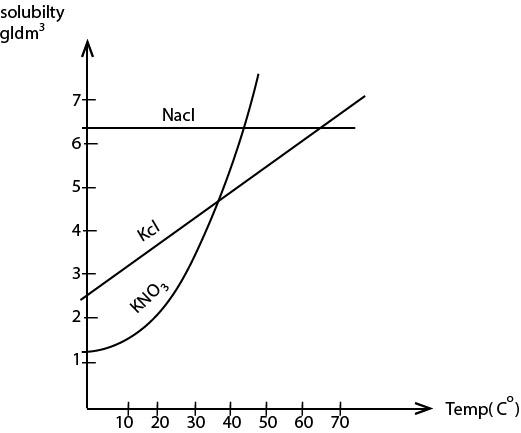
The diagram above is a graph of solubility against temperature. The vertical component is solubility of substance in grams per dm3, whereas the horizontal component is temperature. The graph shows the relationship between solubility and temperature.
From the data of salts NaCl, KCl, and KNO3 analyzed in the graph:
- NaCl has a constant solubility at any temperature; temperature changes do not affect its solubility.
- KCl shows a smooth linear increase in solubility with temperature; it is more soluble than NaCl.
- KNO3 shows a curved graph indicating rapid increase in solubility with temperature; it is more soluble than NaCl and KCl.
Assignment
Take a salt of NaNO3(s) to examine its solubility.
Procedure
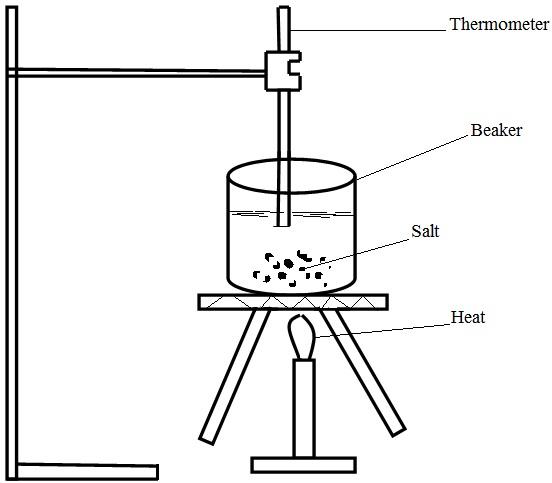
- Measure 1 litre of distilled water and pour it into a beaker.
- Measure 1 g of NaNO3 by electronic balance and pour into the beaker.
- Using a heat source, tripod stand, wire gauze, retort stand, and thermometer, heat both water and salt.
- Observe the disappearance of salt particles until all dissolve and record the temperature.
- Repeat the procedure for other salts.
- Draw a graph of solubility against temperature.
USES OF SALT IN DAILY LIFE
Salt is essential for life, with more than 14,000 uses daily. Common uses are categorized into Food, Agriculture, Water Conditioning, Highway Deicing, and Industrial Chemicals.
1. FOOD
- Sodium chloride is mixed with food as a flavoring (common salt).
- Sodium chloride is used in the food industry as both flavoring and preservative.
- Sodium bicarbonate (NaHCO3) is used in cooking as a raising agent for cakes, bread, etc.
- Baking powder is a mixture of sodium hydrogen carbonate and tartaric acid; it helps keep the pH neutral.
2. AGRICULTURE
Salts are important in agriculture as land additives and nutrients. Fertilizers such as ammonium sulphate (NH4SO4) and sodium nitrate (NaNO3) are used to improve soil fertility and promote healthy crop growth.
3. WATER CONDITIONING
- In urban water purification (Permutit process), aluminum silicate salts are used to remove permanent hardness of water (Al(SiO3)3).
- Sodium carbonate (Na2CO3), called washing soda, is used to soften water by replacing calcium ions with sodium ions.
- Sodium chloride is used in water softeners to regenerate ion exchange columns.
4. HIGHWAY DEICING
Sodium chloride mixed with grit is spread on roads to prevent freezing in cold conditions.
5. INDUSTRIAL USES
- Potassium iodide (KI) is added to sodium chloride to prevent iodine deficiency in diets.
- Sodium carbonate is used in the manufacture of glass.



14 Comments