

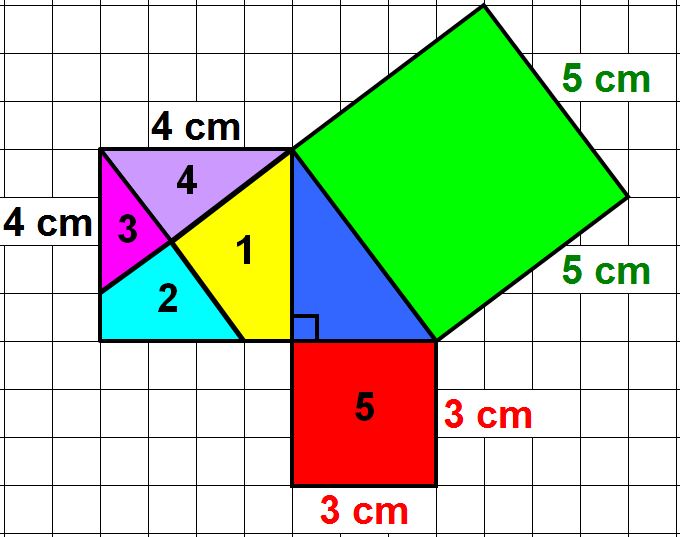
PYTHAGORAS THEOREM
PYTHAGORAS THEOREM
Pythagoras theorem is used to solve problems involving right-angled triangles.
Statement:
In a right-angled triangle, the square on the hypotenuse is equal to the sum of the squares on the other two sides.

Shown below

Required to prove: c2 = a2 + b2
Construction:
Joining L and N. Considering the trapezium PQLN:
Area of the trapezium
But area of trapezium = area Δ PKN + area Δ KQL + area Δ KLN
 (a+b)(a+b) = ab + (c × c)
(a+b)(a+b) = ab + c2
[a2 + 2ab + b2] = ab + c2
a2 + ab + b2 = ab + c2
a2 + b2 = c2 |
a2 + b2 = c2
Examples
- The sides of a triangle containing the right angle have lengths of 5 cm and 12 cm.
Find the length of the hypotenuse.
Solution
C2 = a2 + b2
C2 = 52 + 122
C2 = 25 + 144
C2 = 169
C = 
C = 13 cm
∴ The length of the hypotenuse = 13 cm.
- In the figure below, if AC = 17 cm, BC = 8 cm, and CD = 12 cm, find AD.

Solution:


EXERCISE
- Calculate the unknown side of the following triangle.

SOLUTION:
172 = 152 + b2
b2 = 172 – 152
b2 = 289 – 225
b = 
b = 8 cm
∴ r2 = 82 + 82
r2 = 64 + 64

∴ r = 11.31 cm
- Given triangle ABC, where B = 90°, find the lengths of the sides which are not given.


Find the area of the triangle and the length of the perpendicular from C to B.
- A man travels 15 km due north and then 8 km due west. How far is he from his starting point?
Solution:

X2 = 152 + 82
X2 = 225 + 64
X = 
X = 17 km
∴ He is 17 km from his starting point.





6 Comments