

FRACTIONS
A fraction is a number that can be written in the form of  where a and b are integers and b
  0.
0.

The number written on top of the fraction is called the Numerator and the bottom is called the Denominator, e.g.

Types of Fractions
- Proper fractions: A proper fraction is one in which the numerator is less than the denominator, e.g.
 etc.
etc. - Improper fractions: These are fractions where the numerator is greater than the denominator, e.g. etc.
- Mixed fractions or mixed numbers: These are formed after improper fractions are divided completely, e.g. = 2 , 6 , 9 .
- Equivalent fractions: These are two or more fractions that can be simplified to the same lowest fraction.
 etc.
etc. etc.
etc. = 2
= 2  , 6
, 6  .
.
Example: Change the following into mixed numbers
- = 7
- = 3
- = 6
 = 7
= 7  = 3
= 3 = 6
= 6 
Fractions can be represented on number lines, e.g. represent  on a number line.

Exercise 1
1. (i) Which of the following are:
- (a) Proper fractions
- (b) Mixed fractions
- (c) Improper fractions
(ii) List four equivalent fractions:
- 3


Solution
(a) Proper fractions:
 ,
,  ,
,  ,
,  ,
,  ,
,  ,
,  ,
,  ,
,  ,
,  ,
,  .
.
(b) Improper fractions:
 ,
,  , , ,
, , ,  .
.
(c) Mixed fractions:
1  , 3 .
, 3 .
Four equivalent fractions are:


2. Write the following fractions in words
- (a) three quarters
- (b) A half
- (c) A third
- (d) Five over six
- (e) Nine over Ten
- (f) A quarter
 Nine over Ten
 A quarter
2. Write the name of the fraction of the shaded part in figures ABCD and EFGH

One over three (A third) which is a proper fraction.
E H

F G
 = one over four (A quarter) which is a proper fraction.
Comparison of fractions
Fractions can be compared by using two methods:
- Number line
- L.C.M of the denominators
(I) Number line
Example 1: Show  and on a number line and find which is greater.

(II) L.C.M of the denominators
Determine which fraction is greater between  and
and  .
.
Solution:
1st find the L.C.M of 5 and 7:
L.C.M of 5 and 7 = 35
2nd multiply each fraction by that L.C.M:
 35 = 14
 35 = 20
Conclusion: The fraction with the bigger number after multiplication with L.C.M is greater.

Operations on Fractions
Addition and Subtraction of Fractions
NOTE:
- Add the numerators together if each fraction has the same denominator.
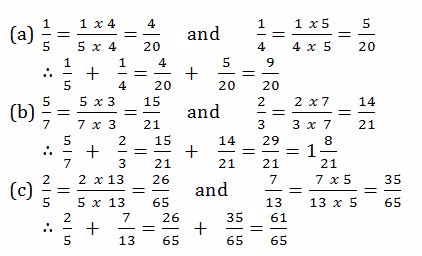
- If the fractions have different denominators, find the smallest number that each denominator divides into exactly (LCM).
- When adding fractions, do not add the denominators.
Example: Evaluate the following fractions


Multiplication
NOTE:
- Before multiplying, convert mixed numbers into improper fractions.
- Multiply the numerators and multiply the denominators.
Examples:


Dividing Fractions
- When dividing fractions, invert the second fraction then multiply the first fraction by the inverted fraction.
- Before dividing, convert mixed numbers into improper fractions.


DECIMALS AND PERCENTAGES
Decimals are fractions of tenths, written using a decimal point which results from division of a normal fraction.
Examples: 0.34, 0.5, 0.333…
In the decimal 0.2546 the place values are:
| Ones | Tenths | Hundredths | Thousandths | Ten Thousandths |
| 0 | 2 | 5 | 4 | 6 |
Decimals can be converted into fractions and vice versa.
Example: Change into decimals.
Solution:
 = 0.75
This fraction which ends after dividing is called a terminating fraction. Other fractions do not end; these are called recurring or repeating decimals.
Example: 

Conversion of Repeating Decimal into Fractions

Solution:
0.3 = 0.333…

Subtract (i) from (ii):
9t = 3.0
t =
Exercise 1
Insert  or
or  between each pair of fractions in questions 4 to 12.
1.  ,
,
Solution:
L.C.M = 3
3 = 2
3 = 1
3. PERCENTAGES
Percentages are fractions expressed out of 100. That is, they are fractions whose denominator is one hundred, denoted by (%) called percent.
Example: 12% means 12  100.
100.
70% =  etc.
etc.
Examples:
1. Convert the following percentages into fractions:
- 65%
- 75%
- 12%
Solution:
(i) 65%
65 100 = 
(ii) 75%
75 100 = 
(iii) 12%
12 100 = 12.5%
2. Change
- 40% into decimal
- 35% into fractions
- 0.125 into percentage
Solution:
(i) 40% = 0.4
(ii) 35% = 
(iii) 0.125 = 12.5%
3. Change the recurring decimals into fractions
(i) 0.
Solution:
Let x = 0.
100x = 21.
Take away equation (i) from (ii):
99x = 20
x = 
Operations on Decimals
Operations with decimals are similar to operations with whole numbers:
Addition
Note: The decimal points must be aligned. Put zeros at the end to give the same number of decimal places in each number.


Multiplication
Note:
- When multiplying decimals, the answer must have the same number of decimal places as the total number of decimal places in the numbers being multiplied.
- First carry out the multiplication in the usual way, without any decimal points, then place the decimal point to the total decimal places.

Division
Note:
It is not easy to divide by a decimal, so multiply each number by a power of 10 so that you are dividing by a whole number.
Example:
(a) 68.32 ÷ 1.4
Solution:
68.32 ÷ 1.4 = 68.32 × 10 ÷ 1.4 × 10 = 683.2 ÷ 14
By long division:

Therefore 68.32 ÷ 1.4 = 48.8
(b) 9.66 ÷ 0.23
Solution:
9.66 × 100 ÷ 0.23 × 100 = 966 ÷ 23

Therefore 9.66 ÷ 0.23 = 42
(c) 7.32 ÷ 1.2
Solution:
7.32 × 10 ÷ 1.2 × 10 = 73.2 ÷ 12

Therefore 7.32 ÷ 1.2 = 6.1
Mariam was given 20,000 shillings by her father. She spent 48% of it to buy shoes. How much money remained?
Solution:
48% of 20,000 = 9,600
20,000 – 9,600 = 11,600
∴ The remaining money was 11,600/=

PERCENTAGES APPLIED TO REAL LIFE PROBLEMS
The examples below show the wide range of applications.
Example 1: In one week, Flora earned 48,000/=. She spent 4,000/= on travel to and from work. What percentage of her money was left?
Solution:

Percentage of a quantity
When finding a percentage of a quantity, it often helps to change the percentage to a decimal and multiply it by the quantity.
Example: Find (a) 20% of 840,000

Percentage increase and decrease
There are two steps to calculate percentage increase (or decrease).
Example: In 1975 the population of a village was 90. It increased by 30% the following year. What was the population in 1976?


6 Comments