


Introduction to Salts
1. (a) A salt is an ionic compound formed when the cation from a base combines with the anion derived from an acid. A salt is therefore formed when the hydrogen ions in an acid are replaced wholly or partially, directly or indirectly, by a metal or ammonium radical.
(b) The number of ionizable or replaceable hydrogen atoms in an acid is called the basicity of the acid.
Some acids are therefore classified as:
- Monobasic acids generally denoted HX, e.g., HCl, HNO3, HCOOH, CH3COOH.
- Dibasic acids generally denoted H2X, e.g., H2SO4, H2SO3, H2CO3, HOOCOOH.
- Tribasic acids generally denoted H3X, e.g., H3PO4.
(c) Some salts are normal salts while others are acid salts.
- (i) A normal salt is formed when all the ionizable or replaceable hydrogen in an acid is replaced by a metal or metallic/ammonium radical.
- (ii) An acid salt is formed when part of the ionizable or replaceable hydrogen in an acid is replaced by a metal or metallic/ammonium radical.
Table showing normal and acid salts derived from common acids:
| Acid name | Chemical formula | Basicity | Normal salt | Acid salt |
|---|---|---|---|---|
| Hydrochloric acid | HCl | Monobasic | Chloride (Cl–) | None |
| Nitric (V) acid | HNO3 | Monobasic | Nitrate (V) (NO3–) | None |
| Nitric (III) acid | HNO2 | Monobasic | Nitrate (III) (NO2–) | None |
| Sulphuric (VI) acid | H2SO4 | Dibasic | Sulphate (VI) (SO42-) | Hydrogen sulphate (VI) (HSO4–) |
| Sulphuric (IV) acid | H2SO3 | Dibasic | Sulphate (IV) (SO32-) | Hydrogen sulphate (IV) (HSO3–) |
| Carbonic (IV) acid | H2CO3 | Dibasic | Carbonate (IV) (CO32-) | Hydrogen carbonate (IV) (HCO3–) |
| Phosphoric (V) acid | H3PO4 | Tribasic | Phosphate (V) (PO43-) | Dihydrogen phosphate (V) (H2PO42-), Hydrogen diphosphate (V) (HP2O42-) |
The table below shows some examples of salts.
| Base/alkali | Cation | Acid | Anion | Salt | Chemical name of salts |
|---|---|---|---|---|---|
| NaOH | Na+ | HCl | Cl– | NaCl | Sodium(I) chloride |
| Mg(OH)2 | Mg2+ | H2SO4 | SO42- | MgSO4, Mg(HSO4)2 | Magnesium sulphate (VI), Magnesium hydrogen sulphate (VI) |
| Pb(OH)2 | Pb2+ | HNO3 | NO3– | Pb(NO3)2 | Lead(II) nitrate (V) |
| Ba(OH)2 | Ba2+ | HNO3 | NO3– | Ba(NO3)2 | Barium(II) nitrate (V) |
| Ca(OH)2 | Ca2+ | H2SO4 | SO42- | CaSO4 | Calcium sulphate (VI) |
| NH4OH | NH4+ | H3PO4 | PO43- | (NH4)3PO4, (NH4)2HPO4, NH4H2PO4 | Ammonium phosphate (V), Diammonium phosphate (V), Ammonium diphosphate (V) |
| KOH | K+ | H3PO4 | PO43- | K3PO4 | Potassium phosphate (V) |
| Al(OH)3 | Al3+ | H2SO4 | SO42- | Al2(SO4)3 | Aluminium(III) sulphate (VI) |
| Fe(OH)2 | Fe2+ | H2SO4 | SO42- | FeSO4 | Iron(II) sulphate (VI) |
| Fe(OH)3 | Fe3+ | H2SO4 | SO42- | Fe2(SO4)3 | Iron(III) sulphate (VI) |
(d) Some salts undergo hygroscopy, deliquescence, and efflorescence.
(i) Hygroscopic salts or compounds are those that absorb water from the atmosphere but do not form a solution. Some examples include anhydrous copper(II) sulphate (VI), anhydrous cobalt(II) chloride, potassium nitrate (V), and common table salt.
(ii) Deliquescent salts or compounds absorb water from the atmosphere and form a solution. Examples include sodium nitrate (V), calcium chloride, sodium hydroxide, iron(II) chloride, and magnesium chloride.
(iii) Efflorescent salts or compounds lose their water of crystallization to the atmosphere. Examples include sodium carbonate decahydrate, iron(II) sulphate (VI) heptahydrate, and sodium sulphate (VI) decahydrate.
(e) Some salts contain water of crystallization and are called hydrated salts. Others do not contain water of crystallization and are called anhydrous salts.
Table showing some hydrated salts:
| Name of hydrated salt | Chemical formula |
|---|---|
| Copper(II) sulphate (VI) pentahydrate | CuSO4.5H2O |
| Aluminium(III) sulphate (VI) hexahydrate | Al2(SO4)3.6H2O |
| Zinc(II) sulphate (VI) heptahydrate | ZnSO4.7H2O |
| Iron(II) sulphate (VI) heptahydrate | FeSO4.7H2O |
| Calcium(II) sulphate (VI) heptahydrate | CaSO4.7H2O |
| Magnesium(II) sulphate (VI) heptahydrate | MgSO4.7H2O |
| Sodium sulphate (VI) decahydrate | Na2SO4.10H2O |
| Sodium carbonate (IV) decahydrate | Na2CO3.10H2O |
| Potassium carbonate (IV) decahydrate | K2CO3.10H2O |
| Potassium sulphate (VI) decahydrate | K2SO4.10H2O |
(f) Some salts exist as simple salts while others exist as complex salts. Below are some examples of complex salts.
Table of some complex salts:
| Name of complex salt | Chemical formula | Colour of the complex salt |
|---|---|---|
| Tetraamminecopper(II) sulphate (VI) | Cu(NH3)4SO4·H2O | Royal/deep blue solution |
| Tetraamminezinc(II) nitrate (V) | Zn(NH3)4(NO3)2 | Colourless solution |
| Tetraamminecopper(II) nitrate (V) | Cu(NH3)4(NO3)2 | Royal/deep blue solution |
| Tetraamminezinc(II) sulphate (VI) | Zn(NH3)4SO4 | Colourless solution |
(g) Some salts exist as two salts in one. They are called double salts.
Table of some double salts:
| Name of double salts | Chemical formula |
|---|---|
| Trona (sodium sesquicarbonate) | Na2CO3·NaHCO3·2H2O |
| Ammonium iron(II) sulphate (VI) | FeSO4(NH4)2SO4·2H2O |
| Ammonium aluminium(III) sulphate (VI) | Al2(SO4)3(NH4)2SO4·H2O |
(h) Some salts dissolve in water to form a solution. They are said to be soluble. Others do not dissolve in water and form a suspension or precipitate.
Table of solubility of salts:
| Soluble salts | Insoluble salts |
|---|---|
| All nitrate (V) salts | |
| All sulphate (VI) / SO42- salts except | Barium (II) sulphate (VI) / BaSO4, Calcium (II) sulphate (VI) / CaSO4, Lead (II) sulphate (VI) / PbSO4 |
| All sulphate (IV) / SO32- salts except | Barium (II) sulphate (IV) / BaSO3, Calcium (II) sulphate (IV) / CaSO3, Lead (II) sulphate (IV) / PbSO3 |
| All chlorides / Cl– except | Silver chloride / AgCl, Lead (II) chloride / PbCl2 (dissolves in hot water) |
| All phosphate (V) / PO43- | |
| All sodium, potassium, and ammonium salts | |
| All hydrogen carbonates / HCO3– | |
| All hydrogen sulphate (VI) / HSO4– | |
| Sodium carbonate / Na2CO3, potassium carbonate / K2CO3, ammonium carbonate (NH4)2CO3 | except All carbonates |
| All alkalis (KOH, NaOH, NH4OH) | except All bases |
13. Salts can be prepared in a school laboratory by methods that use their solubility in water.
- Soluble salts may be prepared by using any of the following methods:
(i) Direct displacement/reaction of a metal with an acid.
By reacting a metal higher in the reactivity series than hydrogen with a dilute acid, a salt is formed and hydrogen gas is evolved. Excess metal must be used to ensure all the acid has reacted. When effervescence, bubbling, or fizzing has stopped, excess metal is filtered off. The filtrate is heated to concentrate then allowed to crystallize. Washing with distilled water then drying between filter papers produces a sample crystal of the salt. The general equation is:
M(s) + H2X → MX(aq) + H2(g)
Examples:
- Mg(s) + H2SO4(aq) → MgSO4(aq) + H2(g)
- Zn(s) + H2SO4(aq) → ZnSO4(aq) + H2(g)
- Pb(s) + 2HNO3(aq) → Pb(NO3)2(aq) + H2(g)
- Ca(s) + 2HNO3(aq) → Ca(NO3)2(aq) + H2(g)
- Mg(s) + 2HNO3(aq) → Mg(NO3)2(aq) + H2(g)
- Mg(s) + 2HCl(aq) → MgCl2(aq) + H2(g)
- Zn(s) + 2HCl(aq) → ZnCl2(aq) + H2(g)
(ii) Reaction of an insoluble base with an acid.
By adding an insoluble base (oxide or hydroxide) to a dilute acid until no more dissolves in the acid, a salt and water are formed. Excess base is filtered off. The filtrate is heated to concentrate, allowed to crystallize, then washed with distilled water before drying between filter papers. Examples include:
- PbO(s) + 2HNO3(aq) → Pb(NO3)2(aq) + H2O(l)
- Pb(OH)2(s) + 2HNO3(aq) → Pb(NO3)2(aq) + 2H2O(l)
- CaO(s) + 2HNO3(aq) → Ca(NO3)2(aq) + H2O(l)
- MgO(s) + 2HNO3(aq) → Mg(NO3)2(aq) + H2O(l)
- MgO(s) + 2HCl(aq) → MgCl2(aq) + H2O(l)
- ZnO(s) + 2HCl(aq) → ZnCl2(aq) + H2O(l)
- Zn(OH)2(s) + 2HNO3(aq) → Zn(NO3)2(aq) + 2H2O(l)
- CuO(s) + 2HCl(aq) → CuCl2(aq) + H2O(l)
- CuO(s) + H2SO4(aq) → CuSO4(aq) + H2O(l)
- Ag2O(s) + 2HNO3(aq) → 2AgNO3(aq) + H2O(l)
- Na2O(s) + 2HNO3(aq) → 2NaNO3(aq) + H2O(l)
(iii) Reaction of insoluble or soluble carbonate/hydrogen carbonate with an acid.
By adding an excess of a soluble or insoluble carbonate or hydrogen carbonate to a dilute acid, effervescence, fizzing, or bubbling of carbon (IV) oxide gas shows the reaction is taking place. When effervescence stops, excess insoluble carbonate is filtered off. The filtrate is heated to concentrate, allowed to crystallize, then washed with distilled water before drying between filter papers. Examples include:
- PbCO3(s) + 2HNO3(aq) → Pb(NO3)2(aq) + H2O(l) + CO2(g)
- ZnCO3(s) + 2HNO3(aq) → Zn(NO3)2(aq) + H2O(l) + CO2(g)
- CaCO3(s) + 2HNO3(aq) → Ca(NO3)2(aq) + H2O(l) + CO2(g)
- MgCO3(s) + H2SO4(aq) → MgSO4(aq) + H2O(l) + CO2(g)
- CuCO3(s) + H2SO4(aq) → CuSO4(aq) + H2O(l) + CO2(g)
- Ag2CO3(s) + 2HNO3(aq) → 2AgNO3(aq) + H2O(l) + CO2(g)
- Na2CO3(s) + 2HNO3(aq) → 2NaNO3(aq) + H2O(l) + CO2(g)
- K2CO3(s) + 2HCl(aq) → 2KCl(aq) + H2O(l) + CO2(g)
- NaHCO3(s) + HNO3(aq) → NaNO3(aq) + H2O(l) + CO2(g)
- KHCO3(s) + HCl(aq) → KCl(aq) + H2O(l) + CO2(g)
(iv) Neutralization/reaction of soluble base/alkali with dilute acid.
By adding an acid from a burette into a known volume of an alkali with 2-3 drops of an indicator, the colour of the indicator changes when the acid has completely reacted with the alkali at the end point. The procedure is then repeated without the indicator. The solution mixture is then heated to concentrate, allowed to crystallize, washed with distilled water before drying with filter papers. Examples include:
- NaOH (aq) + HNO3(aq) → NaNO3(aq) + H2O(l)
- KOH (aq) + HNO3(aq) → KNO3(aq) + H2O(l)
- KOH (aq) + HCl(aq) → KCl(aq) + H2O(l)
- 2KOH (aq) + H2SO4(aq) → K2SO4(aq) + 2H2O(l)
- 2NH4OH (aq) + H2SO4(aq) → (NH4)2SO4(aq) + 2H2O(l)
- NH4OH (aq) + HNO3(aq) → NH4NO3(aq) + H2O(l)
(v) Direct synthesis/combination.
When a metal burns in a gas jar containing a non-metal, the two directly combine to form a salt. Examples include:
- 2Na(s) + Cl2(g) → 2NaCl(s)
- 2K(s) + Cl2(g) → 2KCl(s)
- Mg(s) + Cl2(g) → MgCl2(s)
- Ca(s) + Cl2(g) → CaCl2(s)
Some salts once formed undergo sublimation and hydrolysis. Care should be taken to avoid water or moisture entering the reaction flask during their preparation. Such salts include aluminum (III) chloride (AlCl3) and iron (III) chloride (FeCl3).
1. Heated aluminium foil reacts with chlorine to form aluminium(III) chloride that sublimes away from the source of heating then deposits as solid again:
2Al(s) + 3Cl2(g) → 2AlCl3(s/g)
Once formed, aluminium(III) chloride hydrolyses/reacts with water vapour or moisture present to form aluminium hydroxide solution and highly acidic fumes of hydrogen chloride gas:
AlCl3(s) + 3H2O(g) → Al(OH)3(aq) + 3HCl(g)
2. Heated iron filings react with chlorine to form iron(III) chloride that sublimes away from the source of heating then deposits as solid again:
2Fe(s) + 3Cl2(g) → 2FeCl3(s/g)
Once formed, iron(III) chloride hydrolyses/reacts with water vapour or moisture present to form iron hydroxide solution and highly acidic fumes of hydrogen chloride gas:
FeCl3(s) + 3H2O(g) → Fe(OH)3(aq) + 3HCl(g)
(b) Insoluble salts can be prepared by reacting two suitable soluble salts to form one soluble and one insoluble salt. This is called double decomposition or precipitation. The mixture is filtered and the residue is washed with distilled water then dried. Examples include:
- CuSO4(aq) + Na2CO3(aq) → CuCO3(s) + Na2SO4(aq)
- BaCl2(aq) + K2SO4(aq) → BaSO4(s) + 2KCl(aq)
- Pb(NO3)2(aq) + K2SO4(aq) → PbSO4(s) + 2KNO3(aq)
- 2AgNO3(aq) + MgCl2(aq) → 2AgCl(s) + Mg(NO3)2(aq)
- Pb(NO3)2(aq) + (NH4)2SO4(aq) → PbSO4(s) + 2NH4NO3(aq)
- BaCl2(aq) + K2SO3(aq) → BaSO3(s) + 2KCl(aq)
14. Salts may lose their water of crystallization, decompose, melt, or sublime on heating with a Bunsen burner flame.
The following shows the behavior of some salts on heating gently or strongly in a laboratory school burner:
(a) Effect of heat on chlorides
All chlorides have very high melting and boiling points and therefore are not affected by laboratory heating except ammonium chloride. Ammonium chloride sublimes on gentle heating. It dissociates into the constituent ammonia and hydrogen chloride gases on strong heating.
NH4Cl(s) → NH4Cl(g) → NH3(g) + HCl(g)
(sublimation) (dissociation)
(b) Effect of heat on nitrate (V)
(i) Potassium nitrate (V) / KNO3 and sodium nitrate (V) / NaNO3 decompose on heating to form potassium nitrate (III) / KNO2 and sodium nitrate (III) / NaNO2 and produce oxygen gas in each case.
2KNO3(s) → 2KNO2(s) + O2(g)
2NaNO3(s) → 2NaNO2(s) + O2(g)
(ii) Heavy metal nitrate (V) salts decompose on heating to form the oxide and a mixture of brown acidic nitrogen (IV) oxide and oxygen gases. Examples include:
2Ca(NO3)2(s) → 2CaO(s) + 4NO2(g) + O2(g)
2Mg(NO3)2(s) → 2MgO(s) + 4NO2(g) + O2(g)
2Zn(NO3)2(s) → 2ZnO(s) + 4NO2(g) + O2(g)
2Pb(NO3)2(s) → 2PbO(s) + 4NO2(g) + O2(g)
2Cu(NO3)2(s) → 2CuO(s) + 4NO2(g) + O2(g)
2Fe(NO3)2(s) → 2FeO(s) + 4NO2(g) + O2(g)
(iii) Silver(I) nitrate (V) and mercury(II) nitrate (V) are lowest in the reactivity series. They decompose on heating to form the metal (silver and mercury) and nitrogen (IV) oxide and oxygen gas. For example:
2AgNO3(s) → 2Ag(s) + 2NO2(g) + O2(g)
2Hg(NO3)2(s) → 2Hg(s) + 4NO2(g) + O2(g)
(iv) Ammonium nitrate (V) and ammonium nitrate (III) decompose on heating to nitrogen (I) oxide (which relights a glowing splint) and nitrogen gas respectively. Water is also formed. The reactions are:
NH4NO3(s) → N2O(g) + H2O(l)
NH4NO2(s) → N2(g) + H2O(l)
(c) Effect of heat on sulphates
Only iron(II) sulphate (VI), iron(III) sulphate (VI), and copper(II) sulphate (VI) decompose on heating. They form the oxide and produce highly acidic fumes of sulphur (IV) oxide gas.
2FeSO4(s) → Fe2O3(s) + SO3(g) + SO2(g)
Fe2(SO4)3(s) → Fe2O3(s) + SO3(g)
CuSO4(s) → CuO(s) + SO3(g)
(d) Effect of heat on carbonates (IV) and hydrogen carbonate (IV)
(i) Sodium carbonate (IV) and potassium carbonate (IV) do not decompose on heating.
(ii) Heavy metal carbonate (IV) salts decompose on heating to form the oxide and produce carbon (IV) oxide gas. Carbon (IV) oxide gas forms a white precipitate when bubbled in lime water. The white precipitate dissolves if the gas is in excess. Examples include:
- CuCO3(s) → CuO(s) + CO2(g)
- CaCO3(s) → CaO(s) + CO2(g)
- PbCO3(s) → PbO(s) + CO2(g)
- FeCO3(s) → FeO(s) + CO2(g)
- ZnCO3(s) → ZnO(s) + CO2(g)
(iii) Sodium hydrogen carbonate (IV) and potassium hydrogen carbonate (IV) decompose on heating to give the corresponding carbonate (IV) and form water and carbon (IV) oxide gas. The reactions are:
2NaHCO3(s) → Na2CO3(s) + CO2(g) + H2O(l)
2KHCO3(s) → K2CO3(s) + CO2(g) + H2O(l)
(iv) Calcium hydrogen carbonate (IV) and magnesium hydrogen carbonate (IV) decompose on heating to give the corresponding carbonate (IV) and form water and carbon (IV) oxide gas. The reactions are:
Ca(HCO3)2(aq) → CaCO3(s) + CO2(g) + H2O(l)
Mg(HCO3)2(aq) → MgCO3(s) + CO2(g) + H2O(l)
Name: …………………………………….. Class: ………………. Adm No: ………
CHEMISTRY Practice balancing Chemical equations
Date done: …………….. Date marked: ……………. Date revised: ………
Balance the following chemical equations in the spaces provided on the question paper.
Ca(OH)2(aq) + Cl2(g) → CaCl2(aq) + CaOCl2(aq) + H2O(l) (Cold/dilute) (Calcium Chlorate(I))
Ca(OH)2(aq) + Cl2(g) → CaCl2(aq) + Ca(ClO3)2(aq) + H2O(l) (Hot/Concentrated) (Calcium Chlorate(V))
NaOH + Cl2(g) → NaClO3(aq) + NaCl(aq) + 3H2O(l) (Sodium Chlorate (V))
KOH + Cl2(g) → KClO3(aq) + KCl(aq) + H2O(l) (Potassium Chlorate (V))
Ca(OH)2(aq) + Cl2(g) → CaCl2(aq) + CaOCl2(aq) + H2O(l) (Cold/dilute) (Calcium Chlorate(I))
NaCl(s) + H2SO4(l) → NaHSO4(aq) + HCl(g)
KCl(s) + H2SO4(l) → KHSO4(aq) + HCl(g)
CaO(s) + 2H2O(l) → Ca(OH)2(aq) + H2O(l)
Ca(OH)2(aq) + Cl2(g) → CaOCl2(aq) + H2O(l)
HCl(s) + NH3(g) → NH4Cl(s)
Fe(s) + 2HCl(aq) → FeCl2(aq) + H2(g)
Zn(s) + 2HCl(aq) → ZnCl2(aq) + H2(g)
Mg(s) + 2HCl(aq) → MgCl2(aq) + H2(g)
2Li(s) + 2HCl(aq) → 2LiCl(aq) + H2(g)
Ca(OH)2(aq) + Cl2(g) → CaCl2(aq) + Ca(ClO3)2(aq) + H2O(l) (Hot/Concentrated) (Calcium Chlorate(V))
CaCO3(s) + 2HCl(aq) → CaCl2(aq) + H2O(l) + CO2(g) (Colourless solution)
1. Chemical equation:
Ionic equation:
CaCO3(s) + 2H+(aq) → Ca2+(aq) + H2O(l) + CO2(g)
2. Chemical equation:
Ag2CO3(s) + 2HCl(aq) → 2AgCl(s) + H2O(l) + CO2(g) (Coats/Covers Ag2CO3)
3. Chemical equation:
NaHCO3(s) + HCl(aq) → NaCl(aq) + H2O(l) + CO2(g) (Colourless solution)
Ionic equation:
NaHCO3(s) + H+(aq) → Na+(aq) + H2O(l) + CO2(g)
4. Chemical equation:
CuCO3(s) + 2HCl(aq) → CuCl2(aq) + H2O(l) + CO2(g) (Blue Solution)
Ionic equation:
CuCO3(s) + 2H+(aq) → Cu2+(aq) + H2O(l) + CO2(g)
5. Chemical equation:
FeCO3(s) + 2HCl(aq) → FeCl2(aq) + H2O(l) + CO2(g) (Green solution)
Ionic equation:
FeCO3(s) + 2H+(aq) → Fe2+(aq) + H2O(l) + CO2(g)
6. Chemical equation:
(NH4)2CO3(s) + 2HCl(aq) → 2NH4Cl(aq) + H2O(l) + CO2(g)
Ionic equation:
(NH4)2CO3(s) + 2H+(aq) → 2NH4+(aq) + H2O(l) + CO2(g)
Chemical equation:
NaOH(aq) + HCl(aq) → NaCl(aq) + H2O(l)
Ionic equation:
OH–(aq) + H+(aq) → H2O(l)
Chemical equation:
KOH(aq) + HCl(aq) → KCl(aq) + H2O(l)
Ionic equation:
OH–(aq) + H+(aq) → H2O(l)
Chemical equation:
NH4OH(aq) + HCl(aq) → NH4Cl(aq) + H2O(l)
Ionic equation:
OH–(aq) + H+(aq) → H2O(l)
CuO(s) + 2HCl(aq) → CuCl2(aq) + H2O(l)
Ionic equation:
CuO(s) + 2H+(aq) → Cu2+(aq) + H2O(l)
Chemical equation:
CaO(s) + HCl(aq) → CaCl2(aq) + H2O(l)
Ionic equation:
CaO(s) + 2H+(aq) → Ca2+(aq) + H2O(l)
Chemical equation:
PbO(s) + 2HCl(aq) → PbCl2(s) + H2O(l)
No ionic equation
Chemical equation:
ZnO(s) + HCl(aq) → ZnCl2(aq) + H2O(l)
Ionic equation:
ZnO(s) + 2H+(aq) → Zn2+(aq) + H2O(l)
H2(g) + Cl2(g) → 2HCl(g)
HCl(g) + H2O(aq) → HCl(aq)
NH4Cl(s) → HCl(g) + NH3(g)
Name: …………………………………….. Class: ………………… Adm. No: ………
Date done: ……………. Date marked: ……………. Date revised: ……………
CHEMISTRY Form 2: Practice 1: Time 2 hours 80 marks
1. Study the information in the table below and answer the questions that follow (The letters do not represent the actual symbols of the elements)
| Ionization Energy (kJ/Mole) | |||
|---|---|---|---|
| Element | Electronic configuration | 1st ionization energy | 2nd ionization energy |
| A | 2.2 | 900 | 1800 |
| B | 2.8.2 | 736 | 1450 |
| C | 2.8.8.2 | 590 | 1150 |
(i) What chemical family do the elements A, B, and C belong? (1 mark)
(ii) Write the formula and electronic structure of an ion of B (2 marks)
Formula:
Electronic structure:
(iii) What type of bonding exists in (2 marks):
- Atoms of C
- Chloride of B
(iv) What is ionization energy? (1 mark)
(v) Explain the following:
1. The 1st ionization energy is lower than the second ionization energy. (2 marks)
2. The 1st ionization energy of B is lower than that of C. (2 marks)
(vi) Write a chemical equation for the reaction of element B with:
1. Air
2. Chlorine gas
3. Steam (water vapour)
2. Study the information in the table below and answer the questions that follow (the letters do not represent the actual symbols of the substances)
| Substance | Melting Point (°C) | Boiling Point (°C) | Solubility in water | Density at room temperature (g/cm3) |
|---|---|---|---|---|
| H | -117 | 78.5 | Very soluble | 0.8 |
| J | -78 | -33 | Very soluble | 0.77 x 10⁻³ |
| K | -23 | 77 | Insoluble | 1.6 |
| L | -219 | -183 | Slightly soluble | 1.33 x 10⁻³ |
(i) Which substance would dissolve in water and could be separated from the solution by fractional distillation? Give a reason. (2 marks)
(ii) Which substance is a liquid at room temperature and when mixed with water two layers would be formed? Explain. (2 marks)
(iii) Which letter represents a substance that is gas at room temperature and which can be collected:
I. Over water? Explain. (2 marks)
II. By downward displacement of air? (Density of air is 1.29 x 10⁻³ g/cm3 at room temperature). Explain. (2 marks)
3. The grid below represents part of the periodic table. The letters do not represent the actual symbols.
| A | ||||||||
| B | X | G | P | Z | E | V | ||
| J | I | L | R | T | ||||
| D | G | M | ||||||
a) Select the most reactive:
(i) Non-metal. (1 mark)
(ii) Metal. (1 mark)
b) Write the formula of the compound consisting of (10 marks):
1. D and Z only.
2. X and Z only.
3. Oxide of B.
4. Carbonate of J.
5. Sulphate of D.
6. Nitrate of B.
7. Chloride of X.
8. Sodium compound of E.
9. Aluminium compound of Z.
10. Hydrogen compound of G.
c) Select an element that can form an ion of charge (10 marks):
(i) +1
(ii) -1
(iii) +2
(iv) +3
(v) -3
d) Which element has the least ionization energy? Explain. (2 marks)
f) To which chemical family do the following elements belong? (3 marks)
J
E
B
g) When a piece of element G is placed in cold water, it sinks to the bottom and effervescence of a colourless gas that burns explosively is produced. Use a simple diagram to illustrate how this gas can be collected during this experiment. (3 marks)
h) An element K has relative atomic mass of 40.2. It has two isotopes of masses 39 and 42. Calculate the relative abundance of each isotope. (3 marks)
4. Balance the following chemical equations (6 marks):
- Ca(OH)2(aq) + Cl2(g) → CaCl2(aq) + CaOCl2(aq) + H2O(l)
- NaOH + Cl2(g) → NaClO3(aq) + NaCl(aq) + 3H2O(l)
- NaCl(s) + H2SO4(l) → NaHSO4(aq) + HCl(g)
- CaO(s) + H2O(l) → Ca(OH)2(aq) + H2O(l)
- Fe(s) + HCl(aq) → FeCl3(aq) + H2(g)
- Zn(s) + HCl(aq) → ZnCl2(aq) + H2(g)
5. The diagram below shows a set up of apparatus for the school laboratory collection of dry chlorine gas.
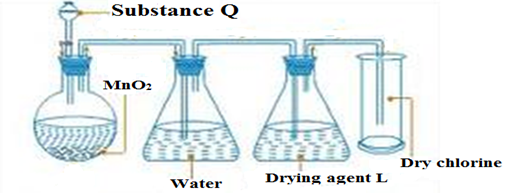
A) Name (2 marks):
(i) Substance Q
(ii) Suitable drying agent L
B) State a missing condition for the reaction to take place faster. (1 mark)
C) Moist red and blue litmus papers were dipped into the chlorine gas from the above set up. State and explain the observations made. (2 marks)
D) Write the equation for the reaction taking place in the conical flask. (1 mark)
E) Name two other substances that can be used in place of MnO2. (2 marks)
F) State three uses of chlorine. (3 marks)
6. Study the set up below.

a) Name salt K. (1 mark)
b) Write the equation for the reaction for the formation of salt K. (1 mark)
c) What property of salt A is exhibited as shown in the experiment? (1 mark)
d) What is the purpose of anhydrous calcium chloride? Explain. (2 marks)
e) Name another metal that can be used to produce similar results. (1 mark)
7. In an experiment, dry hydrogen chloride gas was passed through heated zinc turnings as in the set up below. The gas produced was then passed through copper (II) oxide.
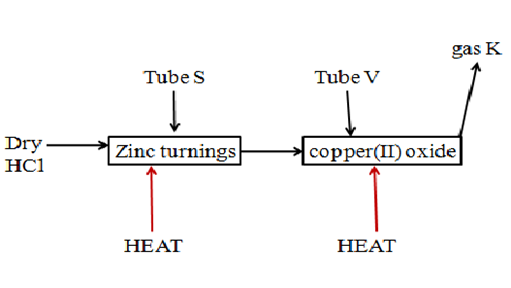
Write the equation for the reaction:
(i) For the preparation of hydrogen chloride gas. (1 mark)
(ii) In tube S. (1 mark)
b) State and explain the observation made in tube V. (2 marks)
c) How would the total mass of tube S and tube V and their contents compare before and after the experiment?
Tube S (2 marks)
Tube V (2 marks)
d) Gas K was condensed to liquid K.
(i) Identify liquid K. (1 mark)
(ii) Describe a simple chemical test to identify liquid K. (3 marks)
(iii) A small piece of sodium metal was placed into a beaker containing liquid K.
I. State three observations made. (3 marks)
II. Write an equation for the reaction that takes place. (1 mark)
III. What is the pH of the resulting solution? Explain. (2 marks)
8. Using dot (.) and cross (x) to represent electrons, show the bonding in:
(a) Hydroxonium ion (H3O+) (2 marks)
(b) Carbon (IV) oxide (CO2) (2 marks)
(c) Carbon (II) oxide (CO) (2 marks)
(d) Ammonia (NH3) (2 marks)
(e) Ammonium ion (NH4+) (2 marks)
(f) Magnesium chloride (MgCl2) (2 marks)
(g) Ethane (C2H6) (2 marks)
9. Study the set-up below and answer the questions that follow.
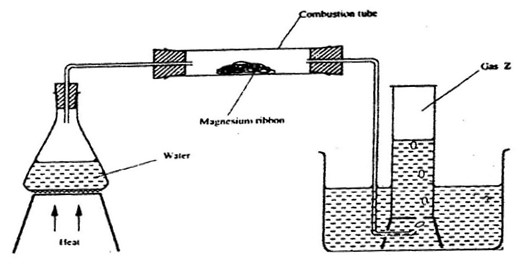
(a) Write an equation for the reaction which takes place in the combustion tube.
(b) What property of gas Z allows it to be collected as shown in the diagram?
(c) State two uses of gas Z.


3 Comments