

C. Periodicity of Chemical Families/Down the Group
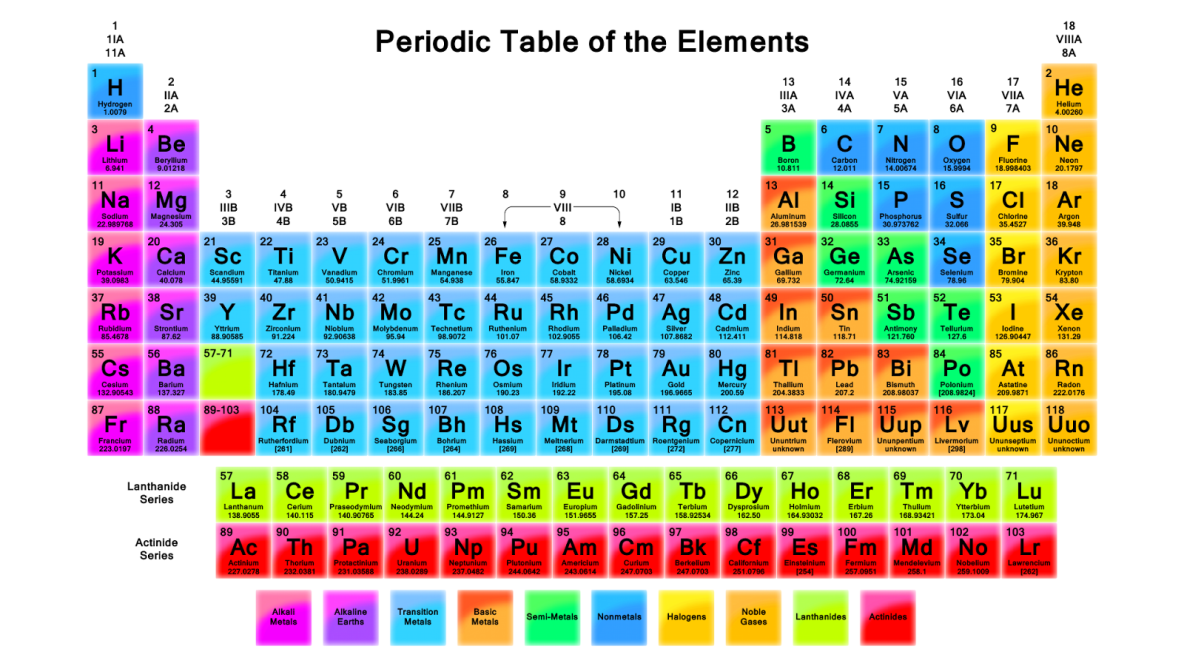
The number of valence electrons and the number of occupied energy levels in an atom of an element determine the position of an element in the periodic table. Specifically, the number of occupied energy levels determines the Period, while the valence electrons determine the Group.
Elements in the same group have similar physical and chemical properties. However, the trends in these properties vary down the group. Elements in the same group thus constitute a chemical family.
Group I Elements: Alkali Metals
Group I elements are called Alkali metals, except Hydrogen, which is a non-metal. The alkali metals include:
| Element | Symbol | Atomic Number | Electron Structure | Oxidation State | Valency |
|---|---|---|---|---|---|
| Lithium | Li | 3 | 2:1 | Li+ | 1 |
| Sodium | Na | 11 | 2:8:1 | Na+ | 1 |
| Potassium | K | 19 | 2:8:8:1 | K+ | 1 |
| Rubidium | Rb | 37 | 2:8:18:8:1 | Rb+ | 1 |
| Caesium | Cs | 55 | 2:8:18:18:8:1 | Cs+ | 1 |
| Francium | Fr | 87 | 2:8:18:32:18:8:1 | Fr+ | 1 |
All alkali metal atoms have one electron in the outer energy level. They are therefore monovalent. They donate or lose the outer electron to have an oxidation state of M+.
The number of energy levels increases down the group from Lithium to Francium. The more the number of energy levels, the larger the atomic size. For example, the atomic size of Potassium is larger than that of Sodium because Potassium has more (4) energy levels than Sodium (3 energy levels).
Atomic and Ionic Radius
The distance between the centre of the nucleus of an atom and the outermost energy level occupied by electron(s) is called the atomic radius. Atomic radius is measured in nanometers (nm). The larger the atomic radius, the larger the atomic size.
The distance between the centre of the nucleus of an ion and the outermost energy level occupied by electron(s) is called the ionic radius. Ionic radius is also measured in nanometers (nm). The larger the ionic radius, the larger the size of the ion.
Atomic radius and ionic radius depend on the number of energy levels occupied by electrons. The more the number of energy levels, the larger the atomic or ionic radius. For example, the atomic radius of Francium is larger than that of Sodium because Francium has more (7) energy levels than Sodium (3 energy levels).
Atomic radius and ionic radius of alkali metals increase down the group as the number of energy levels increases.
The atomic radius of alkali metals is larger than the ionic radius. This is because alkali metals react by losing or donating the outer electron and hence lose the outer energy level.
Table Showing the Atomic and Ionic Radius of Some Alkali Metals
| Element | Symbol | Atomic Number | Atomic Radius (nm) | Ionic Radius (nm) |
|---|---|---|---|---|
| Lithium | Li | 3 | 0.133 | 0.060 |
| Sodium | Na | 11 | 0.157 | 0.095 |
| Potassium | K | 19 | 0.203 | 0.133 |
The atomic radius of Sodium is 0.157 nm. The ionic radius of Na+ is 0.095 nm. This is because Sodium reacts by donating or losing the outer electrons and hence the outer energy level. The remaining electrons and energy levels experience greater nuclear attraction towards the nucleus, reducing the atomic radius.
Electropositivity
Electropositivity is the ease of donating or losing electrons. All alkali metals are electropositive. Electropositivity increases as atomic radius increases because the effective nuclear attraction on outer electrons decreases with increasing atomic radius. The outer electrons experience less nuclear attraction and can be lost or donated more easily. Francium is the most electropositive element in the periodic table because it has the largest atomic radius.
Ionization Energy
The minimum amount of energy required to remove an electron from an atom of an element in its gaseous state is called the 1st ionization energy. The SI unit of ionization energy is kilojoules per mole (kJ mol-1). Ionization energy depends on atomic radius. The larger the atomic radius, the less effective the nuclear attraction on outer electrons, and thus the lower the ionization energy. For alkali metals, the 1st ionization energy decreases down the group as the atomic radius increases and the effective nuclear attraction on outer electrons decreases.
For example, the 1st ionization energy of Sodium is 496 kJ mol-1, while that of Potassium is 419 kJ mol-1. This is because atomic radius increases and effective nuclear attraction on outer electrons decreases down the group from Sodium to Potassium. Therefore, it requires less energy to lose outer electrons in Potassium than in Sodium.
Physical Properties
Soft/Easy to Cut: Alkali metals are soft and easy to cut with a knife. The softness and ease of cutting increase down the group from Lithium to Francium. This is because an increase in atomic radius decreases the strength of the metallic bond and the packing of the metallic structure.
Appearance: Alkali metals have a shiny grey metallic luster when freshly cut. The surface rapidly tarnishes on exposure to air because the metal surface quickly reacts with oxygen.
Melting and Boiling Points: Alkali metals have relatively low melting and boiling points compared to common metals like Iron. This is because alkali metals use only one delocalized electron to form a weak metallic bond.
Electrical/Thermal Conductivity: Alkali metals are good thermal and electrical conductors. Metals conduct using the outer mobile delocalized electrons, which move randomly within the metallic structure.
Summary of Some Physical Properties of the First Three Alkali Metals
| Alkali Metal | Appearance | Ease of Cutting | Melting Point (°C) | Boiling Point (°C) | Conductivity | 1st Ionization Energy (kJ mol-1) |
|---|---|---|---|---|---|---|
| Lithium | Silvery white | Not easy | 180 | 1330 | Good | 520 |
| Sodium | Shiny grey | Easy | 98 | 890 | Good | 496 |
| Potassium | Shiny grey | Very easy | 64 | 774 | Good | 419 |
Chemical Properties
(i) Reaction with Air/Oxygen
On exposure to air, alkali metals react with the elements in the air.
Example
On exposure to air, Sodium first reacts with Oxygen to form sodium oxide:
4Na(s) + O2(g) → 2Na2O(s)
The sodium oxide formed further reacts with water or moisture in the air to form sodium hydroxide solution:
Na2O(s) + H2O(l) → 2NaOH(aq)
Sodium hydroxide solution reacts with carbon (IV) oxide in the air to form sodium carbonate:
2NaOH(aq) + CO2(g) → Na2CO3(aq) + H2O(l)
(ii) Burning in Air/Oxygen
Lithium burns in air with a crimson or deep red flame to form Lithium oxide:
4Li(s) + O2(g) → 2Li2O(s)
Sodium burns in air with a yellow flame to form sodium oxide:
4Na(s) + O2(g) → 2Na2O(s)
Sodium burns in oxygen with a yellow flame to form sodium peroxide:
2Na(s) + O2(g) → Na2O2(s)
Potassium burns in air with a lilac or purple flame to form potassium oxide:
4K(s) + O2(g) → 2K2O(s)
(iii) Reaction with Water
Experiment
- Measure 500 cm3 of water into a beaker.
- Add three drops of phenolphthalein indicator.
- Put about 0.5 g of Lithium metal into the beaker.
- Determine the pH of the final product.
- Repeat the experiment using about 0.1 g of Sodium and Potassium.
Caution: Keep a safe distance.
Observations
| Alkali Metal | Observations | Comparative Speed/Rate of Reaction |
|---|---|---|
| Lithium |
| Moderately vigorous |
| Sodium |
| Very vigorous |
| Potassium |
| Explosive; bursts into flames |
Explanation: Alkali metals are less dense than water and therefore float. They react with water to form a strongly alkaline solution of their hydroxides and produce hydrogen gas. The rate of this reaction increases down the group; Potassium is more reactive than Sodium, and Sodium is more reactive than Lithium.
The reactivity increases as the electropositivity of the alkali metals increases. This is because as the atomic radius increases, the ease of donating or losing the outer electron increases during chemical reactions.
Chemical Equations
2Li(s) + 2H2O(l) → 2LiOH(aq) + H2(g)
2Na(s) + 2H2O(l) → 2NaOH(aq) + H2(g)
2K(s) + 2H2O(l) → 2KOH(aq) + H2(g)
2Rb(s) + 2H2O(l) → 2RbOH(aq) + H2(g)
2Cs(s) + 2H2O(l) → 2CsOH(aq) + H2(g)
2Fr(s) + 2H2O(l) → 2FrOH(aq) + H2(g)
Reactivity increases down the group.
(iv) Reaction with Chlorine
Experiment
Cut about 0.5 g of Sodium into a deflagrating spoon with a lid cover. Heat it on a Bunsen flame until it catches fire. Quickly and carefully lower it into a gas jar containing dry chlorine to cover the gas jar.
Repeat with about 0.5 g of Lithium.
Caution: This experiment should be done in a fume chamber because chlorine is poisonous.
Observation
Sodium metal continues to burn with a yellow flame forming white solid or fumes.
Lithium metal continues to burn with a crimson flame forming white solid or fumes.
Alkali metals react with chlorine gas to form the corresponding metal chlorides. The reactivity increases as electropositivity increases down the group from Lithium to Francium. The ease of donating or losing the outer electrons increases as the atomic radius increases and the outer electron is less attracted to the nucleus.
Chemical Equations
2Li(s) + Cl2(g) → 2LiCl(s)
2Na(s) + Cl2(g) → 2NaCl(s)
2K(s) + Cl2(g) → 2KCl(s)
2Rb(s) + Cl2(g) → 2RbCl(s)
2Cs(s) + Cl2(g) → 2CsCl(s)
2Fr(s) + Cl2(g) → 2FrCl(s)
Reactivity increases down the group.
The table below shows some compounds of the first three alkali metals:
| Lithium | Sodium | Potassium | |
|---|---|---|---|
| Hydroxide | LiOH | NaOH | KOH |
| Oxide | Li2O | Na2O | K2O |
| Sulphide | Li2S | Na2S | K2S |
| Chloride | LiCl | NaCl | KCl |
| Carbonate | Li2CO3 | Na2CO3 | K2CO3 |
| Nitrate(V) | LiNO3 | NaNO3 | KNO3 |
| Nitrate(III) | – | NaNO2 | KNO2 |
| Sulphate(VI) | Li2SO4 | Na2SO4 | K2SO4 |
| Sulphate(IV) | – | Na2SO3 | K2SO3 |
| Hydrogen carbonate | – | NaHCO3 | KHCO3 |
| Hydrogen sulphate(VI) | – | NaHSO4 | KHSO4 |
| Hydrogen sulphate(IV) | – | NaHSO3 | KHSO3 |
| Phosphate | – | Na3PO4 | K3PO4 |
| Manganate(VI) | – | NaMnO4 | KMnO4 |
| Dichromate(VI) | – | Na2Cr2O7 | K2Cr2O7 |
| Chromate(VI) | – | Na2CrO4 | K2CrO4 |
Some uses of alkali metals include:
- Sodium is used in making sodium cyanide for extracting gold from gold ore.
- Sodium chloride is used in seasoning food.
- Molten mixture of sodium and potassium is used as coolant in nuclear reactors.
- Sodium is used in making sodium hydroxide, which is used in making soapy and soapless detergents.
- Sodium is used as a reducing agent for the extraction of titanium from Titanium (IV) chloride.
- Lithium is used in making special high-strength glasses.
- Lithium compounds are used to make dry cells in mobile phones and computer laptops.
Group II Elements: Alkaline Earth Metals
Group II elements are called Alkaline earth metals. The alkaline earth metals include:
| Element | Symbol | Atomic Number | Electron Structure | Oxidation State | Valency |
|---|---|---|---|---|---|
| Beryllium | Be | 4 | 2:2 | Be2+ | 2 |
| Magnesium | Mg | 12 | 2:8:2 | Mg2+ | 2 |
| Calcium | Ca | 20 | 2:8:8:2 | Ca2+ | 2 |
| Strontium | Sr | 38 | 2:8:18:8:2 | Sr2+ | 2 |
| Barium | Ba | 56 | 2:8:18:18:8:2 | Ba2+ | 2 |
| Radium | Ra | 88 | 2:8:18:32:18:8:2 | Ra2+ | 2 |
All alkaline earth metal atoms have two electrons in the outer energy level. They are therefore divalent. They donate or lose the two outer electrons to have an oxidation state of M2+.
The number of energy levels increases down the group from Beryllium to Radium. The more the number of energy levels, the larger the atomic size. For example, the atomic size or radius of Calcium is larger than that of Magnesium because Calcium has more (4) energy levels than Magnesium (3 energy levels).
Atomic radius and ionic radius of alkaline earth metals increase down the group as the number of energy levels increases.
The atomic radius of alkaline earth metals is larger than the ionic radius. This is because they react by losing or donating the two outer electrons and hence lose the outer energy level.
Table Showing the Atomic and Ionic Radius of the First Three Alkaline Earth Metals
| Element | Symbol | Atomic Number | Atomic Radius (nm) | Ionic Radius (nm) |
|---|---|---|---|---|
| Beryllium | Be | 4 | 0.089 | 0.031 |
| Magnesium | Mg | 12 | 0.136 | 0.065 |
| Calcium | Ca | 20 | 0.174 | 0.099 |
The atomic radius of Magnesium is 0.136 nm. The ionic radius of Mg2+ is 0.065 nm. This is because Magnesium reacts by donating or losing the two outer electrons and hence the outer energy level. The remaining electrons and energy levels experience greater nuclear attraction towards the nucleus, reducing the atomic radius.
Electropositivity
All alkaline earth metals are also electropositive like alkali metals. Electropositivity increases with increasing atomic radius or size. Calcium is more electropositive than Magnesium because the effective nuclear attraction on outer electrons decreases with increasing atomic radius. The two outer electrons in Calcium experience less nuclear attraction and can be lost or donated more easily due to the larger atomic radius.
Ionization Energy
For alkaline earth metals, the 1st ionization energy decreases down the group as the atomic radius increases and the effective nuclear attraction on outer electrons decreases. For example, the 1st ionization energy of Magnesium is 900 kJ mol-1, while that of Calcium is 590 kJ mol-1. This is because atomic radius increases and effective nuclear attraction on outer electrons decreases down the group from Magnesium to Calcium.
It therefore requires less energy to lose outer electrons in Calcium than in Magnesium.
The minimum amount of energy required to remove a second electron from an ion of an element in its gaseous state is called the 2nd ionization energy.
The 2nd ionization energy is always higher than the 1st ionization energy because once an electron is lost from an atom, the overall effective nuclear attraction on the remaining electrons increases. Removing a second electron from the ion therefore requires more energy than removing the first electron.
The atomic radius of alkali metals is larger than that of alkaline earth metals. This is because across the period from left to right there is an increase in nuclear charge from additional protons, while electrons enter the same energy level. The increase in nuclear charge increases the effective nuclear attraction on the outer energy level, pulling it closer to the nucleus. For example, the atomic radius of Sodium (0.157 nm) is larger than that of Magnesium (0.137 nm) because Magnesium has greater effective nuclear attraction on the outer energy level than Sodium.
Physical Properties
Soft/Easy to Cut: Alkaline earth metals are not soft and easy to cut with a knife like alkali metals. This is because the smaller atomic radius of alkaline earth metals increases the strength of the metallic bond and the packing of the metallic structure. Alkaline earth metals are:
- Ductile (able to form wire or thin long rods)
- Malleable (able to be hammered into sheets or thin plates)
- Have high tensile strength (able to be coiled without breaking, not brittle, and withstand stress)
Appearance: Alkaline earth metals have a shiny grey metallic luster when their surface is freshly polished or scrubbed. The surface slowly tarnishes on exposure to air because the metal surface slowly oxidizes to form an oxide layer. This oxide layer should be removed before using the alkaline earth metals.
Melting and Boiling Points: Alkaline earth metals have relatively higher melting and boiling points than alkali metals. This is because alkali metals use only one delocalized electron to form a weaker metallic bond, while alkaline earth metals use two delocalized electrons to form a stronger metallic bond.
The melting and boiling points decrease down the group as the atomic radius increases, reducing the strength of the metallic bond and packing of the metallic structure. For example, Beryllium has a melting point of 1280°C, while Magnesium has a melting point of 650°C. Beryllium has a smaller atomic radius than Magnesium, so the metallic bond and packing are stronger in Beryllium.
Electrical/Thermal Conductivity: Alkaline earth metals are good thermal and electrical conductors. The two delocalized valence electrons move randomly within the metallic structure.
Electrical conductivity increases down the group as the atomic radius increases, making the delocalized outer electrons less attracted to the nucleus. Alkaline earth metals are better thermal and electrical conductors than alkali metals because they have two outer delocalized electrons. For example, Magnesium is a better conductor than Sodium because it has two delocalized electrons compared to Sodium’s one. Calcium is a better conductor than Magnesium because it has a larger atomic radius, making its delocalized electrons more free and mobile.
Summary of Some Physical Properties of the First Three Alkaline Earth Metals
| Alkaline Earth Metal | Appearance | Ease of Cutting | Melting Point (°C) | Boiling Point (°C) | Conductivity | 1st Ionization Energy (kJ mol-1) | 2nd Ionization Energy (kJ mol-1) |
|---|---|---|---|---|---|---|---|
| Beryllium | Shiny grey | Not easy | 1280 | 3450 | Good | 900 | 1800 |
| Magnesium | Shiny grey | Not easy | 650 | 1110 | Good | 736 | 1450 |
| Calcium | Shiny grey | Not easy | 850 | 1140 | Good | 590 | 970 |
Chemical Properties
- Reaction with Air/Oxygen
On exposure to air, the surface of alkaline earth metals is slowly oxidized to form an oxide on prolonged exposure.
Example
On exposure to air, the surface of magnesium ribbon is oxidized to form a thin film of Magnesium oxide:
2Mg(s) + O2(g) → 2MgO(s)
- Burning in Air/Oxygen
Experiment
Hold about 2 cm length of Magnesium ribbon on a Bunsen flame. Stop heating when it catches fire.
Caution: Do not look directly at the flame.
Put the products of burning into 100 cm3 beaker. Add about 5 cm3 of distilled water. Swirl. Test the mixture using litmus papers. Repeat with Calcium.
Observations
- Magnesium burns with a bright blinding flame.
- White solid or ash produced.
- Solid dissolves in water to form a colourless solution.
- Blue litmus paper remains blue.
- Red litmus paper turns blue.
- Colourless gas with pungent smell of ammonia.
Explanation
Magnesium burns in air with a bright blinding flame to form a mixture of Magnesium oxide and Magnesium nitride:
2Mg(s) + O2(g) → 2MgO(s)
3Mg(s) + N2(g) → Mg3N2(s)
Magnesium oxide dissolves in water to form magnesium hydroxide:
MgO(s) + H2O(l) → Mg(OH)2(aq)
Magnesium nitride dissolves in water to form magnesium hydroxide and produce ammonia gas:
Mg3N2(s) + 6H2O(l) → 3Mg(OH)2(aq) + 2NH3(g)
Magnesium hydroxide and ammonia are weakly alkaline with pH 8–11 and turn red litmus paper blue.
Calcium burns in air with a faint orange or red flame to form a mixture of Calcium oxide and Calcium nitride:
2Ca(s) + O2(g) → 2CaO(s)
3Ca(s) + N2(g) → Ca3N2(s)
Calcium oxide dissolves in water to form calcium hydroxide:
CaO(s) + H2O(l) → Ca(OH)2(aq)
Calcium nitride dissolves in water to form calcium hydroxide and produce ammonia gas:
Ca3N2(s) + 6H2O(l) → 3Ca(OH)2(aq) + 2NH3(g)
Calcium hydroxide is also a weakly alkaline solution with pH 8–11 and turns red litmus paper blue.
- Reaction with Water
Experiment
Measure 50 cm3 of distilled water into a beaker.
Scrub or polish with sandpaper 1 cm length of Magnesium ribbon.
Place it in the water. Test the product mixture with blue and red litmus papers.
Repeat with Calcium metal.
Observations
- Surface of magnesium covered by bubbles of colourless gas.
- Colourless solution formed.
- Effervescence, bubbles, or fizzing takes place in Calcium.
- Red litmus paper turns blue.
- Blue litmus paper remains blue.
Explanations
Magnesium slowly reacts with cold water to form Magnesium hydroxide and bubbles of Hydrogen gas that stick on the surface of the ribbon:
Mg(s) + 2H2O(l) → Mg(OH)2(aq) + H2(g)
Calcium moderately reacts with cold water to form Calcium hydroxide and produce a steady stream of Hydrogen gas:
Ca(s) + 2H2O(l) → Ca(OH)2(aq) + H2(g)
- Reaction with Water Vapour/Steam
Experiment
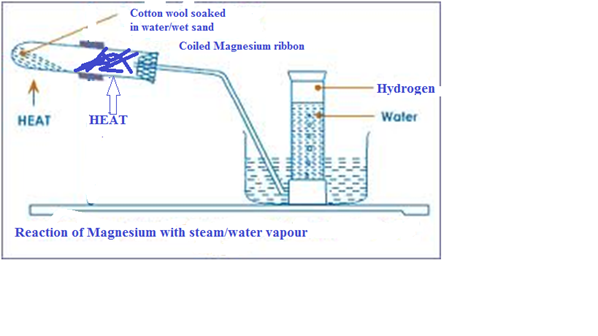
Put some cotton wool soaked in water or wet sand in a long boiling tube.
Coil a well-polished magnesium ribbon into the boiling tube.
Ensure the coil touches the side of the boiling tube. Heat the cotton wool or sand slightly, then strongly heat the Magnesium ribbon.
Setup of Apparatus
Observations
- Magnesium glows red hot then burns with a blinding flame.
- Magnesium continues to glow or burn even without more heating.
- White solid or residue formed.
- Colourless gas collected over water.
Explanation
On heating wet sand, steam is generated which drives out the air that would otherwise react with or oxidize the ribbon.
Magnesium burns in steam or water vapour generating enough heat to ensure the reaction goes to completion even without further heating. White Magnesium oxide is formed and hydrogen gas is evolved.
To prevent suck back, the delivery tube should be removed from the water before heating is stopped at the end of the experiment.
Mg(s) + H2O(g) → MgO(s) + H2(g)
- Reaction with Chlorine Gas
Experiment
Lower slowly burning magnesium ribbon or shavings into a gas jar containing Chlorine gas. Repeat with a hot piece of calcium metal.
Observation
- Magnesium continues to burn in chlorine with a bright blinding flame.
- Calcium continues to burn for a short time.
- White solid formed.
- Pale green colour of chlorine fades.
Explanation
Magnesium continues to burn in chlorine gas forming white magnesium chloride solid:
Mg(s) + Cl2(g) → MgCl2(s)
Calcium burns slightly in chlorine gas to form white calcium chloride solid. Calcium chloride formed coats unreacted Calcium stopping further reaction:
Ca(s) + Cl2(g) → CaCl2(s)
- Reaction with Dilute Acids
Experiment
Place about 4.0 cm3 of 0.1M dilute sulphuric (VI) acid into a test tube. Add about 1.0 cm length of magnesium ribbon into the test tube. Cover the mouth of the test tube using a thumb. Release the gas and test the gas using a burning splint.
Repeat with about 4.0 cm3 of 0.1M dilute hydrochloric or nitric (V) acid.
Repeat with 0.1 g of Calcium in a beaker with all the above acids.
Caution: Keep distance when using calcium.
Observation
- Effervescence, fizzing, or bubbles with dilute sulphuric (VI) and nitric (V) acids.
- Little effervescence or fizzing with calcium and dilute sulphuric (VI) acid.
- Colourless gas produced that extinguishes a burning splint with an explosion or “pop” sound.
- No gas is produced with Nitric (V) acid.
- Colourless solution is formed.
Explanation
Dilute acids react with alkaline earth metals to form a salt and produce hydrogen gas.
Nitric (V) acid is a strong oxidizing agent. It quickly oxidizes the hydrogen produced to water.
Calcium is very reactive with dilute acids and thus a very small piece of very dilute acid should be used.
Chemical Equations
Mg(s) + H2SO4(aq) → MgSO4(aq) + H2(g)
Mg(s) + 2HNO3(aq) → Mg(NO3)2(aq) + H2(g)
Mg(s) + 2HCl(aq) → MgCl2(aq) + H2(g)
Ca(s) + H2SO4(aq) → CaSO4(s) + H2(g)
(insoluble CaSO4(s) coats Ca(s))
Ca(s) + 2HNO3(aq) → Ca(NO3)2(aq) + H2(g)
Ca(s) + 2HCl(aq) → CaCl2(aq) + H2(g)
Ba(s) + H2SO4(aq) → BaSO4(s) + H2(g)
(insoluble BaSO4(s) coats Ba(s))
Ba(s) + 2HNO3(aq) → Ba(NO3)2(aq) + H2(g)
Ba(s) + 2HCl(aq) → BaCl2(aq) + H2(g)
The table below shows some compounds of some alkaline earth metals:
| Beryllium | Magnesium | Calcium | Barium | |
|---|---|---|---|---|
| Hydroxide | Be(OH)2 | Mg(OH)2 | Ca(OH)2 | Ba(OH)2 |
| Oxide | BeO | MgO | CaO | BaO |
| Sulphide | – | MgS | CaS | BaS |
| Chloride | BeCl2 | MgCl2 | CaCl2 | BaCl2 |
| Carbonate | BeCO3 | MgCO3 | CaCO3 | BaCO3 |
| Nitrate(V) | Be(NO3)2 | Mg(NO3)2 | Ca(NO3)2 | Ba(NO3)2 |
| Sulphate(VI) | BeSO4 | MgSO4 | CaSO4 | BaSO4 |
| Sulphate(IV) | – | – | CaSO3 | BaSO3 |
| Hydrogen carbonate | – | Mg(HCO3)2 | Ca(HCO3)2 | – |
| Hydrogen sulphate(VI) | – | Mg(HSO4)2 | Ca(HSO4)2 | – |
Some uses of alkaline earth metals include:
- Magnesium hydroxide is a non-toxic mild base used as an antacid medicine to relieve stomach acidity.
- Making duralumin, an alloy of Magnesium and aluminium used for making aeroplane bodies because it is light.
- Making plaster of Paris – Calcium sulphate (VI) is used in hospitals to set fractured bones.
- Making cement – Calcium carbonate is mixed with clay and sand then heated to form cement for construction.
- Raising soil pH – Quicklime or calcium oxide is added to acidic soils to neutralize and raise the soil pH in agricultural farms.
- As nitrogenous fertilizer – Calcium nitrate (V) is used as an agricultural fertilizer because plants require calcium for proper growth.
- In the blast furnace – Limestone is added to the blast furnace to produce more reducing agent and remove slag during the extraction of Iron.
Group VII Elements: Halogens
Group VII elements are called Halogens. They are all non-metals. They include:
| Element | Symbol | Atomic Number | Electronic Configuration | Charge of Ion | Valency | State at Room Temperature |
|---|---|---|---|---|---|---|
| Fluorine | F | 9 | 2:7 | F– | 1 | Pale yellow gas |
| Chlorine | Cl | 17 | 2:8:7 | Cl– | 1 | Pale green gas |
| Bromine | Br | 35 | 2:8:18:7 | Br– | 1 | Red liquid |
| Iodine | I | 53 | 2:8:18:18:7 | I– | 1 | Grey solid |
| Astatine | At | 85 | 2:8:18:32:18:7 | At– | 1 | Radioactive |
All halogen atoms have seven electrons in the outer energy level. They acquire or gain one electron in the outer energy level to be stable. They are therefore monovalent and exist in oxidation state X–.
The number of energy levels increases down the group from Fluorine to Astatine. The more the number of energy levels, the larger the atomic size. For example, the atomic size or radius of Chlorine is larger than that of Fluorine because Chlorine has more (3) energy levels than Fluorine (2 energy levels).
Atomic radius and ionic radius of Halogens increase down the group as the number of energy levels increases.
The atomic radius of Halogens is smaller than the ionic radius. This is because they react by gaining or acquiring an extra electron in the outer energy level. The effective nuclear attraction on the additional electrons decreases. The incoming extra electron is also repelled, causing the outer energy level to expand to reduce the repulsion and accommodate more electrons.
Table Showing the Atomic and Ionic Radius of Four Halogens
| Element | Symbol | Atomic Number | Atomic Radius (nm) | Ionic Radius (nm) |
|---|---|---|---|---|
| Fluorine | F | 9 | 0.064 | 0.136 |
| Chlorine | Cl | 17 | 0.099 | 0.181 |
| Bromine | Br | 35 | 0.114 | 0.195 |
| Iodine | I | 53 | 0.133 | 0.216 |
The atomic radius of Chlorine is 0.099 nm. The ionic radius of Cl– is 0.181 nm. This is because Chlorine atom or molecule reacts by gaining or acquiring an extra electron. The additional electrons experience less effective nuclear attraction towards the nucleus. The outer energy level expands to reduce the repulsion of the existing and incoming electrons.
Electronegativity
Electronegativity is the ease of gaining or acquiring extra electrons. All halogens are electronegative. Electronegativity decreases as atomic radius increases because the effective nuclear attraction on outer electrons decreases with increasing atomic radius. The outer electrons experience less nuclear attraction, reducing the ease of gaining extra electrons.
Electronegativity is measured using Pauling’s scale. Fluorine, with a Pauling scale value of 4.0, is the most electronegative element and thus has the highest tendency to acquire or gain an extra electron.
Table Showing the Electronegativity of the Halogens
| Halogen | F | Cl | Br | I | At |
|---|---|---|---|---|---|
| Electronegativity (Pauling scale) | 4.0 | 3.0 | 2.8 | 2.5 | 2.2 |
The electronegativity of the halogens decreases down the group from Fluorine to Astatine because atomic radius increases down the group, decreasing electron-attracting power. Fluorine is the most electronegative element in the periodic table because it has the smallest atomic radius.
Electron Affinity
The minimum amount of energy required to gain or acquire an extra electron by an atom of an element in its gaseous state is called the 1st electron affinity. The SI unit of electron affinity is kilojoules per mole (kJ mol-1). Electron affinity depends on atomic radius. The larger the atomic radius, the less effective the nuclear attraction on outer electrons and thus the lower the electron affinity. For halogens, the 1st electron affinity decreases down the group as the atomic radius increases and the effective nuclear attraction on outer electrons decreases. Due to its small size, Fluorine shows exceptionally low electron affinity because a lot of energy is required to overcome the high repulsion of the existing and incoming electrons.
Table showing the electron affinity of halogens for the process:
X + e → X–
| Halogen | F | Cl | Br | I |
|---|---|---|---|---|
| Electron Affinity (kJ mol-1) | -333 | -364 | -342 | -295 |
The higher the electron affinity, the more stable the ion. For example, Cl– is a more stable ion than Br– because it has a more negative or exothermic electron affinity.
Electron affinity is different from:
- Ionization energy: Ionization energy is the energy required to lose or donate an electron from an atom of an element in its gaseous state, while electron affinity is the energy released or required to gain or acquire an extra electron by an atom in its gaseous state.
- Electronegativity: Electron affinity is the energy change when an atom gains an electron in the gaseous state (X(g) + e → X–(g)). Electronegativity is the tendency of an element to attract electrons during chemical reactions and is measured theoretically using Pauling’s scale.
Physical Properties
State at Room Temperature: Fluorine and Chlorine are gases, Bromine is a liquid, and Iodine is a solid. Astatine is radioactive.
All halogens exist as diatomic molecules bonded by strong covalent bonds. Each molecule is joined to another by weak intermolecular forces or Van-der-Waals forces.
Melting/Boiling Point: The strength of intermolecular or Van-der-Waals forces increases with increasing molecular size or atomic radius.
Iodine has the largest atomic radius and thus the strongest intermolecular forces, making it a solid at room temperature.
Iodine sublimes when heated to form (caution: highly toxic) purple vapour. This is because Iodine molecules are held together by weak Van-der-Waals forces which require little heat energy to break.
Electrical Conductivity: All halogens are poor conductors of electricity because they have no free delocalized electrons.
Solubility in Polar and Non-Polar Solvents: All halogens are soluble in water (a polar solvent).
When a boiling tube containing either chlorine gas or bromine vapour is separately inverted in a beaker containing distilled water and tetrachloromethane (a non-polar solvent), the level of solution in the boiling tube rises in both water and tetrachloromethane.
This is because halogens are soluble in both polar and non-polar solvents. Solubility of halogens in water decreases down the group, while solubility in non-polar solvents increases down the group.
The level of water in chlorine is higher than in bromine, and the level of tetrachloromethane in chlorine is lower than in bromine.
Caution: Tetrachloromethane, Bromine vapour, and Chlorine gas are all highly toxic.
Table Showing the Physical Properties of Halogens
| Halogen | Formula of Molecule | Electrical Conductivity | Solubility in Water | Melting Point (°C) | Boiling Point (°C) |
|---|---|---|---|---|---|
| Fluorine | F2 | Poor | Insoluble/soluble in tetrachloromethane | -238 | -188 |
| Chlorine | Cl2 | Poor | Insoluble/soluble in tetrachloromethane | -101 | -35 |
| Bromine | Br2 | Poor | Insoluble/soluble in tetrachloromethane | 7 | 59 |
| Iodine | I2 | Poor | Insoluble/soluble in tetrachloromethane | 114 | Sublimes |
Chemical Properties
(i) Displacement
Experiment
Place separately in test tubes about 5 cm3 of sodium chloride, sodium bromide, and sodium iodide solutions.
Add 5 drops of chlorine water to each test tube.
Repeat with 5 drops of bromine water instead of chlorine water.
Observation
Using Chlorine Water: Yellow colour of chlorine water fades in all test tubes except with sodium chloride. Coloured solution formed.
Using Bromine Water: Yellow colour of bromine water fades in test tubes containing sodium iodide. Coloured solution formed.
Explanation
The halogens displace each other from their solutions. The more electronegative halogen displaces the less electronegative from their solutions.
Chlorine is more electronegative than bromine and iodine. On adding chlorine water, bromine and iodine are displaced from their solutions by chlorine.
Bromine is more electronegative than iodide but less than chlorine. On adding bromine water, iodine is displaced from its solution but not chlorine.
Table Showing the Displacement of the Halogens
(✓) means there is displacement, (x) means there is no displacement.
| Halogen Ion in Solution | F– | Cl– | Br– | I– |
|---|---|---|---|---|
| F2 | x | |||
| Cl2 | x | x | ||
| Br2 | x | x | x | |
| I2 | x | x | x | x |
Chemical/Ionic Equations
With Fluorine
F2(g) + 2NaCl(aq) → 2NaF(aq) + Cl2(aq)
F2(g) + 2Cl–(aq) → 2F–(aq) + Cl2(aq)
F2(g) + 2NaBr(aq) → 2NaF(aq) + Br2(aq)
F2(g) + 2Br–(aq) → 2F–(aq) + Br2(aq)
F2(g) + 2NaI(aq) → 2NaF(aq) + I2(aq)
F2(g) + 2I–(aq) → 2F–(aq) + I2(aq)
With Chlorine
Cl2(g) + 2NaBr(aq) → 2NaCl(aq) + Br2(aq)
Cl2(g) + 2Br–(aq) → 2Cl–(aq) + Br2(aq)
Cl2(g) + 2NaI(aq) → 2NaCl(aq) + I2(aq)
Cl2(g) + 2I–(aq) → 2Cl–(aq) + I2(aq)
With Bromine
Br2(g) + 2NaI(aq) → 2NaBr(aq) + I2(aq)
Br2(g) + 2I–(aq) → 2Br–(aq) + I2(aq)
Uses of Halogens
- Fluorine – manufacture of P.T.F.E (Polytetrafluoroethylene) synthetic fiber.
- Reduces tooth decay when added in small amounts in toothpaste.
NB – large quantities of fluorine or fluoride ions in water cause browning of teeth or fluorosis.
- Hydrogen fluoride is used to engrave words or pictures in glass.
- Bromine – Silver bromide is used to make light-sensitive photographic paper and films.
- Iodide – Iodine dissolved in alcohol is used as medicine to kill bacteria in skin cuts. It is called tincture of iodine.
Table Showing Some Compounds of Halogens
| Element/Halogen | H | Na | Mg | Al | Si | C | P |
|---|---|---|---|---|---|---|---|
| F | HF | NaF | MgH2 | AlF3 | SiF4 | CF4 | PF3 |
| Cl | HCl | NaCl | MgCl2 | AlCl3 | SiCl3 | CCl4 | PCl3 |
| Br | HBr | NaBr | MgBr2 | AlBr3 | SiBr4 | CBr4 | PBr3 |
| I | HI | NaI | MgI2 | AlI3 | SiI4 | Cl2 | PBr3 |
Bond Energy of Four Halogens
Bond energy is the energy required to break or form one mole of chemical bonds.
| Bond | Bond Energy (kJ mol-1) |
|---|---|
| Cl-Cl | 242 |
| Br-Br | 193 |
| I-I | 151 |
Explanation of Trend in Bond Energy of Halogens:
- Bond energy decreases down the group from chlorine to iodine.
- Atomic radius increases down the group, decreasing the energy required to break the covalent bonds between the larger atoms with reduced effective nuclear charge and outer energy levels involved in bonding.
Group VIII Elements: Noble Gases
Group VIII elements are called Noble gases. They are all non-metals. Noble gases occupy about 1.0% of the atmosphere as a colourless gaseous mixture. Argon is the most abundant with 0.9%.
They exist as monatomic molecules with very weak Van-der-Waals or intermolecular forces holding the molecules.
They include:
| Element | Symbol | Atomic Number | Electron Structure | State at Room Temperature |
|---|---|---|---|---|
| Helium | He | 2 | 2 | Colourless gas |
| Neon | Ne | 10 | 2:8 | Colourless gas |
| Argon | Ar | 18 | 2:8:8 | Colourless gas |
| Krypton | Kr | 36 | 2:8:18:8 | Colourless gas |
| Xenon | Xe | 54 | 2:8:18:18:8 | Colourless gas |
| Radon | Rn | 86 | 2:8:18:32:18:8 | Radioactive |
All noble gas atoms have a stable duplet (two electrons in the 1st energy level) or octet (eight electrons in other outer energy levels) in the outer energy level. They therefore do not acquire or gain extra electrons in the outer energy level or donate or lose electrons. They are therefore zerovalent.
The number of energy levels increases down the group from Helium to Radon. The more the number of energy levels, the larger the atomic size or radius. For example, the atomic size or radius of Argon is larger than that of Neon because Argon has more (3) energy levels than Neon (2 energy levels).
Atomic radius of noble gases increases down the group as the number of energy levels increases.
The effective nuclear attraction on the outer electrons decreases down the group.
The noble gases are generally unreactive because the outer energy level has a stable octet or duplet. The stable octet or duplet in noble gas atoms leads to comparatively very high 1st ionization energy. This is because losing or donating an electron from the stable atom requires a lot of energy and makes it unstable.
As atomic radius increases down the group and the 1st ionization energy decreases, very electronegative elements like Oxygen and Fluorine are able to react and bond with lower members of the noble gases. For example, Xenon reacts with Fluorine to form a covalent compound XeF6. This is because the outer electrons or energy level of Xenon is far from the nucleus and thus experience less effective nuclear attraction.
Noble gases have low melting and boiling points because they exist as monatomic molecules joined by very weak intermolecular or Van-der-Waals forces that require very little energy to weaken and form liquid and break to form gas.
The intermolecular or Van-der-Waals forces increase down the group as the atomic radius or size increases from Helium to Radon. The melting and boiling points thus increase down the group.
Noble gases are insoluble in water and are poor conductors of electricity.
| Element | Formula of Molecule | Electrical Conductivity | Solubility in Water | Atomic Radius (nm) | 1st Ionization Energy (kJ mol-1) | Melting Point (°C) | Boiling Point (°C) |
|---|---|---|---|---|---|---|---|
| Helium | He | Poor | Insoluble | 0.128 | 2372 | -270 | -269 |
| Neon | Ne | Poor | Insoluble | 0.160 | 2080 | -249 | -246 |
| Argon | Ar | Poor | Insoluble | 0.192 | 1520 | -189 | -186 |
| Krypton | Kr | Poor | Insoluble | 0.197 | 1350 | -157 | -152 |
| Xenon | Xe | Poor | Insoluble | 0.217 | 1170 | -112 | -108 |
| Radon | Rn | Poor | Insoluble | 0.221 | 1134 | -104 | -93 |
Uses of Noble Gases
- Argon is used in light bulbs to provide an inert environment to prevent oxidation of the bulb filament.
- Argon is used in arc welding as an insulator.
- Neon is used in street and advertisement lights.
- Helium is mixed with Oxygen during deep sea diving and mountaineering.
- Helium is used in weather balloons for meteorological research instead of Hydrogen because it is unreactive. Hydrogen when impure can ignite with an explosion.
- Helium is used in making thermometers for measuring very low temperatures.


