

Chemistry Form Two Notes
Introduction to Electrolysis (Electrolytic Cell)
1. Electrolysis is defined as the decomposition of a compound by an electric current or electricity.
A compound that is decomposed by an electric current is called an electrolyte. Some electrolytes are weak, while others are strong.
2. Strong electrolytes are those that are fully ionized or dissociated into many ions. Common strong electrolytes include:
- All mineral acids
- All strong alkalis such as sodium hydroxide and potassium hydroxide
- All soluble salts
3. Weak electrolytes are those that are partially ionized or dissociated into few ions. Common weak electrolytes include:
- All organic acids
- All bases except sodium hydroxide and potassium hydroxide
- Water
4. A compound that is not decomposed by an electric current is called a non-electrolyte.
Non-electrolytes are compounds or substances that exist as molecules and thus cannot ionize or dissociate into any ions. Common non-electrolytes include:
- Most organic solvents (e.g., petrol, paraffin, benzene, methylbenzene, ethanol)
- All hydrocarbons (alkanes, alkenes, alkynes)
- Biological chemicals such as proteins, carbohydrates, lipids, starch, and sugar
5. Electrolytes in the solid state have fused or joined ions and therefore do not conduct electricity. However, the ions (cations and anions) are free and mobile in the molten and aqueous (solution, dissolved in water) states.
6. During electrolysis, the free ions are attracted to the electrodes.
An electrode is a rod through which current enters and leaves the electrolyte during electrolysis.
An electrode that does not influence or alter the products of electrolysis is called an inert electrode.
Common inert electrodes include:
- Platinum
- Carbon graphite
Platinum is not usually used in a school laboratory because it is very expensive. Carbon graphite is easily and cheaply available (from used dry cells).
7. The positive electrode is called the Anode. The anode is the electrode through which current enters the electrolyte and electrons leave the electrolyte.
8. The negative electrode is called the Cathode. The cathode is the electrode through which current leaves the electrolyte and electrons enter the electrolyte.
9. During electrolysis, free anions are attracted to the anode where they lose or donate electrons to form neutral atoms or molecules. For example:
M(l) → M+(l) + e– (for cations from molten electrolytes)
M(s) → M+(aq) + e– (for cations from electrolytes in aqueous state or solution)
The neutral atoms or molecules form the products of electrolysis at the anode. This is called discharge at the anode.
10. During electrolysis, free cations are attracted to the cathode where they gain or accept electrons to form neutral atoms or molecules.
X+(aq) + 2e– → X(s) (for cations from electrolytes in aqueous state or solution)
2X+(l) + 2e– → X(l) (for cations from molten electrolytes)
The neutral atoms or molecules form the products of electrolysis at the cathode. This is called discharge at the cathode.
11. The setup below shows an electrolytic cell.

12. For a compound or salt containing only two ions (binary salt), the products of electrolysis in an electrolytic cell can be determined as in the examples below:
a) To determine the products of electrolysis of molten Lead (II) chloride
(i) Decomposition of electrolyte into free ions:
PbCl2 (l) → Pb2+ (l) + 2Cl– (l)
(Compound decomposed into free cation and anion in liquid state)
(ii) At the cathode (negative electrode):
Pb2+ (l) + 2e– → Pb (l)
(Cation Pb2+ gains or accepts electrons to form free atom)
(iii) At the anode (positive electrode):
2Cl– (l) → Cl2 (g) + 2e–
(Anion Cl– donates or loses electrons to form free atoms then a gas molecule)
(iv) Products of electrolysis therefore are:
- At the cathode: grey beads or solid lead metal
- At the anode: pale green chlorine gas
b) To determine the products of electrolysis of molten Zinc bromide
(i) Decomposition of electrolyte into free ions:
ZnBr2 (l) → Zn2+ (l) + 2Br– (l)
(Compound decomposed into free cation and anion in liquid state)
(ii) At the cathode (negative electrode):
Zn2+ (l) + 2e– → Zn (l)
(Cation Zn2+ gains or accepts electrons to form free atom)
(iii) At the anode (positive electrode):
2Br– (l) → Br2 (g) + 2e–
(Anion Br– donates or loses electrons to form free atoms then a liquid molecule which changes to gas on heating)
(iv) Products of electrolysis therefore are:
- At the cathode: grey beads or solid zinc metal
- At the anode: red bromine liquid or red/brown bromine gas
c) To determine the products of electrolysis of molten sodium chloride
(i) Decomposition of electrolyte into free ions:
NaCl (l) → Na+ (l) + Cl– (l)
(Compound decomposed into free cation and anion in liquid state)
(ii) At the cathode (negative electrode):
2Na+ (l) + 2e– → Na (l)
(Cation Na+ gains or accepts electrons to form free atom)
(iii) At the anode (positive electrode):
2Cl– (l) → Cl2 (g) + 2e–
(Anion Cl– donates or loses electrons to form free atoms then a gas molecule)
(iv) Products of electrolysis therefore are:
- At the cathode: grey beads or solid sodium metal
- At the anode: pale green chlorine gas
d) To determine the products of electrolysis of molten Aluminum (III) oxide
(i) Decomposition of electrolyte into free ions:
Al2O3 (l) → 2Al3+ (l) + 3O2- (l)
(Compound decomposed into free cation and anion in liquid state)
(ii) At the cathode (negative electrode):
4Al3+ (l) + 12e– → 4Al (l)
(Cation Al3+ gains or accepts electrons to form free atom)
(iii) At the anode (positive electrode):
6O2- (l) → 3O2 (g) + 12e–
(Anion O2- donates or loses electrons to form free atoms then three gas molecules)
(iv) Products of electrolysis therefore are:
- At the cathode: grey beads or solid aluminum metal
- At the anode: colourless gas that relights or rekindles a glowing splint
13. In industries, electrolysis has the following uses or applications:
(a) Extraction of reactive metals from their ores
Potassium, sodium, magnesium, and aluminum are extracted from their ores using electrolytic methods. This process allows the isolation of highly reactive metals that cannot be extracted by traditional chemical reduction methods.
(b) Purifying copper after extraction from copper pyrites ores
Copper obtained from copper pyrites ores is not pure. After extraction, the copper is refined by electrolyzing copper (II) sulphate solution using the impure copper as the anode and a thin strip of pure copper as the cathode. Electrode ionization takes place as follows:
(i) At the cathode: Cu2+ (aq) + 2e– → Cu(s) (Pure copper deposits on the strip)
(ii) At the anode: Cu(s) → Cu2+ (aq) + 2e– (Impure copper erodes or dissolves)
(c) Electroplating
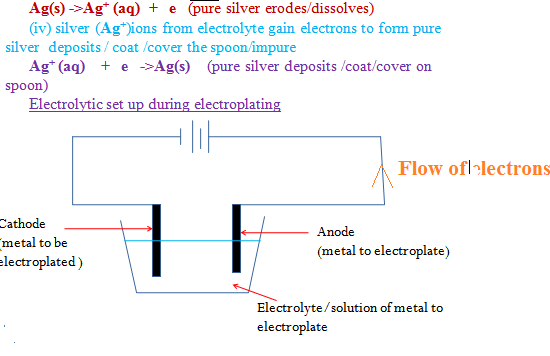
The label EPNS (Electro Plated Nickel Silver) on some steel or metallic utensils means they are plated or coated with silver and/or nickel to improve their appearance (add aesthetic value) and prevent or slow corrosion (rusting of iron). Electroplating is the process of coating a metal with another metal using an electric current. During electroplating, the cathode is made of the metal to be coated or purified.
Example:
During the electroplating of a spoon with silver:
- The spoon (impure) is placed as the cathode (negative terminal of battery)
- The pure silver is placed as the anode (positive terminal of battery)
- The pure silver erodes, ionizes, or dissociates to release electrons:
Ag(s) → Ag+ (aq) + e– (Pure silver erodes or dissolves)
Silver (Ag+) ions from the electrolyte gain electrons to form pure silver deposits that coat the spoon (impure):
Ag+ (aq) + e– → Ag(s) (Pure silver deposits or coats the spoon)