Classification of Substances
Substances are classified as either pure or impure. A pure substance contains only one type of substance, meaning it has a uniform and definite composition throughout. Examples include pure solids, pure liquids, or pure gases.
An impure substance contains two or more different substances mixed together. These mixtures can often be separated by physical means. The three states of matter in nature—solid, liquid, and gas—often appear as mixtures of one state with another.
Common mixtures include:
(a) Solutions / Solid-liquid dissolved mixtures
Experiment:
To prepare a solution of copper (II) sulphate (VI), potassium manganate (VII), or sodium chloride.
Procedure
Place about 100 cm3 of water in three separate beakers. Add a half spatula end full of copper (II) sulphate (VI), potassium manganate (VII), and sodium chloride crystals separately into each beaker. Stir each mixture for about two minutes.
Observation
- Copper (II) sulphate (VI) crystals dissolve to form a blue solution.
- Potassium manganate (VII) crystals dissolve to form a purple solution.
- Sodium chloride crystals dissolve to form a colourless solution.
Explanation
Some solids, liquids, and gases dissolve in certain liquids. The liquid in which a substance dissolves is called the solvent, while the substance that dissolves is called the solute.
When a solute dissolves in a solvent, it forms a uniform mixture called a solution. If water is the solvent, the solute is said to be in the aqueous state. Water is known as the universal solvent because it dissolves many substances.
A solute that dissolves in a solvent is described as soluble. The soluble particles spread uniformly between the particles of the solvent and cannot be seen.
Solute + Solvent → Solution
Solute + Water → Aqueous solution of solute
The solute dissolved in water gives the name of the solution, for example:
- Sodium chloride solution is formed by dissolving sodium chloride crystals in water. Sodium chloride exists in the aqueous state after dissolving.
NaCl(s) + H2O(l) → NaCl(aq) - Ammonia solution is formed by dissolving ammonia gas in water. Ammonia exists in the aqueous state after dissolving.
NH3(g) + H2O(l) → NH3(aq) - Copper (II) sulphate (VI) solution is formed by dissolving copper (II) sulphate (VI) crystals in water. Copper (II) sulphate (VI) exists in the aqueous state after dissolving.
CuSO4(s) + H2O(l) → CuSO4(aq) - Potassium manganate (VII) solution is formed by dissolving potassium manganate (VII) crystals in water. Potassium manganate (VII) exists in the aqueous state after dissolving.
KMnO4(s) + H2O(l) → KMnO4(aq)
(b) Suspension / Precipitates / Solid-liquid mixtures which do not dissolve
Experiment: To prepare suspensions of soil, flour, and lead (II) iodide
Procedure
Place about 100 cm3 of water in three separate beakers. Add a half spatula end full of soil, flour, and lead (II) iodide separately into each beaker. Stir each mixture for about two minutes.
Observation
- Some soil, flour, and lead (II) iodide float in the water.
- A brown suspension forms in the water containing soil.
- A white suspension forms in the water containing flour.
- A yellow suspension forms in the water containing lead (II) iodide. Some particles settle at the bottom after some time.
Explanation
Some solids do not dissolve in liquids and are called insoluble. When an insoluble solid is placed in a liquid:
- Some particles remain suspended or floating in the liquid, forming a suspension or precipitate.
- Some particles settle at the bottom, forming sediments after standing.
The colour of the suspension corresponds to the insoluble solid, for example:
- A white suspension contains fine white particles suspended in the liquid. It is not a “white solution”.
- A blue suspension contains fine blue particles suspended in the liquid.
- A green suspension contains fine green particles suspended in the liquid.
- A brown suspension contains fine brown particles suspended in the liquid.
- A yellow suspension contains fine yellow particles suspended in the liquid.
(c) (i) Miscible Liquid-liquid mixtures
To prepare water-ethanol and kerosene-turpentine miscible mixtures
Procedure
- Measure 50 cm3 of ethanol into a 100 cm3 beaker. Measure 50 cm3 of water and add it to the ethanol. Swirl for about one minute.
- Measure 50 cm3 of kerosene into a 100 cm3 beaker. Measure 50 cm3 of turpentine oil and add it to the kerosene. Swirl for about one minute.
Observation
- The two liquids do not form layers.
- Ethanol and water form a uniform mixture.
- Kerosene and turpentine oil form a uniform mixture.
Explanation
Ethanol is miscible in water, and kerosene is miscible in turpentine oil. Miscible mixtures form uniform mixtures without layers. The particles of one liquid are smaller and fit between the particles of the other liquid.
(ii) Immiscible Liquid-liquid mixtures
To prepare water-turpentine oil and kerosene-water immiscible mixtures
Procedure
- Measure 50 cm3 of water into a 100 cm3 beaker. Measure 50 cm3 of turpentine oil and add it to the water. Swirl for about one minute.
- Measure 50 cm3 of water into a 100 cm3 beaker. Measure 50 cm3 of kerosene and add it to the water. Swirl for about one minute.
Observation
- The two liquids form layers.
- Turpentine oil and water do not form a uniform mixture.
- Water and kerosene do not form a uniform mixture.
Explanation
Kerosene is immiscible in water, and water is immiscible in turpentine oil. Immiscible mixtures do not form uniform mixtures but separate into layers. The particles of one liquid are similar in size to those of the other, so they cannot fit between each other. The denser liquid settles at the bottom, and the less dense liquid floats on top.
(d) Solid-solid mixtures / Alloys
Before solidifying, some heated molten metals dissolve in another metal to form a uniform liquid mixture. Upon solidifying, this forms a uniform solid mixture called an alloy. In an alloy, particles of one metal occupy the spaces between particles of the other metal.
Common alloys of metals
| Alloy name | Constituents of the alloy | Uses of the alloy |
|---|---|---|
| Brass | Copper and Zinc | Making screws and bulb caps |
| Bronze | Copper and Tin | Making clock springs, electrical contacts, and copper coins |
| Solder | Lead and Tin | Soldering and joining electrical contacts due to low melting point and high thermal conductivity |
| Duralumin | Aluminum, Copper, and Magnesium | Making aircraft, utensils, and window frames because of its light weight and corrosion resistance |
| Steel | Iron, Carbon, Manganese, and other metals | Railway lines, car bodies, girders, and utensils |
| Nichrome | Nickel and Chromium | Providing resistance in electric heaters and ovens |
| German silver | Copper, Zinc, and Nickel | Making coins |
Methods of Separating Mixtures
Mixtures can be separated by applying various physical methods, depending on the nature of the mixture.
(a) Decantation
Decantation is the process of separating sediments from a liquid by carefully pouring out the liquid, leaving the sediments behind.
Experiment
Put some sand in a beaker and add about 200 cm3 of water. Allow the sand to settle at the bottom. Carefully pour off the water into another beaker.
Observation
- Sand settles at the bottom as sediment.
- Less clean water is poured out.
Explanation
Sand does not dissolve in water and is denser, so it settles at the bottom as sediment. The less dense water can be poured out, separating it from the sand.
(b) Filtration
Filtration is an improved method of decantation used to separate insoluble solids from liquids by passing the mixture through a porous material.
Experiment: To separate soil and water using filtration
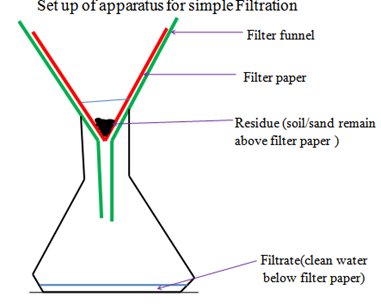
Fold a filter paper to fit into a filter funnel. Place the funnel in an empty 250 cm3 beaker.
Mix one spatula end full of soil with 50 cm3 of water. Stir and pour the mixture into the filter funnel.
Observation
- Clean water collects below the filter funnel.
- Soil remains above the filter paper.
Explanation
The filter paper is porous and acts like a fine sieve with very small holes. These holes allow water particles to pass through but block larger soil particles. The liquid that passes through is called the filtrate, and the solid left behind is called the residue.
Set up of apparatus
In industries, filtration is used in engine filters to clean air.
(c) Evaporation
Evaporation is a method of separating a solute from its solution by heating the solution to vaporize the solvent, leaving the pure solute behind. Insoluble solids are filtered out before evaporation.
Experiment: To separate a mixture of soil and salt (sodium chloride)
Procedure:
- Place one spatula end full of soil on a filter paper.
- Add one spatula full of common salt (sodium chloride) to the same filter paper and mix well.
- Pour about 200 cm3 of water into a beaker.
- Add the contents of the filter paper into the water and stir thoroughly for about one minute.
- Fold a filter paper into a filter funnel.
- Pour half of the mixture from the beaker into the filter funnel.
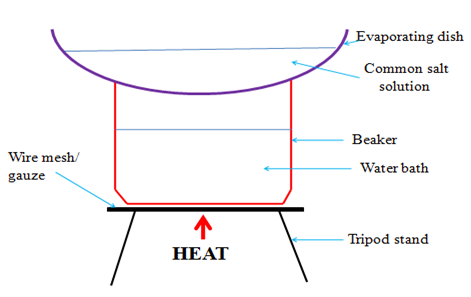
- Collect the filtrate in an evaporating dish and heat it using a water bath.
Observation
- On mixing: Colourless crystals and brown soil particles appear on the filter paper.
- On adding water: Common salt dissolves, soil particles do not.
- On filtration: Colourless liquid (filtrate) collects below the filter paper; brown residue remains above.
- On evaporation: Colourless salt crystals form after evaporation.
Explanation
The mixture contains sand and common salt, each retaining its colour. Salt dissolves in water forming a solution, while soil remains insoluble, forming a suspension.
Filtration separates the insoluble soil as residue, while the salt solution passes through as filtrate.
Heating the filtrate evaporates the water, leaving behind salt crystals.
Evaporation can occur without heating, as seen when drying wet clothes on a line.
Set up of apparatus
(d) Distillation
Distillation is an improved evaporation method that separates both the solute and solvent by heating the solution to vaporize the solvent, then condensing the vapor back into liquid form.
Experiment: To obtain copper (II) sulphate (VI) crystals and water from copper (II) sulphate (VI) solution
Procedure:
- Place one spatula end full of copper (II) sulphate (VI) crystals into a 250 cm3 beaker.
- Add about 200 cm3 of water and stir thoroughly for about one minute.
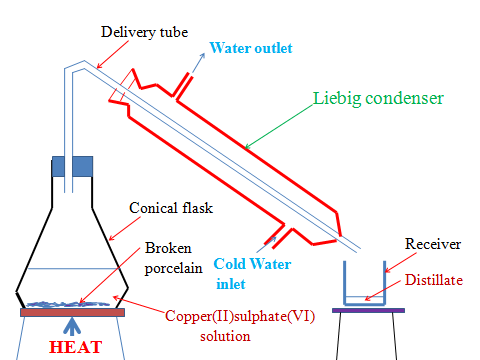
- Pour half of the mixture into a round-bottomed or conical flask. Add broken porcelain, sand, or glass pieces to the flask.
- Stopper the flask.
- Connect the flask to a Liebig condenser using a delivery tube.
- Place a clean 200 cm3 beaker or conical flask at the condenser’s outlet to collect the distillate.
- Circulate cold water through the Liebig condenser.
- Heat the flask strongly on a tripod stand with wire gauze until boiling bubbles disappear.
Observation
Copper (II) sulphate (VI) crystals dissolve in water forming a blue solution. On heating, colourless liquid collects in the receiver, and blue crystals remain in the flask. Further heating turns the blue crystals to white powder.
Explanation
Heating vaporizes the solvent (water), which passes through the delivery tube to the Liebig condenser. Cold water circulating in the condenser cools the vapor, condensing it back to liquid (distillate) collected in the receiver.
The solute (copper (II) sulphate (VI)) remains as residue in the flask.
Broken porcelain or glass pieces prevent bumping and ensure smooth boiling.
Simple distillation is used to purify salty sea water and separate mixtures with boiling points differing by about 40°C.
Set up of apparatus
(e) Fractional distillation
Fractional distillation is an advanced form of simple distillation used to separate miscible mixtures with close boiling points.
Fractional distillation involves:
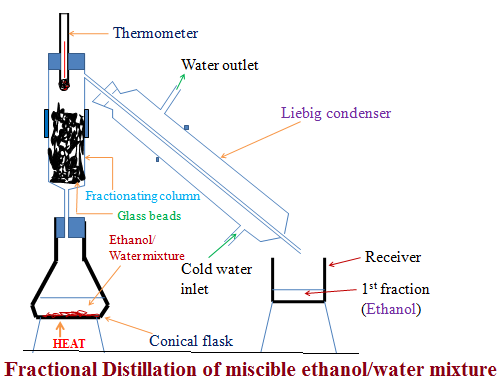
- Heating the mixture in a flask. The more volatile substance with the lower boiling point evaporates first. For example, ethanol boils at 78°C, water at 100°C at sea level. Ethanol vaporizes first.
- The flask is connected to a fractionating column packed with glass beads or porcelain to increase surface area for condensation.
- Vapors condense on the packing material. The less volatile substance condenses and trickles back down, while the more volatile vapor rises higher in the column.
- The fractionating column connects to a Liebig condenser, where the vapor condenses into liquid and is collected as the first fraction.
- A thermometer at the top monitors temperature. When the first substance is fully separated, the temperature rises, indicating the next substance is vaporizing.
- Subsequent fractions are collected separately as the temperature changes.
- Each fraction is confirmed by known physical or chemical properties.
Example
Ethanol
Ethanol is a colourless liquid with a characteristic smell. When ignited on a watch glass, it burns with a blue flame.
Water
Water is a colourless liquid with no smell. When ignited on a watch glass, it does not catch fire.
Set up of apparatus
Industrial application of fractional distillation
On a large scale, fractional distillation is used:
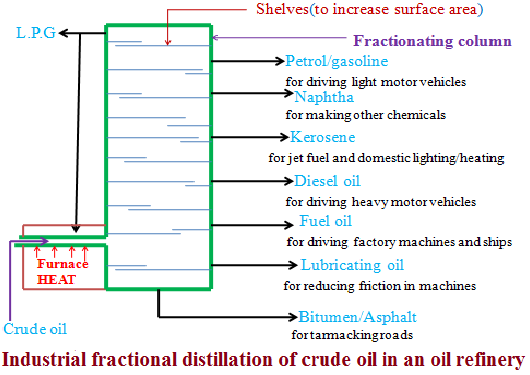
- In oil refineries to separate crude oil into fractions based on boiling points. In Kenya, this process occurs at Changamwe in Mombasa.
- In air separation plants to separate air into nitrogen, argon, and oxygen by cooling air to very low temperatures and then heating it. Nitrogen (-196°C) is the most volatile and comes out first, followed by argon (-186°C), then oxygen (-183°C).
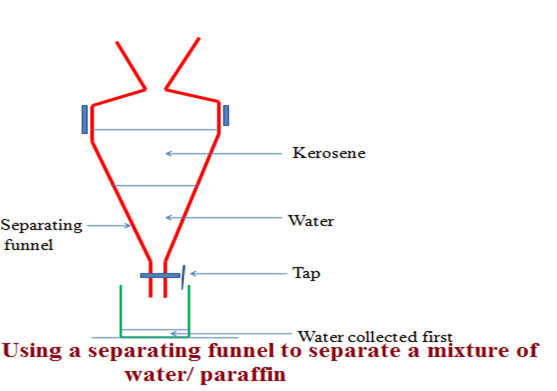
(f) Separation of immiscible liquids (Using a separating funnel)
Immiscible liquids form layers when mixed, arranging themselves according to density. The denser liquid sinks, and the less dense floats. They can be separated using a separating funnel.
Experiment: To separate an immiscible mixture of paraffin and water
Procedure
- Place about 100 cm3 of water into a 250 cm3 beaker. Add about 100 cm3 of paraffin and stir.
- Transfer the mixture into a separating funnel and allow it to settle for about one minute.
- Open the tap and slowly run out the lower layer into a clean beaker. Close the tap when the upper layer is near the tap.
- Discard the intermediate mixture near the tap.
- Run out the remaining upper layer into a fresh beaker.
- Test each layer by placing a portion in a watch glass and igniting it.
Observation
- Water and paraffin are both colourless liquids.
- Two layers form on mixing.
- The lower layer (water) is colourless and odorless and does not catch fire.
- The upper layer (paraffin) is colourless with a characteristic smell and burns with a yellow smoky flame.
Explanation
Water is denser than paraffin, so it settles at the bottom. When the tap is opened, water runs out first. The mixture at the interface is discarded as it is not pure.
Set up of apparatus
(g) Sublimation / Deposition
Some solids, when heated, do not melt but change directly into gas. This process is called sublimation. The gas cools and changes directly back into solid, called deposition. Sublimation and deposition are opposite processes.