

| LEARNING OBJECTIVES By the end of this chapter, you should be able to: 1. Define: Density and state its S.I unit and other units. 2. Determine experimentally the densities of: – Regular and Irregular Solids, – Liquids, and – Gases/Air. 3. Solve numerical problems on density and density of mixtures. 4. Define: Relative Density (R.D) – Determine experimentally the R.D of; – Solids and – Liquids. 5. Solve numerical problems on relative density of solids and liquids. |
3.0 Density
Definition
Density is defined as mass per unit volume of a substance.
Mathematically, it is expressed as: Density = 
ρ = 
(a) S.I Unit
The SI unit of density is kg/m3 (kgm-3). It is a derived unit, i.e., a unit derived from the units of the quantities in the formula of density.
(b) Derivation of the unit
From Density =  we have;
= 
Conveniently expressed as =  or
or 
The smaller unit of density is g/cm3 (g cm-3).
Note: The density of a substance is subject to variation depending on the prevailing physical factors.
3.1 (a) Factors that affect density
There are two physical factors that affect the density of a substance. These are:
- Temperature and Pressure.
(i) Effect of Temperature on density of substances
Substances expand and contract when their temperature changes. The expansion and contraction cause increase and decrease in the volume. Since density is the ratio of mass to volume of a substance, there will be a change in the value of the density.
Effect of High temperature
At high temperature, a substance absorbs heat energy and expands, increasing the volume. Since the mass remains constant, the value of the density (mass/volume) decreases.
Effect of Low temperature
At low temperature, a substance loses heat energy and contracts. The volume decreases. Dividing the constant mass by the reduced volume gives a higher density than under normal conditions.
(ii) Effect of Pressure on Density of substances
Pressure mostly affects the density of gases.
High pressure
High pressure squeezes gas molecules into a smaller volume. If a given mass of gas is contained within a smaller volume, the density increases.
Low pressure
At low pressure, gas molecules occupy a larger volume, so the density decreases.
Note: As a result of the above factors, when stating densities of gases, the temperature and pressure values must be stated as well.
The table 3.1 below shows the densities of some common substances/materials.
| Substance | Density in kg m-3 |
| (a) Solids: – Ice | 920 (9 x 10²) |
| – Aluminium | 2,700 (2.7 x 10³) |
| – Copper | 8,900 (8.9 x 10³) |
| – Lead | 11,300 (1.13 x 10⁴) |
| (b) Liquids: – Water | 1,000 (1 x 10³) |
| – Paraffin, gasoline | 800 (8 x 10²) |
| – Mercury | 13,600 (1.36 x 10⁴) |
| Gases (at *stp) – Air | 1.30 |
| – Hydrogen | 0.09 |
| – Oxygen | 1.43 |
| – Carbon dioxide | 1.98 |
Table 3.1
Note: (i) The above density values should not be memorised except for water.
(ii) *stp – stands for Standard Temperature and Pressure.
(b) Uses of Density
Density is used to:
- Identify materials.
- Determine the purity of a material.
- Choose light gases for filling meteorological balloons.
(c) Importance of density
The densities of materials are important to architects and engineers in the design of structures. For example, aircraft and overhead cables for the transmission of electricity are made of aluminium alloy because aluminium has low density (i.e., is light) and is quite strong.
Worked Examples
Calculating density
Steps in problem solving
Before solving any problem, ask yourself the following questions:
- What is asked in the question?
- What information is given to help solve the problem?
- What are the equation(s) to solve the problem?
- Are units of the quantities given matching?
These questions can only be answered when you collect the data.
A glass stopper has a volume of 16 cm3 and a mass of 40 g. Calculate the density of the glass stopper in:
(i) g/cm3 (ii) kg/m3
Solution
Data: m = 40 g, v = 16 cm3, ρ = ?
(i) Density =
 = = 2.5 g/cm3
Note: For (ii), the units of mass and volume in the data are small units, but you are required to get the answer in kg/m3. This means that the mass must be in kg and the volume in m3. So first convert the mass from gram to kg and volume from cm3 to m3.
Converting the units:
Mass: 40 g =
= 0.04 kg = 4.0 x 10⁻² kgVolume: 16 cm3 =
= 0.000016 m3 = 1.6 x 10⁻⁵ m3Now calculate the density:
ρ =
= = 2.5 x 10³ kg/m3The mass of 24.4 cm3 of mercury is 332 g. Find the density of mercury.
Solution: Data: m = 332 g, v = 24.4 cm3, ρ = ?
ρ =
= = 13.6 g/cm325 cm3 of aluminium has a mass of 67.5 g. Calculate its density in:
(a) g/cm3 (b) kg/m3
Solution: Data: (a) v = 25 cm3, m = 67.5 g, ρ = ?
ρ =
= = 2.7 g/cm3(b) First convert the mass and the volume into their respective SI units.
Converting the mass: 1 kg = 1000 g
m = 67.5 g =
= 0.0675 kgConverting the volume: 1 m3 = 1,000,000 cm3
v = 25 cm3 =
= 0.000025 m3Now applying the formula ρ = m/v, we have:
ρ =
= ρ = 2700 kg/m3 or 2.7 x 10³ kgm-3
Calculating mass
The density of copper is 8.9 g/cm3. What is the mass of 100 cm3 of copper?
Solution: Data: ρ = 8.9 g/cm3, v = 100 cm3, m = ?
ρ = m/v
8.9 = m / 100
m = 8.9 x 100
m = 890 g
Calculating volume
Calculate the volume of a block of expanded polystyrene of mass 400 g if its density is 16 kg/m3.
Solution Data: m = 400 g, ρ = 16 kg/m3, v = ?
Note: The mass must be converted to kilograms to match the density unit.
m = 400 g = 0.4 kg
Rearranging the formula for density:
v = m / ρ = 0.4 / 16 = 0.025 m3
 =
=  = 2.5 g/cm3
 = 0.04 kg = 4.0 x 10⁻² kg
 = 0.000016 m3 = 1.6 x 10⁻⁵ m3
 =
=  = 2.5 x 10³ kg/m3
 =
=  = 13.6 g/cm3
 =
=  = 2.7 g/cm3
 = 0.0675 kg
 = 0.000025 m3
 =
= 
3.2 Measurement of Density
(a) To find the density of a Regular Solid
- Measure the dimensions of the solid object (length, width, height, or diameter) using an appropriate instrument.
- Calculate the volume of the object from the appropriate formula.
Say volume of object = y m3
- Find the mass of the object using a triple beam balance. Say mass = x kg.
- Calculate the density from the formula:
Density = 
Examples
A cuboid of wood of mass 20 g measures 5 cm by 4 cm by 2 cm. Find its density.
Solution: Data: m = 20 g, l = 5 cm, w = 4 cm, h = 2 cm, ρ = ?
Volume = l × w × h = 5 × 4 × 2 = 40 cm3
Density ρ = m / volume = 20 / 40 = 0.5 g/cm3
A spherical metal made of aluminium weighs 90.477 g in air. If the diameter of the sphere is 4.0 cm, find the density of the sphere. (Take π = 3.14)
Solution: Data: m = 90.477 g, d = 4.0 cm (r = 2 cm), v = ?, ρ = ?
Volume v = (4/3) π r3 = (4/3) × 3.14 × 23 = 33.49 cm3
Density ρ = m / v = 90.477 / 33.49 = 2.7 g/cm3
(b) To find the density of an Irregular Solid
- Pour water in a measuring cylinder and record the first reading of the water level, say x cm3.
- Tie the irregular solid with a piece of thin silk thread and carefully immerse it into the water in the measuring cylinder.
- Read and record the second reading of the water level, say y cm3.
- Find the volume of the irregular solid from the formula:
Volume of object = (Second reading – First reading) = (y – x) cm3
Determine the mass of the solid on a triple beam balance, say mass = z g.
Calculation:
Mass of object in air = z g
Volume of object = (y – x) cm3
Density = mass / volume = z / (y – x)
Example
When a piece of irregular stone of mass 164.5 g was immersed in 300 cm3 of water in a measuring cylinder, the water level rose to 370 cm3. Calculate the density of the stone.
Solution:
Mass of stone = 164.5 g
Initial water level = 300 cm3
Final water level = 370 cm3
Volume of stone = 370 – 300 = 70 cm3
Density = 164.5 / 70 = 2.35 g/cm3
To find the density of liquid e.g. Paraffin
Procedure:
- Weigh an empty beaker on a triple beam balance, say x grams.
- Pour a known volume, v, of the liquid in the beaker.
- Weigh the beaker and the liquid (paraffin). Let the total mass be y grams.
- Calculate the density as below:
Mass of empty beaker = x g
Mass of beaker + paraffin = y g
Mass of paraffin only = (y – x) g
Volume of paraffin = v cm3
Density = mass / volume = (y – x) / v
Example
An empty beaker weighs 120 g in air and weighs 180 g when filled with 75 cm3 of methylated spirit. Find the density of the methylated spirit.
Solution:
Mass of empty beaker = 120 g
Mass of beaker + paraffin = 180 g
Mass of paraffin only = 180 – 120 = 60 g
Volume of paraffin = 75 cm3
Density = 60 / 75 = 0.8 g/cm3
3.2 Density of Mixtures
A mixture is a substance that consists of two or more substances physically combined together.
Mixtures are obtained by mixing two or more substances physically. In dealing with the calculations of density of mixtures, the following assumptions are made:
- The constituents of the mixture do not react with one another.
- The total mass of the mixture is the sum of the masses of the constituents.
- The total volume of the mixture is the sum of the volumes of the constituents.
The density of mixtures is calculated from the formula:
Density of mixture = 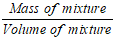
N.B. (a) The density of the mixture lies between the densities of its constituents.
(b) Calculations on density of mixtures are of two types:
- Where the masses and volumes of the constituents are given directly.
(ii) Where either the masses and densities are given but volumes not given, or volumes and densities are given but masses not given.
In case (b)(i), the formula for calculating density of mixture is applied directly after getting the total mass and total volume of the mixture.
While for case (b)(ii), we first use the formula for calculating density to get the quantities which are not given. Then we apply the formula of density of mixtures.
(a) Calculating density of a mixture when the masses and the volumes of the constituents are given
Example 1
100 cm3 of fresh water which weighs 100 g is mixed with 100 cm3 of sea water which weighs 103 g. Calculate the density of the mixture.
Hint: For this type of question, get the total mass and total volume of the mixture and then substitute the values in the formula of density of mixtures.
Solution:
Mass of fresh water = 100 g
Mass of sea water = 103 g
Mass of mixture = 100 + 103 = 203 g
Volume of fresh water = 100 cm3
Volume of sea water = 100 cm3
Volume of mixture = 100 + 100 = 200 cm3
Density of mixture = 203 / 200 = 1.015 g/cm3
(b) Calculating density of a mixture when either masses or volumes of the constituents are not given
Example 2
0.0018 m3 of fresh water of density 1000 kg/m3 is mixed with 0.0022 m3 of sea water of density 1025 kg/m3. Calculate the density of the mixture.
Solution:
Mass of fresh water = ?
Volume of fresh water = 0.0018 m3
Density of fresh water = 1000 kg/m3
Mass of sea water = ?
Volume of sea water = 0.0022 m3
Density of sea water = 1025 kg/m3
Hint: The masses are not given. Use the formula of density of a substance to get the masses of the constituents first and then follow the steps in example 1 above.
Calculating mass of fresh water:
ρ = m / v
m = ρ × v = 1000 × 0.0018 = 1.8 kg
Calculating mass of sea water:
m = ρ × v = 1025 × 0.0022 = 2.255 kg
Since the masses and volumes of the constituents are now known, the density of the mixture can be calculated:
Mass of mixture = 1.8 + 2.255 = 4.055 kg
Volume of mixture = 0.0018 + 0.0022 = 0.004 m3
Density of mixture = 4.055 / 0.004 = 1.013 kg/m3
Note: The detailed steps are to help you understand how to solve problems in this topic. In examinations, present your work briefly and clearly.
3.3 Relative Density (R.D)
Definition
Relative density of a substance is defined as the ratio of the density of a substance to the density of water.
Mathematically, R.D is expressed as:
Relative density (R.D) = 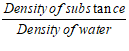
If the masses of equal volume of a substance and water are found, then this relation takes the form:
Relative density (R.D) = 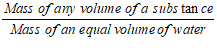
In normal weighing, the mass of a substance is proportional to the weight, so it is also true to say:
Relative density (R.D) = 
NB: R.D has no unit since it is a ratio of the same quantity (densities, masses, or forces), so the units cancel.
3.31 Measurement of Relative Density (R.D)
(a) To measure the density of Liquid
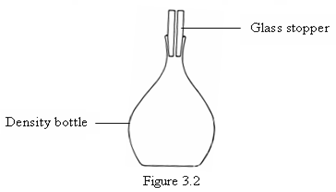 The R.D of a liquid is measured using a density bottle. The density bottle has a glass stopper with a fine hole through it, so that when it is filled fully with the liquid and the stopper inserted, the excess liquid rises through the fine hole and runs down the outside.
 As long as the bottle is filled to the same liquid level at the top of the hole, it will always contain the same volume of whatever liquid is filled in it, provided the temperature remains the same.
Experiment to determine the R.D of liquid e.g. Paraffin
Procedure:
- Weigh the density bottle when empty.
- Fill the bottle full with paraffin.
- Wipe the paraffin that runs out through the hole and weigh the bottle and the paraffin.
- Empty the bottle and clean it thoroughly.
- Refill the bottle with water to the same level and weigh it after wiping the water that flows out.
Mass of empty bottle = x g
Mass of bottle full of liquid = y g
Mass of bottle full of water = z g
Mass of liquid = (y – x) g
Mass of water = (z – x) g
Applying the formula:
Relative density of liquid = (mass of liquid) / (mass of equal volume of water) = (y – x) / (z – x)
(b) Precautions
To obtain accurate results, the following precautions should be taken:
- The outside of the bottle must be wiped dry before weighing.
- The bottle must not be held by the neck with a warm hand; otherwise, some liquid may be lost due to expansion.
Worked Examples
Steps in problem solving
Before solving any problem, ask yourself the following questions:
- What is asked in the question?
- What information is given to help solve the problem?
- What are the equations to solve the problem?
These questions are answered when you collect the data.
Example 1
A density bottle was used to measure the relative density of a liquid and the following results were obtained.
Solution:
Mass of empty density bottle = 30 g
Mass of bottle full of liquid = 110 g
Mass of bottle full of water = 130 g
Mass of liquid = 110 – 30 = 80 g
Mass of water = 130 – 30 = 100 g
Relative density of liquid = 80 / 100 = 0.8
Example 2
The mass of an empty density bottle is 46.00 g. When fully filled with water it weighs 96 g. When full of a liquid of unknown R.D., it weighs 86 g.
Calculate:
(i) the R.D of the liquid.
(ii) the density of the liquid.
Solution:
Mass of empty bottle = 46 g
Mass of bottle full of liquid = 86 g
Mass of bottle full of water = 96 g
Mass of liquid = 86 – 46 = 40 g
Mass of water = 96 – 46 = 50 g
Relative density of liquid = 40 / 50 = 0.8
(ii) Density of liquid = R.D × density of water = 0.8 × 1000 = 800 kg/m3
(c) To measure the Relative Density of Solid
The R.D of solid/liquid substances can best be measured by applying Archimedes’s Principle.
Archimedes’s Principle states that:
When a body is wholly or partially immersed in a fluid, it experiences an upthrust equal to the weight of fluid displaced.
Procedure:
- Suspend the solid whose relative density is to be determined from a spring balance by means of a light string in air and record its weight.
- Immerse the solid wholly in water and record its apparent weight.
Results:
Weight of solid object in air = Wa N
Weight of solid object in water (Apparent weight) = Ww N
Calculation:
Upthrust (Loss in weight of object) = Weight of water displaced = Weight in air – Apparent weight = (Wa – Ww) N
Volume of water displaced = Volume of the solid immersed
Relative Density = Weight in air / Loss in weight in water = Wa / (Wa – Ww)
Note: For details on R.D of solids, see chapter 10.
Examples
1. A piece of aluminium weighs 80 N in air and 50.37 N when completely immersed in water. Calculate the relative density of aluminium.
Solution:
Weight in air = 80 N
Apparent weight in water = 50.37 N
Weight of water displaced = 80 – 50.37 = 29.63 N
Relative Density = 80 / 29.63 = 2.7
SELF-CHECK 3.0
- To calculate the density of an object, which one of the following must be known?
I. Height II. Volume III. Area IV. Mass V. Weight
A. I and II B. II and V C. III and IV D. II and IV - A block of wood 10 m × 5 m × 4 m has a mass of 80,000 kg. What is the density of this wood?
A. 2000 kg/m3 B. 4000 kg/m3 C. 200 kg/m3 D. 400 kg/m3 - The density of gold is 19.3 g/cm3. What is the mass of 10 cm3 gold?
A. 19.3 g B. 0.193 g C. 1.93 g D. 193 g - What is the mass of the copper cube having each side 2 cm? (Take copper density = 9 g/cm3)
A. 0.18 g B. 72 g C. 180 g D. 36 g - What is the volume of 60 g wood? (Density of wood = 0.6 g/cm3)
A. 10 cm3 B. 36 cm3 C. 100 cm3 D. 360 cm3 - Study the table below and use it to spot the correct answer.
| Material | Density (g/cm3) | Mass (g) |
| K L M N | 3 9 6 5 | 60 180 360 200 |
From the values shown in the table, which material has the biggest volume?
A. K B. L C. M D. N
- What is the volume and mass of the block which measures 2 m by 3 m by 5 m if its density is 1500 kg/m3?
A. 50 m3, 75,000 kg B. 100 m3, 75,000 kg C. 30 m3, 75,000 kg D. 30 m3, 75,000 kg - Two litres of corn oil has a mass of 1.85 kg. What is the density of the oil?
A. 1850 kg/m3 B. 925 kg/m3 C. 185 kg/m3 D. 92.5 kg/m3 - If an object of volume 0.02 m3 weighs 500 N in a liquid of density 2000 kg/m3, what is the weight in air?
A. 900 N B. 1000 N C. 400 N D. 600 N - Which one of the following is the SI unit of density?
A. kgm3 B. kg/m-3 C. g/cm3 D. kg/m3 - If 10 g water and 10 cm3 alcohol are mixed, what will be the mass of the mixture? (Density of alcohol = 0.80 g/cm3)
A. 18 g B. 20 g C. 16 g D. 19 g - A tin containing 5 litres of paint has a mass of 8.5 kg. The mass of the empty tin is 2.0 kg. The density of the paint is:
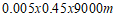
A. 1.3 kg/m3 B. 1.3 x 10³ kg/m3 C. 1.7 x 10³ kg/m3 D. 2.1 x 10³ kg/m3 - A rectangular block of tin is 0.5 m long and 0.01 m thick. Find the width of the block if its mass and density are 0.45 kg and 9000 kg/m3 respectively.
A. B.
C. D. - A box of dimensions 0.2 m by 0.3 m by 0.5 m is full of a gas of density 200 kg/m3. The mass of the gas is:
A. 3 x 10⁻² kg B. 6.0 x 100 kg C. 2 x 10² kg D. 6.7 x 10³ kg - A piece of material of mass 200 g has a density of 25 kg/m3. Calculate its volume in m3.
A. B. C. D. - Two solid cubes have the same mass but their edges are in the ratio 4:1. What is the ratio of their densities?
A. 1:4 B. 1:8 C. 1:16 D. 1:64 - A tin containing 6 x 10⁻³ m3 of paint has a mass of 8 kg. If the mass of the empty tin with the lid is 0.5 kg, calculate the density of the paint in kg/m3.
A. B. C. D. - A tank 2 m tall with base area of 2.5 m2 is filled to the brim with a liquid which exerts a force of 40,000 N at the bottom. Calculate the density of the liquid.
A. B. C. D. - The following readings were recorded when measuring the density of a stone: Mass of the stone = 25 g, volume of water = 25 cm3, volume of water and stone = 35 cm3. What is the density of the stone?
A. B. C. D. - Liquid Y of volume 0.40 m3 and density 900 kg/m3 is mixed with liquid Z of volume 0.35 m3 and density 800 kg/m3. Calculate the density of the mixture.
A. 800 kg/m3 B. 840 kg/m3 C. 850 kg/m3 D. 900 kg/m3
 B.
B. 
 D.
D. 
 B.
B.  C.
C.  D.
D. 
 B.
B.  C.
C.  D.
D. 
 B.
B.  C.
C.  D.
D. 
 B.
B.  C.
C.  D.
D. 


