


BIOLOGY PAPER 231/2 K.C.S.E 2000
PRACTICAL MARKING SCHEME
(a) You are provided with a specimen labeled D
(i) Name the specimen to which the specimen belongs: Arthropoda
(ii) State three characteristics found in the members belonging to the phylum:
- Presence of exoskeleton/ectoskeleton
- Jointed limbs/appendages/legs
- Segmented body parts
(b) (i) Name the class to which the specimen belongs: Insecta
State four characteristics found in the members of the class:
(c) Remove, draw, and label the mouth parts used for:
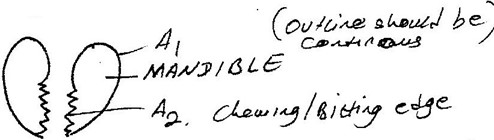
(i) Biting and chewing food
- Hold food
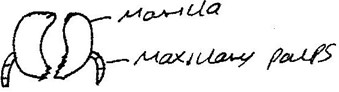
 Feeling and tasting food
 Feeling and tasting food
- Examine the wings of the specimen. State the differences between them.
Forewing/outer wing Hind wing/inner wing
– Hard – Soft/membranous
– Narrow/small surface – Wide/broad/large surface area
– Stiff/rigid/inflexible – Flexible/can fold
– Opaque – Translucent
2. Confidential requirements:
Specimens:
G- onion bulb (Sprouting) E- Taproot/Taproot tuber/swollen tap root/main root/Carrot root hairs/ F- stem tuber
You are provided with specimens labelled E, F, and G.
(a) With reasons state which part of the plant are specimens E, F, and G.
E- carrot root hairs
Reasons
- Presence of lateral roots
- Short stem. Swollen with food
F- Irish Potato
Reasons
F- Stem tuber
- Presence of lateral buds/auxiliary buds
- Presence of scale leaves
- Swollen with food
G- Bulb/Onion bulb/Onion plant bulb
Reasons
- Scale leaves/scaly leaves
- Short stem/flattened stem
- Fleshy leaf bases/leaves swollen with food
 Make a longitudinal section through G
(b) Draw and label the specimen
(c) (i) Name the vitamin present in specimen E:
Vitamin A retinal
(ii) What are two functions of the vitamin named in (c) (i) above?
- Protection of skin and cornea from drying
- Synthesis of Rhodopsin pigment
- Improves night vision/vision in poor light
F G
– Food stored in stem – Food stored in leaves
– Swollen stem – Small short/flattened stem
– Rudimentary/not well developed scaly leaves – Dry papery/well developed scale leaves
– Small/inconspicuous scale leaves – Presence of adventitious roots
– Absence of adventitious roots
3. You are provided with a substance labelled H. Filter the substance and collect filtrate. Filtration is expected to be complete after about 30 minutes. Using the reagents provided, test for the food substances in the residue and the filtrate. Record your procedures, observations, and conclusions in the table below.
Residue
| Food substance | Procedure | Observations | Conclusion |
|---|---|---|---|
| Starch | Add a drop of iodine | Colour of iodine/yellow/orange/brown/reddish brown/no colour change | Starch absent |
| Proteins | Add NaOH then a drop of 1% CuSO4 and shake | Purple violet colour | Presence of proteins |
| Reducing simple sugars | Add Benedict’s solution and heat in warm water bath | Green colour/yellow/orange/red/brown colour | Traces of reducing sugar if colour change is greenish. Reducing/simple sugars present |
Filtrate
| Food substance | Procedure | Observations | Conclusion |
|---|---|---|---|
| Starch | Add a drop of iodine | No colour change/colour of iodine/yellow/brown/orange/reddish brown colour | No starch present |
| Protein | Add NaOH then CuSO4 and shake | Blue colour/light blue/no colour change/colour of copper sulphate retained/purple colouration | Absence of proteins or presence of proteins according to observations |
| Reducing/simple sugars | Add Benedict’s solution and heat/place in a warm water bath | Green/yellow/orange/red/brick red ppt | Greenish colouration Traces of reducing/simple sugars |


