


BIOLOGY PAPER 231/1 K.C.SE 2006
QUESTIONS.
1. a) State the functions of cristae in mitochondria.
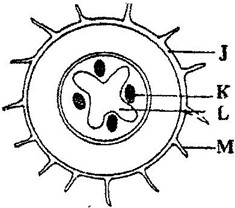
b) The diagram below represents a cell organelle.

(i) Name the part labeled Y. (1mk)
(ii) State the functions of the part labeled X. (1mk)
2. Name the part of the flower that develops into
- a) Seed
- b) Fruit (1mk)
3. a) Name two tissues in plants which are thickened with lignin. (2mks)
b) How is support attained in herbaceous plants? (1mk)
4. a) Name the fluid that is produced by sebaceous glands. (1mk)
b) What is the role of sweat in human skin? (2mks)
5. State two ways in which floating leaves of aquatic plants are adapted to gaseous exchange. (2mks)
6. a) State three characteristics of Monera that are not found in other kingdoms. (3mks)
b) Name the class to which a termite belongs. (1mk)
7. a) Name one defect of the circulatory system in humans. (1mk)
b) State three functions of blood other than transport. (3mks)
8. State the role of vitamin C in humans. (2mks)
9. a) State two processes which occur during anaphase of mitosis. (2mks)
b) What is the significance of meiosis? (2mks)
10. State the importance of tactic response among some members of kingdom Protista. (1mk)
11. State the role of insulin in the human body. (1mk)
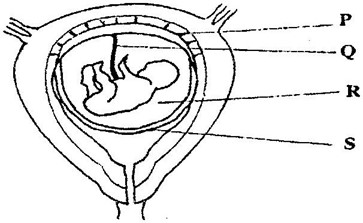
12. An experiment was set up as shown below.
The set up was left for 30 minutes.
a) State the expected results. (1mk)
b) Explain your answer in (a) above. (3mks)
13. a) In what form is energy stored in muscles? (1mk)
b) State the economic importance of anaerobic respiration in plants. (2mks)
14. a) Distinguish between epigeal and hypogeal germination. (1mk)
b) Why is oxygen necessary in the germination of seeds? (2mks)
15. Explain continental drift as evidence of evolution. (3mks)
16. What is the importance of the following in an ecosystem? (2mks)
- a) Decomposers
- b) Predation
17. a) Distinguish between the terms homodont and heterodont. (1mk)
b) What is the function of carnassial teeth? (1mk)
c) A certain animal has no incisors, no canines, 6 premolars and 6 molars in its upper jaw. In the lower jaw there are 6 incisors, 2 canines, 6 premolars and six molars. Write its dental formula.
18. a) State two functions of bile juice in the digestion of food. (2mks)
b) How does substrate concentration affect the rate of enzyme action? (1mk)
19. a) Explain how the following prevent self-pollination. (1mk)
- (i) Protoandry
- (ii) Self-sterility
b) Give three advantages of cross-pollination. (3mks)
20. a) What name is given to the response to contact with surface exhibited by tendrils and climbing stems in plants?
b) State three biological importance of tropisms in plants.
21. The diagram below represents a reflex arc in humans.
a) Name the parts labeled X and Y.
b) Name the substance that is responsible for the transmission of an impulse across the synapse. (1mk)
22. a) State the function of ciliary muscles in the human eye. (1mk)
b) State two functional differences between the rods and cones in the human eye. (2mks)
23. State the function of each of the following parts of the human ear. (4mks)
- a) Ear ossicles
- b) Cochlea
- c) Semi-circular canals
- d) Eustachian tube
24. State four ways in which respiratory surfaces are suited to their function. (4mks)
25. a) A dog weighing 15.2 kg requires 216 kJ while a mouse weighing 50 g requires 2736 kJ per day. Explain. (2mks)
26. The chart below represents a simplified nitrogen cycle.
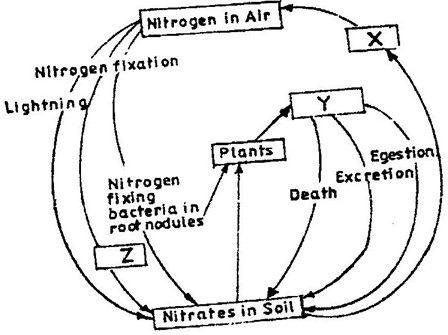
What is represented by X, Y, and Z?
27. Name the end products of the light stage in photosynthesis.


