


Introduction
Farm power refers to any form of energy used on the farm to perform work. It is essential for various agricultural activities, improving efficiency and productivity.
Sources of Farm Power
Human Power
- Used to perform light tasks on the farm.
- The quality of work produced can vary depending on the individual.
- Tasks often take a long time to complete due to limited strength and endurance.
Animal Power
Provided by draught animals such as camels, donkeys, horses, and elephants.
- Commonly used in land preparation and transportation.
Disadvantages
- Relatively slow compared to mechanical power.
- Animals are susceptible to sickness and fatigue.
- Require adequate food and care to maintain performance.
Wind Power
- Used to pump water from boreholes.
- Employed in winnowing crops such as beans, finger millet, and rice.
- Can generate electricity in some setups.
Disadvantages
- Wind is not easy to control and may not be available when needed.
Water Power
- Used for irrigation purposes.
- Drives grinding mills to grind maize grains.
Disadvantages
- Difficult to use on the farm because it is not easy to control water flow.
Biomass
Includes organic materials such as:
- Wood or charcoal.
- Biogas power.
Charcoal/Wood Fuel Energy
Uses
- Provides heat for boiling water and cooking.
- Used in dehydrating some crops.
- Employed in curing tobacco.
Disadvantages
- Exhaustible resource.
- Cannot be used directly in some farm operations.
- Large quantities are required for significant energy output.
- Bulky and difficult to transport.
Biogas
Uses
- Provides heat and light for cooking, boiling water, and lighting.
- Can produce electricity.
Disadvantages
Only feasible where there are animals under zero grazing systems. It is labor-intensive.
- Requires large quantities of dung.
- Cannot be used directly in some farm operations.
Fossil Fuels
Include coal, petroleum oils, and natural gas.
Uses
- Petrol or diesel is burned in internal combustion engines to produce power.
- Kerosene is mainly used to light rural homes.
- Natural gas is used for cooking, heating, and lighting.
Electrical Power
Includes:
- Hydro-electrical power (HEP).
- Geothermal energy.
- Nuclear energy.
- Power stored in batteries.
- Nuclear energy is a potential source of power not yet widely used on farms.
Uses of Electrical Power
- Runs stationary machines such as milling machines, grinding mills, cooling machines, and water pumps.
- Supplies heat and light for operations such as brooders.
Disadvantages
- Cannot be used directly in some farm operations.
- Lack of electricity supply in many rural areas.
- Power failures can lead to significant losses.
- Installation and maintenance are costly.
Solar Energy
Energy obtained from the sun.
Uses
- Provides heat and light.
- Used by all plants in photosynthesis.
- Used in dehydrating crops such as vegetables, maize grains, beans, and hay.
- Boils water to drive turbines that produce power for minor uses.
Disadvantages
Low energy concentration on cloudy days.
Expensive equipment is required for collecting and concentrating solar energy.
Cannot be used directly in some farm operations.
- Requires skilled labor to install and maintain.
Tractor
- The tractor has an internal combustion engine that burns petrol or diesel to produce power.
- This power is transmitted to the gearbox and then distributed in various ways.
- The common tractor engine is a four-stroke cycle engine.
The Four Strokes are:
- Induction stroke.
- Compression stroke.
- Power stroke.
- Exhaust stroke.
Induction Stroke
- The piston moves down.
- The inlet valve opens.
- Fuel and air enter the cylinder.
Compression Stroke
- The inlet valve closes.
- The piston moves up the cylinder.
- The fuel-air mixture is compressed.
Power Stroke
- A spark is produced at the spark plug, igniting the fuel-air mixture.
- The increased pressure forces the piston down the cylinder.
Exhaust Stroke
- The exhaust valve opens.
- The piston moves up the cylinder.
- Burned fuel-air mixture is expelled.
Advantages of the Four-Stroke Engines
- Produce high power capable of performing heavy farm work.
- Efficient fuel and oil utilization.
- Can perform a wide range of farm operations.
- Effectively cooled with water, allowing for larger engine sizes.
- Exhaust gases are effectively expelled from the cylinders.
Disadvantages
- Expensive to buy and maintain.
- Use is limited in some areas.
- Tractors are best suited for flat or gently sloping areas.
- Require skilled personnel and support services.
The Two-Stroke Engines
- Found in small machines such as mowers, motorbikes, and water pumps used for light farm tasks.
- All cycles are completed in two strokes of the piston.
These strokes are:
Induction and Compression Stroke
- The piston is at the bottom.
- The piston moves up, uncovering the inlet port.
- Fuel-air mixture is drawn in.
- Ignition occurs when the piston reaches the top.
- The piston is forced downward, compressing the mixture in the crankcase.
Power and Exhaust Stroke
- The piston is at the top.
- Ignited gases produce pressure, forcing the piston downwards.
- The piston covers the inlet port, trapping fresh fuel-air mixture in the crankcase.
- The piston moves further down to uncover the exhaust port.
- Fuel-air mixture is transferred from the crankcase to the combustion chamber.
Advantages of Two-Stroke Engine
- Cheap to buy and easy to maintain.
- Economical in fuel consumption.
- Can be used in a wide range of farmland, including hilly areas.
- Suitable for small tasks that would be uneconomical for four-stroke engines.
Disadvantages of Two-Stroke Engine
- Produce less power and cannot be used for heavy duties.
- Inefficient in burning fuel to produce power.
- Air-cooled, limiting engine size.
Systems of a Tractor
The modern tractor has the following systems:
- Fuel system.
- Electrical system.
- Ignition system.
- Cooling system.
- Power transmission system.
The Fuel System
Supplies fuel to the engine and is categorized into two types depending on the fuel used:
- Petrol fuel system.
- Diesel fuel system.
The Petrol Fuel System
Consists of:
- Fuel tank – stores fuel.
- Fuel filter – removes foreign particles from the fuel.
- Carburettor – atomizes fuel into spray, introduces fuel-air mixture into the engine, and regulates fuel-air proportions.
- Fuel pump – forces fuel into the carburettor.
- Delivery pipe – connects all the devices.
Maintenance
- Clean the carburettor regularly.
- Clean the fuel filter in the petrol system.
- Clean the hole in the fuel tank cap.
The Diesel Fuel System
Consists of:
- Fuel tank – stores fuel.
- Fuel injection pump – pumps diesel through injection nozzles, breaking it into a fine spray.
- Fuel filters – remove foreign particles from the fuel.
- Delivery pipes – connect the various devices.
Maintenance
- Replace the fuel filter as needed.
- Bleed the system if air is trapped.
- Clean the sediment bowl regularly.
Structural and Functional Differences Between Petrol and Diesel Engines
| Petrol Engine | Diesel Engine |
|---|---|
| Has a carburettor. | Has an injection pump. |
| Fuel and air are mixed in the carburettor. | Fuel and air are mixed within the cylinder. |
| Fuel is ignited by an electric spark. | Fuel is ignited by compression of air and fuel mixture in the cylinder. |
| Produces little smoke because petrol is completely burnt. | Produces a lot of smoke since diesel is not completely burnt. |
| Lightweight and suited for light duties. | Relatively heavy and suited for heavy duties. |
Electrical System
Consists of the following components:
- Battery
- Converts chemical energy into electrical energy.
- Stores electrical energy produced by the running engine.
- Ignition circuit – provides electrical current required by spark plugs to produce a spark.
- Generator circuit – provides electrical current to start the engine.
- Lighting circuit – supplies electrical current for lighting.
- Starter motor circuit – starts the engine.
Care and Maintenance of a Tractor Battery
- Keep electrolyte level just above the plates by topping with distilled water.
- Scrape clean corroded terminals and smear with grease.
- Secure the battery tightly to avoid spillage and damage.
- Ensure the battery is correctly fitted on the tractor.
- Charge the battery regularly and periodically.
- During long storage, keep the battery contents upside down.
- Ensure the generator fan belt is functional to keep the battery charged.
Ignition System
Consists of:
- Ignition coil – changes low voltage from the battery to high voltage current for spark plugs.
- Condenser – absorbs self-induced current in the primary circuit.
- Stores current briefly.
- Passes electric current to the distributor.
- Distributor – distributes high voltage current to spark plugs.
- Contact breaker – interrupts normal current flow in the primary circuit.
Maintenance Practices for the Ignition System
- Remove carbon deposits on spark plug electrodes.
- Replace worn-out spark plugs.
- Clean contact breaker points.
- Adjust breaker points to lie between 0.30mm and 0.50mm.
- Replace the condenser regularly.
- Keep ignition system dry.
- Replace ignition wires with poor insulation.
Cooling System
- Prevents the engine from overheating, which could cause piston seizure in the cylinder.
- Some tractor engines are air-cooled, while others are water-cooled.
Characteristics of Air-Cooled Engines
- Simple construction.
- Have fins and a fan blade to assist air circulation.
- Lightweight due to absence of radiators and water jackets.
Limitations
- Heat up quickly and require heavy lubricating oil.
- Cooling is inadequate under heavy load conditions.
Water-Cooled Systems
- Consist of radiator, water jackets, hoses, water pump, thermostat, and fan mechanism.
- Water absorbs heat from the engine block efficiently.
Care and Maintenance of Water Cooling System
- Lubricate water pumps regularly.
- Use clean water in the radiator and remove debris from fins.
- Ensure all pipes are tightly fitted to avoid leaks.
- Fill radiator with clean water before starting work.
- Check and adjust fan belt tension regularly.
Lubrication System
- Supplies oil to all engine parts where friction occurs.
Importance of Lubrication System
- Increases machine efficiency and reduces wear and tear.
- Reduces heat generated by friction and acts as a seal between surfaces.
- Cleans by washing off dust, dirt, soot, and metal particles to the sump.
Types of Lubrication Systems
- Splash feed type.
- Force feed type.
- Oil mist type.
Types of Lubricants
- SAE 10 – Thin engine oil providing little protection when heated.
- SAE 50 – Thicker engine oil recommended for bearing protection.
- SAE 90-100 – Transmission oils recommended for clutch, gearbox, wheel lubrication, and ball bearings.
Note: SAE – Society of Automobile Engineers.
Care and Maintenance of Lubrication Systems
- Do not use old or contaminated oil.
- Drain oil when still hot to avoid sticking to sump walls.
- Replace oil filters when necessary.
- Use the correct oil type as per manufacturer’s instructions.
Power Transmission System
- Transfers power from the tractor engine to the drive shaft, wheel axle, power take-off shaft, and hydraulic system.
- Consists of clutch, gearbox, differential, and final drive.
Power is made available through:
- Propeller shaft – connects gearbox to differential.
- Power take-off shaft (PTO) – located at the rear, rotates at engine crankshaft speed.
- Hydraulic system – operated by a lever near the driver’s seat.
- Connected to the 3-point linkage to raise or lower mounted implements like ploughs, mowers, planters, and sprayers.
- Drawbar – a one-point linkage at the rear for attaching trailed implements during harrowing, transportation, or rolling.
Tractor Servicing
- Aims to keep the tractor in good and efficient working condition.
- Servicing can be short term or long term.
Short Term Tractor Servicing
- Check engine oil daily using a dipstick; add oil if low.
- Check fuel level daily and refill if necessary.
- Check radiator water level and top up if possible.
- Check electrolyte level daily and top up with distilled water.
- Tighten nuts and bolts daily; replace lost ones before work.
- Apply grease through nipples using a grease gun.
- Remove large sediments from the sediment bowl.
- Check tyre pressure daily before work.
- Check fan belt tension; it should deflect 1.9cm to 2.5cm when pushed.
- Grease brake shaft bearing.
- Maintain brake fluid at recommended level.
Long Term Services
- Drain and replace engine oil completely.
- Check and refill gearbox oil as recommended.
- Replace oil in the differential as recommended.
- Grease linkage and pulley attachments.
- Check and top up pulley oil level.
- Remove dirty oil and replace with clean oil.
Farm Machinery
Tractor Drawn Implements
Implements attached to the tractor during operation.
Categories of Tractor Drawn Implements
- One-point hitch implements
- Attached at one point, the drawbar.
- Include trailed implements such as trailers, heavy harrows, planters, and rollers.
- Three-point hitch implements
- Attached at three points: top linkage and two lower linkages.
- Operated by the hydraulic system.
- Include ploughs, most harrows, subsoilers, planters, mowers, ridgers, sprayers, and rotavators.
Trailers
- One-point hitch implements.
- Used for transporting goods.
- Small trailers have two wheels; larger ones have four.
Maintenance
- Lubricate all moving parts.
- Adjust tyre pressure to correct levels.
- Replace worn-out tyres.
- Tighten loose nuts and bolts; replace worn ones.
- Store under a shed during long storage.
Ploughs
Primary tillage implements.
Common types include:
- Disc ploughs.
- Mouldboard ploughs.
Disc Ploughs
Made of heavy steel concave discs 60-70 cm in diameter.
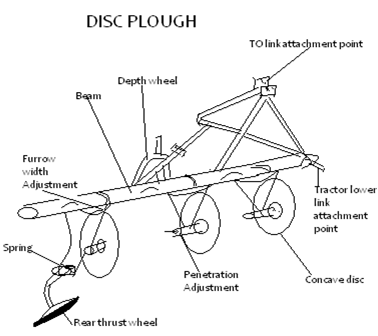
Parts and Functions of a Disc Plough
- Hitchmast: Attachment for the three-point hitch; made of two side links and a top link; connected to tractor hydraulic system for lifting and pulling.
- Beam: Supports other parts and adds weight for better soil penetration.
- Depth wheel: Controls ploughing depth when driving on highways; may not be present on all disc ploughs.
- Standard or leg: Connects discs to the beam.
- Hub: Allows discs to rotate smoothly and cut furrow slices.
- Scrapers: Remove trash and mud clinging to discs.
- Disc blades: Cut and invert furrow slices.
- Rear furrow wheel: Controls digging depth and stabilizes discs.
Adjustment
The cutting angle should be set between 35° and 50° from the line of travel by pivoting the beam or standard.
- Depth of digging: Adjusted by changing the height of the depth wheel, hydraulic system settings, or adding weights.
Care and Maintenance of Disc Plough
- Check and replace loose nuts and bolts.
- Sharpen disc blades if blunt.
- Lubricate rotating parts with oil or grease to reduce friction.
- Paint exposed parts such as the beam and framework.
- Clean after each day’s work before storage.
- Store under a shed.
- Coat unpainted parts with old engine oil to prevent rust.
Uses of a Disc Plough
Suitable for:
- Virgin land with many obstacles.
- Land with excessive trash or tall vegetation.
- Opening up pasture land.
Mouldboard Ploughs
Primary tillage implement suited for areas without obstacles such as stones, tree stumps, and roots.
- Provides uniform ploughing depth.

Parts and Functions of Mouldboard Ploughs
- Share: Makes horizontal cut and starts turning furrow slices.
- Mouldboard: Continues turning furrow slices and pulverizes soil.
- Disc coulter: Makes vertical cut to separate furrow slice from unploughed land.
- Skim coulter: Removes trash between furrow slices.
- Frog: Part where share, mouldboard, and landside attach.
- Landside: Stabilizes plough and absorbs side forces during furrow turning.
- Shin: Leading edge of mouldboard.
- Knife coulter: Vertical knife cutting trash and earth ahead of share.
Care and Maintenance
- Lubricate rolling parts such as wheel and disc coulter bearings.
- Paint scratched parts.
- Sharpen or replace worn shares.
- Check and replace loose nuts and bolts.
- Clean after each day’s work to remove soil, mud, and trash.
- Store under a shed and apply lubricants for long storage.
Adjustment
- Depth: Controlled by raising or lowering the depth wheel and hydraulic lever settings.
- Pitch: Controlled by altering the length of the top link.
- Front furrow width: Controlled by cross shaft adjustment lever or rotating the cross shaft crank.
- Lateral leveling: Controlled by tractor lift rod.
Operational Differences Between a Disc and a Mouldboard Plough
| Disc Plough | Mouldboard Plough |
|---|---|
| Suitable for fields with stones, roots, and stumps. | Cannot be used on fields with stones, roots, or stumps. |
| Does not invert furrow slices completely. | Inverts furrow slices completely. |
| Requires more secondary operations after use. | Requires fewer secondary operations. |
| Cuts at varying points. | Operates at uniform depth. |
| Not easily broken by obstacles. | Can be easily broken by obstacles. |
| Requires less power to operate. | Requires more power to operate. |
Harrows
Secondary cultivation implements.
Types include:
- Disc harrows.
- Spring tine harrows.
- Spike tooth harrows.
Disc Harrows
Consist of gangs with concave discs.
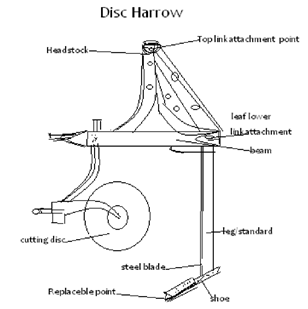
Uses
- Mix soil particles.
- Level seedbed by breaking large soil lumps.
- Kill weeds.
Classified by gang arrangement:
- Tandem.
- Double tandem.
- Offset tandem.
Depth Adjustment
- Add weights on harrows.
- Use hydraulic force.
- Use light or heavy harrows.
- Use regulating wheels.
Care and Maintenance
- Check for loose nuts and bolts daily.
- Lubricate shafts and bearings.
- Clean and oil before storage.
Spring Tine Harrow
Made of flat and curved tines acting as springs.
Uses
- Level and smooth seedbed.
- Break soil clods.
- Mix trash and soil to prevent wind erosion.
- Aerate soil.
Adjustments
- Control depth with horizontal connecting link and depth wheel.
- Adjust individual tines using crossbar and loosen screws.
Care and Maintenance
- Tighten loose nuts and bolts.
- Clean after use.
- Oil lever mechanism.
Spike Tooth Harrows
- Metal framework with rigid metal spikes that break soil by hitting large lumps as pulled through soil.
Uses
- Smooth and compact soil.
- Break big soil lumps into smaller particles.
- Used for cultivating small crops if properly set.
Subsoilers
- Heavy implements requiring high horsepower to pull.
- Ploughing depth of 51-90 cm.
Functions
- Break up compacted soil.
- Break up hardpan layers.
Care and Maintenance
- Clean after use.
- Check and replace worn points.
- Oil when not in use.
Ridger
- Double mouldboard plough used to make ridges and furrows.
- Prevents waterlogging and drains water through furrows for easy harvesting of root crops.
Rollers
Used to gently compact soil, especially where tiny seeds are planted.
Rotavators (Rotary Cultivators)
- Operate with high-speed revolving flail blades that beat and cut soil and trash.
- Used for both primary and secondary tillage.
- Driven by the tractor’s PTO shaft.
Uses
- Break large soil particles into smaller ones.
- Mix vegetation and soil.
- Perform two operations in one pass.
Adjustments
- Forward tractor speed controls seedbed fineness via gearbox.
- Depth controlled by depth wheel.
- Slip clutch may break if knives hit obstructions.
Mowers
Uses
- Cut grass for hay or silage making.
- Cut overgrown grass.
- Clear fields.
Reciprocating Mower
Parts and Functions
- Swath stick: Guides cut crop to fall correctly.
- Swath board: Removes cut crop.
- Shoe: Runner that absorbs weight and wear.
- Cutter bar: Flat bar guiding the fingers.
- Wear plate: Counters downward force and holds knives.
Adjustments
- Adjust knife register by moving the entire bar relative to the yoke.
- Knife lead: Outer shoe adjusted 4 cm outside inner shoe.
Maintenance
- Tighten loose nuts and bolts.
- Keep knife sections sharp.
- Lubricate knife parts.
- Check knife to ledger plate cup for optimal cutting.
- Keep all parts tight.
Rotary Mowers
- Cutting edge consists of two blades fitted opposite each other on a horizontal disc.
- Blades swing horizontally at high speed.
Adjustment and Maintenance
- Keep blades sharp.
- Fit guards around blades to protect operator from flying objects.
- Lubricate PTO shafts.
- Check gearbox oil regularly and fill to correct level.
Planters
- Machines used for sowing seeds.
- Two types: row crop planters and seed drills.
Functions of the Planters
- Meter seed and fertilizers from hoppers.
- Open seed furrow.
- Deposit seed in furrow through delivery tubes.
- Cover the seed.
Functions of Parts of a Seed Plate
- Filler plate: Ensures proper seed depth.
- False ring: Allows seed to fall from seed plate into boot.
- Knockout pawl: Pushes seeds out of plate cells by roller action.
- Cut-off pawl: Prevents more than one seed remaining in a cell.
- Cells: Shaped holes holding seeds.
Adjustments
- Adjust coulter depth for the crop.
- Fix the correct seed plate.
- Place planter level.
- Ensure all shafts turn freely.
Care and Maintenance
- Tighten loose nuts and bolts.
- Clean and oil planter after use.
- Grease drive sprockets regularly.
Seeders
- Grain drills sow grains such as wheat, barley, oats, peas, beans, and alfalfa.
Parts Adjustable to Change Sowing Rate
- Select feed wheel side as per drill charts for seed rate.
- Change wheel speed by changing gears or sprockets.
- Adjust feed gate position in the cup.
- Use reducers below feed wheel.
Care and Maintenance
- Keep seed and fertilizer hoppers dry and clean.
- Lubricate drive shafts.
- Paint parts such as fertilizer hopper to maintain appearance.
Combine Harvester
Use
- Harvest cereal crops such as maize, wheat, and barley.
Designed to perform:
- Cutting.
- Threshing.
- Winnowing.
- Bagging.
Parts of a Combine Harvester
- Cutter bar – cuts grain heads.
- Pick-up reel – directs crop into cutter bar.
- Elevator – channels cut grain to threshing drum.
- Winnowing fan – blows trash onto straw walker and out of harvester.
- Delivery tube – delivers clean grains to collecting tank for bagging.
Maintenance of a Combine Harvester
- Tighten loose nuts and bolts.
- Remove foreign materials stuck in the machine after work.
Ridgers
- Used for harvesting tuber crops and making furrows or ridges.
Maintenance
- Lubricate moving parts.
- Clean after use.
- Store under a shed.
- Repair or replace worn or broken parts.
- Tighten loose nuts and bolts.
- Oil unpainted parts during long storage.
- Sharpen shares if blunt.
Foragers
- Tractor-mounted and powered by PTO shaft.
- Used for harvesting forage crops such as Napier grass, sorghum, and maize.
Maintenance
- Tighten loose nuts and bolts.
- Lubricate moving parts.
- Store in a shed.
- Clean after work.
- Repair or replace worn or broken parts.
- Oil unpainted parts to prevent rust.
Maize Shellers
- Stationary implements, hand or tractor-driven.
- Consist of a rotating disc that shells maize grains from cobs.
Maintenance
- Grease moving parts.
- Remove stuck maize cobs.
- Repair or replace worn or broken parts.
- Store in a shed.
Animal Drawn Implements
Ox Plough
- Simple mouldboard plough pulled by oxen, donkeys, or camels.

Functions of the Parts of an Ox-Plough
- Main beam: Main component to which all parts attach.
- Mouldboard: Inverts cut furrow slice upside down.
- Plough share: Cuts furrow slices.
- Land wheel: Regulates ploughing depth.
- Draft rod: Rod with chain connected to yoke; forms draught mechanism.
Advantages of an Ox-Plough Over Tractor Drawn Plough
- Requires less skill to operate.
- Useful where tractors cannot be used, e.g., steep slopes.
- Cheap to buy and maintain.
Disadvantages of an Ox-Plough Over Tractor Drawn Plough
- Time-consuming to train oxen.
- Tedious and laborious for the driver and controller.
- Animals may be sick or in poor condition.
- Requires extra land for grazing oxen.
Adjustments
- Ploughing depth controlled by land wheel and draft rod.
Care and Maintenance
- Sharpen or replace worn shares.
- Replace worn parts such as hooks and drawbar assembly.
- Oil shiny parts like mouldboard.
- Wash off soil after use.
- Paint handles, beam, and braces to prevent rust.
Ox-Drawn Cart
- Small carriages harnessed to animals by a yoke.
- Small carts have two wheels; larger ones have four.
- Pulled by animals singly or in pairs.
- Used for transport.
Maintenance
- Oil moving parts.
- Repair or replace worn yokes.
- Check and adjust tyre pressure.
- Repair other damages on the cart.


1 Comment