

Introduction
- The agricultural sector is a key player in the economy of our country.
- It is a major employer and generates significant national income through foreign exchange earnings.
National Income
- National income refers to the total earnings from goods and services produced by a country within a period of one year.
Relationship Between Firm and Household
- A household is considered a unit comprising a farmer and family members.
- It produces raw materials and consumes manufactured goods.
- A firm is any manufacturing or processing unit that consumes raw materials and produces manufactured goods.
- Both households and firms generate income, which is used to:
- Improve the standard of living of household members by paying for essential goods and services.
- Enable firms to build more industries, creating employment and generating revenue through salaries and wages.
- Finance government projects through taxes, contributing to national development.
Gross Domestic Product (G.D.P.)
- Gross Domestic Product is the total value of all goods and services produced within a country in one year.
Gross National Product (G.N.P.)
- Gross National Product is the sum of G.D.P. and the net income from abroad, which is the difference between income inflow (revenue coming into the country) and income outflow (money sent out by foreign investors).
- It represents the total income earned by the country both domestically and internationally.
Per Capita Income
- Per capita income is the Gross National Income divided by the total population of the country.
- It is not always a good measure of economic well-being due to uneven income distribution among the population.
Contribution of Agriculture to National Development
- The interaction between households and firms generates income that finances the expansion of firms.
- This expansion creates more employment and revenue.
- The government taxes this income to fund national development programs such as:
- Health services,
- Education,
- Water and energy supply,
- Communication infrastructure.
Factors of Production
- A factor of production is any resource that directly contributes to output; it is a productive resource.
- Productive resources used in producing goods and services include:
- Land,
- Labour,
- Capital,
- Management.
Land
- As a factor of production, land refers to the natural characteristics and properties of a given area.
- Key factors include productivity elements such as soil fertility, availability of water and minerals. Land is fixed in supply and has no geographical mobility.
Labour
- Humans are both consumers and a factor of production.
- They provide the labour force (human power) required in production.
- Labour is assessed by productivity rather than just the number of workers.
- It is measured in man-hours, man-days, or man-months. The labourer’s productive capacity depends on factors such as:
- Age,
- Health,
- Nutrition,
- Level of education.
- The amount and efficiency of work performed determine the quality of labour.
Capital
- Capital refers to all man-made assets that assist land and labour in production.
- It is categorized into:
- Fixed/durable capital,
- Working capital,
- Liquid capital.
Fixed/Durable Capital
Examples include:
- Machinery,
- Buildings,
- Permanent improvements on land such as fences,
- Roads,
- Irrigation facilities,
- Water supply systems.
Working Capital
This includes consumer goods such as:
- Fertilizers,
- Livestock feeds,
- Fuel in store,
- Pesticides.
Liquid Capital
Examples include:
- Ready money,
- Bank deposits,
- Shares in financial institutions.
Management
- Management is the process of decision-making on the farm.
- Managers use their knowledge and judgment to decide how to combine the other three productive resources most effectively.
- They plan, execute, and bear the risks or consequences of their decisions.
Production Function
Definition
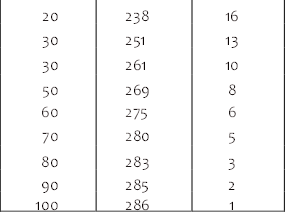
- A production function is the physical relationship between inputs and outputs in a production process.
- It indicates the quantity of output expected from a given combination of inputs.
- Production functions can be expressed in tables or graphically as curves.
Example
Feeding pigs for pork production at varying levels of concentrate feed.
| Unit of feed | Body wt. | Marginal |
|---|---|---|
| 0 | 212 | – |
| 10 | 222 | 10 |
Types of Production Functions
- Production functions assume three forms, which may be treated as different types:
- Increasing Returns,
- Constant Returns,
- Decreasing (Diminishing) Returns.
Increasing Returns
- Each additional unit of input results in a larger increase in output than the previous unit.
- This indicates that resources are underutilized.
Constant Returns
- The product increases by the same amount for each additional input unit, indicating constant returns to the input factor.
- Resources are still underutilized in this stage.
Decreasing (Diminishing) Returns
- Each additional unit of input results in a smaller increase in output than the previous unit.
- Resource use is stretched to the maximum.
- This is the most common form encountered in agricultural enterprises.
- It gives rise to the law of Diminishing Returns.
Examples
- Feeding dairy cows with varying amounts of feed for milk production.
- Crop responses to different amounts of fertilizer application.
- Using varying units of labour on a fixed unit of land.
Economic Laws and Principles
The Law of Diminishing Returns
- The law states:
“If successive units of one input are added to fixed quantities of other inputs, a point is eventually reached where additional product (output) per additional unit of input declines.”
- This law applies practically to all forms of agricultural production.
- It helps determine the most rational and profitable level of production.
Example
Production of maize at varying levels of N.P.K. fertilizer application on a fixed area of land.
| Unit of NPK | Total | Marginal |
|---|---|---|
| Fertilizer | Yields | Products |
| (bags) | (bags) | |
| 30 | 10 | – |
| 60 | 27 | 17 |
| 90 | 42 | 15 |
| 120 | 56 | 14 |
| 150 | 63 | 7 |
| 180 | 65 | 3 |
| 210 | 65 | 0 |
| 240 | 60 | -5 |
| 270 | 52 | -8 |
| 300 | 42 | -10 |
Zones of a Production Function Curve
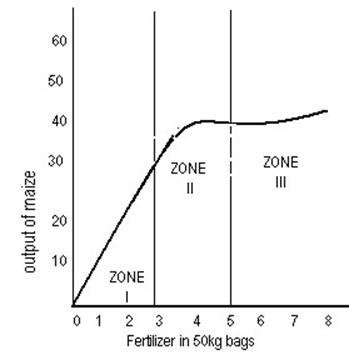
The zones of a production function curve are:
- Irrational zone or Zone I,
- Rational zone or Zone II,
- Irrational zone or Zone III.
- The three zones are determined by drawing two perpendicular lines through the production function curve: one at MP = AP and another at MP = 0.
- In Zone I, resources are not fully utilized, while in Zone III, excessive resource application leads to production decline or loss.
- It is not economical to produce at these levels.
- In Zone II, resources are maximally utilized, resulting in maximum production.
- Therefore, it is economical (or wise) to produce at this level.
Principle of Substitution
This principle states: “If the output in a production process is constant, it is profitable to substitute one input factor for another, as long as it is cheaper than its alternative.”
- This principle applies when more than one variable input factor is used.
- For example, feeding hay and concentrates for milk production, or using farmyard manure and phosphatic fertilizers in maize production.
- The basic problem the producer wishes to solve when two input factors are combined is: in what proportions should the inputs be combined to minimize cost and maximize profit?
- To solve this, the producer must determine the least cost combination of inputs.
- The least cost combination is attained where the Marginal Rate of Substitution (MRS) equals the inverse of the price ratio of the factors involved.
That is:
 x2 = P x1
 x1 = P x2
x1 – first input factor
x2 – second input factor
– change (increase or decrease)
P – price (cost of input factors)

- Producing 20 bags of maize using varying combinations of farmyard manure and phosphate fertilizers.
- Price of farmyard manure (FYM) is KShs 10/- per unit and phosphate fertilizer is KShs 50/- per unit.
| X1 (P-fert) | x2 (N-fert) | X2 (MRS) / X1 |
|---|---|---|
| 100kg units | 100kg units | |
| 1 | 9.00 | – |
| 2 | 4.00 | 5.1 |
| 3 | 2.80 | 1.20 |
| 4 | 2.40 | 0.40 |
| 5 | 2.00 | 0.40 |
| 6 | 1.80 | 0.20 |
| 7 | 1.65 | 0.15 |
| 8 | 1.55 | 0.10 |
| 9 | 1.45 | 0.10 |
| 10 | 1.45 | 0.05 |
In this example, the following assumptions are made:
- A fixed quantity of output is to be produced.
- Input factors substitute for one another at varying rates.
- Relative prices of input factors do not change drastically during production.
NOTE: One input factor substitutes for another at a diminishing marginal rate of substitution.
Principle of Equimarginal Returns
- This principle states: “The last unit of an input factor spent in one enterprise yields a marginal return exactly equal to the marginal return earned from the last unit invested in other enterprises.”
Example
- If the last shs. 100/- spent on cattle feed returns more than shs. 100/- spent on fertilizer for maize, it is advisable to buy more feed until the last shs. 100/- spent on feed returns the same as the last shs. 100/- spent on fertilizer.
- This concept is relevant when farmers lack sufficient capital to employ inputs up to the level where marginal revenue equals marginal cost.
The Principle of Profit Maximization
- Profit is the difference, in monetary terms, between total returns (income) and total costs (expenses) in production.
- Profit maximization aims to obtain the highest returns at minimum cost per unit of input factor used.
- This can be achieved by considering two concepts.
Marginal Concept
- Profit is maximized when marginal revenue (MR) equals or slightly exceeds marginal cost (MC).
- At this point, every additional input factor yields higher returns than the cost of investing it.
Net Revenue Concept
- Profit is maximized when Net Revenue (NR), the difference between total revenue (TR) and total costs (TC), is highest: NR = TR – TC.
- This is determined by analyzing total costs and revenues from an enterprise and subtracting costs from revenues.
When calculating profit using these concepts, the following assumptions are made:
- Input costs (e.g., fertilizers, labour) remain constant during production.
- Prices of the produce remain unchanged.
- Fixed costs are ignored; only variable costs directly involved are considered.
Farm Planning
- Planning is the process of establishing organizational objectives and defining means to achieve them.
Factors to consider when drawing a farm plan include:
- Size of the farm,
- Environmental factors,
- Current labour market trends,
- Farmer’s objectives and preferences,
- Possible production enterprises,
- Existing market conditions and price trends,
- Availability and cost of farm inputs,
- Government regulations and policies,
- Security,
- Communication and transport facilities.
Farm Budgeting
- Farm budgeting is the process of estimating future outcomes of a proposed farm plan, including future incomes and expenses.
Importance of Farm Budgeting
- It aids decision-making on the farm.
- Helps the farmer predict future returns and plan ahead.
- Prevents losses by avoiding investment in less profitable enterprises.
- Assists in securing loans from financial institutions such as Agricultural Finance Corporation and commercial banks.
- Ensures periodic analysis of the farm business.
- Acts as a record for future reference.
- Identifies strengths and weaknesses in farm operations.
Types of Budgets
Partial Budget
- Represents financial effects of minor changes in a farm organization.
- Used when a farmer wants to replace or reduce an enterprise.
Complete Budget
- Necessary when starting a new business or making major changes affecting both variable and fixed costs.
- Involves significant reorganization of the farm business.
Agricultural Services Available to the Farmer
- Agricultural production efficiency is greatly enhanced by services provided by:
- Government institutions,
- Non-governmental organizations.
Some of these services include:
- Extension and Training,
- Banking Services,
- Credit facilities.
Extension and Training
- Provided in the field and at farmer training centres to improve knowledge and skills.
Banking Services
- Enable farmers to save farm income and invest in future projects.
- Credit is financial assistance advanced to farmers to finance projects, repayable with interest.
- It is a borrowed resource.
Types of Credit
- Credit is categorized by:
- Time of repayment,
- Types of projects financed.
Examples include:
Short-term Credit
- Repayable within one year, used for purchasing:
- seeds,
- fertilizers,
- animal feeds.
Medium-term Credit
- Repayable within 2 to 5 years, used for projects such as:
- fencing materials,
- livestock purchase,
- light farm equipment.
Long-term Credit
- Repayable over 15 years or more.
- Used for long-term or durable projects such as:
- land purchase,
- construction of soil and water conservation structures,
- farm buildings,
- irrigation projects for perennial cash crops like coffee,
- farm machinery and implements.
Sources of Credit
- Co-operative societies and unions,
- Crop boards,
- Commercial banks,
- Agricultural Finance Corporation,
- Insurance companies,
- Individual money lenders,
- Settlement fund trustees.
Artificial Insemination Services
- Provide farmers with semen from improved or superior bulls to enhance livestock herds through controlled breeding.
Agricultural Research Organizations
- Develop and disseminate improved production techniques and crop and livestock species with better performance in different ecological zones.
Marketing Outlets
- Agencies that ensure effective and efficient conveyance of farm produce to processing and consumption points.
- These include crop marketing boards, corporations, and cooperative societies.
Veterinary Services
- Veterinary officers assist farmers in treating and controlling livestock diseases and parasites.
Farm Input Supplies
- Farmers obtain inputs from organizations such as cooperatives and private companies.
- These organizations bring inputs closer to farmers, for example, Kenya Farmers Association and private agrovets.
Tractor Hire Services
- Farmers who do not own tractors can hire tractors and machinery at a cost.
Sources
- Ministry of Agriculture,
- Private contractors,
- Individual farmers,
- Other service providers.
Risks and Uncertainties in Farming
- Uncertainty is the state of not knowing future events or outcomes.
- Risk is the difference (divergence) between expected and actual outcomes.
Types of Risks and Uncertainties
- Fluctuation of commodity prices,
- Physical yield uncertainty,
- Ownership uncertainty,
- Outbreak of pests and diseases,
- Sickness and injury,
- New production techniques,
- Obsolescence, for example, machinery becoming outdated quickly,
- Death of either farmer or livestock,
- Natural catastrophes such as:
- Floods,
- Drought,
- Earthquakes,
- Storms and strong winds that may destroy crops or kill animals.
Ways in Which Farmers Adjust to Risks and Uncertainties
- Diversification of enterprises,
- Selecting more certain enterprises,
- Contracting,
- Insurance,
- Input rationing,
- Flexibility in production methods,
- Adopting modern production methods.


