

The Mole
Gas Laws
1. Matter is made up of small particles in accordance with the Kinetic Theory of Matter.
There are basically three states of matter: Solid, Liquid, and Gas.
(i) A solid is made up of particles that are very closely packed with a definite/fixed shape and fixed/definite volume, occupying definite space. It has a very high density.
(ii) A liquid is made up of particles that have some degree of freedom. It thus has no definite/fixed shape and takes the shape of the container it is put in. A liquid has fixed/definite volume, occupying definite space.
(iii) A gas is made up of particles free from each other. It has no definite/fixed shape and takes the shape of the container it is put in. It has no fixed/definite volume, occupying every space in a container.
2. Gases are affected by physical conditions. There are two physical conditions:
- Temperature
- Pressure
3. The SI unit of temperature is Kelvin (K).
Degrees Celsius/Centigrade (oC) are also used.
The two units can be interconverted using the relationship:
oC + 273 = K
K – 273 = oC
Practice Examples
1. Convert the following into Kelvin.
(i) 0oC
oC + 273 = K substituting: 0oC + 273 = 273 K
(ii) -273oC
oC + 273 = K substituting: -273oC + 273 = 0 K
(iii) 25oC
oC + 273 = K substituting: 25oC + 273 = 298 K
(iv) 100oC
oC + 273 = K substituting: 100oC + 273 = 373 K
2. Convert the following into degrees Celsius/Centigrade (oC).
(i) 10 K
K – 273 = oC substituting: 10 – 273 = -263oC
(ii) 1 K
K – 273 = oC substituting: 1 – 273 = -272oC
(iii) 110 K
K – 273 = oC substituting: 110 – 273 = -163oC
(iv) -24 K
K – 273 = oC substituting: -24 – 273 = -297oC
The standard temperature is 273 K = 0oC.
The room temperature is assumed to be 298 K = 25oC.
4. The SI unit of pressure is Pascal (Pa) / Newton per metre squared (Nm-2). Millimeters of mercury (mmHg), centimeters of mercury (cmHg), and atmospheres are also commonly used.
The units are not interconvertible, but Pascals (Pa) are equal to Newton per metre squared (Nm-2).
The standard pressure is the atmospheric pressure.
Atmospheric pressure is equal to about:
- 101325 Pa
- 101325 Nm-2
- 760 mmHg
- 76 cmHg
- one atmosphere
5. Molecules of gases are always in continuous random motion at high speed. This motion is affected by the physical conditions of temperature and pressure.
Physical conditions change the volume occupied by gases in a closed system.
The effect of physical conditions of temperature and pressure was investigated and expressed in both Boyle’s and Charles’ laws.
6. Boyle’s law states that:
“the volume of a fixed mass of a gas is inversely proportional to the pressure at constant/fixed temperature“
Mathematically:
Volume α 1 / Pressure (Fixed / constant Temperature)
i.e. PV = Constant (k)
From Boyle’s law, an increase in pressure of a gas causes a decrease in volume. For example, doubling the pressure causes the volume to be halved.
Graphically, a plot of volume (V) against pressure (P) produces a curve.
Graphically, a plot of volume (V) against inverse/reciprocal of pressure (1/P) produces a straight line.
For two gases:
P1 V1 = P2 V2
- P1 = Pressure of gas 1
- V1 = Volume of gas 1
- P2 = Pressure of gas 2
- V2 = Volume of gas 2
Practice Examples:
1. A fixed mass of gas at 102300 Pa pressure has a volume of 25 cm3. Calculate its volume if the pressure is doubled.
Working:
P1 V1 = P2 V2
Substituting: 102300 × 25 = (102300 × 2) × V2
V2 = (102300 × 25) / (102300 × 2) = 12.5 cm3
2. Calculate the pressure which must be applied to a fixed mass of 100 cm3 of Oxygen for its volume to triple at 100000 Nm-2.
P1 V1 = P2 V2
Substituting: 100000 × 100 = P2 × (100 × 3)
P2 = (100000 × 100) / (100 × 3) = 33333.3333 Nm-2
3. A 60 cm3 weather balloon full of Hydrogen at atmospheric pressure of 101325 Pa was released into the atmosphere. Will the balloon reach the stratosphere where the pressure is 90000 Pa?
P1 V1 = P2 V2
Substituting: 101325 × 60 = 90000 × V2
V2 = (101325 × 60) / 90000 = 67.55 cm3
The new volume at 67.55 cm3 exceeds the balloon capacity of 60.00 cm3. It will burst before reaching the destination.
7. Charles’ law states that “the volume of a fixed mass of a gas is directly proportional to the absolute temperature at constant/fixed pressure“.
Mathematically:
Volume α Temperature (Fixed / constant pressure)
i.e. V = Constant (k) × T
From Charles’ law, an increase in temperature of a gas causes an increase in volume. For example, doubling the temperature causes the volume to be doubled.
Gases expand/increase by 1/273 by volume on heating. Gases contract/decrease by 1/273 by volume on cooling at constant/fixed pressure.
The volume of a gas continues decreasing with decrease in temperature until at -273oC / 0 K the volume is zero, i.e., there is no gas.
This temperature is called absolute zero. It is the lowest temperature at which a gas can exist.
Graphically, a plot of volume (V) against Temperature (T) in:
(i) oC produces a straight line that is extrapolated to the absolute zero of -273oC.
(ii) Kelvin/K produces a straight line from absolute zero of 0 Kelvin.
For two gases:
V1 / T1 = V2 / T2
- T1 = Temperature in Kelvin of gas 1
- V1 = Volume of gas 1
- T2 = Temperature in Kelvin of gas 2
- V2 = Volume of gas 2
Practice Examples:
1. 500 cm3 of carbon(IV) oxide at 0oC was transferred into a cylinder at -4oC. If the capacity of the cylinder is 450 cm3, explain what happened.
V1 / T1 = V2 / T2
Substituting: 500 / (0 + 273) = V2 / (-4 + 273)
V2 = 500 × (269 / 273) = 492.674 cm3
The capacity of the cylinder (500 cm3) is more than the new volume (492.674 cm3).
7.326 cm3 (500 – 492.674 cm3) of carbon(IV) oxide gas did not fit into the cylinder.
2. A mechanic was filling a deflated tyre with air in his closed garage using a hand pump. The capacity of the tyre was 40,000 cm3 at room temperature. He rolled the tyre into the car outside. The temperature outside was 30oC. Explain what happens.
V1 / T1 = V2 / T2
Substituting: 40000 / (25 + 273) = V2 / (30 + 273)
V2 = 40000 × (303 / 298) = 40671.1409 cm3
The capacity of the tyre (40000 cm3) is less than the new volume (40671.1409 cm3).
The tyre thus bursts.
3. A hydrogen gas balloon with 80 cm3 was released from a research station at room temperature. If the temperature of the highest point it rose is -30oC, explain what happened.
V1 / T1 = V2 / T2
Substituting: 80 / (25 + 273) = V2 / (-30 + 273)
V2 = 80 × (243 / 298) = 65.2349 cm3
The capacity of the balloon (80 cm3) is more than the new volume (65.2349 cm3).
The balloon thus remained intact.
8. The continuous random motion of gases differs from gas to gas. The movement of molecules (of a gas) from a region of high concentration to a region of low concentration is called diffusion.
The rate of diffusion of a gas depends on its density. That is, the higher the rate of diffusion, the less dense the gas.
The density of a gas depends on its molar mass/relative molecular mass. That is, the higher the density, the higher the molar mass/relative molecular mass and thus the lower the rate of diffusion.
Examples:
1. Carbon (IV) oxide (CO2) has a molar mass of 44 g. Nitrogen (N2) has a molar mass of 28 g. N2 is thus lighter/less dense than Carbon (IV) oxide (CO2). N2 diffuses faster than CO2.
2. Ammonia (NH3) has a molar mass of 17 g. Nitrogen (N2) has a molar mass of 28 g. N2 is thus about twice heavier/denser than Ammonia (NH3). Ammonia (NH3) diffuses twice faster than N2.
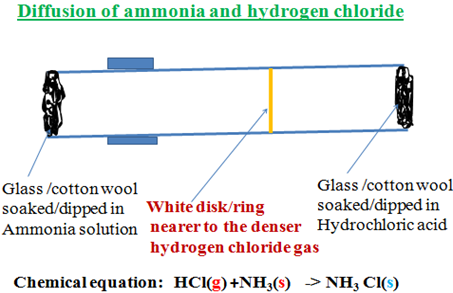
3. Ammonia (NH3) has a molar mass of 17 g. Hydrogen chloride gas has a molar mass of 36.5 g. Both gases on contact react to form white fumes of ammonium chloride. When a glass/cotton wool dipped in ammonia and another glass/cotton wool dipped in hydrochloric acid are placed at opposite ends of a glass tube, both gases diffuse towards each other. A white disk appears near the glass/cotton wool dipped in hydrochloric acid. This is because hydrogen chloride is heavier/denser than ammonia and thus its rate of diffusion is lower.
The rate of diffusion of a gas is in accordance with Graham’s law of diffusion. Graham’s law states that:
“the rate of diffusion of a gas is inversely proportional to the square root of its density, at the same/constant/fixed temperature and pressure.”
Mathematically:
R α 1 / √ρ and since density is proportional to mass, then R α 1 / √m
For two gases:
R1 / R2 = √M2 / √M1
where R1 and R2 are the rates of diffusion of the 1st and 2nd gas, and M1 and M2 are the molar masses of the 1st and 2nd gas.
Since rate is inverse of time, i.e., the higher the rate, the less the time:
For two gases:
T1 / T2 = √M1 / √M2
where T1 and T2 are the times taken for the 1st and 2nd gas to diffuse.
Practice Examples:
1. It takes 30 seconds for 100 cm3 of carbon(IV) oxide to diffuse across a porous plate. How long will it take 150 cm3 of nitrogen(IV) oxide to diffuse across the same plate under the same conditions of temperature and pressure? (C=12.0, N=14.0, O=16.0)
Molar mass CO2 = 44.0; Molar mass NO2 = 46.0
Method 1:
100 cm3 CO2 takes 30 seconds
150 cm3 takes (150 × 30) / 100 = 45 seconds
T CO2 / √M CO2 = T NO2 / √M NO2
45 / √44.0 = T NO2 / √46.0
T NO2 = 45 × √46.0 / √44.0 = 46.01 seconds
Method 2:
100 cm3 CO2 takes 30 seconds
1 cm3 takes 30 / 100 = 0.3 cm3 sec-1
R CO2 / √M NO2 = R NO2 / √M CO2
0.3 / √46.0 = R NO2 / √44.0
R NO2 = 0.3 × √44.0 / √46.0 = 0.29 cm3 sec-1
0.29 cm3 takes 1 second
150 cm3 takes 150 / 0.29 = 517.24 seconds
2. How long would 200 cm3 of Hydrogen chloride take to diffuse through a porous plug if carbon(IV) oxide takes 200 seconds to diffuse through?
Molar mass CO2 = 44 g; Molar mass HCl = 36.5 g
T CO2 / √M CO2 = T HCl / √M HCl
200 / √44.0 = T HCl / √36.5
T HCl = 200 × √36.5 / √44.0 = 182.16 seconds
3. Oxygen gas takes 250 seconds to diffuse through a porous diaphragm. Calculate the molar mass of gas Z which takes 227 seconds to diffuse.
Molar mass O2 = 32 g; Molar mass Z = x g
T O2 / √M O2 = T Z / √M Z
250 / √32 = 227 / √x
√x = 227 × √32 / 250 = 5.137
x = (5.137)2 = 26.38 grams
4. 25 cm3 of carbon(II) oxide diffuses across a porous plate in 25 seconds. How long will it take 75 cm3 of carbon(IV) oxide to diffuse across the same plate under the same conditions of temperature and pressure? (C=12.0, O=16.0)
Molar mass CO2 = 44.0; Molar mass CO = 28.0
Method 1:
25 cm3 CO takes 25 seconds
75 cm3 takes (75 × 25) / 25 = 75 seconds
T CO / √M CO = T CO2 / √M CO2
75 / √28.0 = T CO2 / √44.0
T CO2 = 75 × √44.0 / √28.0 = 94.02 seconds
Method 2:
25 cm3 CO2 takes 25 seconds
1 cm3 takes 25 / 25 = 1.0 cm3 sec-1
R CO2 / √M CO = R CO / √M CO2
1.0 / √28.0 = R CO / √44.0
R CO = 1.0 × √28.0 / √44.0 = 0.80 cm3 sec-1
0.80 cm3 takes 1 second
75 cm3 takes 75 / 0.80 = 93.75 seconds


