


Chemistry Form Three Notes
Chemistry of Carbon
A: Carbon
Carbon is an element in Group IV (Group 4) of the Periodic Table. It has atomic number 6 and electronic configuration 2:4, thus possessing four valence electrons (tetravalent). Carbon does not easily ionize but forms strong covalent bonds with other elements, including itself, making it highly versatile in forming compounds.
(a) Occurrence
Carbon naturally occurs mainly as:
- Allotropes of carbon such as graphite, diamond, and fullerenes.
- Amorphous carbon found in coal, peat, charcoal, and coke.
- Carbon(IV) oxide gas, which accounts for approximately 0.03% by volume of normal air in the atmosphere.
(b) Allotropes of Carbon
Carbon naturally exists in two main crystalline allotropic forms: carbon-diamond and carbon-graphite.
| Carbon-diamond | Carbon-graphite |
|---|---|
| Shiny crystalline solid | Black/dull crystalline solid |
| Has a very high melting/boiling point due to a closely packed giant tetrahedral structure joined by strong covalent bonds | Has a high melting/boiling point due to a closely packed giant hexagonal planar structure joined by strong covalent bonds |
| Very high density (hardest known natural substance) | Soft |
| Abrasive | Slippery |
| Poor electrical conductor because it has no free delocalized electrons | Good electrical conductor due to free 4th valency delocalized electrons |
| Used in making jewels, drilling, and cutting metals | Used in making lead pencils, electrodes in batteries, and as a lubricant |
| Has giant tetrahedral structure | Has giant hexagonal planar structure |
(c) Properties of Carbon
(i) Physical properties of carbon
- Carbon occurs widely and naturally as a black solid.
- It is insoluble in water but soluble in carbon disulphide and organic solvents.
- It is a poor electrical and thermal conductor.
(ii) Chemical properties of carbon
I. Burning
Experiment: Introduce a small piece of charcoal into a Bunsen flame, then lower it into a gas jar containing oxygen gas. Add three drops of water, swirl, and test the solution with blue and red litmus papers.
Observation:
- Carbon chars then burns with a blue flame.
- Colourless and odourless gas is produced.
- Solution formed turns blue litmus paper faint red; red litmus paper remains red.
Explanation: Carbon burns in air and more rapidly in oxygen with a blue, non-sooty flame forming carbon (IV) oxide gas. In limited air supply, it burns with a blue, non-sooty flame forming carbon (II) oxide gas. Carbon (IV) oxide dissolves in water to form a weak acidic solution of carbonic (IV) acid.
Chemical Equations:
- C(s) + O2(g) → CO2(g) (in excess air)
- 2C(s) + O2(g) → 2CO(g) (in limited air)
- CO2(g) + H2O(l) → H2CO3(aq) (very weak acid)
II. Reducing agent
Experiment: Mix equal amounts of powdered charcoal and copper (II) oxide thoroughly in a crucible and heat strongly.
Observation: Colour changes from black to brown.
Explanation: Carbon acts as a reducing agent. It has been used for ages to reduce metal oxide ores to metals, itself oxidized to carbon (IV) oxide gas. Carbon reduces black copper (II) oxide to brown copper metal.
Chemical Equations:
- 2CuO(s) + C(s) → 2Cu(s) + CO2(g) (black to brown)
- 2PbO(s) + C(s) → 2Pb(s) + CO2(g) (brown when hot/grey when cool)
- 2ZnO(s) + C(s) → 2Zn(s) + CO2(g) (yellow when hot/white when cool)
- Fe2O3(s) + 3C(s) → 2Fe(s) + 3CO2(g) (brown when hot/cool to grey)
- Fe3O4(s) + 4C(s) → 3Fe(s) + 4CO2(g) (brown when hot/cool to grey)
B: Compounds of Carbon
The main compounds of carbon include:
- Carbon(IV) Oxide (CO2)
- Carbon(II) Oxide (CO)
- Carbonate(IV) (CO32-) and hydrogen carbonate(IV) (HCO3–)
- Sodium carbonate (Na2CO3)
(i) Carbon(IV) Oxide (CO2)
(a) Occurrence
Carbon(IV) oxide is found:
- In the atmosphere as approximately 0.03% by volume.
- As a solid carbon(IV) oxide mineral in Esageri near Eldame Ravine and Kerita near Limuru in Kenya.
(b) School Laboratory Preparation
In the school laboratory, carbon(IV) oxide can be prepared by reacting marble chips (CaCO3) or sodium hydrogen carbonate (NaHCO3) with dilute hydrochloric acid.


(c) Properties of Carbon(IV) Oxide Gas
1. Write the equation for the reaction for the school laboratory preparation of carbon (IV) oxide gas.
Any carbonate reacted with dilute hydrochloric acid produces carbon (IV) oxide gas.
Chemical equations:
- CaCO3(s) + 2HCl(aq) → CaCl2(aq) + H2O(l) + CO2(g)
- ZnCO3(s) + 2HCl(aq) → ZnCl2(aq) + H2O(l) + CO2(g)
- MgCO3(s) + 2HCl(aq) → MgCl2(aq) + H2O(l) + CO2(g)
- CuCO3(s) + 2HCl(aq) → CuCl2(aq) + H2O(l) + CO2(g)
- NaHCO3(s) + HCl(aq) → NaCl(aq) + H2O(l) + CO2(g)
- KHCO3(s) + HCl(aq) → KCl(aq) + H2O(l) + CO2(g)
2. What method of gas collection is used in preparation of Carbon(IV) oxide gas? Explain.
Downward delivery (upward displacement of air or over mercury) is used because carbon(IV) oxide gas is about 1½ times denser than air.
3. What is the purpose of:
(a) Water?
To absorb the more volatile hydrogen chloride fumes produced during the vigorous reaction.
(b) Sodium hydrogen carbonate?
To absorb the more volatile hydrogen chloride fumes and react with the acid to produce more carbon (IV) oxide gas.
Chemical equation:
NaHCO3(s) + HCl(aq) → NaCl(aq) + H2O(l) + CO2(g)
(c) Concentrated sulphuric(VI) acid?
To dry the gas, acting as a drying agent.
4. Describe the smell of carbon(IV) oxide gas.
It is colourless and odourless.
5. Effect on lime water.
Experiment: Bubble carbon(IV) oxide gas into a test tube containing lime water for about three minutes.
Observation: White precipitate forms and dissolves when excess carbon(IV) oxide gas is bubbled.
Explanation: Carbon(IV) oxide reacts with lime water (Ca(OH)2) to form an insoluble white precipitate of calcium carbonate. Calcium carbonate then reacts with more carbon(IV) oxide to form soluble calcium hydrogen carbonate.
Chemical equations:
- Ca(OH)2(aq) + CO2(g) → CaCO3(s) + H2O(l)
- CaCO3(s) + H2O(l) + CO2(g) → Ca(HCO3)2(aq)
6. Effects on burning magnesium ribbon
Experiment: Lower a piece of burning magnesium ribbon into a gas jar containing carbon (IV) oxide gas.
Observation:
- The ribbon continues to burn with difficulty.
- White ash/solid is formed.
- Black specks/solid particles form on the side of the gas jar.
Explanation: Carbon (IV) oxide gas does not support combustion. Magnesium burns, releasing enough heat to decompose carbon (IV) oxide gas into carbon and oxygen. Magnesium continues to burn in oxygen, forming white magnesium oxide solid/ash. Black specks of carbon/charcoal residue form on the sides of the reaction flask. During the reaction, carbon (IV) oxide is reduced (acting as an oxidizing agent) to carbon, while magnesium is oxidized to magnesium oxide.
Chemical equation:
2Mg(s) + CO2(g) → C(s) + 2MgO(s)
7. Dry and wet litmus papers were separately put in a gas jar containing dry carbon (IV) oxide gas. State and explain the observations made.
Observation:
- Blue dry litmus paper remains blue.
- Red dry litmus paper remains red.
- Blue wet/damp/moist litmus paper turns red.
- Red wet/damp/moist litmus paper remains red.
Explanation: Dry carbon (IV) oxide gas is a molecular compound that does not dissociate or ionize to release H+ ions and thus has no effect on litmus papers. Wet/damp/moist litmus paper contains water that dissolves/reacts with dry carbon (IV) oxide gas to form a weak solution of carbonic (IV) acid (H2CO3). Carbonic (IV) acid dissociates to a few free H+ and CO32- ions. The few H+ ions cause blue litmus paper to turn faint red, indicating the gas is very weakly acidic.
Chemical equation:
H2CO3(aq) → 2H+(aq) + CO32-(aq)
8. Explain why Carbon (IV) oxide cannot be prepared from the reaction of:
(i) Marble chips with dilute sulphuric (VI) acid.
Explanation: The reaction forms insoluble calcium sulphate (VI) that coats unreacted marble chips, stopping further reaction.
Chemical equation:
- CaCO3(s) + H2SO4(aq) → CaSO4(s) + H2O(l) + CO2(g)
- PbCO3(s) + H2SO4(aq) → PbSO4(s) + H2O(l) + CO2(g)
- BaCO3(s) + H2SO4(aq) → BaSO4(s) + H2O(l) + CO2(g)
(ii) Lead (II) carbonate with dilute hydrochloric acid.
The reaction forms insoluble lead (II) chloride that coats unreacted lead (II) carbonate, stopping further reaction unless heated. Lead (II) chloride is soluble in hot water.
Chemical equation:
PbCO3(s) + 2HCl(aq) → PbCl2(s) + H2O(l) + CO2(g)
9. Describe the test for the presence of Carbon (IV) oxide.
Using a burning splint: Lower a burning splint into a gas jar suspected to contain carbon (IV) oxide gas. The burning splint is extinguished.
Using lime water: Bubble the gas suspected to be carbon (IV) oxide. A white precipitate that dissolves in excess bubbling is formed.
Chemical equations:
- Ca(OH)2(aq) + CO2(g) → CaCO3(s) + H2O(l)
- CaCO3(s) + H2O(l) + CO2(g) → Ca(HCO3)2(aq)
10. State three main uses of Carbon (IV) oxide gas.
- In the Solvay process for manufacturing soda ash/sodium carbonate.
- In preservation of aerated drinks.
- As a fire extinguisher because it does not support combustion and is denser than air.
- In the manufacture of baking powder.
(ii) Carbon (II) Oxide (CO)
(a) Occurrence
Carbon (II) oxide is produced from incomplete combustion of fuels such as petrol, charcoal, and liquefied petroleum gas (LPG).
(b) School Laboratory Preparation
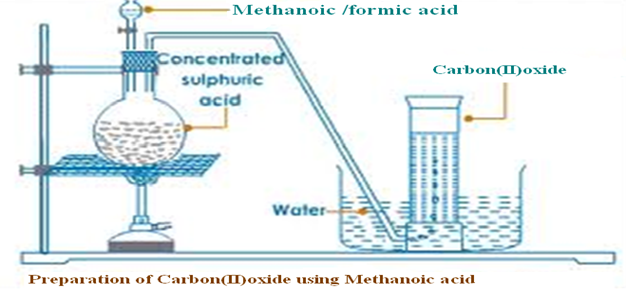
In the school laboratory, carbon (II) oxide can be prepared by dehydration of methanoic acid (formic acid, HCOOH) or ethan-1,2-dioic acid (oxalic acid, HOOCCOOH) using concentrated sulphuric (VI) acid. Heating is necessary.


(c) Properties of Carbon (II) Oxide
1. Write the equation for the reaction for the preparation of carbon(II) oxide using:
(i) Method 1:
Chemical equation:
HOOCCOOH(s) –Conc.H2SO4→ CO(g) + CO2(g) + H2O(l)
H2C2O4(s) –Conc.H2SO4→ CO(g) + CO2(g) + H2O(l)
(ii) Method 2:
Chemical equation:
HCOOH(s) –Conc.H2SO4→ CO(g) + H2O(l)
H2CO2(s) –Conc.H2SO4→ CO(g) + H2O(l)
2. What method of gas collection is used during the preparation of carbon (II) oxide?
Over water because the gas is insoluble in water. Downward delivery is also used because the gas is 1½ times denser than air.
3. What is the purpose of:
(i) Potassium hydroxide/sodium hydroxide in Method 1:
To absorb/remove carbon (II) oxide produced during the reaction.
Chemical equations:
2KOH (aq) + CO2(g) → K2CO3(s) + H2O(l)
2NaOH (aq) + CO2(g) → Na2CO3(s) + H2O(l)
(ii) Concentrated sulphuric(VI) acid in Method 1 and 2:
Acts as a dehydrating agent, removing water (hydrogen and oxygen in ratio 2:1) present in both methanoic and ethan-1,2-dioic acid.
4. Describe the smell of carbon (II) oxide.
It is colourless and odourless.
5. State and explain the observation made when carbon(IV) oxide is bubbled in lime water for a long time.
No white precipitate is formed.
6. Dry and wet/moist/damp litmus papers were separately put in a gas jar containing dry carbon (II) oxide gas. State and explain the observations made.
Observation:
- Blue dry litmus paper remains blue.
- Red dry litmus paper remains red.
- Wet/moist/damp blue litmus paper remains blue.
- Wet/moist/damp red litmus paper remains red.
Explanation: Carbon(II) oxide gas is a molecular compound that does not dissociate or ionize to release H+ ions and thus has no effect on litmus papers. It is therefore a neutral gas.
7. Carbon (II) oxide gas was ignited at the end of a generator as shown below.


(i) State the observations made in flame K.
Gas burns with a blue flame.
(ii) Write the equation for the reaction taking place at flame K.
2CO(g) + O2(g) → 2CO2(g)
8. Carbon (II) oxide is a reducing agent. Explain.
Experiment: Pass carbon (II) oxide through a glass tube containing copper (II) oxide. Ignite any excess poisonous carbon (II) oxide.
Observation: Colour changes from black to brown. Excess carbon (II) oxide burns with a blue flame.
Explanation: Carbon acts as a reducing agent. It reduces metal oxide ores to metals, itself oxidized to carbon (IV) oxide gas. Carbon (II) oxide reduces black copper (II) oxide to brown copper metal.
Chemical Equation:
- CuO(s) + CO(g) → Cu(s) + CO2(g) (black to brown)
- PbO(s) + CO(g) → Pb(s) + CO2(g) (brown when hot/grey when cool)
- ZnO(s) + CO(g) → Zn(s) + CO2(g) (yellow when hot/grey when cool)
- Fe2O3(s) + 3CO(s) → 2Fe(s) + 3CO2(g) (brown when hot/cool to grey)
- Fe3O4(s) + 4CO(g) → 3Fe(s) + 4CO2(g) (brown when hot/cool to grey)
These reactions are used during the extraction of many metals from their ores.
9. Carbon (II) oxide is a pollutant. Explain.
Carbon (II) oxide is highly poisonous/toxic. It preferentially combines with haemoglobin to form stable carboxyhaemoglobin in the blood instead of oxyhaemoglobin. This reduces the free haemoglobin in the blood, causing nausea, coma, and eventually death.
10. The diagram below shows a burning charcoal stove/burner/jiko. Use it to answer the questions that follow.

Explain the changes that take place in the burner
Explanation:
The charcoal stove has air holes through which air enters. Air oxidizes carbon to carbon (IV) oxide gas at region I. This reaction is exothermic (-∆H), producing heat.
Chemical equation:
C(s) + O2(g) → CO2(g)
Carbon (IV) oxide gas formed rises to meet more charcoal, which reduces it to carbon (II) oxide gas.
Chemical equation:
2CO2(g) + C(s) → 2CO(g)
At the top of the burner in region II, carbon (II) oxide gas is further oxidized to carbon (IV) oxide gas if there is plenty of air but escapes if air is limited, poisoning living things around.
Chemical equation:
2CO(g) + O2(g) → 2CO2(g) (excess air)
11. Describe the test for the presence of carbon(II) oxide gas.
Experiment: Burn/ignite the pure sample of the gas. Pass/bubble the products into lime water/calcium hydroxide.
Observation: Colourless gas burns with a blue flame. A white precipitate is formed that dissolves on further bubbling of the products.
Chemical equations:
- 2CO(g) + O2(g) → 2CO2(g) (gas burns with blue flame)
- Ca(OH)2(aq) + CO2(g) → CaCO3(s) + H2O(l)
- CO2(g) + CaCO3(s) + H2O(l) → Ca(HCO3)2(aq)
12. State the main uses of carbon (II) oxide gas.
- As a fuel / water gas.
- As a reducing agent in the blast furnace for extracting iron from iron ore (magnetite/haematite).
- As a reducing agent in extraction of zinc from zinc ore/zinc blende.
- As a reducing agent in extraction of lead from lead ore/galena.
- As a reducing agent in extraction of copper from copper iron sulphide/copper pyrites.
(iii) Carbonate(IV) (CO32-) and hydrogen carbonate(IV) (HCO3–)
1. Carbonate (IV) (CO32-) are normal salts derived from carbonic (IV) acid (H2CO3), and hydrogen carbonate (IV) (HCO3–) are acid salts derived from carbonic (IV) acid.
Carbonic (IV) acid (H2CO3) is formed when carbon (IV) oxide gas is bubbled in water. It is a dibasic acid with two ionizable hydrogens.
H2CO3(aq) → 2H+(aq) + CO32-(aq)
H2CO3(aq) → H+(aq) + HCO3–(aq)
2. Carbonate (IV) (CO32-) are insoluble in water except Na2CO3, K2CO3, and (NH4)2CO3.
3. Hydrogen carbonate (IV) (HCO3–) are soluble in water. Only five hydrogen carbonates exist: NaHCO3, KHCO3, NH4HCO3, Ca(HCO3)2, and Mg(HCO3)2.
Ca(HCO3)2 and Mg(HCO3)2 exist only in aqueous solutions.
3. The following experiments show the effect of heat on Carbonate (IV) (CO32-) and Hydrogen carbonate (IV) (HCO3–) salts:
Experiment: In a clean dry test tube, place separately about 1.0 g of the following: zinc(II) carbonate(IV), sodium hydrogen carbonate(IV), sodium carbonate(IV), potassium carbonate(IV), ammonium carbonate(IV), potassium hydrogen carbonate(IV), lead(II) carbonate(IV), iron(II) carbonate(IV), and copper(II) carbonate(IV). Heat each portion gently then strongly. Test any gases produced with lime water.
Observation:
- Colourless droplets form on the cooler parts of the test tube in the case of sodium carbonate(IV) and potassium carbonate(IV).
- White residue/solid is left in the case of sodium hydrogen carbonate(IV), sodium carbonate(IV), potassium carbonate(IV), and potassium hydrogen carbonate(IV).
- Colour changes from blue/green to black in the case of copper(II) carbonate(IV).
- Colour changes from green to brown/yellow in the case of iron (II) carbonate(IV).
- Colour changes from white when cool to yellow when hot in the case of zinc (II) carbonate(IV).
- Colour changes from yellow when cool to brown when hot in the case of lead (II) carbonate(IV).
- Colourless gas produced that forms a white precipitate with lime water in all cases.
Explanation:
1. Sodium carbonate(IV) and potassium carbonate(IV) exist as hydrated salts with 10 molecules of water of crystallization that condense and collect on cooler parts of the test tube as a colourless liquid.
Chemical equations:
- Na2CO3·10H2O(s) → Na2CO3(s) + 10H2O(l)
- K2CO3·10H2O(s) → K2CO3(s) + 10H2O(l)
2. Carbonate (IV) (CO32-) and hydrogen carbonate (IV) (HCO3–) salts decompose on heating except sodium carbonate(IV) and potassium carbonate(IV).
(a) Sodium hydrogen carbonate(IV) and potassium hydrogen carbonate(IV) decompose on heating to form sodium carbonate(IV) and potassium carbonate(IV). Water and carbon(IV) oxide gas are also produced.
Chemical equations:
- 2NaHCO3(s) → Na2CO3(s) + H2O(l) + CO2(g)
- 2KHCO3(s) → K2CO3(s) + H2O(l) + CO2(g)
(b) Calcium hydrogen carbonate(IV) and magnesium hydrogen carbonate(IV) decompose on heating to form insoluble calcium carbonate(IV) and magnesium carbonate(IV). Water and carbon(IV) oxide gas are also produced.
Chemical equations:
- Ca(HCO3)2(aq) → CaCO3(s) + H2O(l) + CO2(g)
- Mg(HCO3)2(aq) → MgCO3(s) + H2O(l) + CO2(g)
(c) Ammonium hydrogen carbonate(IV) decomposes on heating to form ammonium carbonate(IV). Water and carbon(IV) oxide gas are also produced.
Chemical equation:
2NH4HCO3(s) → (NH4)2CO3(s) + H2O(l) + CO2(g)
(d) All other carbonates decompose on heating to form the metal oxide and produce carbon(IV) oxide gas, e.g.
Chemical equations:
- MgCO3(s) → MgO(s) + CO2(g)
- BaCO3(s) → BaO(s) + CO2(g)
- CaCO3(s) → CaO(s) + CO2(g)
- CuCO3(s) → CuO(s) + CO2(g)
- ZnCO3(s) → ZnO(s) + CO2(g)
- PbCO3(s) → PbO(s) + CO2(g)
4. The following experiments show the presence of Carbonate (IV) (CO32-) and Hydrogen carbonate (IV) (HCO3–) ions in a sample of a salt:
(a) Using Lead(II) nitrate(V)
I. Using a portion of salt solution in a test tube, add four drops of Lead(II) nitrate(V) solution. Preserve.
| Observation | Inference |
|---|---|
| White precipitate/ppt | CO32-, SO32-, SO42-, Cl– |
II. To the preserved solution, add six drops of dilute nitric(V) acid. Preserve.
| Observation | Inference |
|---|---|
| White precipitate/ppt persists White precipitate/ppt dissolves | SO42-, Cl– CO32-, SO32- |
III. To the preserved sample (that forms a precipitate), heat to boil.
| Observation | Inference |
|---|---|
| White precipitate/ppt persists White precipitate/ppt dissolves | SO42- Cl– |
IV. To the preserved sample (that does not form a precipitate), add three drops of acidified potassium manganate(VII)/lime water.
| Observation | Inference |
|---|---|
| Effervescence/bubbles/fizzing colourless gas produced Acidified KMnO4 decolorized/no white precipitate on lime water Effervescence/bubbles/fizzing colourless gas produced Acidified KMnO4 not decolorized/white precipitate on lime water | SO32- CO32- |
Experiments/Observations:
(b) Using Barium(II) nitrate(V)/ Barium(II) chloride
I. To about 5cm3 of a salt solution in a test tube, add four drops of Barium(II) nitrate (V) / Barium(II) chloride. Preserve.
| Observation | Inference |
|---|---|
| White precipitate/ppt | SO42-, SO32-, CO32- ions |
II. To the preserved sample in (I) above, add six drops of 2M nitric(V) acid. Preserve.
Observation 1
| Observation | Inference |
|---|---|
| White precipitate/ppt persists | SO42- ions |
Observation 2
| Observation | Inference |
|---|---|
| White precipitate/ppt dissolves | SO32-, CO32- ions |
III. To the preserved sample observation 2 in (II) above, add 4 drops of acidified potassium manganate(VII)/dichromate(VI).
Observation 1:
| Observation | Inference |
|---|---|
| (i) Acidified potassium manganate(VII) decolorized (ii) Orange colour of acidified potassium dichromate(VI) turns to green | SO32- ions |
Observation 2:
| Observation | Inference |
|---|---|
| (i) Acidified potassium manganate(VII) not decolorized (ii) Orange colour of acidified potassium dichromate(VI) does not turn to green | CO32- ions |
Explanations:
Using Lead(II) nitrate(V)
(i) Lead(II) nitrate(V) solution reacts with chlorides (Cl–), sulphate (VI) salts (SO42-), sulphite (IV) salts (SO32-), and carbonates (CO32-) to form insoluble white precipitates of lead(II) chloride, lead(II) sulphate (VI), lead(II) sulphite (IV), and lead(II) carbonate (IV).
Chemical/ionic equations:
- Pb2+(aq) + Cl–(aq) → PbCl2(s)
- Pb2+(aq) + SO42-(aq) → PbSO4(s)
- Pb2+(aq) + SO32-(aq) → PbSO3(s)
- Pb2+(aq) + CO32-(aq) → PbCO3(s)
(ii) When the insoluble precipitates are acidified with nitric(V) acid:
- Lead(II) chloride and lead(II) sulphate (VI) do not react with the acid and thus their white precipitates persist.
- Lead(II) sulphite (IV) and lead(II) carbonate (IV) react with the acid to form soluble lead(II) nitrate (V) and produce effervescence/fizzing/bubbling of sulphur(IV) oxide and carbon(IV) oxide gases respectively.
Chemical/ionic equations:
- PbSO3(s) + 2H+(aq) → H2O(l) + Pb2+(aq) + SO2(g)
- PbCO3(s) + 2H+(aq) → H2O(l) + Pb2+(aq) + CO2(g)
(iii) When lead(II) chloride and lead(II) sulphate (VI) are heated/warmed:
- Lead(II) chloride dissolves in hot water (recrystallizes on cooling).
- Lead(II) sulphate (VI) does not dissolve in hot water; its white precipitate persists on heating/boiling.
(iv) When sulphur(IV) oxide and carbon(IV) oxide gases are produced:
- Sulphur(IV) oxide will decolorize acidified potassium manganate(VII) and/or turn the orange colour of acidified potassium dichromate(VI) to green. Carbon(IV) oxide will not.
Chemical equations:
- 5SO32-(aq) + 2MnO4–(aq) + 6H+(aq) → 5SO42-(aq) + 2Mn2+(aq) + 3H2O(l)
- 3SO32-(aq) + Cr2O72-(aq) + 8H+(aq) → 3SO42-(aq) + 2Cr3+(aq) + 4H2O(l)
Carbon(IV) oxide forms an insoluble white precipitate of calcium carbonate if three drops of lime water are added into the reaction test tube when effervescence is taking place. Sulphur(IV) oxide will not.
Chemical equation:
Ca(OH)2(aq) + CO2(g) → CaCO3(s) + H2O(l)
These tests should be done immediately after acidifying to ensure the gases produced react with the oxidizing agents/lime water.
Using Barium(II) nitrate(V)/ Barium(II) Chloride
(i) Barium(II) nitrate(V) and/or barium(II) chloride solution reacts with sulphate (VI) salts (SO42-), sulphite (IV) salts (SO32-), and carbonates (CO32-) to form insoluble white precipitates of barium(II) sulphate (VI), barium(II) sulphite (IV), and barium(II) carbonate (IV).
Chemical/ionic equations:
- Ba2+(aq) + SO42-(aq) → BaSO4(s)
- Ba2+(aq) + SO32-(aq) → BaSO3(s)
- Ba2+(aq) + CO32-(aq) → BaCO3(s)
(ii) When the insoluble precipitates are acidified with nitric(V) acid:
- Barium (II) sulphate (VI) does not react with the acid and thus its white precipitates persist.
- Barium(II) sulphite (IV) and barium(II) carbonate (IV) react with the acid to form soluble barium(II) nitrate (V) and produce effervescence/fizzing/bubbling of sulphur(IV) oxide and carbon(IV) oxide gases respectively.
Chemical/ionic equations:
- BaSO3(s) + 2H+(aq) → H2O(l) + Ba2+(aq) + SO2(g)
- BaCO3(s) + 2H+(aq) → H2O(l) + Ba2+(aq) + CO2(g)
(iii) When sulphur(IV) oxide and carbon(IV) oxide gases are produced:
- Sulphur(IV) oxide will decolorize acidified potassium manganate(VII) and/or turn the orange colour of acidified potassium dichromate(VI) to green. Carbon(IV) oxide will not.
Chemical equations:
- 5SO32-(aq) + 2MnO4–(aq) + 6H+(aq) → 5SO42-(aq) + 2Mn2+(aq) + 3H2O(l)
- 3SO32-(aq) + Cr2O72-(aq) + 8H+(aq) → 3SO42-(aq) + 2Cr3+(aq) + 4H2O(l)
Carbon(IV) oxide forms an insoluble white precipitate of calcium carbonate if three drops of lime water are added into the reaction test tube when effervescence is taking place. Sulphur(IV) oxide will not.
Chemical equation:
Ca(OH)2(aq) + CO2(g) → CaCO3(s) + H2O(l)
These tests should be done immediately after acidifying to ensure the gases produced react with the oxidizing agents/lime water.
(iii) Sodium carbonate(IV) (Na2CO3)
(a) Extraction of sodium carbonate from soda ash
Sodium carbonate naturally occurs in Lake Magadi in Kenya as trona. Trona is the double salt sodium sesquicarbonate: NaHCO3·Na2CO3·H2O. It is formed from volcanic activity in Lake Naivasha, Nakuru, Bogoria, and Elementeita. These lakes drain into Lake Magadi through underground rivers. Lake Magadi has no outlet.
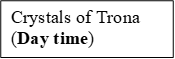
Solubility of trona decreases with increasing temperature. High daytime temperatures cause trona to naturally crystallize. It is mechanically scooped/dredged/dug and put in a furnace.
Inside the furnace, trona decomposes into soda ash/sodium carbonate.
Chemical equation:
2NaHCO3·Na2CO3·H2O (s) → 3Na2CO3 (s) + 5H2O(l) + CO2(g)
(trona) → (soda ash)
Soda ash is then bagged and sold as Magadi soda. It is mainly used:
- In making glass to lower the melting point of raw materials (sand/SiO2 from 1650°C and CaO from 2500°C to around 1500°C).
- In softening hard water.
- In the manufacture of soapless detergents.
- As a swimming pool “pH increaser”.
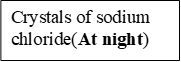
Sodium chloride is also found dissolved in the lake. Its solubility decreases with decreasing temperature. At lower temperatures, sodium chloride crystallizes out and is mechanically dug/dredged/scooped then packed for sale as animal/cattle feeds and seasoning food.
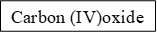
Summary flow diagram showing the extraction of soda ash from trona



(b) The Solvay process for industrial manufacture of sodium carbonate(IV)
(i) Raw materials
- Brine / Concentrated sodium chloride from salty seas/lakes.
- Ammonia gas from Haber process.
- Limestone / Calcium carbonate from chalk/limestone rich rocks.
- Water from rivers/lakes.
(ii) Chemical processes
Ammonia gas is passed up to meet a downward flow of sodium chloride solution (brine) to form ammoniated brine / ammoniacal brine mixture in the ammoniated brine chamber.
The ammoniated brine mixture is then pumped up to the carbonator/solvay tower.
In the carbonator/solvay tower, ammoniated brine slowly trickles down to meet an upward flow of carbon(IV) oxide gas.
The carbonator is shelved/packed with quartz/broken glass to:
- Reduce the rate of flow of ammoniated brine.
- Increase surface area of the liquid mixture to ensure maximum reaction with carbon(IV) oxide gas.
Insoluble sodium hydrogen carbonate and soluble ammonium chloride are formed from the reaction.
Chemical equation:
CO2(g) + H2O(l) + NaCl(aq) + NH3(g) → NaHCO3(s) + NH4Cl(aq)
The products are then filtered. Insoluble sodium hydrogen carbonate forms the residue while soluble ammonium chloride forms the filtrate.
Sodium hydrogen carbonate itself can be used:
- As baking powder and for preservation of some soft drinks.
- As a buffer agent and antacid in animal feeds to improve fibre digestion.
- In making dry chemical fire extinguishers.
In the Solvay process, sodium hydrogen carbonate is heated to form sodium carbonate (soda ash), water, and carbon (IV) oxide gas.
Chemical equation:
2NaHCO3(s) → Na2CO3(s) + CO2(g) + H2O(l)
Sodium carbonate is stored ready for use in:
- Making glass by lowering the melting point of sand/SiO2 from 1650°C and CaO from 2500°C to around 1500°C.
- Softening hard water.
- Manufacture of soapless detergents.
- Swimming pool “pH increaser”.
Water and carbon(IV) oxide gas are recycled back to the ammoniated brine chamber.
More carbon(IV) oxide is produced in the kiln/furnace by heating limestone to decompose into calcium oxide and carbon(IV) oxide.
Chemical equation:
CaCO3(s) → CaO(s) + CO2(g)
Carbon(IV) oxide is recycled to the carbonator/solvay tower. Carbon (IV) oxide is added to water in the slaker to form calcium hydroxide. This process is called slaking.
Chemical equation:
CaO(s) + H2O(l) → Ca(OH)2(aq)
Calcium hydroxide is mixed with ammonium chloride from the carbonator/solvay tower in the ammonia regeneration chamber to form calcium chloride, water, and more ammonia gas.
Chemical equation:
Ca(OH)2(aq) + 2NH4Cl(aq) → CaCl2(s) + 2NH3(g) + H2O(l)
NH3(g) and H2O(l) are recycled.
Calcium chloride may be used:
- As a drying agent in the school laboratory during gas preparation (except ammonia gas).
- To lower the melting point of solid sodium chloride / rock salt during the Downs process for industrial extraction of sodium metal.
Detailed Summary flow diagram of Solvay Process

Practice
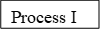
1. The diagram below shows part of the Solvay process used in manufacturing sodium carbonate. Use it to answer the questions that follow.


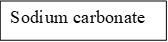


(a) Explain how sodium chloride required for this process is obtained from the sea.
Sea water is pumped or scooped into shallow ponds. Evaporation of most of the water takes place, leaving a very concentrated solution of sodium chloride.
(b)(i) Name process:
I. Filtration
II. Decomposition
(ii) Write the equation for the reaction in process:
Process I
Chemical equation:
CO2(g) + H2O(l) + NaCl(aq) + NH3(g) → NaHCO3(s) + NH4Cl(aq)
Process II
Chemical equation:
2NaHCO3(s) → Na2CO3(s) + CO2(g) + H2O(l)
(c)(i) Name two substances recycled in the Solvay process
Ammonia gas, carbon(IV) oxide, and water.
(ii) Which is the by-product of this process?
Calcium(II) chloride / CaCl2
(iii) State two uses that the by-product can be used for:
- As a drying agent in the school laboratory preparation of gases.
- In the Downs cell/process for extraction of sodium to lower the melting point of rock salt.
(iv) Write the chemical equation for the formation of the by-products in the Solvay process.
Chemical equation:
Ca(OH)2(aq) + 2NH4Cl(aq) → CaCl2(s) + 2NH3(g) + H2O(l)
(d) In an experiment to determine the % purity of sodium carbonate produced in the Solvay process, 2.15 g of the sample reacted with exactly 40.0 cm3 of 0.5 M sulphuric (VI) acid.
(i) Calculate the number of moles of sodium carbonate that reacted.
Chemical equation:
Na2CO3(aq) + H2SO4(aq) → Na2SO4(aq) + CO2(g) + H2O(l)
Mole ratio Na2CO3 : H2SO4 = 1:1
Moles H2SO4 = Molarity × Volume = 0.5 × 40.0 / 1000 = 0.02 moles
Moles of Na2CO3 = 0.02 moles
(ii) Determine the % of sodium carbonate in the sample.
Molar mass of Na2CO3 = 106 g/mol
Mass of Na2CO3 = moles × molar mass = 0.02 × 106 = 2.12 g
% of Na2CO3 = (2.12 g × 100) / 2.15 = 98.60%
(e) State two uses of soda ash.
- In making glass by lowering the melting point of sand/SiO2 from 1650°C and CaO from 2500°C to around 1500°C.
- In softening hard water.
- In the manufacture of soapless detergents.
- As a swimming pool “pH increaser”.
(f) The diagram below shows a simple ammonia soda tower used in manufacturing sodium carbonate. Use it to answer the questions that follow:





(i) Name the raw materials needed in the above process
- Ammonia
- Water
- Carbon(IV) oxide
- Limestone
- Brine / Concentrated sodium chloride
(ii) Identify substance A
Ammonium chloride / NH4Cl
(iii) Write the equation for the reaction taking place in:
I. Tower
Chemical equation:
CO2(g) + NaCl(aq) + H2O(l) + NH3(g) → NaHCO3(s) + NH4Cl(aq)
II. Production of excess carbon (IV) oxide
Chemical equation:
CaCO3(s) → CaO(s) + CO2(g)
III. The regeneration of ammonia
Chemical equation:
Ca(OH)2(aq) + 2NH4Cl(aq) → CaCl2(s) + 2NH3(g) + H2O(l)
(iv) Give a reason for having the circular metal plates in the tower.
- To slow the downward flow of brine.
- To increase the rate of dissolving of ammonia.
- To increase the surface area for dissolution.
(v) Name the gases recycled in the process illustrated above.
Ammonia gas, carbon(IV) oxide, and water.
2. Describe how you would differentiate between carbon (IV) oxide and carbon (II) oxide using chemical methods.
Method I:
- Bubble both gases in lime water / Ca(OH)2.
- White precipitate is formed if the gas is carbon (IV) oxide.
- No white precipitate is formed if the gas is carbon (II) oxide.
Method II:
- Ignite both gases.
- Carbon (IV) oxide does not burn/ignite.
- Carbon (II) oxide burns with a blue non-sooty flame.
Method III:
- Lower a burning splint into a gas containing each gas separately.
- Burning splint is extinguished if the gas is carbon (IV) oxide.
- Burning splint is not extinguished if the gas is carbon (II) oxide.
3. Using magnesium sulphate(VI) solution, describe how you can differentiate between a solution of sodium carbonate and a solution of sodium hydrogen carbonate.
- Add magnesium sulphate(VI) solution to separate portions of a solution of sodium carbonate and sodium hydrogen carbonate in separate test tubes.
- White precipitate is formed in the test tube containing sodium carbonate.
- No white precipitate is formed in the test tube containing sodium hydrogen carbonate.
Chemical equation:
Na2CO3(aq) + MgSO4(aq) → Na2SO4(aq) + MgCO3(s)
Ionic equation:
CO32-(aq) + Mg2+(aq) → MgCO3(s)
Chemical equation:
2NaHCO3(aq) + MgSO4(aq) → Na2SO4(aq) + Mg(HCO3)2(aq)
4. The diagram below shows a common charcoal burner. Assume the burning takes place in a room with sufficient supply of air.

(a) Explain what happens around:
(i) Layer A
Sufficient/excess air/oxygen enters through the air holes into the burner. It reacts with/oxidizes carbon to carbon(IV) oxide.
Chemical equation:
C(s) + O2(g) → CO2(g)
(ii) Layer B
Hot carbon(IV) oxide rises up and is reduced by more carbon/charcoal to carbon (II) oxide.
Chemical equation:
C(s) + CO2(g) → 2CO(g)
(iii) Layer C
Hot carbon(II) oxide rises up and burns with a blue flame to be oxidized by the excess air to form carbon(IV) oxide.
Chemical equation:
2CO(g) + O2(g) → 2CO2(g)
(b) State and explain what would happen if the burner is put in an enclosed room.
The hot poisonous/toxic carbon(II) oxide rising up will not be oxidized to carbon(IV) oxide, leading to accumulation of toxic gas.
(c) Using a chemical test, describe how you would differentiate two unlabelled black solids suspected to be charcoal and copper(II) oxide.
Method I:
- Burn/ignite the two substances separately.
- Charcoal burns with a blue flame.
- Copper(II) oxide does not burn.
Method II:
- Add dilute sulphuric(VI) acid/nitric(V) acid/hydrochloric acid separately.
- Charcoal does not dissolve.
- Copper(II) oxide dissolves to form a colourless solution.
5. Excess Carbon(II) oxide was passed over heated copper(II) oxide as in the set up shown below for five minutes.

(a) State and explain the observations made in the combustion tube.
Observation: Colour changes from black to brown.
Explanation: Carbon (II) oxide reduces black copper(II) oxide to brown copper metal, itself oxidized to carbon(IV) oxide.
Chemical equation:
CO(g) + CuO(s) → Cu(s) + CO2(g)
(black to brown)
(b) (i) Name the gas producing flame A
Carbon(II) oxide
(ii) Why should the gas be burnt?
It is toxic/poisonous.
(iii) Write the chemical equation for the production of flame A
2CO(g) + O2(g) → 2CO2(g)
(c) State and explain what happens when carbon(IV) oxide is prepared using barium carbonate and dilute sulphuric(VI) acid.
Reaction starts then stops after some time, producing a small quantity of carbon(IV) oxide gas.
Barium carbonate reacts with dilute sulphuric(VI) acid to form insoluble barium sulphate(VI) that coats unreacted barium carbonate, stopping further reaction.
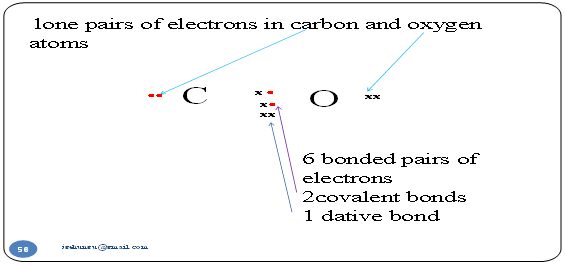
(d) Using dot (•) and cross (×) to represent electrons show the bonding in a molecule of:
(i) Carbon(II) oxide
(ii) Carbon(IV) oxide

(e) Carbon (IV) oxide is an environmental pollutant of global concern. Explain.
- It is a greenhouse gas, thus causing global warming.
- It dissolves in water to form acidic carbonic acid, which causes acid rain.
(f) Explain using chemical equation why lime water is used to test for the presence of Carbon (IV) oxide instead of sodium hydroxide.
Using lime water/calcium hydroxide:
- A visible white precipitate of calcium carbonate is formed that dissolves on bubbling excess carbon (IV) oxide gas.
Chemical equations:
Ca(OH)2(aq) + CO2(g) → CaCO3(s) + H2O(l)
CaCO3(s) + H2O(l) + CO2(g) → Ca(HCO3)2(aq)
Using sodium hydroxide:
- No precipitate of sodium carbonate is formed. Both sodium carbonate and sodium hydrogen carbonate are soluble salts and dissolve.
Chemical equations:
2NaOH(aq) + CO2(g) → Na2CO3(s) + H2O(l)
(No white precipitate)
Na2CO3(s) + H2O(l) + CO2(g) → 2NaHCO3(s)
(g) Ethan-1,2-dioic acid and methanoic acid may be used to prepare small amounts of carbon(II) oxide in a school laboratory.
(i) Explain the modification in the set up when using one over the other.
Before carbon(II) oxide is collected:
- When using methanoic acid, no concentrated sodium/potassium hydroxide is needed to absorb carbon(IV) oxide.
- When using ethan-1,2-dioic acid, concentrated sodium/potassium hydroxide is needed to absorb carbon(IV) oxide.
(ii) Write the equation for the reaction for the formation of carbon(II) oxide from:
I. Methanoic acid
Chemical equation: HCOOH(aq) → CO(g) + H2O(l)
II. Ethan-1,2-dioic acid
Chemical equation: HOOCCOOH(aq) → CO2(g) + CO(g) + H2O(l)
(h) Both carbon(II) oxide and carbon(IV) oxide affect the environment. Explain why carbon(II) oxide is more toxic/poisonous.
- Both gases are colourless, denser than water, and odourless.
- Carbon(II) oxide is preferentially absorbed by human/mammalian haemoglobin when inhaled, forming stable carboxyhaemoglobin instead of oxyhaemoglobin. This reduces free haemoglobin in the blood, leading to suffocation and quick death.
- Carbon(IV) oxide is a greenhouse gas that increases global warming.
- Carbon(II) oxide is readily oxidized to carbon(IV) oxide.
6. Study the flow chart below and use it to answer the questions that follow.

(a) Name:
(i) The white precipitate A
Calcium carbonate
(ii) Solution B
Calcium hydrogen carbonate
(iii) Gas C
Carbon(IV) oxide
(iv) White residue B
Calcium oxide
(v) Solution D
Calcium hydroxide/lime water
(b) Write a balanced chemical equation for the reaction for the formation of:
(i) The white precipitate A from solution D
Chemical equation:
Ca(OH)2(aq) + CO2(g) → CaCO3(s) + H2O(l)
(ii) The white precipitate A from solution B
Chemical equation:
Ca(HCO3)2(aq) → CO2(g) + CaCO3(s) + H2O(l)
(iii) Solution B from the white precipitate A
Chemical equation:
CO2(g) + CaCO3(s) + H2O(l) → Ca(HCO3)2(aq)
(iv) White residue B from the white precipitate A
Chemical equation:
CaCO3(s) → CO2(g) + CaO(s)
(v) Reaction of white residue B with water
Chemical equation:
CaO(s) + H2O(l) → Ca(OH)2(aq)


1 Comment