

8. MINING QUESTIONS
This topic entails
- Defining mining
- Explaining the factors influencing:-
-The occurrence of minerals
-Mining activities
- Describing methods of mining
- Locating major minerals on the map of East Africa
- Explaining the significance of minerals in Kenya
- Accounting for the problems facing the mining industry in Kenya.
- Explaining the effects of mining on the environment in Kenya.
- Describing the occurrence of specific minerals and their exploitation in selected countries.
1. (a) (i) What problem has been brought about by uncontrolled mining of minerals in Kenya?
(ii) Where is fluorspar mined in Kenya?
(iii) Describe how trona is mined and processed in Magadi
(b) (i) List two ways in which mining leads to loss of biodiversity
(ii) List two ways in which mining leads to pollution
2. (a) (i) Name three methods of mining.
(ii) State five factors that influence the exploration of minerals.
(iii) State three ways in which mining derelicts can be reclaimed.
3. (a) State two ways in which gold in South Africa occurs. (2mks)
(b) Give three ways in which abandoned mined sites could be rehabilitated.
4. (a) Name two countries in Africa where oil is mined
(b) State two by-products of crude oil
5. (a) (i) Define the term ‘mining method’
(ii) Explain how the following factors influence mining:-
– Technology
– Quality of the ore
(b) Use the map of East Africa below to answer question (i)
MAP OF EAST AFRICA
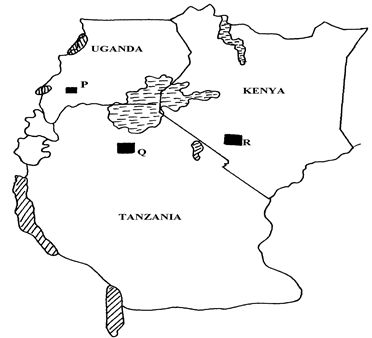
(i) Name the minerals found in the areas marked P, Q, R
(ii) Name two areas in South Africa where diamonds are mined
c) Open-cast method of mining.
d) Benefits of trona to Kenya.
e) Problems facing the mining industry in Kenya.
6. Use the map of East Africa below to answer question (a) (i)
(a) (i) Name the minerals mined in the areas marked W, X, Y and Z
(ii) Give four ways in which minerals occur
(b)Identify any five factors that influence the exploitation of minerals
(c) Explain any four problems associated with mining
(d) List any four main minerals mined in Kenya
7. (a) Give three main methods of mining
(b) The following data shows the value of minerals exported from Tanzania between the
years 2000-20003. Use it to answer the following questions:
Value of mineral exports in millions of Tshs. | ||||
2000 | 2001 | 20002 | 2003 | |
Gold | 680 | 700 | 500 | 400 |
Diamonds | 1000 | 800 | 700 | 900 |
Mica | 400 | 100 | 400 | 100 |
(i) Calculate the percentage decline in the value of diamond exports between 2000 and 20001.
(c)Explain any four ways in which trona mining contributes to the growth of the economy
in Kenya
8. (a) (i) State three methods used in mining
(ii) Name the mineral found in the following areas;-
– Magadi
– Mwandui
– Kasese
(b) Describe the following factors influence mining of minerals
(i) Technology
(ii) Quality of ore
(iii) Accessibility
(c) Explain four problems facing the mining of Gold in South Africa
(d) (i) List two leading to oil producing countries in the middle East
(ii) State three uses of petroleum
(e). State three problems of land dereliction
9. The diagram below shows
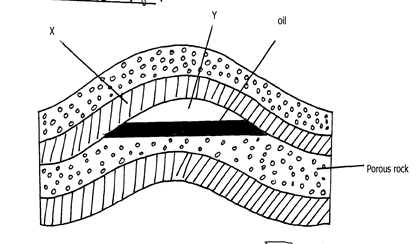
(a) Identify the parts marked X and Y
(b) Give three reasons why Kenya imports petroleum in crude form and not as refined
by-products
10. (a) Differentiate between veins and lodes
(b) State three effects of land dereliction
11. (a) (i) Give three methods of mining.
(ii) Name two places where gold is mined in Tanzania.
(b) Explain four factors which influence the exploitation of minerals.
(c) State four negative effects of mining on the environment.
(d) (i) Describe how solution mining is carried out.
(ii) State three ways n which mining contributes to the economy of Kenya.
12. (a) (i) Name three methods of mining
(ii) Explain three ways in which soda ash contributes to the economy of Kenya
(iii) Identify four problems facing gold mining in South Africa
(b) (i) State three conditions necessary for the formation of petroleum
(ii) Give two by-products obtained when crude oil is refined
(c) What three benefits would Kenya get if the current prospecting for oil yields good results
(d) (i) Name two minerals mined in the Southern Highlands of Tanzania
(ii) Name two ports through which minerals from East Africa are exported through
8. MINING ANSWERS
1. (a) i) Mining has led to exhaustion of most mineral mines in Kenya e.g. Gold in macalder
ii) Flourspar is mixed in Kerio Valley
iii) Trona is mined on Lake Magadi through redging
- The dredger accumulates and digs out the minerals
- Inside the dredger, trona is crushed into crystals from the lake bed
- It is then mixed with lake liquor and pumped to the factory on the lake shore
- At the factory, the trona is mixed with water to clear it of impurities
- It is then dried and send to dessicators for heating
- After heating it is allowed to cool
- After cooling it is then crushed into soda ash
b( i) – Mining results in the destruction of various species of vegetation
– The destruction of plant like destroys the habitat for wildlife
ii) – Mining leads to emission of toxic gases from underground
- When it rains, such gases and chemicals are washed into rivers and lakes hence affecting aquatic life
- Heavy machinery used in mining causes noise pollution
- Heavy machinery and trucks used raise a lot of dust that causes air pollution
2. a i) – Open cast mining.
– Underground mining.
– Alluvial mining.
ii) – The value of minerals.
– The rise of the mineral deposit.
– Methods of mining.
– Technology.
– Capital.
– Market.
– Transport cost.
– Security.
iii) – By filling the pits or the holes using the heaps of soils.
– Through planting trees and keeping a wide range of animals thus creating a tourist centre.
– By changing the pits or holes into a man made lake which could serve as in land
fisheries or a sporting centre.
3. a) – As veins and lodes
– As alluvial deposits
b) – By planting trees in the area
- By filling up the pits with fresh soils
- By upgrading the abandoned mine into a tourist attraction
- By keeping a wide variety of animals in the area to restore its natural ecosystem
4. a) Angola – Nigeria
Libya – Chad
Sudan
. b) Wax – Bitumen/Tar/Pitch/Osphel
Sulphur – Petro – Chemicals
Lubricants e.g grease
5. (a) (i) – method used to extract mineral and fossil fuels from the ground
ii) – Availability of skills and relevant modern machines are important for specialized mining
operators.
- If the skills /technology is inadequate then there would be need to bring in foreign experts mini therefore becomes dependent on foreign control.
- High quality ores are economical to extract as they yield a large amount metal/low quality ores are rarely extracted for their metal content is very low.
- Some rare minerals e.g uranium are exported despite their ores having low mineral content because they are important
b i) P – Copper
Q – Gold
R – Trona
b ii) – Kimberley
- Pretorca
- Jagers Foutein
- Koffie fontein
- Unwanted materials /overburden is removed.
- Excavators are used if surface materials are soft but if they are hard then explosive are used to loosen the materials.
- Excavators are used to dig up the mineral deposits.
- The extracted ore is loaded into lorries using excavators and transported to the processing plant.
- Kenya earns foreign exchange from the exportation of trona. This is used to import other essential items like machinery.
- Trona mining has created employment opportunities for many Kenyans thus improving their living standards.
- It has led to the development of related industries e.g glass making industries in Nairobi, Mombasa e.t.c.
- It has led to the provision of social amenities which have improved the living conditions of the people around e.g schools.
- It has stimulated construction of transport lines e.g the Magadi – Konza railway live.
- Has led to the growth of Magadi town.
- Provision of water for both the domestic and industrial use within the area. This has improved the living standards of the people.
- Government earns revenue through taxation.
- Air pollution by dust and smoke emitted from blasting, quarrying & processing of the ores.
- Derelict land is dangerous to both people and animals.
- Wastage of agricultural and settlement land as the mine holes become useless.
- Inadequate skilled personnel who are required for the industry leading to reliance on imported skilled workers.
- Insufficient capital for the exploitation of minerals.
- Inaccessibility of some minerals due to hilly or mountains landscape.
- Pollution of groundwater sources as well as rivers by water leakage from processing plants
6 a i) W- Fluorspar X – Gold Y – Diamonds Z – Copper
ii) – Veins/ lodes
– Beds/ seams
– Weathering products
– Alluvial deposits
b) – Mode of occurrence
– Value/ cost of mining
– Size of deposit
– Level of technology
– Capital availability
– Labour supply
– Transport
– Government policy
– Market availability
(c) – Land dereliction – waste agricultural land/ makes land ugly/ limits town expansion
– Health and accident hazards – collapse of mines/ fall in open pits/ drowning in water filled pits/ toxic gases and dust
– Unemployment/ depressed economy – after exhaustion of the minerals
– Conflicts – cross boarder minerals
– Loss of biodiversity – clearing vegetation for mining
– Soil erosion – clearing of vegetation
d) – Trona/ soda ash
– Flour par/ Fluorite
– Limestone/ lime
– Carbon dioxide
– Gold
7. a) – Under ground/ shaft/ adit/ solution
– Alluvial/ panning/ placer/ dredging/ hydraulic
– Open cast/ strip
b i) 1000 – 800 = 200
200/1000 x 100 = 20%
c) – Exported to earn foreign exchange for economic development
- Creates employment opportunities reducing unemployment/ crime/ improving living standards
- Provides raw materials for industries leading to industrialization
- Leads to development of transport networks improving transportation trade
- Leads to development of social amenities improving the living standards
- Led to growth of town – magadi
- Led to growth of tourism – revenue
- Provides revenue through taxation for provision of facilities
8. a i) – Underground mining
– Open-cast mining
– Alluvial/place mining
(ii) –trona
-gold
– copper
b i) – Availability of technology skills and modern machines are important for specialized
mining operations
– Inadequate skills, lead to importation of expatriates
– Mining operations may up becoming dependent on foreign control
ii) – High quality ores economical to extract as they yield a large amount of metal
– Low quality ores have low metal content and are rarely extracted
– Rare metals e.g. uranium are exploited despite the ore having a low mineral content
iii) – Minerals in remote areas with poor transport systems are less likely to be exploited
– Almost all ores are heavy and bulky and are therefore costly to transport. it becomes
hard to exploit them in the absence of good transport systems
– Deposits at or neat ports enjoy cheap transportation compared to inland deposits
– Deposits near the ports are likely to be more exploited
c ) – Exhaustion of the mineral because gold is non re-newable and the old mines in the rand
are being depleted
– The gold grade being worked now is of poorer quality that of some years back
– The mines are becoming deeper hence mining costs have escalated and also required
new technology which is more costly
– Inadequacy of water for processing gold due to seasonal rainfall received and
increased population on the rand
– High cost f labour because of increased demand for higher wages and competition from
other factors of the economy
(e). – Ugliness – all the natural beauty of the landscape has been lost
– Health hazard- mineral exploitation can create open pits that become breeding grounds for mosquitoes
– Lost productivity – the soil left behind after mining may not be able to support any meaningful economic activity
9. a) x – Non porous rock.
y – Porous gas.
b) – It is cheaper to transport oil in crude form.
– Oil refining creates employment opportunities to most Kenyans.
– Some of the refines by-products are exported to land locked countries in East & Central
Africa thereby earning foreign exchange.
– Oil refining has led to establishment of industries e.g. oil refinery at Changamwe and
other related industries such as fertilizer manufacturing, plastic making e..t.c.
10. a) A vein is a small crack containing minerals deposited in crystalline form wile a lode
is a large crack containing minerals in crystalline form
b) – waste of Agricultural land
– Waste of industrial land
– Lightness where land has lost its beauty
– Health and accident hazards)
11. a i) – Shaft/underground
- Open cast mining
- Placer/alluvial/panning/slope boring
- Adit/drift/horizontal/hill dredging
- Submarine mining
ii) – Geita
- Mpanda
- Irambal/Sekenke
- Musoma
- Mabuki
. b) – The value of mineral-valuable minerals e.g. gold will be mined since it earns
higher profits
- Size of the deposits – should be large enough to justify mining
- Capital- mining needs a lot of money to pay workers and purchase machinery
- World market prices which are controlled by international bodies when prices are high more minerals will be mined
- Transport cost- it is economical to extract ores near major industrial centres because of good transport routes
c) – Mining leads to pollution of air/water/land/noise
- Mining leads to depletion of land
- Mining disrupts/lowers the water table
- Mining leads to loss of biodiversity /plants and animals
- It leads to soil erosion/degeneration of soil
d i) – Apply where mineral is dissolved by water
- A well vertical shaft is sunk to reach the mineral
- Pipes are laid down though this vertical shaft
- Superheated water is pumped into the deposits of mineral
- Mineral dissolves in hot water and form a solution
- Solution is pumped to the surface where it is evaporated and the mineral is extracted
ii) – Exported to earn foreign exchange
- Generates employment opportunities
- Has led to development of settlement
- Has led to establishment of industries
- Earning higher income hence better living standards
12. a i) – Alluvial mining
– Under ground mining
– Open cost mining
ii) – Creation of employment opportunities which helps in reducing unemployment
- When exported it earns foreign exchange which is used in other sectors
- Development of related of related industries that helps increase the wealth of the country
- Leads to provision and improvement of social facilities
- It helps in the development of infrastructure e.g. roads
iii) – Water shortage for power supply and processing
- Labour shortage and competition from other industries/ sectors
- Increase depth of mines makes mining expensive and risky
- Decreasing quality of one
b)(i)- Presence/ deposition of remains of flora and fauna fossils over a long period of time
- Presence of non- porous rocks under neath the deposits of flora and fauna
- Deposition of other layers of rocks/ non- porous rocks over the remains of flora and fauna
- Compression of the remains of fauna and flora due to folding of the layer of rocks
ii) – Bitumen/ pitch/ asphalt
- Grease/ lubricants
- Resin/ petro chemicals
c) – Employment opportunities
- Saving of foreign exchange
- Earning of foreign exchange from exports
- Industrial development
- Earnings would raise the standards of living/ raise the per capita income
d) i) – Coal
– Iron ore
ii) – Kilindini
- Dar- es- salaam
- Tanga


