

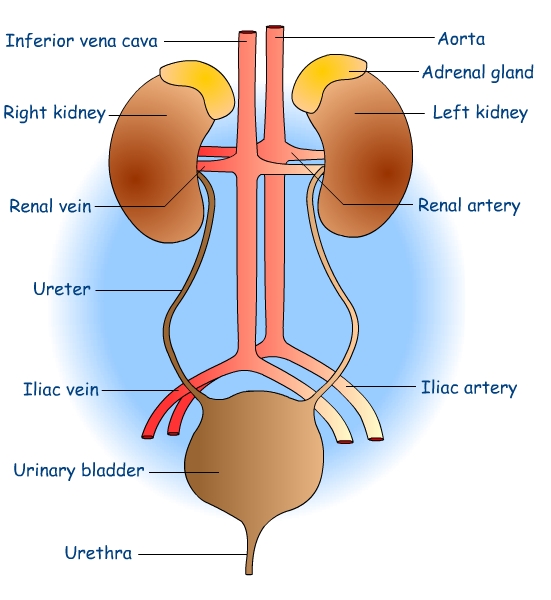
8. Excretion and homeostasis Questions
1. Explain the following:-
i) Fresh water fish excrete ammonia
ii) Glucose is absent in urine yet present in glomerular filtrate
2. (a) State two functions of the kidney
(b) Name two substances that are not found in urine of a healthy person
(c) Name two diseases that affect the kidney
3. (a) State two structural modification of the kidneys of deserts animals like kangaroo rat.
(b) Describe how ingestion of very salty food may reduce the amount of water excreted in urine.
4. A student mixed a sample of urine from a person with Benedict’s solution and heated, the colour
changed to orange.
(a) What was present in the urine sample?
(b) What did the student conclude on the health status of the person?
(c) Which organ in the person may not be functioning properly?
5. (a) If the human pancrease is not functional:-
(i) Name the hormone which will be deficient
(ii) Name the disease the human is likely to suffer from
(b) What is diuresis?
6. State one structural adaptation of nephron in the kidney of a desert mammal
7. Name the nitrogenous wastes excreted by the following organisms:-
Animal Nitrogenous Waste
(i) Desert mole
(ii) Marine fish
(iii) Tilapia
8. The table below shows description of sizes of glomeruli renal tubules of two animals which are
living in different environments
Animal X | Animal Y | |
Glomeruli | Large and few | Small and many |
Renal tubules | Short | Long |
(a) Name the likely environment in which each animal lives : (i)Animal X
(ii) Animal Y
(b) What role does vasoconstriction play in thermoregulation?
9. The table below shows the approximate percentage concentration of various components in blood
plasma entering the kidney, glomerular filtrate and urine of a healthy human being
Component | Plasma | Glomerular filtrate | Urine |
Water | 90 | 90 | 94 |
Glucose | 0.1 | 0.10 | 0.00 |
Amino acids | 0.05 | 0.05 | 0.00 |
Plasma proteins | 8.0 | 0.00 | 0.00 |
Urea | 0.03 | 0.03 | 2.00 |
Inorganic ions | 0.72 | 0.72 | 1.50 |
(a) Name the process responsible for the formation of glomerular filtrate
(b) What process is responsible for the absence of glucose and amino acids in urine?
(c) Explain why there are no plasma proteins in the glomerular filtrate?
10. What is the importance of sebaceous glands in the human skin?
11. Explain why sweat accumulates on a person’s skin in a hot humid environment
12. Distinguish between diabetes mellitus and diabetes inspidus
13. State two processes through which plants excrete their metabolic wastes.
14. The figure below shows a vertical section through a mammalian kidney.
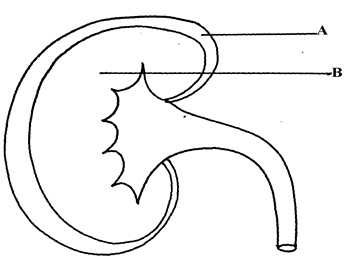
(a) Label the parts A and B
(b) Which part is the Bowman’s capsule found?
15. (a) Explain the effects of the production of large amounts of Antidiuretic hormone in the human
body
(b) State two functions of the loop of Henle
16. Study the homeostatic scheme below:

(a) Identify the hormone labeled A
(b) Name the site of action of hormone A
(c) Identify the feedback labeled D
17. State three importance of Osmosis in plants
18. A patient was complaining of thirst most of the times. A sample of the patient’s urine was found
not to contain a lot of sugar but was dilute:-
(a) Name the hormone the person’s body was deficient of
(b) Which gland produces the above hormone
(c) Name the disease that the patient was most likely suffering from
19. State two features in the nephron that facilitate ultra filtration
20. The table below shows a description of size of glomeruli and renal tubules of two animals
which are adapted to living in different environment:-
Animal A Animal B |
Glomeruli large and few small and many |
Renal tubules short long |
a) Name the likely environment in which animal A lives b) Suggest the main nitrogenous waste produced by animal B c) Name the organelle of osmoregulation in each of the following animal: i) Paramecium
ii) Insects
21. What role is played by the liver in excretion?
22. The equation below represents a metabolic process that occurs in the mammalian liver: Amino acids organic compound + urea
a) Name the process
(b) What is the importance of the process to the mammals?
23. A person was found to pass out large volume of dilute urine frequently. Name the:-
(a) disease the person was suffering from?
(b) hormone that was deficient
24. Explain the effects of the following on the quantity and composition of urine
(a) Drinking large amount of clean water
(b) Drinking very salty soup
(c) Removal of pancreas
25. (a) Distinguish between excretion and egestion
(b) State the importance of excretion in the bodies of living organisms.
26. The diagram below shows simplified structures of kidneys from two different animals.


(a) Suggest possible habitat in which animal N is found.
(b) Give two reasons for your answer in (a) above.
27. (a) What is poikilotherm?
(b) State two classes of phylum chordata where all members are poikilothermic .
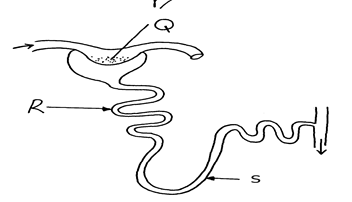 28. The diagram below represents a mammalian nephron
(i) Name the structure labelled Q …………………………………………………………………………
(ii) State two adaptations of part labeled R
29. Distinguish between internal environment and external environment as used in
30. The diagram below represents a nephron of a mammal:
(a) Name the parts labeled A, B and D
(b) Name a major substance in glomerular filtrate whose concentration remains the same
between A and C
31. Name the parts of the flower that are responsible for the production of gametes
32. The equation below represents a metabolic process that occurs in a certain organ in the m
mammalian body:-
Ammonia enzymes Organic compound Q + water
Carbon (IV) oxide
a) Name the process represented in the equation.
b) Name the organ in which the process occurs.
c) Why is the process important to the mammal?
d) Identify the organic compound Q.
e) Explain the source of ammonia in the organ named in (b) above. f) What happens to organic compound Q?
33. Kosgei and Onyancha collided during a football match and each got bruised. Kosgei’s bruise stopped bleeding after ten minutes while Onyancha’s bruise continued bleeding and he had
to be taken to hospital for treatment.
(a) Explain the process which brought about stoppage of Kosgei’s bleeding
(b) Distinguish between blood clotting and haemagglutination.
(c) Name the disease, that Onyancha could be suffering from.
34. The table below shows the percentage of some substances in the glomerular filtrate and urine
of a certain mammal:-
Substances | Contents in glomerular filtrate | Contents in urine |
Water | 90 | 90 |
Sodium ions | 0.3 | 0.35 |
Chloride ions | 0.37 | 0.60 |
Glucose | 0.1 | 0.0 |
Urea | 0.03 | 2.0 |
Proteins | 0.0 | 0.0 |
(a) From the above table, account for (i) The absence of glucose in urine (ii) The absence of protein in both glomerular filtrate and urine
(b) Explain the significance of the flow system in the nephron where the glomerular filtrate
flows in opposite direction to that of blood in the surrounding capillaries
(c) Name the hormone that controls the percentage of water in urine and that which control the
amount of salts Percentage of water
Amount of salts
(d) List any two diseases /disorders of the kidney
35. Study the diagram below and answer the questions that follow
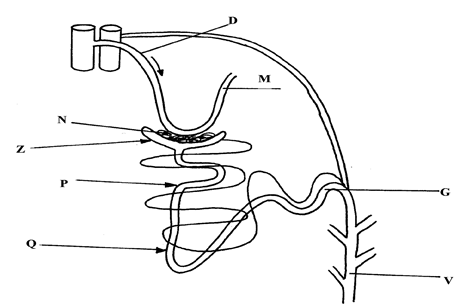
(a) Name the structure represented by the diagram
(b) (i) Name the parts labelled D and M
(ii) Name the hormones whose sites of action are Q and G (c) Name one substance that is present in part N but absent in part Z
(d) The contents of part V were boiled with Benedicts’ solution and an orange precipitate was
formed. Account for the results
36. In an investigation, two persons A and B drunk the same amount of glucose solution. Their blood
sugar levels were determined immediately and thereafter at intervals of one hour for the next six
hours.
The results were as shown in the following table:-
Time (hrs) | Blood glucose level (mg/100ml) | |
Person A | Person B | |
0 | 90 | 120 |
1 | 220 | 360 |
2 | 160 | 370 |
3 | 100 | 380 |
4 | 90 | 240 |
5 | 90 | 200 |
6 | 90 | 160 |
(a) Draw a graph of blood sugar levels of persons A and B against time on the same axis
(b) Explain each of the following observations;-
(i) Blood sugar level increased in person A between 0 and 1 hour
(ii) The blood sugar level dropped in person A between 1 and 4 hours
(c) From the graph, what is the normal blood glucose sugar level for human beings
(d) Suggest a reason for the high sugar level in person B
(e) How can the high blood sugar level in person B controlled?
(f) What is the biological significance of maintaining a relatively constant sugar level in a human
being
(g) Account for the decrease in the blood glucose level of person B after 4 hours
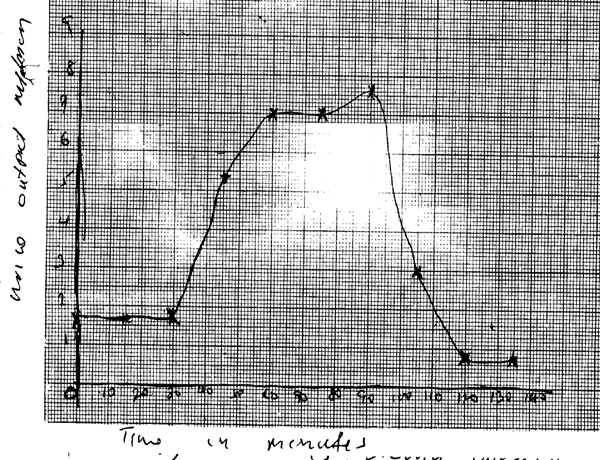
37. An experiment was carried out to determine the effect of drinking on excess amount of water on
the flow of urine. A person drinks one litre of water and urine was collected at intervals of 15minutes.
The results were as shown below:
Time in minutes | 0 | 15 | 30 | 45 | 60 | 75 | 90 | 105 | 120 | 135 |
Urine output ml/min | 1.6 | 1.6 | 1.6 | 5.4 | 9.0 | 9.0 | 7.6 | 3.0 | 0.8 | 0.8 |
(a) Plot a suitable graph to represent urine output with time.
(b) Explain the rate of flow of urine between the following times;
(i) 15 and 60minutes.
(ii) 60 and 75minutes.
(iii) 75 and 135 minutes.
(c) Name two hormones responsible for regulation of relative amount of salts and water in man.
38. a) Explain how urea is formed in the human body
b) Describe the path taken by urea from the organ where it is formed until it is released from
the human body
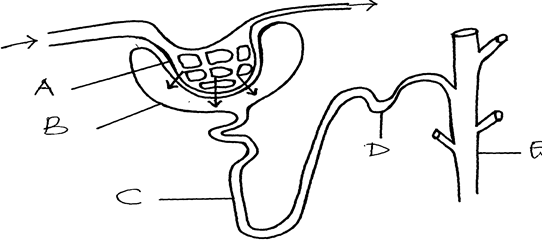 39. The diagram below represents a mammalian nephron.
(a) Name the structures labeled B,C and D
(c) Name the process by which substances are reabsorbed from structure C into blood capillaries
(d) How is the pressure in structure A achieved?

a) Identify substance X
(c) Give the end products of the process labelled H
(d) Give three other functions of the liver
41. The flow diagram below represents blood clotting process
a) Name the proteins represented by the letters; V, Y, Z b) State the importance of blood clotting
c) Why doesn’t the physiological process above occur in undamaged blood vessels
42. How does an Endotherm respond to both heat gain and heat loss?
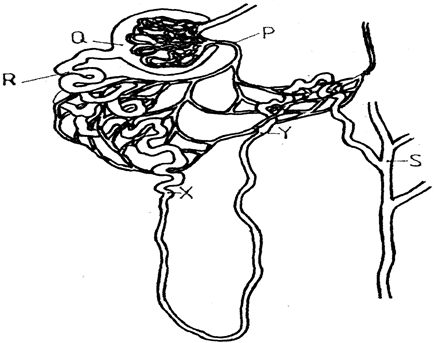 43. The diagram below represents a mammalian nephron
(a) Name the: (i) Structure labelled P
(b) State the structural modifications of the part label led Q for
(i) Desert mammals
(ii) Fresh water mammals
(c ) (i) Name one substance present at point R but absent at point S in a healthy mammal.
(ii) The appearance of the substance you have named in (c)(i) above is a symptom of a
certain disease. Name the disease
44. Describe how the mammalian skin regulates body temperature
8. Excretion and homeostasis Answers
1. i) Ammonia is highly soluble in water and requires a lot of water for excretion hence assists in
the removal of excess ammonia;
ii) All the glucose is reabsorbed at the proximal convoluted tubule;
2. (a) – Excretion;
– Osmo-regulation;
(b) – Glucose
– Amino acids;
(c) – Nephritis;
– kidney stones /Gall stones;
– Hepatitis A and B;
3. (a) Extra long loop of henle; Have fewer and smaller glomeruli;
(b) Salty food increased the salt concentration in blood; Blood becomes hypertonic to kidney tubules; more water is reabsorbed from kidney tubules; hypertonic urine is thus produced;
4. (a) Glucose;
(b) The person was a sufferer of diabetes mellitus;
(c) Pancrease;
5. a) i)insulin;
ii) Diabetes mellitus;
b) Diuresis is a condition which is characterised by production of large volumes of dilute urine;
6. i) urea;
ii) Triethylamine;
iii) Ammonia;
7. a) i) Fresh water; reject water
ii) Desert/ Arid areas; reject land
b) Reduces blood flow to the skin as more blood is stored in the spleen, reducing heat loss
through the skin;
8. a) Ultra filtration;
b) Selective reabsorption;
c) Proteins have large molecular weights hence not ultrafiltrated;
9. Produces sebum to keep hair and epidermis supple and water proof; and protect skin against
bacteria (through antiseptic substances);
10. a) Sweat produced does not evaporate due to high humidity;
b) Body does not cool hence more sweat is produced leading to accumulation;
11. Diabetes mellitus
– Caused by failure of the pancreas to secrete enough insulin;
– High glucose concentration in the blood than normal;
Diabetes insipidus
– Inability of the pituitary gland to secret anti-duretic hormone;
– High concentration of solutes in blood
12. Two processes through which plants excrete metabolic wastes:-
-Gaseous exchange;
-Transpiration;
-Shading leaves;
-Production of resins and gums;
-Storage of wastes in seeds/bark/fruits;
13. Has got long loop of henle in order to maximize water reabsorption thus conserving it;
14 .i) urea;
ii) Triethylamine;
iii) Ammonia;
15. (a) i) Fresh water; reject water
ii) Desert/ Arid areas; reject land
b) Reduces blood flow to the skin as more blood is stored in the spleen, reducing heat loss through
the skin;
16. a) Ultrafiltration;
b) Selective reabsorption;
c) Proteins have large molecular weights hence not ultrafiltrated
17. Produces sebum to keep hair and epidermis supple and water proof; and protect skin against
bacteria (through antiseptic substances);
18. a) Sweat produced does not evaporate due to high humidity
b) Body does not cool hence more sweat is produced leading to accumulation
19.
Diabetes mellitus | Diabetus insipidus |
-Caused by failure of the pancreas to secrete enough insulin -High glucose concentration in the blood than normal – Caused by failure of the pancreas to secrete enough insulin – High glucose concentration in the blood than normal | -Inability of the pituitary gland to secret anti-duretic hormone -High concentration of solutes in blood Inability of the pituitary gland to secret anti-duretic hormone High concentration of solutes in blood |
20. Two processes through which plants excrete metabolic wastes:-
-Gaseous exchange
-Transpiration
-Shading leaves
-Production of resins and gums
-Storage of wastes in seeds/bark/fruits
21. a) A – medulla; B – Cortex;
b) Cortex;
22. a) Enhances more reabsorption of water; leading production little but conc urine;
b) Reabsorption of water; Na+/CL– ions;
23. a) Aldosterone;
b) Loop of Henle;
c) Positive feed back;
24. – Reabsorption of unuseful substances in the kidney;
– Absorption of digested food from the ileum;
– Removal of metabolic waste products from kidney;
25. a) A D H / Vasopression;
b) Pituitary gland;
c) Diabetes Inspidus;
26. a) – Afferent vessels are wider than effereal vessels;
– Presence of pores on capillary and Glomerula membrane;
– Highly coiled narrow capillaries to reduce speed of flow of blood and increase
27. a) Arid/ semi arid areas
b) Ammonia
c)i) Contractile vacuole
Malpigian tubules
28. – Deamination
– Detoxification
– Breakdown of haemoglobin
29. a)Deamination;
b)-Removal of excess amino acids;
-Availing of energy in the body;
-Formation of glycogen /fats for storage; (award any one)
30. a)diabetes insipidus;
b)antidiusetic hormones (ADH);
31. a) large quantities of dilute urine;
b) Small quantities of concentrated urine ( renal failure if habitual)
c) Production of urine containing glucose/sugar;
32. (a) Excretion — Separation and elimination of waste products of metabolism from
bodies of living organisms:
Egestion; Removal of undigested materials from food vacuoles/alimentary canals of animals:
(b) Removes waste products metabolism to create/pro’. idea suitable internal environment for
best working of cells
33. (a) N – desert/arid/semi arid;
(b) Small sized glomeruli; to reduce ultra filtration longer loop of henle; to increase
reabsorption of water – conservation of water.
N.B – Reject 12(b) if 12 (a) is wrong.
34. (a) – Organisms whose body temperature varies with the environmental temperature;
(b) – Reptilia – rej. Reptile;
– amphibia – rej. Amphibians;
35. Glomerulus;
Adaptations of part R
- Coiled to increase the surface area for re-absorption of some glomerular filtrate
- Presence of numerous Mitochondria to promote active transport of glucose, amino acids
- covered by dense network of blood capillary for absorption of useful glomerular filtrate
36. Internal environment is the immediate surrounding of the body cells while external environment is the immediate surrounding of the organism
37.
- Radiation;
- Conduction;
- Convection;
- Evaporation
38. a) A – capsular space/ Bowmans capsule;
B – Descending wing of loop of Henle;
D – Glomerula
b) Urea;
39. Ovary; accept ovules
Anthers;
40. a) Detoxification;
b) Liver;
c) Prevents ammonia from accumulating to toxic levels; which would affect body functions;
d) Urea;
e) Excess amino acids are broken down to form amino group; which is combined with
hydrogen atom to form ammonia;
f) It is transported to the kidney; through the renal artery where it is excreted
41. a) platelets exposed to air rupture on damage tissues to release thromboplastin/(enzyme) /thrombokinase; Thromboplastin neutralizes heparin; and activates prothrombin to thrombin;
throbin activates the conversion of fibrinogen to fibrin; which forms meshwork of fibres on the bruised surface;
b) blood clotting is the conversion of soluble blood protein into a mass of tangled threads of
insoluble protein; while haemogglutination is the clumping together of red blood cells; c)haemophilia;
42. a)i)glucose is completely reabsorbed at proximal convoluted tubule back to blood stream;
ii) Protein has molecules hence not ultrafiltered (from glomerulus) to proximal
convoluted tubule); b) Create a steep diffusion gradient; hence higher rate of reabsorption of useful
Substances-glucose/amino acids/sodium and chloride ions from the nephron tubules back to the blood stream;
c) -antidiuretic hormone;
-Aldosterone;
d) nephritis; kidney stones
43. (a) Nephron;
(b) (i) D = Afferent arteriole;
M = Efferent vessel;
(ii) Q = Aldosterone G – ADH/ vasopressin.
(c) Red blood cells/white blood cells/ plasma proteins;
(d) This shows that reducing sugar (glucose) was present in urine; the person is likely
to be suffering from Diabetes mellitus;
44. (b) (i) Blood sugar level increased as a result of the glucose being absorbed in the ileum; by
diffusion / or active transport;
(ii) – The blood sugar level dropped as a result of the conversion of glucose to glycogen;
(and fats) by influence of insulin;.
– There was also an increased rate of respiration reducing the blood sugar level
(c) 90 mg/100ml of blood;
(d) Person B has a defect in the pancreas; He did not produce enough insulin to control the
blood sugar level
(e) By administration of insulin;
(f) – A constant level of blood sugar ensures optimum levels of metabolism;
– High level will increase the osmotic pressure and that affect metabolism;
– Low levels reduce energy supply in the body tissues and affect metabolism;
(g) – Glucose is used for respiration;
– Glucose was lost in urine;
45. a) Axis
Scale
Plotting
b) i) The rate increases with time;
Because a lot of acid been drunk;
Very little ADH or No ADH produced yet;
No reabsorption taking place;
ii) The rate remain constant
Pituitary not stimulated to produce ADH
Nephrone, less permeable
No water being reabsorbed back to blood;
iii) The rate reduces with time;
Little water remaining in blood; due to a lot of water lost through urine;
No water being taken
 c) ADH; Adosterone


46. (a) Explain how urea is formed in the human body:
– Excess amino acids are deaminated and the converted into urea in the liver
(b) Describe the path taken by urea from the organ where it is formed until it leaves the human body
– Urea from the liver is carried through hepatic vein into post/in prior vena cava; right auricle,
right ventricle; pulmonary artery into lungs; Pulmonary vein , left auricle; left ventricle; aorta
renal artery; glomerulus’s; into Bowman’s capsule; kidney tubules ascending and descending);
collecting tubule ureter; into urinary bladder , urethra and out of the body in the form of urine.
47. a) B- Bowman’s capsule
C- Loop of Henle
D- Distal convoluted tubule
b)
– have numerous/ many microvilli; to increase surface area for reabsorption
– coded to slow down filtrate for reabsorption
– have many/ numerous mitochondria to provide energy for reabsorption
c) – Active transport
d) Afferent arteriole is wider than the efferent arteriole
(d) Storage of vitamins (e.g. vitamin A, B2 & D)
– Storage of mineral salts (e.g. Potassium and Iron)
– Storage of Blood
– Manufacture of R.B.C
– Manufacture of plasma proteins (Albumen, fibrinogen & Globulin)
– Regulation of amino acids (deamination)
– Regulation of lipids
– Regulation of body temperature (thermoregulation)
– Destruction of worn out R.B.C
– Elimination of sex cells
48. a) X- Thromboplastin
Y- Fibrin
Z– Thrombin
b) Promotes wound healing; stops further loss of blood/ bleeding; prevents entry of
pathogens/ injection
49. a) Response of an endotherm to heat grain
i) Subcutaneous of fat little/ localized: to encourage heat loss/ not to impede heat loss
ii) Hair is lowered/ lies flat; by relaxation of erector pilli muscles; insulator reduced/
little air trapped; heat readily lost (by radiation and convector)
iii) Sweating/ panting occur
Evaporation of water absorbs latent heat of vaporization; leaving a cooling effect
iv) Cutaneous/ superficial blood vessels dilate;
Blood flows near skin surface facilitating heat loss
v) Metabolic rate falls/ BMR falls
Less heat generated to avoid overheating
b) Response of Endotherm to heat loss
i) Subcutaneous/ Adipose fat insulates; facilitating heat conservation
ii) Hair raised/ erects; by contraction of erector pili muscle; Insulator increased/ traps
air; facilitating heat conservation
iii) Cutaneous/ superficial blood vessel vasoconstrict blood flows deep in the
dermis; conserving heat
iv) Sweating/ panting stops; little heat is conserved
v) Extra heat is produced; by increase in metabolic rate of liver/ muscles/ shivering/
goose pimples/ animals become more active
50. (a) (i) Efférent arteriole/vessel; (I mark)
(ii) Loop of Henle: (Rj. Wrong spelling) (I mark)
(b) (i) Small sized; Few; (2mrks)
(ii) Large sized: Many: (2marks)
(c) (i) Glucose:
(ii) Diabetes mellitus: (Rej; wrong spelling)
51. High body temperature above normal: sweat glands: produce sweat: water in the sweat
evaporates/ sweat evaporates: absorbing latent heat of vaporization produces a cooling effect.
Hairs lie flat; due to relaxation of erector pilli muscles: no/little air is trapped: [fins increased heat loss from the body; Blood arterioles/vessels; vasodilate/dilates: more blood floss to the skin hence more heat is dispersed by radiation and convection: when the body temperature is low below normal; sweat glands produce less/no sweat: no latent heat is absorbed/more heat is retained in the body; The hairs stand upright/erect: to trap air between them: that insulates the body against at loss; more heat is retained in the body; Blood vessels/arterioles constrict/vasoconstrict: less blood flows to the skin: reduces heat loss/ more heat is retained in the body;
Subcutaneous fat/ adipose [issue; beneath the skin insulates the body against heat loss: more
heat is retained in the body: 22 marks


