THIRD TERM E-LEARNING NOTE
SUBJECT: FURTHER MATHEMATICS CLASS: SS 2
SCHEME OF WORK
WEEK | TOPIC |
1. | Revision of Second Term Examination Questions. |
2. | Projectile: Trajectory of Projectile, Greatest Height Reached, Time of Flight, Range, and Projectile along Inclined Plane. |
3. | Binomial Expansion: Pascal Triangle Binomial Theorem of Negative, Positive and Fractional Power |
4. | Mechanics: Vectors in Two and Three Dimension. Scalar Product of Vectors inThree Dimension. |
5 | Vector or Cross Product on Three Dimension.Application of Cross Product Cross Product of Two Vectors. |
6 | Review of the Half Term Work. |
7. | Integration: Indefinite Integrals Concept, Different Methods of Integration.e.g (Algebraic and Trigonometric Substitution by Parts and Partial Fractions. |
8. | Integration Continued: Definite Integral, Area Under Curve. |
9. | Integration Continued: Application of Integration to Kinematics Volumes of Solids at Revolution and Trapezium Rule. |
10. | Correlation and Regression: Concept, Scatter Diagram, Regression Line, Coefficient of Regression, Rank Correlation and Product Moment Correlation Coefficient. |
11. | Revision. |
REFERENCES
Further Mathematics Project 2 and 3.
WEEK ONE
REVISION OF SECOND TERM EXAMINATION QUESTIONS.
WEEK TWO
TOPIC:PROJECTILES: MOTION UNDER GRAVITY IN TWO DIMENSION,DERIVATION AND APPLICATION OF EQUATIONS INVOLVING GREATEST HEIGHT, TIME OF FLIGHT AND RANGE
Motion Under Gravity in Two Dimensions:
If a particle is projected with an initial velocity u at angle to the horizontal, the prativle will be resolved into vertical and horizontal components of the velocity.
 VY
VY

Horizontal components: Vx = ucos
Horizontal distance: Sx = utcos
Vertical components: Vy = usin
Vertical distance: sy = utsin – ½ gt2
Magnitude of the velocity, v = vx 2 + vy2
The acceleration due to gravity acts against the motion of the body, hence it is negative.
Example:
- A particle is projected with an initial velocity of 46m/s at an angle of 550 to the horizontal. After 3 seconds, find: (i) the vertical component of the velocity (ii) horizontal component (iii) vertical distance traveled. (iv) Magnitude of the velocity.
SOLUTION:
= 550 u=46m/s
(i) Vy = usin- gt
= 46 sin 55 – 10 x 3
= 37.68 – 30
= 7.68/s
(ii) Vx = ucos
= 46 cos 55
=26.38m/s
(iii) sy = utsin – (10×9)
= 138sin55 – 5×9
= 113.04 – 45
= 68.04m
(iv) = vx2 +vy2
7.682 + 26.382 = 58.98 + 695.9
= 27.48m/s
EVALUATION: A particles is fired with an initial speed of 40m/s at an angle of 300 to the horizontal. Determine the vertical and horizontal components of the velocity after 2.5 seconds.
GREATEST HEIGHT REACHED: when a projected particle reaches its greatest height, the vertical components become zero. Therefore;
RecallVy, = usin – gt
Squaring both sides, (Vy) 2 = (usinn – gt)2
Vy2 = u2sin2 – 2gsy
Since: vy =0, hence, 0 = u2sin2 – 2gsy
 Sy =u2sin2
 2g
Therefore the greatest height reaches is represented by H=u2sin2
2g
Time taken to reach the greatest height: The time taken to reach the maximum height I at the point when the vertical component is zero. Hence,
,Vy = usin–gt
0 = usin–gt
T=usin
g
Example:
- A particle is projected with velocity 56m/s at an angle of 600 from a point O on a horizontal plane. The particle moves freely under gravity and hits the plain again A. Calculate, correct to 3 significant figures: (a) the greatest height above OA attainedby the particle (b) the time taken by the particle to reach A from O.
Solution:
U = 56m/s = 600
- Greatest height reached, h = U2sin2O
2g
h = 562 x (sin 60)2
2 x 9.8
h = 2352 h = 120m.
19.6
(a) Time taken to reach A from O; t = usin
g
t = 56 sin 60
9.8
T = 4.9secs.

Evaluation: A project is fired with a velocity of 45m/s and at angle of elevation of 810 to the horizontal. Find the time taken by the particle to reach its destination. (Take g = 10m/s2)
Time of flight: This is the time taken by a particle which is projected to return to its original point of projection. At this point the vertical distance becomes zero. Hemce,
T = 2usin
g
Range: This is the horizontal distance covered when the particle returns to its original point of projection. The range is equal to the product of the horizontal component and the time of flight.
Hence,
R =ucosx2usin
g
R =u2 x 2sincos (but; 2sincos = sin 2)
g
R = u2 x 2sin
g
Maximum range: A particle will cover a maximum range if it is projected at angle 450 to the horizontal. That is; = 450. Thus sin2 =1
Hence, Rmax= U2
g
Example: The vertical and horizontal components of the initial velocity of a projectile are 36m/s and 64m/s. find (i) initial velocity of the projectile (ii) the inclination to the horizontal at which the projectile was fired. (iii) the greatest height reached; (iv) the time of flight; (v) the horizontal range of the projectile.
Solution:
Vy = 36m/s Vx= 64m/s
- VVx2 +Vy2
U = 642 + 362 U = 73.43m/s
- Inclination to the horizontal; ( the angle of projection)
Vx = u cos
64 = 73.43 cos
= cos-1 (64/73.43); = 29.40
- Greatest height reached; h = U2 sin
2g
h = 73.432 x (sin 29.4)2
2 x10
h = 5391.96 x 0.2410
20
h = 64.97m
- Time of flight: T = 2usin
g
T = 2x 73.43 x sin 29.4
10
T = 7.2 secs.
- Horizontal range: R = u2 sin2
g
R = 73.432 x sin (2×29.4)
10
R = 461.2m
EVALUATION:A particle is projected into the air with a speed of 50m/s at an inclination sin-1(3/5). Find the: (greatest height reached by the particles; (ii) horizontal range; (iii) time of flight
Reading Assignment
New Further Maths Project 2 page 262 -270.
GENERAL EVALUATION
1) A particle is projected with an initial speed of 45m/s at an angle of 35 to the horizontal, find the time it takes for the particle to (i) reach the highest level (ii) return to its original level
2) A particle is projected horizontally with a velocity of 40m/s from the top of a tower 80.5m above the level ground find how far from the bottom of the tower the particle when it hits the ground
3) A particle is projected into the air with a speed of 20m/s at an inclination 30 to the horizontal , find the (i) greatest height reached (ii) horizontal range (iii) time of flight
4) Show that a particle which is projected with a given velocity reaches its maximum range at an elevation of sin-1 (21/2 /2)
WEEKEND ASSIGNMENT
The vertical and horizontal components of the initial velocity of a projectile are 36m/s and 64m/s respectively find the
1) greatest height reached a) 32.4m b) 97.2m c) 64.8m d) 16.2m
2) time of flight a) 7.2s b) 3.6s c) 1.8s d) 14.4s
3) horizontal range a) 23.04m b) 46.08m c) 11.5m d) 92.16m
4) initial velocity of the projectile a) 73.4m/s b) 146.8m/s c) 36.7m/s d)18.4m/s
5) inclination to the horizontal a) 19 b) 21 c) 29 d) 49
THEORY
1) Find the initial speed which a projectile must be subjected to give a maximum horizontal range of 490m
2) Prove that the maximum range on a horizontal plane of a particle fired with velocity V at an angle x to the horizontal is V2 / g
WEEK THREE
TOPIC:BINOMIAL EXPANSION: PASCAL TRIANGLE, BINOMIAL THEOREM OF NEGATIVE, POSITVE AND FRACTIONAL POWER
PASCAL’S TRIANGLE
Consider the expressions of each of the following:
(x + y)0 (x + y )1 (x + y)2 (x + y)3 (x + y)4
(x + y)0 = 1
(x + y)1 = 1x + 1y
(x + y)2 = 1x2 + 2xy + 1y2
(x + y)3= 1x3 + 3x2y + 3xy2 + 1y3
(x + y)4 = 1x4 + 4x3y + 6x2y2 + 4xy3 + 1x4
The coefficient of x and y can be displayed in an array as:
1
1 1
1 2 1
1 3 3 1
1 4 6 4 1
The array of coefficients displayed above is called Pascal’s triangle, and it is used in determining the co-efficients of the terms of the powers of a binomial expression
Coefficient of (x + y)0 1
Coefficient of (x + y)1 1 1
Coefficients of (x + y)2 1 2 1
Coefficients of (x + y)3 1 3 3 1
Coefficients of (x + y)4 1 4 6 4 1
Example 1
Using Pascal’s riangle, expand and simplify completely: (2x + 3y)4
Solution:
(2x + 3y)4 = (2x)4 + 4(2x)3 (3y) + 6(2x)2(3y)2 + 4(2x)(3y)3 + (3y)4
= 16x4 + 96x3y + 216x2y2 + 216xy3 + 81y4
Examples 2:
Using pascal’s triangle, the coefficients of (x + y)5are: 1,5,10,10,5,1.
Therefore (x – 2y)5 = x5 + 5x4(-2y) + 10x3(-2y)2 + 10x2(-2y)3 + 5x(-2y)4 + (-2y)5
= x5 – 10x4y + 40x3y2 – 80x2y3 + 80xy4 – 32y5
Example 3
Using Pascal’s triangle, simplify, correct to 5 decimal places (1.01)4
Solution
We can write (1.01)4 = (1 + 0.01)4
(1 + 0.01)4 = 1 + 4(0.01) + 6(0.01)2 + 4(0.01)3+(0.01)4
= 1 + 0.04 + 0.0006 + 0.000004 + 0.00000001
= 1.04060401
= 1.04060 (5 d.p)
The Binomial Expansion Formula
Consider the expansion of (x + y)5 again
(x + y)5 = (x + y)(x + y)(x + y)(x + y)(x + y)
The first term is obtained by multiplying the xs in the five brackets. there is only one way to doing this
(x + y)n = xn + nxn – 1y + xn – 2y2 + xn-3y3 + ….
xn-ryr + …. yn
It can be shown that the binomial expansion formula holds for positive, negative, integral or any rational value of n, provided there is a restriction on the values of x and y in the expansion of (x + y)n
We shall however consider only the binomial expansion formula for a positive integral n
Example 4:
- Write down the binomial expansion of 6 simplifying all the terms
- Use the expansion in (a) to evaluate (1.0025)6 correct to five significant figures.
Solution
6 = 1 + 6C1 1 + 6C22
+ 6C3 3 + 6C4
+ 6C5 5 + 6C6 6
6= 1 + x + 3 + x
4 + x 5 + 6
= 1 + x + x2+ x3 +x4 + x5 + x6
- (1.0025)6 = (1 + 0.0025)6
= )6
= )6
Put x =
x = x 4 = = 0.01
therefore (1.0025)6 = 1 + (0.01) + (0.01)2 + (0.01) +(0.01)4 + …
= 1 + 0.015 + 0.00009375 + 0.0000003125
= 1.0150940625
= 1.0151 (5 s.f.)
EVALUATION
Expand ( 2 + 4x )4 simplifying the terms
Example 5
(a) Using the binomial theorem, obtain the expansion of (1 + 3x)6 + (1 – 3x)6 simplifying all the terms(b)Use the above result to calculate the value of (1.03)6 + (0.97)6, correct to five decimal places
Solution:
(1 + 3x)6 = 1 + 6C1 (3x) + 6C2 (3x)2 + 6C3 (3x)3 _ 6C4 (3x)4 _ 6C5 (3x)5 + 6C6 (3x)6 ….. (1)
(1 – 3x)6 = 1 – 6C1 (3x) + 6C2 (3x)2 – 6C3 (3x)3 + 6C4 (3x)4 _ 6C5 (3x)5 + 6C6 (3x)6 ….. (2)
Adding (1) and (2)
(1 + 3x)6 +(1 – 3x)6 = 2 + 2 x 6C2 (3x)2 + 2 x 6C4 (3x)4 + 2 x 6C6 (3x)6
= 2 + 2 x 9x2 + 2 x x 81x4 + 2 x 729x6
= 2 + 270x2 + 2430x4 + 1458x6
(1.03)6 = (1 + 0.03)6
(0.97)6 = (1 – 0.03)6
Put 1 + 0.03 = 1 + 3x
Therefore 3x = 0.03
Therefore x = 0.01
Hence
(1.03)6 + (0.97)6 = 2 + 270(0.01)2 + 2430(0.01)4 + 1458(0.01)
= 2 + 0.027 + 0.0000243 + 2.0270243
= 2.02702 (5 d.p)
Example 6
- Using the binomial theorem, expamd (1 + 2x)5, simplifying all the terms
- Use your expansion to calculate the value of 1.025, correct to six significant figures
If the first three terms of the expansion of (1 + px)n in ascending powers of x are 1 + 20x + 160x,
Find the values of n and p
Solution:
- (1 + 2x)5 = 1 . 5C1(2x) + 5C2(2x)2 + 5C3(2x)2 + 5C4(2x)4 + 5C5(2x)5
= 1 + 5.(2x) + . 4x2 + . 8x3 + . 16x + 32x5
= 1 + 10x + 40x2 + 80x3 + 80x4 + 32x5
- (1.02) = (1 + 0.02)
Put 1 + 0.02 = 1 + 2x
Therefore 2x = 0.02
x = 0.01
Hence:
(1.02)5 = 1 + 10(0.01) + 40(0.01)2 + 80(0.01)3 + 80(0.01)4 + 32(0.01)5
= 1 + 0.1 + 0.004 + 0.0008 + 0.00000008
= 1.10408 (6.s.f.)
6.3 The Binomial Theorem for any index
The Binomial expansion formula is also applicable to any index n, where n can be positive or negative integer or even a fraction
If /x/ 1, then:
(1 + x)n = 1 + nx + + + x4 + … where n may be a negative integer or a fraction.
Example 7
Use the Binomial expansion formula to obtain the first five terms of the expansion of (1 + x)-2
Solution:
(1 + x)-2 = 1 + (-2) ( x) + ( ( x)2 + ( x)3 + ( x)4 + ….
= 1 – x + 3. 2 – 4.3 + 5.4
- (1 + px)n = 1 + 20x + 160x2 + …
(1 + px)n = 1 + nc1 (px) + nc1 (px)2 + …
= 1 + npx + p2x2 …
= 1 + 20x + 160x2 + …
By equating coefficients
np = 20 … (1)
p2 = 160 … (2)
From (1) p = … (3)
Therefore p2 = … (4)
Substituting (4) into (2)
x = 160
x 200 = 160
There 200(n – 1) = 160n
200n – 200 = 160n
200n – 160n = 200
40n = 200
n = 5
From (3)p = = 4
Hence, n = 5, p = 4
Example 8
Obtain the first four terms of the explanation of (2 + x)8in ascending powers of x. hence, find the value of (2.005)8, correct to five significant figures.
Solution:
(2 + x)8= 28(1+ x)8
= 28[1 +8C1( x) + 8C2 ( )2 + 8C3 ( )3 + … ]
= 28[1 +8( x) + ( )2 + ( )3 + …]
= 28[1 + 2X + X2+ X3 + …]
Write 2.0.005
Put 2 + x = 2 + 0.005
Therefore x = 0.005
Therfore x = 0.005 x 2
= 0.01
Hence,
(2.005)8 = 28[1 +2(0.01) + (0.01)2+ (0.01)3 ]
(2.005)8 = 28 + 29(0.01) + 26.7(0.01)2 + 25 x 7(0.01)3 + …
= 256 + 5.12 + 0.0448 + 0.000224
= 261.165025
= 261.17 (5 s.f.)
GENERAL EVALUATION
1) Write down and simplify all the terms of the binomial expansion of ( 1 – x )6 . Use the expansion to evaluate 0.9976 correct to 4 dp
2) Write down the expansion of ( 1 + ¼ x ) 5 simplifying all its coefficients
3) Use the binomial theorem to expand ( 2 – ¼ x)5 and simplify all the terms
4) Deduce the expansion of ( 1 – x +x2 )6 in ascending powers of x
Reading Assignment
New Further Maths Project 2 page 73 – 78
WEEKEND ASSIGNMENT
If the first three terms of the expansion of ( 1 + px )n in ascending powers of x are 1 + 20v + 160x find the value of
1) n a) 2 b) 3 c) 4 d) 5
2) p a) 2 b) 3 c) 4 d) 5
3) In the expansion of ( 2x + 3y )4 what is the coefficient of y4 a) 16 b) 81 c) 216 d) 96
4) How many terms are in the expansion of ( 1 – 4x ) 5 a) 3 b) 5 c) 6 d) 8
5) What is the third term in the expansion of ( 1 – 3x )6 in ascending powers of x a) 18 b) -540 c) 135 d) 729
THEORY
1) Using binomial theorem, write down and simplify the first seven terms of the expansion of ( 1 + 2x )10 in ascending powers of x
2) Expand ( 2 + x )5 ( 1 – 2x ) 6 as far as the term in x3 . Evaluate ( 1.999 )5 ( 1.002 )6
WEEK FOUR
TOPIC:MECHANICS (VECTOR GEOMETRY)
SCALAR OR DOT PRODUCT OF TWO VECTORS
The scalar or dot product of two vectors a and b is written as a.b and pronounced as (a dot b). Therefore, a.b =|a| |b| cos dot is defined as a.b = a b cos where is the angle between vectors a and b
If a = a1 I + a2j and b = b1 I b2j
Thus a .b = (a)1bi ii + ab2j I 1 + 2 bi I h +a2 b2 j
Recall that I and j are mutually perpendicular unit vector hence
i.i = |x| cos 0 =1
i.j = |x| cos 90 =0
j.i = |x| cos 90 =0
j.i =|x| cos 0 =1
Hence, a.b =a1b1 + a2 b2
Examples
- Find the scale product of the following vectors 9i -2j + k and I – 3j -4k
Solution:
A=(9i- 2j +k) and b= (i-3j -4k)
a.b = (9i-2j +k) (i-3j-4k)
=9 (1) -2(-3) + 1(-4)=9+6-4a.b =11
2. Let a = 3i+2j, b = -4i+2j and c = i+4j, calculate a.b, a.c and a. (b+c)
Solution:
I a.b = (3i + 2j ) (-4i+2j) = 3 (-4) +2(2)
= -12+4
=-8
II a.c = (3i+2j) (I +4j)
= 3 (1) + 2 (4)
= 3+8 = 11
III a.(b+c)
Find (b+c) = -4i + 2j +i +4j
=-3i +6j
- (b+c) = (3i+2j) (-3i +6j)
=3(-3) + 2(6)
= -9+12 = 3.
PERPENDICULARITY OF VECTORS:
If two vectors P and q are in perpendicular directions, thus p.q =0
Example 1: show that the vectors p = 3i+ 2j and q= -2i + 3j are perpendicular.
Solution:
P:q = (3i+2j) (-2i +3j)
=3(-2) + 2(3)
=-6+ =0
Since p.q=0, then the vectors p and q are perpendicular.
2. If p= 4i + kj and q=2i – 3j are perpendicular, find the value of k, where k is a scalar..
Solution:
p.q=0
(4i+kj)(2i-3j)=0
4(2) + k(-3)=0
-3k=-8
K=8/3.
EQUAL VECTORS: Vectors p ad q are equal if p is equal to q.
Example: find the value of the scalar K for which the vectors 2ki + 3j and 8i+kj
Solution:
2ki +3j = 8i +kj
Hence, 2ki =8i, 3j=
2k = 8 12=3k
K=8/2 k=12/3
K=4 k=4
EVALUATION
- The vectors AB and C are -2i+6j-3k and -2i-3j+6k respectively. Find the scalar product AB.AC
- Find the value of the scalar A for which the pairs of vectors 5i +3j and 2i-4Aj are perpendicular.
ANGLES BETWEEN TWO VECTORS
Is the angle between two vectors and from dot product where a.b=|a|b| cos . Hence, Cos
Where = Magnitude of vector a= 21 +22
|b| =Magnitude of vector b=21 +22
Example:
Find the angle between the vectors pp=2i – 2j + k and q=12i +4j – 3k
Solution:
Cos =
p.q= (2i-2j+k)(12i+4j-3k)
=2(12) -2(4)_1(3)
= 24-8-3
=13
|p|=2 + (-2)2 + 12=+4+1 ==3
|q|= 2 + 42 + (-3) = 144+16+9= 169 =13
Cos
Cos =1/3. =Cos-1 (1/3)
DIRECTION COSINES A VECTOR:
The direction is specified by the angles which the vector makes wit x and y axes. If we represent these angles by and respectively then,
Cos = Cos =
Example: find the direction cosine of the vector 4i + 3J – 11k
Solution:
Let a = 4i + 3J-11k
|a|= 2 + y2 +z2 = |=2 + 2 + (-11)2 =
Direction cosine, Cos Cos =Cos=
EVALUATION
- Find the angle between the vectors 2i + 3j +6k and 3i+4j+12k
- Find the direction cosine of vector a = 10i- j+2k
EVALUATION: find the projection of the vector a on the vector b if a=5i-4j+2k and b=6i – j +3k
GENERAL REVISION EVALUATION
- Given that a=4i – 2j +k, b=2i – j +3k and c=5i +2k find (i) (a+b)c (ii) a=c+b.c
- If a = 4i – 2j +k, b=6i +5j find (i) the unit vector in direction of b. (ii) the projection of a on b (iii) the unit ve4xtor in the direction of a (iv) the projection of b on a.
READING ASSIGNMENT: Read vector Geometry, Further Mathematics project II page 236-240
WEEKEND ASSIGNMENT
- If = 3i + 4j and b=gi +2k are perpendicular, what is the value of g? A.-4 B.3 C.-8/3
- Find the value of the scalar k for which the vectors ki + 8j and 3i + are equal. A. 3 B.6 C.9
- Find the projection of the vector a on the vector if a = 4i + 6j and b=3i-2j. A.-3\ 52 B.5\ 13 C. 0
- Calculate the angle between a = -4i +2j and b =I -3j. A.450 B.600 C.1350
- Find the scalar product of vectors – 2i-3j and 4i +5j? A.-23 B.23 C.7
THEORY
1a) Given that a = 4i – 5j + 2k and b = -7i + 3j – 6k find the scalar product of a and b (b) find the direction cosine 2a + 3b
2 ) Find the angle between p = 6i + 2j – 4k and q = 9i + 5j
WEEK FIVE
TOPIC : MECHANICS VECTORS OR CROSS PRODUCT ON TWO OR THREE DIMENSION , CROSS PRODUCT OF TWO VECTORS AND APPLICATION OF CROSS PRODUCT
Vector Product of two vectors
Given two vectors andwhose directions are inclined at an angle, their vector productis defined as a vector whose magnitude issinand whose directions is perpendicular to both and and also being positive relative to a rotation from themvector and also being positive relative to a rotation from the vectorto the re
ctor.
The vector product ofand b is designated
b
Thus:
= x =|| || sin . whereis a unit vector perpendicular to the plane of and .
Properties of vector Product
- x = |b||a| sin(-) 0 <<
= – |a||b| sin (-)
= – b
Thus the vector product of two vectors is not commutative .
- (k) x = x (k )
= k (x)
= k |||| sin )
Where k is a scalar.
- x ( + c) = x + x c
Distribute law
- x = x = x
x = = – x , x k = =
- x
x = – x
- |a x b| = area of parallelogram with sides
and .
- If x = 0 and and b are non zero vectors, then a and b are parallel
- If a = a1 i+ a2i + a3k
b = b1 + b2i +b3k then
i j k
a ba1 a2 a3
b1 b2 b3
We shall make use of the following important result in determinant of order 2 x 2 and order 3 x 3 defined respectively as follows.
a bc d = ad – bc
a b c e f – b d f + c d e
d e f = a h I g I g h
g h i
The expansion of the determinant of order 3 x 3 is along the first row.
Notwithstanding it can be along any other row or any column.
Example 1
Find the vector of a andb where:
a = 4I – 3j + 2k, b = i + 2 j – 5k
Solution
a = 4 I – 3 j + 2 k
b = I + 2j – 5k
a x b = i j k
4 -3 2
1 2 -5
=i -3 2 4 2 4 -3–j +k
2 -5 1 -5 1 2
= I (15 -4) –j (-20 -2) + k (8 + 3)
= 11i + 20j + 11k
If p =2i – 3j + 4k
q =5i – 4j – 3k
Find :
- p x q;
- |p x q|
Solution - p x q = i j k
2 -3 4
5 4 -3
=i -3 4 2 4 2 -3–j +k
4 -3 5 -3 5 4
= i (9 – 8) –j (- 6 -20) + k (8 + 15)
=i + 26j + 23 k
- |p x q| = |I + 26j + 23k|
=
=
` =
=
=
Example
Show that (a x b)2 = a2b2 – (a.b)2
Solution
(a x b)2 = (absin)2
= a2 b2 sin2
= a2 b2 (1 – cos2 )
= a2 b2 – a2 b2 cos2
= a2 b2 – (a.b)2
Hence
(a x b)2 = a2 b2 – (a.b)2
EVALUATION
Given that p = 2i + 3j +4k and q= 5i – 6j +7k find (1) p x q ( 2) (p + q ) . ( p-q)
Application of vector product
Area of a parallelogram
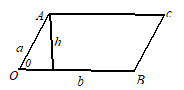
ExampleShow that the area of parallelogram with sides a andb is.
SolutionArea of parallelogram
OAC B= h/b
=/a/ sin /b/
=/a/ /b/sin
=/a x b/
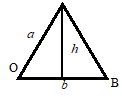
Area of angle
Example
Show that the area of a triangle with sides a and b is |a x b|SolutionArea of = OAB = |b| x h
= |b||a| Sin
= |a||b| Sin
= (a x b)
Example
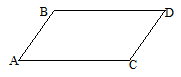
The adjacent sides of a parallelogram are
= 2 i – j – 6k and = i + 3 j – k . Find
the area of the parallelogram.
SolutionAB = 2 i – j – 6k
AC = i + 3 j – k
Area of parallelogram = |AB x AC| = xi j k2 -1 -6
1 3 -1
x
= i -1 -6 –j 2 -6 +k 2 -1
3 -1 1 -1 1 3
= I (1 + 18) –j (-2 + 6) + k (6 + 1)
= 19 I – 4 j + 7 k
|AB x AC| = |19i – 4j + 7k|
=
=
=
Hence
Area of parallelogram = sq. Units
GENERAL EVALUATION
1) Find the vector product of a= 4i -3j +4k and b = -I + 2j +7k
2) Given that p = 7i + 2j + k and q = 3i – 2j + 4k find (i) p x q (ii) | p x q | (iii) the unit vector perpendicular to both p and q
3) Find the sine of the angle between the vectors : a = I – j + k and b = 8i + 2j + 3k
4) The adjacent sides of a parallelogram are PQ= 4i + 3j + k and PR = -5i + 2j +3k find the area of the parallelogram
5) The position vectors OA, OB and OC are 2i – 3j + 4k , 6i + 4j -8k and 3i + 2j + 5k respectively find (i) vector AB (ii) vector BA (iii) vector BC (iv) AB x BC
Reading Assignment: New Further Maths Project 2 page 216 – 222
WEEKEND ASSIGNMENT
Given that a = I + 2j + k and b = 2i +3j- 5k
1) find ( a x b ) . a a) 0 b) 1 c) 2 d) 3
2) find ( a x b ) . b a) 1 b) 2 c) 0 d) 3
Given that p = I + 5j + 6k and q = – 2i + j + 3k
3) find p x q a) 15i +11j -11k b) 11i – 15j + 11k c) 11i – 11j + 15k d) 11i- 15j -11k
4) find q x p a) -11i + 15j – 11k b) 11i – 15j + 11k c) 15i – 11j-11k d) 15i+11j+11k
5) Given that a = i – j+ 3k and b = 6i + 2j – 2k find ( a + b ) . ( a x b ) a) 1 b) 0 c) 2 d) 3
THEORY
1) AB = 4i +3j+5k and AC= 2i-3j+k are two sides of a triangle ABC , find the area of the triangle
2) PQ = 2i+5j+3k and PR = 3i-3j + k are two adjacent sides of a parallelogram, find the area of the parallelogram.
WEEK SIX
REVIEW OF HALF TERM WORK
WEEK SEVEN
TOPIC: INTEGRATION
Integration: This is defined as anti- differentiation. Suppose, y = x3 + 2x, the first derivative is
3x2 + 2. (dy/dx = 3x2 + 2)
then the anti – derivative of 3x2 + 2 = x3 + 2x
Thus, integration is the reverse process of differentiation and denoted by the symbol ∫.
If dy/dx = xn , then ∫ dy/dx = xn+1 + C
n + 1 (n ≠ -1)
where c is the arbitrary constant.
INDEFINITE INTEGRAL CONCEPTS
General Concept
Example: Evaluate the following integrals:
1. ∫x2 dx 2. ∫x5/2 dx 3.∫ 4/ x5 dx 4.∫ √x8 5.∫ (7x4 + 2) dx 6.∫(x5 + 2x4 – x3 + 6) dxSolution;
1. x3 + C 2.x5/2 + 1 = 2x7/2 + c 3. ∫ 4x-5 dx = 4x-5+1= – 4x – 4 + C
3 5/2 + 1 7 -5 + 1
4. ∫ x4 = x4+1 = x5 + C 5. 7x4 +1 + 2x0+1 =7x5 + 2x + C
4 + 1 5
6. x6 + 2x5 – x4+ 6x + C
6 5 4
NB: Integral of a constant is not zero but the variable in the question.
Evaluation: Evaluate the following integrals; 1. ∫ (12x3 – x6 +1/x2) dx 2. ∫x2(3x2 + 4x) dx
Trigonometric integral:
The trigonometric integrals can be summarized in the following table. Remember that this is the reverse process of differentiation.F(x) ∫ f(x)dx
Sin x – cos x + c
Cos x sin x + c
Sec2x tan x + c
Cosec2x – cot x + c
Sec x tan x sec x + c
exex + c
1/x ln x + c
Example: Evaluate each of the following integrals.
1. ∫ sin x – 5 cos x)dx 2. ∫ (5sinx + 3x2)dx
Solution:
1. . ∫ sin x – 5 cos x )dx = ∫sin x dx – ∫5 cos x dx
= -cos x – 5 ( sin x ) + c
= – cos x – 5sin x + c
2.∫ (5sinx + 3x2 )dx = ∫5 sin x dx + ∫3×2 dx
= -5cos x + x3 + c
3. ∫ e2x dx = e2x/2 + c
Evaluation: Evaluate the integrals:
1. ∫ (3 cos x + 2 sin x) dx 2. ∫ e2×2 + 5x dx
INTEGRATION BY ALGEBRAIC SUBSTITUTION
Sometimes integral are not given in the standard form, such integral are then reduced to standard form format before evaluation by algebraic substitution.
Suppose, an integral is given in the form ∫ f(ax + b)n dx
Then, the algebraic substitution is to represent the function in the bracket by any letter.
Let u = (ax + b) du/dx = a, dx = du/ a
∫un dx = ∫ un du/a
= 1/a ∫ un du
Example:
Evaluate the following integrals.
1. ∫ (2x2 – 5x )4 dx 2. ∫ 7 dx 3. ∫ xcos 2x2 dx 4. ∫ x2 √(x3 + 5)dx(5x – 4 )5
Solution:
1. .∫ (2x2 – 5x )4 dx let u = 2x2 – 5x , du/dx = 4x – 5 , dx = du/4x -5
. ∫ u 4 du/ 4x -5 = u5+ c
5(4x – 5)
= (2x2 – 5x )5+ c
20x – 25
2. ∫ 7 dx let u = ( 5x – 4) , du/dx = 5, dx = du/5
(5x – 4 )5
∫ 7 u -5 du/5 = 7u-4+ c
5 x – 4
= 7(5x – 4 )-4
-20
3. ∫ x cos 2x2 dx let u = 2x2, du/dx = 4x, dx = du/4x
then; ∫x cos 2x2 dx = ∫x cos u du/4x = 1 x ( sin u ) = 1 sin 2x2 + c
4 4
4. ∫ x2 √(x3 + 5)dx let u = x3 + 5, du/dx = 3x2, dx = du/3x2
∫ x2 √(x3 + 5)dx = ∫x2 u1/2 du/3x2 = 1 x u3/2 = 2 (x3 + 5)3/2+ c
3/2 x 3 9
Evaluation:
Evaluate the following integrals:
1. ∫(5x – 7 )7/2dx 2. ∫cos 9x dx 3. ∫ xcos 2x dx.
INTEGRATION BY PARTS
This technique is uniquely useful in evaluating integrals that are not in the standard form. Such integrals cannot be solved by algebraic substitution.
From the product rule of differentiation, it can be generalized thus;
∫ vdu = uv – ∫ udv.
Example: Evaluate the following integral by parts.
- ∫ 2x sin x dx 2. ∫ e2xcos 2x dx
solution:
1. ∫ 2x sin x dx , let v = 2x, dv/dx = 2, dv = 2dx
∫du = sin x dx
u = -cos x
∫ vdu = uv – ∫ udv.
∫ x2 sin x = – x2cos x – ∫- cos x x 2 dx
= – x2cosx + 2∫ cos x
= – x2cos x + 2 sin x + c
2. ∫ x2ex dx , let v = x2, dv/dx = 2x, dv = 2xdx
du = ex u = ex dx
∫ vdu = uv – ∫udv
∫ x2ex = ex x2 – ∫ ex 2xdx
= x2 ex– 2∫ex x dx
the integral part in the RHS will have to be evaluated using integration by parts;
thus, v = x, dv/dx = 1, dv = dx , du =ex, u = ex
∫ vdu = uv – ∫udv
∫ x ex = ex . x – ∫exdx
= ex.x – ex
finally, ∫x2ex = x2 ex – 2(ex.x – ex)
= x2ex – 2xex + 2ex + c
Evaluation:
Evaluate 1. ∫x2cos x dx 2. ∫x3 e-x dx
INTEGRATION BY PARTIAL FRACTION
Sometimes rational functions are not expressed in the proper standard form; such function can be evaluated by transforming them into standard form through partial fractions. The knowledge of partial fractions is needed here to evaluate the functions.
Example; Integrate each of the following with respect to x;
1 2x + 32 x + 8
(2x + 1) (x – 1) ( x2 + 3x + 2)
solution:
1. resolve into partial fraction; 2x + 3 = A + B
(2x + 1)(x – 1) (2x + 1) (x – 1)
2x + 3 = A(x-1) + B(2x + 1)
when x = 1, 2(1) + 3 = B(2 + 1)
5 = 3B, B= 5/3
when x = -1/2, 2(-1/2) + 3 = A(-1/2 – 1 )
2 = – 3/2 A A = – 4/ 3
2x + 3 = ∫ -4 + ∫ 5 dx
(2x + 1)(x – 1) 3( 2x + 1) 3(x – 1)
= -4 ln (2x + 1) + 5 ln (x – 1)
2 x 3 3
= – 2/3 ln (2x + 1) + 5/3 ln ( x – 1) + c
2.x + 8 = x + 8 = A + B
(x2 + 3x + 2) (x + 1)(x + 2) x + 1 x + 2
x + 8 = A(x+2) + B(x+1)
when x = -2,
– 2 + 8 = B(-2+1)
6 = -B, B = – 6
when, x = -1, – 1 + 8 = A(-1 + 2)
7 = A.
thus, x + 8 =∫ 7 + ∫ – 6
x + 1 x + 2
= 7ln (x+ 1) – 6 ln(x+2) + c
Evaluation
Integrate by partial fraction.
1. 4x + 3 2. 1
(x – 3)(x+2) (x2+ 3x + 2)
GENERAL EVALUATION/REVISIONAL QUESTIONS
1.Find the derivatives of the following with respect to x;
(a) y = (15 + 5x)(1 + 2x) (b) y = (1 + 2x)12 (c) y = 3x2 (3 – 2x + 4x2) ½
2. Given that the gradient function of a curve is 8x – 2, find the equation of the curve at point (2, 4)
3. Find ∫(x2 + 1)(x3 – 2)dx
4. Find ∫x2 e2xdx
Reading Assignment: Read Integration, Page 31 – 46 Further Mathematics project III.
WEEKEND ASSINGMENT
1. Evaluate ∫ (x5 + 3)dx . A. x6/6 + 3x + c B. x5/6 + c C. x6/6 + c
2. Evaluate ∫ cos 7x dx A. 7sin 7x B. 1/7 sin 7x + c C. 7sin 7x + c
3. Integrate the function; (3x + 5)5wrt x .A 12(2x+3)6 + c B. (2x +3)6+ c C. (3x + 5)6 + c
12 18
4. Find ∫(x+1)(x2– 2)dx A. x4 + x3 – x2 – 2x + c B. x4 – x3 + x2 + c C. x + x4 – x3 – x2 + c
4 3 3 4
5. Integrate 1/x5 wrt x. A. x 6 + c B .x-4 + c C. x-4+ c
6 – 4 5
Theory:
1. Find ∫x sin2xdx 2. Evaluate ∫ dxx ( x + 2)
WEEK EIGHT
TOPIC : INTEGRATION [INDEFINITE INTEGRALDEFINITE INTEGRAL AND AREA UNDER CURVE]
The process of reversing differentiation is called Integration. If dy/dx = 3x2, then y could be x3, as the derivative of x3is 3x2.
We say that x3 is an integral of 3x2 with respect to x. The symbol for integration sign is given by ∫ . The expression to be integrated is put between the ∫ sign and dx.
∫ 3×2 dx could be x3
Since differentiating any constant gives zero, the following also have derivation 3x2.
X3 + 2, x3 + 4.5, x3 – 17etc
In general, any function of the form x3 + c, where c is the constant has derivative of 3x2
Hence, ∫ 3x2 dx = x3 + C. C is called constant of integration. Because we do not know the actual or definite value of C, this is called INDEFINITE INTEGRAL.
Let y = xn+1/ n+1 , Differentiating dy/dx = (n+1) xn+1/n+1 = xn
Reversing this,
∫ xn dx = xn+1/n+1 + C
∫ kxn dx = K xn+1/n+1 + C
To Integrate a sum, integrate each term as this is similar to differentiating a sum.
Examples:
Evaluate (i) ∫(2x3 + 3x2 – 4) dx
2/4x4 + 3/3x3 – 4x + C
½ x2 + x3 – 4x + C
Evaluate ∫(4t3 + 2t2 + ½ t2) dt
4/4 t4 + 2/3 t3 + ½ × ½ t2 + C
t4 + 2t3 + ¼ t2 + C.
Integration of basic Trigonometric functions
Consider the table below for differentiating trigonometric functions.
Y
sinKx
Cos Kx
Tan Kx
dy/dx
kcoskx
-ksinkx
k/(coskx)2
Consider a similar table as the one given above
Y
Sin x
Cos x
Tan x
Cosx+C
Sinx +C
Tanx +C
Y
sinkx
coskx
Tankx
∫ydx
-1/k coskx + C
1/k sinkx + C
1/k tankx + C
Example
∫(cos2x + sin3x) dx
∫cos2x dx + ∫ sin3x dx
½ sin2x + -1/3 cos3x
½ sin2x – 1/3 cos3x + K.
Sometimes,the value of the constant C can be found, if extra information is given.
If dy/dx = x2+2x-3, find y in terms of x given that x = 1, y =4
Y =∫(x2 +2x-3)dx
Y =x3/3 + 2x/2 – 3x + C
Y = x3/3 +x2 -3x + C
Putting x=1,and y = 4
4 = 1/3 + 1 – 3 + C. hence; C = 5 2/
. 1/3×3 – x2 – 3x + 5 2/3.
If dy/dx = 2Cos3x, find y given that y =2 and x = 1/6∏
∫2Cos3x = 2/3Sin3x + C
2 = 2/3Sin3(∏/6) + C = 2/3 Sin∏/2 + C
Multiplying by ½ ∏ (180/∏) = 900
Sin ½ ∏ – Sin 900 = 1
2 = 2/3 ×1 + C
C = 4/3
Y = 2/3Sin3x + 4/3 .
Evaluation:
Evaluate these indefinite integrals
- ∫(y2 – 7y)dy
- ∫(3×2 – 2x – 1)dx
- ∫(Cos4x)dx
- ∫(3cos2x + 4sin3x)dx
- If dy/dx = 4×2 + 1 and y = 2 when x =3, find y in terms of x
- If dy/dx = 2Sin1/3x and y = 4 when x =∏m, find y
DEFINITE INTEGRALS
In this part, the constant is removed. If a definite integration is performed, the function is evaluated between the values called limits. Upper and lower ie
Example: Evaluate
=x3 + C , (33 + c) – (23 + c)
(27 + C) – (8 + C)
27 + C -8 – C
19.
= 19.
= { ½ Sin2}
(½ sin× 0)
½ sin
= ½
Area under curve using Definite Integral
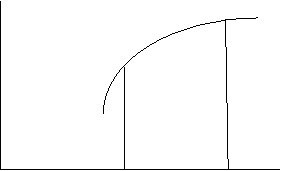
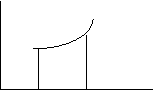
Given in the diagram, the area between the curve and the x axis from x = a and to x = b. The area is given byArea =
The area can be explained as: Area = ∫ y × dx = Sum of height of rectangle × width of rectangle
ya b
Ex 1: Find the Area between the curve y = x3 – x and the x axis when x =2 and x = 4.
y0 2 4 x
{ ¼ (4)4 – ½(4)2} – { ¼ X 24 – ½ (2)2}
64 – 8 -4 + 2 = 54 UNITS.
Ex 2 : Find the area in the diagram shown below
y = 4 – x2 4
-2 0 2
∫(4 – x2 )dx
{4x – x3/3}22.
4(2) – 23/3 – 4(-2) – (-2)3/3
(8- 8/3) – (-8 + 8/3)
8 – 8/3 + 8 – 8/3
32/3.square unitrs
Evaluation:
Find the area between the values as shown below
yy = 3x2
0 2 4 x
Find the area between the curve y = x2 + 3 At the xs axis and when x = -1 and x = 3.
Evaluation
1. x2 and the line y = 2.
General Evaluation:
- ∫(3x – 1)(x + 2) dx
- ∫5cos4x (dx)
Reading Assignment :Solve the evaluation questions given above
Weekend Assignment:
- Evaluate A. 2/3 B. -2/3 C. -6 2/3 D. 6 2/3
- Evaluate A. 4 B. 2 C. 4/3 D. 1/3
- Evaluate A. – ½ B. 1 C. -1 D. 0
- Find the area enclosed by by the curve y = x2 , X = 0 and X = 3 A. 9 B. 7 C. 5/2 D. 5
- Given y = 3x -2, x=3, x=4. Find the area under the curve A. 4/3 B. 17/2 C. 6 D. 3
Theory
- Find the area enclosed between the curve y =x2 + x -2 and the x axis
- Find the area enclosed by the curve y = x2 – 3x + 3 and the y = 1.
WEEK NINE
TOPIC : APPLICATION OF INTEGRATION II : SOLID REVOLUTION AND TRAPEZOIDAL RULE
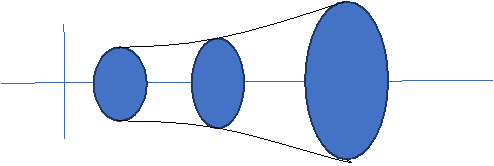
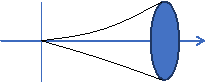
A solid whichb has a central axis of symmetry is a solid of revolution.Forexample, a cone, a cylinder , a vase etc.
y
Consider the area under a portion AB of the curve y = f(x) revolved about the x axis through four right angle or 3600, each point of the curve describes a circle centered on the x axis. A solid revolution can be thought of as created in this way with the circular plane ends cutting the x – axis at x = a and x = b.
Let v be the volume of the solid for x = a up to an arbitrary value of x between a and b. Given abincreament dx in x , and y takes an increamentdy and v increases by dv.
The figure shows a section through the x axis, from this it is seen that the slice dv of bthickness dx is enclosed between two cylinders of outer radius y +dy and inner radius y .
Then ,πy2dx< dv < π (y + dy)2dx;
With appropriate modification, if the curve is falling at this point.
π y2 < dv/dx < π (y + dy)2if dx 0, dy 0 as dv/dx dv/dx: . dv/dx = πy2 or V =
Where y = f(x) and v = volume of solid revolution of the curve where y = f(x) is rotation completely and x – axis between limits x = a and x =b.
Examples;The portion ofthe curve y = x2 between x = 0 and x = 2 is rotated complrtely around the x axis, find the volume of the solid generated?
V =
=
V =
V = =
Put x = 2 and x = 0 then substitute into the expression above
V =
THE TRAPEZOIDAL RULE
There are many definite integrals which can’t be evaluated and thus required advance techniques e.g
etc
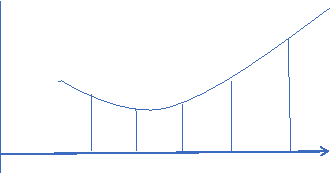
We can find an approximate value for such integralsbyb finding the area approximately. There are many methods methods of doing this and such methods include the Trapezium rule. Y
Y = f(x)
y1 y2y3 yn-1yn
x1 x2 x3 xn-1xn
= ½ (y1 +y2)h + ½ (y2 +y3)h + ½ (yn-1 +yn)h
½ h(y1+2y2+2y3+……….+2yn-1 + yn)
½ (width of each trap. ) × (first ordinate + last ordinate )+ 2( sum of all other ord.)
F(x)dx = ½ h{y1 + yn} +2{y2 +y3 + …Yn}.
Example
Find the approximate value of at interval 0.5
X
1
1.5
2
2.5
3.0
Y = 1/x
1
0.67
0.5
0.4
0.33
Applying the rule;
{ ½ . ½ { (1 +0.33) + 2 ( 0.67 + 0.5 + 0.4)}
¼ {(1.33) +2(1.57)}
¼ (4.47) = 1.12.
1 0.67 0.5 0.4 0.33
Ex (2). Make a table of value of y for which y = for which x =2 t0 x = 3 at interval of 0.2.
X
2
2.2
2.4
2.6
2.8
3
X2-1
3
3.84
4.76
5.76
6.84
8
1.732
1.956
2.182
2.4
2.615
2.828
0.5754
0.5703
0.4583
0.4167
0.3824
0.3536
Using the rule.
= ½ *0.2 (0.5774 +0.3536 + 3.5354)
0.44664 *2
0.89 correct to 2 dp
APPLICATION OF INTEGRATION TO KINEMATICS
If the ve;locityis given as a function of time, the displacement is the integral of the velocity function with respect to the time .
ds/dt = f(t)
then S =
= f(t) + C
Similarly, if the acceleration is a function of time, the velocity is the integral of the acceleration function.
Ex. A particle is projected in a straight line from O until a speed of 6m/s is attained. At time t secs.Later,its acceleration is (1 + 2t) m/s2 for the value of t = 4. Calculate for the particle (i) its velocity (ii) its distance from O
dv/dt = 1+ 2t
v = = t + t2 + C
when t = 0
v = 6m/sand c = 6.
V = (t2 + t + 6) m/s
When t = 4, v = 16 + 4 + 6 = 26m/s.
(ii) distance (s) = ds/dt = t2 + t + 6
S =
S = {t3/3 + 16/2 6t}4
= 160/3
m.
Evaluation
1. Find the area enclosed byb y = x2 – x -2 and the x axis
2. find the area under the curve y = x2/3 between x = 2 and x = k is 8 times the area under the same curve between x = 1 and x =2, hence find the value of k.
GENERAL EVALUATION
- A particle moves in astraight line from O until the initial velocity was 2m/s. its acceleration is given by (2t -3)m/s2. Calc. (i) its velocity after 3 secs. (ii) the distance from O when it is momentarily at rest.
- Find the volume of solid revolution when a is the region bounded by the cuerve y = 2x. and the ordinate at x = 2,and x = 4 and the x axis is revolved by 2π.
Reading Assignment :F/Matrhs Project, pg 47 – 63
WEEKEND ASSIGNMENT
1. Integrate 2√x A. B.4x3/2 + C C. + C D.
2. Integrate A. + C B. x3/2 + C C. x2 + C D. + C
3. The gradient of a curve is 6x + 2 and it passes through the point (1,3), find its equation A. 3x2 – 2x + 2 B. 3x2 -2x -2 + 2x + 2 C. 3x2 – 2x + 2 D. 3x2 – 2x -2
4. Evaluate A. – + x2 – 2x + C B. x3/3 – x3/2 + x2 + 2x +C C. x3/3 + x2/2 +x3-2x + C D. x4/4+x3/3-x2+2x+C
5. Eval. A. 9 +C B. 8/3 + C C. 24 D. 18 + C
THEORY
- Evaluate
- Using trapezoidal rule, with ordinate x = -3,-2,-1,0,1,2,3 and 4. Calc correct to 3 dp an approximate value of
WEEK TEN
TOPIC: REGRESSION LINE AND CORRELATION COEFFICIENT
SCATTER DIAGRAM
Definition: a scatter diagram is a graphic display of bivariate data. A bivariate data involves two variables
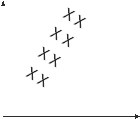
TYPES OF SCATTER DIAGRAM:
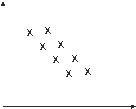
Linear positive correlation.
A positive correlation between two variables x any y means that in general, increase in x is accompanied by increase in y. The regression line has a positive slope.
X
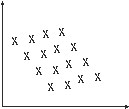
Linear negative correlation
A negative correlation between x and y means that an increase in x is accompanied by a decrease in y, negative correlation has a negative slope.
x
Zero Correlation: There is no apparent association between x and y.y
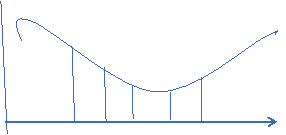
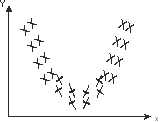
Non Linear Correlation:
Most of the points lie on or near a curve which is parabolic in shape. The parabolic curve is called a regression curve.x
REGRESSION LINE OR LINE OF BEST FIT OR THE LEAST SQUARES LINE
There are two variables where one is dependent and the other is independent variable. The regression line can be fit using scatter diagram method and the least squares method.
LEAST SQUARES METHOD: If x is independent variable and y dependent variable, that is y on x. then :The equation of the regression line is written as y = ax + b
Where a is the slope and b is the y – intercept. Given two sets of variables x and y it can be deduced that
a = n ∑ xy – ∑ x ∑ y
∑ x2 – ( ∑ x)2
b = y a – axWhere x = ∑ xn
y = ∑ ynExample: use the least square method to fit a regression line of y on x for the following data
X
3
5
6
9
11
14
15
18
Y
2
3
5
7
10
12
13
17
Find value of y when x = 8
SOLUTION:
X
y
Xy
x2
3
2
6
9
5
3
15
25
6
5
30
36
9
7
63
81
11
10
110
121
14
12
168
196
15
13
195
225
18
17
306
324
∑ x = 81
∑ y = 69
∑ xy = 893
∑ x2= 1017
a = n ∑ xy – ∑x ∑ y= 8 (893) – 81x 69n∑(x2 ) – ( ∑x)2 8 (1017) – (81)2 a = 7144 – 5589 = 1555 8136 – 6561 1575a = 0. 9873
x = ∑ x = 81 = 10.125n 8y = ∑ y = 69 = 8. 625n 8
b = y – axb = 8.625 — 0.9873 (10.125)
= 8.625 – 9.996
b = -1.37
y = ax + b
y = 0.9873x – 1.37 (regression line of y on x )
When x = 8
y = 0. 9873 (8) – 1.37
y = 6.5284 ~ 6. 5
EVALUATION
Use the least square method to fit a regression line of y on x for the following data
X
1
4
5
7
8
10
12
16
19
20
Y
2
3
4
5
7
8
10
15
20
18
Use the line obtained to find the value of y when x = 9
CORRELATION COEFFICIENT
DEFINITION:
The correlation coefficient determines the amount or degree of linear relationship between two variables. The correlation coefficient is represented by r
The characteristics of r are as follows:
- The value of r is the same irrespective of the variable labelled x or y.
- the value of r satisfies the inequality -1< x < + 1
- if r is close to +1, the variables are highly positively correlated. If r is close to -1 then, x and y are highly negatively correlated. If r is close to zero, the correlation between x and y is very low. There is no correlation between x and y when r = 0
There are two methods of obtaining the correlation coefficient.
- Pearson’s coefficient of correlation or product moment correlation coefficient
- Rank correlation coefficient.
RANK CORRELATION COEFFICIENT: It is also known as Spearman’s rank correlation coefficient and defined as :
rk = 1 – 6 ∑ D2
n(n2 -1)
As the name implies, the variables (if not ranked) can be ranked in ascending order or descending order. Where there are ties, the average is used as the rank.
Where D is the difference between the pairs of variables and n is the number of variables. D = Rx – Ry
Example:
The table below gives the examination marks of 10 students in mathematics and history.
Maths
51
25
33
55
65
38
35
53
61
44
History
20
65
25
36
51
50
77
31
60
5
A Calculate the rank correlation coefficient
b) Comment briefly on your result
SOLUTION:
MATHS (x)
HISTORY (y)
Rx
Ry
D
D2
51
20
5
9
-4
16
25
65
10
2
8
64
33
25
9
8
1
1
55
36
3
6
-3
9
65
51
1
4
-3
9
38
50
7
5
2
4
35
77
8
1
7
49
53
31
4
7
-3
9
61
60
2
3
-1
1
44
5
6
10
-4
16
∑D2 = 178
rk = 1- 6 ∑D2
n(n2 – 1)=1 – 6 x 178
10 (102 – 1)1 – 1068/990
= 1-1.178= -0.078
There is a very low negative correlation between the marks obtained in mathematics and history.
EVALUATION:
The table below shows the marks obtained by ten students in both theory (x) and practical (y) examination.
X
50
70
85
35
60
65
75
40
45
80
Y
45
55
75
40
50
60
70
35
30
65
Calculate the rank correlation coefficient between x and y comment on your result.
PEARSON’S CORRELATION COEFFICIENT: It is fully called Pearson’s product moment correlation coefficient. It is simple to calculate and it does not recognise any of the variables as independent or dependent. It is obtained using the formula below.
r = n ∑ xy – ∑x∑ y
√ [n∑(x2 ) – (∑x)2 ][n∑(y2) – (∑y)2
Example:
Calculate the product moment correlation coefficient for the following data
X
2
4
7
9
11
Y
1
2
3
7
9
Comment on your result.
SOLUTION:
X
Y
XY
X2
Y2
2
1
2
4
1
4
2
8
16
4
7
3
21
49
9
9
7
63
81
49
11
9
99
121
81
∑x = 33
∑y = 22
∑xy = 193
∑x2 = 271
∑y2 = 144
r = 5 x 193 – 33 x 22√[5(271) – ( 33)2][5(144) – ( 22)2]
r = 965 – 726
√266 x 236
r = 239
250.55
r = 0.9539. r = 0.95 (approximately to 2 s.f)
Comment: The relationship between x and y is highly positive.
EVALUATION: The following data are the marks obtained by five students in statistics (X) and mathematics(Y). Calculate the product moment correlation coefficient and comment on your result.
X
33
36
42
52
40
Y
42
46
38
62
52
GENERAL EVALUATION/REVISIONAL QUESTIONS
- If Cos A = 24/25 and Sin B= 3/5, where A is acute and B is obtuse, find without using tables, the values of (a) Sin 2A (b) Cos 2B (c) Sin (A-B)
- Use the addition formula to find the values of the following
(a)Sin 750 (b) cos 750 (c) tan 450
- Calculate the Product moment correlation coefficient and the Spearman’s rank correlation coefficient.
X
50
45
43
30
30
43
23
43
25
Y
12
13.5
14
11
12
15
13.5
12
14
READING ASSIGNMENT: Read correlation and regression.Page313–320. Further Mathematics project 2.
WEEKEND ASSIGNMENT
Use the table below to answer questions 1 and 2.
Height
160
161
162
163
164
165
No of students
4
6
3
7
8
2
- The mean of the distribution is
(a) 4875.1 cm ( b) 4001.2 (c) 3571.0cm (d) 162.2 cm (e) 129.2cm
2. The median of the distribution is
(a) 160 (b) 162 (c) 163 (d) 164 (e) 165
3. Calculate the standard deviation of 3,4, 5,6,7,8,9
(a) 2 (b) 2.4 (c) 3.6 (d) 4.0 (e) 4.2
4. Calculate the mean deviation of 6 , 8 , 4 , 0 , 4
(a) 4 .0 (b) 3.6 (c) 3.0 (d) 2. 8 (e) 2 . 1
5. The table below shows the rank Rx and Ry of marks scored by 10 candidates in an oral and
written tests respectively. Calculate the spearman’s rank correlation coefficient of the data.
Rx
1
2
3
4
5
6
7
8
9
10
Ry
2
3
4
1
6
5
8
7
10
9
(a)51/55 b) 6/55 c)49/55 d)54/55 e) 61/55
THEORY
1 The distribution of marks scored in statistics and mathematics by ten students is given in the table below:
Maths(x
11
20
23
42
48
50
57
64
80
90
Stat(y)
26
23
35
46
44
50
50
58
68
70
- Plot a scatter diagram for the distribution
- Draw an eye- fitted line of best fit
- Use your line to estimate the students marks in statistics if his mark in maths is 40
2. The table below gives the marks obtained by members of a class in maths and physics examination
STUDENTS
A
B
C
D
E
F
G
H
I
J
Maths
85
75
59
43
74
69
62
80
54
63
Physic
92
72
62
48
85
73
46
74
58
50
- Calculate the product moment correlation coefficient.
- Comment on your result.