


SUBJECT: MATHEMATICS CLASS: SSS 1
WEEK SCHEME OF WORK
- Revision of JSS 3 works. Basic operations of Integers, Addition, Subtraction, Multiplication and Division
- (a) Conversion from One Base To Base Ten (10) or Vice Versa
(b) Conversion Of Decimal Fraction(bicimal) in One Base to Base 10
(c) Conversion of Number from One Base to Another Base
- (a) Addition, Subtraction, Multiplication and Division of Number Bases
(b) Application to Computer Programming
- (a) Concept of Module Arithmetic
(b) Addition, Subtraction and Multiplication Operations in Module Arithmetic.
(c) Application to Daily Life.
- (a) Standard Form
(b) Approximation such as: Rounding off of Numbers: Decimal Places; significant Figures
- Indices (a) Application of the Base Laws: (b) Negative, Zero and Fractional Indices
- Review of the First Half Term’s Work and Periodic Test
- Logarithms:
- Logarithms of Whole Number e.g. 10,100,1000 etc. (in base 10)
- Logarithm Table for Multiplication and Division
- Logarithms (cont’d)
- Calculations Involving Powers and Roots
- Relationship Between Indices and Logarithms
- Simple Equation and Variations
- Change of Subject of Formulae
- Types of Variation such as: Direct, Inverse, Joint and Partial
- Applications of Variations
- Revision of the First Term’s Work and Preparation for Examination
- Examination
REFERENCE BOOKS
New General Mathematics SSS 1 M.F. Macrae et al
WEEK 1
REVISION OF BASIC OPERATION OF INTEGERS
ADDITION OF WHOLE NUMBERS
Examples:
- Add the following numbers
4109,39787,1501 and 7865
- A trader brought 13 dozens of oranges, 1 gross of apples and 9 scores of pineapple. How many fruits did she buy altogether?
Solution
- 4,109
39,787
1,501
 + 7,865
 53,262
- 13 dozens of oranges = 13 X 12 oranges
= 156 oranges
1 gross of apples = 144 apples
9 scores of pineapples = 9 X 20
= 180 pineapples
Total number of fruit that she bought altogether = 156 + 144 + 180
156
144
 +180 480


EVALUATION
- What is the sum of 6119, 19786 and 1999?
- A school library has 3 gross of maths textbooks, 7 scores of English textbooks and 8 dozens of basic technology textbooks. How many books altogether are in the library?
SUBTRACTION OF WHOLE NUMBER
Examples:
- Find the difference between 42006 and 7998.
- A boy was sent on an errand to buy 3 dozens of milk at #680 per dozen and 2 packs of sugar which cost #150 per packet. How much will he collect if he was given #2400?
Solution
- Required difference 42006 – 7998
42006
 – 7998
 34008
34008
- Cost of 3 dozens of milk at #680 per dozens
= 3 x #680 =2,040
Cost of 2 packs of sugar at #150 per pack = 2 x #150
=#300
Total cost of the item brought = #2,040 + #300
=2,340
Hence,
The change that the boy will collect = #2,400 – #2,340
#2,400
 #2,340
 # 60
# 60
EVALUATION
- Subtract 449 from 1,001
- The number of students in a school is 1,819. What is the number of boys in the school ,if the number of girls is 27?
MULTIPLICATION OF NUMBERS
Examples:
- Find the product of 819 and 39
- Evaluate 79 X 109
Solution
- />
- Required product 819 X 36
819
X 36
 4914
4914
 2457
2457
 29,484
- 79 X 109
109
 X 79
X 79
981
 763
763
 8,611
8,611
EVALUATION
- Evaluate 417 X 29
- What is the product of 439 and 17?
DIVISION OF NUMBERS
Examples
- Find the value of 6,513 ÷ 13
- Given that 19 x y =323. Find the value of y
- What is the quotient of 3,618

9
Solution
- 6,513÷ 13 501
13 6,513
651
013
13 - 19 X y=323Y= 323
19
17Y= 19 323
19133
133 Y= 17


EVALUATION
- What is the value of P if 19 x P=3819?
- In an estate, 26 people are living in a house. If there are 26026 people living in the estate altogether. How many houses are in the estate?
GENERAL/REVISION EVALUATION
- Find the sum of 62429, 325, 1426 and 98
- Find the difference between 76211 and 8899
- If 16 X q= 40960.find the value of q
- In a village of 17598 people, 9998 are male. how many female are in the village?
READING ASSIGNMENT
NGM SSS1,review test 1 and 2 pages 3-4.
WEEKEND ASSIGNMENT
- Add the following numbers : 719,35,608 (a)5459 (b)6469 (c) 7469 (d)8489
- Find the difference between 10001 and 799 (a)8202 (b)7202 (c) 9202 (d)1002
- What is the product of 56 and 415? (a)23240 (b) 23250 (c) 33240 (d)25340
- Evaluate the quotient 414? (a)64 (b)46 (c) 56 (d)76
9
- Given that 43 x A=43043, find the value of A. (a) 11 (b)101 (c)1001 (d)2463
THEORY
- Mr. Ade’s pay slip reads thus
Basic salary #15,500
Transport #9,900
House allowance #4900
Medical allowance #8750
Other allowance #3,870
- What is the gross salary of Mr. Ade?
- If Mr. Ade pays #500 as tax and #650 for pension and also repay a loan of #3,250.how much is his net income?
- (a) There are 37 students in each classroom in a certain school. If the school has 19 classrooms, how many students are there in the school?
(b) Given that 17 x z = 28985 Find the value of Z

WEEK TWO
NUMBER BASE CONVERSIONS
People count in twos, fives, twenties etc. Also the days of the week can be counted in 24 hours. Generally people count in tens. The digits 0,1,2,3,4,5,6,7,8,9 are used to represent numbers. The place value of the digits is shown in the number. Example: 395:- 3 Hundreds, 9 Tens and 5 Units. i.e.
39510 = 3 x10² + 9 x 101 +5 x 100.
Since the above number is based on the powers of ten, it is called the base ten number system i.e.
= 300 + 90 + 5.
Also 4075 = 4 Thousand 0 Hundred 7 Tens 5 Units i.e. 4 x 10³ + 0 x 102 + 7 x 101 + 5 x 100 Other Number systems are sometimes used.
Example: The base 8 system is based on the power of 8. For example: Expand 6477, 265237, 1011012,
(a) 6457 = 6 x 72 + 4 x 71 + 5 X 70 = 6 x 49 + 4 x 7 + 5 x 1
(b) 265237 = 2 x 74 + 6 x73 + 5 x 72 + 2 x 71 + 3 x 70
(c) 1011012 = 1 x 25 + 0 x 24 + 1 x 23 + 1 x 22 + 0 x21 + 1 x 20
EVALUATION
Expand The Following
1. 7358 2. 10100112
CONVERSION TO DENARY SCALE (BASE TEN)
When converting from other bases to base ten the number must be raised to the base and added.
Worked Examples:
Convert the following to base 10
(a) 278 (b) 110112
Solutions:
(a) 278 = 2 x 81 + 7 x 80 = 2 x 8 + 7 x 1 = 16 + 7 = 23
(b) 110112 = 1 x 24 + 1 x 23 + 0 x 22 + 1 x 21 + 1 x 20 = 1 x 16 + 1 x 8 + 0 x 4 + 1 x 2 + 1 x 1
= 16 + 8 + 0 + 2 + 1 = 27
EVALUATION
Convert The Following To Base Ten:
(a) 1010112 (b) 21203
CONVERSION FROM BASE TEN TO OTHER BASES
To change a number from base ten to another base
1. Divide the base ten numbers by the new base number
2. Continue dividing until zero is reached;
3. Write down the remainder each time;
4. Start at the last remainder and read upwards to get the answer.
Worked Examples:
1. Convert 6810 to base 4.
2. Covert 12910 to base 2

 Solutions:
1. 5 68 2 129
5 13 R 3 2 64 R 1
5 2 R 3 2 32 R 0
0 R 2 2 16 R 0
2335 2 8 R 0 100000012
2 4 R 0
2 2 R 0
EVALUATION 2 1 R 0
1. Convert 56810 to base 8 0 R 1
2. Convert 10010 to base 2
Bicimals
Base ten fractions, or decimals, are based on negative powers of ten
 6 100 5 10-1 8 10-2 3 10-3


6.583
Similarly we can have base two fractions, bicimals, based on negative powers of two


 1 20 1 2-1 0 2-2 1 2-3
1.101
To convert a bicimal to a decimal, first express each digit as a power of two, then change the powers to fractions. Study the example below
Example 1
Convert the following bicimals to decimals.
a. 1.101 b. 10.011 c. 110.11
- 1.101 = 1 20 + 1 2-1 + 0 2 -2 + 1 2-3
= 1 + 1 + 0 + 1
= 1 + + 0 +
= 1 + 0.5 + 0 + 0.125
= 1.625
- 10.011 = 1 + 21 + 0 20 + 0 x 2-1 + 1 2-2 + 1 2-3
= 2 + 0 + 0 + 1 + 1
= 2 + 0 + 0 + +
= 2 + 0.25 + 0.125
= 2.375
- 110.11 = 1 22 + 1 21 + 0 20 + 1 2-1 + 1 2-2
= 4 + 2 + 0 + +
= 6 + 0.5 + 0.25
= 6.75
EVALUATION
Convert the following bicimals to base ten.
- 10.0001
- 10.01
- 11.1
- 0.001
Conversion of number from one base to another base
A number given in one base other than base ten can be converted to another base via base ten.
Example 1
Convert: (a) 1534six to base eight
(b) 8A9Fsixteen to base eight.
Solution
- 1534six to base eight
First convert 1534six to base ten.
1534six = 1 63 + 5 62 + 3 61 + 4 60
= 216 + 180 + 18 + 4
= 418ten
Now convert 418ten to base eight.
8 418 Remainders8 52 2
8 6 4
0 6 i.e. 418ten = 642eight
Thus, 1534six = 642eight
- 8A9Fsixteen to base eight
8A9Fsixteen = 8 163 + 10 162 + 9 161 + 15 160
= 32768 + 2560 + 144 + 15
= 35487ten
Now convert 35487ten
8 35487 Remainders9 4435 78 554 3
8 69 2
8 8 5
8 1 0
0 1
i.e. 35487ten = 105237eight
thus, 8A9Fsixteen = 105237eight



Example 2
Determine the number bases x and y in the following simultaneous equations:
32x – 12y = 9 ten and 23x – 21y = 4ten
Solution
32x – 12y = 9ten (1)
23x – 21y = 4ten (2)
Change equation (1) to base ten as follows:
(3 x1 + 2 x0) – (1 y1 + 2 y0) = 9
3x + 2 – y – 2 = 9
3x – y = 9 (1a)
Similarly, change equation (2) to base ten:
i.e. x – y = 1 (2a)
subtracting equations (2a) from (1a):
2x = 8
X = 4
Substituting x = 4 in (2a)
4 – y = 1
4 – 1 = y
y = 3
Thus, x = 4 and y = 3.
EVALUATION
- If x represents a base number in the following equations, what is the value of x?
- 315x – 223x = 72x
- 405x + 43eight = 184ten
- Convert each of the following to the base indicated:
- 10401.11seven to base eight
- 4B3Fsixteen to base twelve
GENERAL EVALUATION
- Convert
(a) 178510 to base 7 (b) Convert 21256 to base 10
- Determine the number bases x and y in the following simultaneous equations:
- 31x + 20y = 2310
23x – 11y = 510
- 26x – 34y = 10002
38x – 21y = 1115
- Find the value of Q if (Q4)2 = 1001002
READING ASSIGNMENT
New Gen Math SS 1pg52 – 51
WEEKEND ASSIGNMENT
1. Express 3426 as number in base 10 (a) 134 (b) 341 (c) 143
2. Change the number 100102 to base 10 (a) 1001 (b) 40 (c) 18
3. Express in base 2, 10010 (a) 100100 (b) 1100100 (c) 11001
4. Convert 120 base 10 to base 3 (a) 111103 (b) 12103 (c) 121103
5. Convert 25 base 10 to base 2 (a) 110012 (b) 10012 (c) 11002
THEORY
1. Convert 23647 to base 10
2. Convert 10510 to base 2
WEEK THREE
TOPIC: BINARY NUMBERS (BASE 2 NUMBERS)
- Addition in base 2
- Subtraction in base 2
- Multiplication & Division in base 2
ADDITION IN BASE TWO
We can add binary numbers in the same way as we separate with ordinary base 10 numbers.
The identities to remember are:-
0 + 0 = 0, 0 + 1 = 1, 1 + 0 = 1, 1 + 1 = 10, 1 + 1 + 1 = 11, 1 + 1 + 1 + 1 = 100
Worked Examples
Example 1
Simplify the following
1. 1110 + 1001 2. 1111 + 1101 + 101
Solutions:
1. 1110
+ 1001
10111
2. 1111
+ 1101
101
100001
Note: 11 take 1 carry 1
10 take 0 carry1
100 take 0 carry 10
Example 2
- 11011two + 1111two
- 10011 + 1110
- 110111 + 11011 + 10111
Solution
- 11011two + 1111two
1 1 0 1 1
1 1 1 1
1 0 1 0 1 0 - 10011 + 1110
1 0 0 1 1
1 1 1 0
1 0 0 0 0 1 - 110111 + 11011 + 10111
1 1 0 1 1 1
1 1 0 1 1
1 0 1 1 1


 1 1 0 1 0 0 1
EVALUATION
1. Simplify the following; 1001 + 101 + 1111
2. 10101 + 111
SUBTRACTION IN BASE TWO
The identities to remember on subtraction are: 0 – 0 = 0, 1 – 0 = 1, 10 – 1 = 1, 11 – 1 = 10, 100 – 1 = 11
Worked Examples
Simplify the following:-
(a) 1110 – 1001 (b) 101010 – 111
Solutions:
(a) 1110
– 1001
101
(b) 101010
– 111
1110
Example 2
- 1001two – 111two
- 10001 – 1111
- 11010two – 1111two
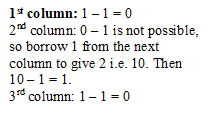 Solution
- 1001two – 111two
1 0 0 1
1 1 1
1 0 - 10001 – 1111
1 0 0 0 1
1 1 1 1
1 02 - 11010two – 1111two
1 1 0 1 0
1 1 1 11 0 1 1


MULTIPLICATION AND DIVISION IN BASE TWO
In multiplication, 0 x 0 = 0, 1 x 0 = 0, 1 x 1 = 1.
When there is long multiplication of binary numbers, the principle of addition can be used to derive the answer. Under division, the principle of subtraction can be used.
Worked Examples:
1. 1110 x 111 2. 110 ÷ 10
Solution:
1. 1110 2. 11

 x 110 10 110
 0000 10
1110 10
1110 10
1010100 00
Example 2
- 101011 X 110
- 11101 X 111
Solution
- 101011 X 110
The working is shown below without explanation
1 0 1 0 1 1
1 1 0
0 0 0 0 0 01 1 0 1 0 1

 1 1 0 1 0 1
1 0 0 0 0 0 0 1 0

- 11101 X 111
1 1 1 0 1
1 1 11 1 1 0 1

1 1 1 0 1
 1 1 1 0 1
1 1 0 0 1 0 1 1

Example 3
- 101010 111 (base two)110

111
111
 111
111
111
 00
00
 00
00
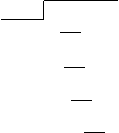
- Divide 1010.01two by 11two giving your answer to 3 places after the binary point.11.011
11 1010.010
– 11
100
-11
101
-11
100
11
1
EVALUATION
- Evaluate 10111÷110
- Evaluate 10001 x 11
- Evaluate 10001 – 1110
GENERAL EVALUATION
- Evaluate 111101 x 111
- Evaluate 40205 ÷ 115
- 11001 + 1111
- 1101 – 111
- 1 1 1 1
1 1 0


READING ASSIGNMENT
Essential Mathematics for SS 1 pages 54 – 55
WEEKEND ASSIGNMENT
1. Express 3426 as a number in base 10. (a) 342 (b) 3420 (c) 134
2. Change the number 10010 to base 10 (a) 18 (b) 34 (c) 40
3. Express in base two the square of 11 (a) 1001 (b) 1010 (c) 1011
4. Find the value of (101)2 in base two (a) 1010 (b) 1111 (c) 1001
5. Multiply 1000012 by 11 (a) 1001 (b) 1100011 (c) 10111
THEORY
- Convert the following to binary number
- 10ten
- (10ten)2
- Calculate 1102 x (10112 + 10012 – 1012)
- Multiply 345 by 225.
WEEK FOUR
TOPIC: Modular Arithmetic
CONTENT
- Concept of Modular Arithmetic
- Addition, Subtraction and Multiplication Operations in Module Arithmetic
- Application to daily life.
Modular Arithmetic
In the previous section, we discovered a new kind of arithmetic, where we add positive integers by roating in number cycle. This arithmetic is called modular arithmetic. In our example, we ignored multiples of 4 and concentrated on the remainders. In this case we say that the modulus is 4
For example,
5 = 1 (mod 4)
Where mod 4 means with modulus 4 or modulo 4.
Note that 9 4 = 2, remainder 1
And 45 4 = 11 remainder 1
We say that 9 and 45 are equal modulo 4,
i.e. 9 = 45 = 1 (mod 4)
Example 1
Reduce 55 to its simplest form:
- Modulo 3
- Modulo 4
- Modulo 5
- Modulo 6
- 55 3 = 18, remainder 1
55 = 1 (mod 3)
- 55 4 = 13, remainder 3
55 = 3 (mod 4)
- 55 5 = 11, remainder 0
55 = 0 (mod 5)
- 55 6 = 9, remainder 1
55 = 1 (mod 6)
EVALUATION
- Write down the names of four markets in your locality which are held in rotation over 4* days.
Addition, Subtraction and Multiplication Operations in Module Arithmetic
Addition and Subtraction
The table below shows an addition table (mod 4) in which numbers 0, 1, 2 and 3 are added to themselves.
Second number
0 | 1 | 2 | 3 | |
| 0 | 1 | 2 | 3 |
2 | 1 | 2 | 3 | 0 |
3 | 2 | 3 | 0 | 1 |
4 | 3 | 0 | 1 | 2 |

In the table, multiples of 4 are ignored and remainders are written down. For example 2 3 = 5 = 1 (mod 4) and 2 2 = 4 = 0 (mod 4.) note that we often use the symbol to show addition in modular arithmetic.
Example 1
Find a. 0 3 (mod 4), b. 1 2 (mod 4)
- Start at 0 and move in an anticlockwise direction three places.
The result is 1.
Therefore, 0 3 = 1 (mod 4)
- Start at 1 and move in an anticlockwise direction two places. The result is 3.
Therefore, 1 2 = 3 (mod 4).
Second number
0 | 1 | 2 | 3 | |
| 0 | |||
1 | 1 | 0 | 3 | |
2 | 2 | 1 | ||
3 | 3 |
Notice the importance here of stating which number comes first, e.g. 2 1 1 2
Example 2
Add 39 29 (mod 6)
Either
39 29 = 68
= (6 x 11 + 2)
= 2 (mod 6)
Or, expressing both numbers in mod 6
39 29 = (6 x 6 + 3) + (6 x 4 + 5)
= (3 + 5) (mod 6)
= 8 (mod 6)
=2 (mod 6)
Multiplication
Example 1
Evaluate the following, modulo 4,
- 2 2 b. 3 2 c. 33 9
- 2 2 = 4 (mod 4)
- 3 2 = 4 + 2 = 2 (mod 4)
- 33 9 = 297 = 4 x 74 + 1 = 1 (mod 4)
Or expressing both numbers in mod 4
33 9 = 1 x 1 (mod 4)
= 1 (mod 4)
Example 2
Evaluate the following in the given moduli.
a. 16 7 (mod 5) b. 18 17 (mod 3)
a. 16 7 = 112
= 22 5 + 2
= 2 (mod 5)
or
16 = 15 + 1 = 1 (mod 5)
7 = 5 + 2 = 2 (mod 5)
16 7 = 1 2 (mod 5)
= 2 (mod 5)
- 18 7 (mod 3)
18 = 0 (mod 3)
17 = 2 (mod 3)
18 17 = 0 2 (mod 3)
= 0 (mod 3)
In examples 1, 2, it can be seen that it is usually most convenient to convert the given numbers to their simplest form before calculation.
EVALUATION
- Find the following numbers in their simplest form, modulo 4.
- 15
- 102
- 38
- Find the values in the moduli written beside them.
- 16 7 (mod 5)
- 80 29 (mod 7)
- 21 18 (mod 10)
GENERAL EVALUATION
- Complete the multiplication modulo 5
0 | 1 | 2 | 3 | 4 | 5 | |
0 | 0 | 0 | 0 | 0 | ||
1 | 0 | |||||
2 | 0 | |||||
3 | 0 | 1 | ||||
4 | 1 | |||||
5 | 0 | 0 |
- a. The shorter hand of a clock points a 10. What number did it point to 29 hours ago?
b. find the simplest positive form of -29 (mod 12)
c. Calculate 10 – 29 (mod 12)
READING ASSIGNMENT
New General Mathematics for SS 1 Page 239 ex. 20c 1 – 10
WEEKEND ASSIGNMENT
Find the simplest form of the following in the given moduli.
- -75 (mod 7)A. 4 B. 2 C. 5 D. 7
- -56 (mod 13)A. 10 B. 5 C. 9 D. 12
Find the values in the moduli written beside them.
- 8 25 (mod 3) A. 2 B. 5 C. 9 D. 4
- 27 4 (mod 7)A. 7 B. 5 C. 1 D. 3
- 21 65 (mod 4) A. 1 B. 9 C. 4 D. 8
THEORY
- Calculate the following
- 42 28 (mod 8)
- 12 9 (mod 4)
- Complete the multiplication modulo 6
2 | 3 | 4 | 5 | |
2 | ||||
3 | 3 | 0 | ||
4 | ||||
5 | 3 | 2 | 1 |
WEEK FIVE
REVISION OF STANDARD FORM AND APPROXIMATION
CONTENT
- Revision of Standard Form
- Rounding off of Numbers, Decimal Places and Significant Figures
REVISION OF STANDARD FORM
A number written in the form of A X 10n, such that A is a number between 1 and 10 (1 ≤ A ≤10) and n is a whole number (integer) is said to be in standard form.
Examples: 2 X 10⁶, 7 X 10⁻³, 2.5 X 10⁴, 8.6 X10⁻⁹e.t.c
Work Example:
1. Express the following numbers in standard form:
- 300000 (b) 55 (c) 2,300,000 (d)720,000,000 (e)9,400,000,000
Solution
- 300,000 = 3.0 X 100,000
=3.0 X 10⁵
- 55 =5.5 X 10
=5.5 X 101
- 2,300,000 =2.3 X 1,000,000
=2.3 X 10⁶
- 720,000,000 = 7.2 X 100,000,000
=7.2 X 10⁸
- 9,400,000,000 = 9.4 X 1,000,000,000
=9.4 X10⁹
2. Change the following from standard form to ordinary form:
- 5.1 X 107 = 5.1 X 10,000,000
=51,000,000
- 2.5 X 106 = 2.5 X 1,000,000
=2,500,000
- 3.4 X 101 = 3.4 X 10 =34
- 9.8 X 105 =9.8 X 100,000 = 980,000
- 6 X 108 = 6 X 100,000,0000 = 600,000,000
Since decimal fraction can be expressed as power of 10,they can also be expressed in standard form as shown in the example below:
3. Express the following fractions in standard form
- 0.0015 (b) 0.000026 (c) 0.000000067 (d) 0.3
Solution
- 0.0015 = 15 10,000
= 1.5 X10
10,000 = 1.5103
= 1.5 X 10⁻³


(Since from the 4th law of indices 1/xa = x-a)
- 0.000026 = 26 1,000,000 =2.6 X 10
1,000,000
= 2.6100,000
= 2.6105
= 2.6 X 10⁻⁵
- 0.000000067 = 67
1,000,000,000
= 6.7 X 101,000,000,000
= 6.7 X 1
1,000,000,000 = 6.7 X 1108
=6.7 X 10⁻⁸
- 0.3 = 3 10 = 3 X 1
101
=3 X 10⁻¹


4. Express the following as decimal fractions
(a )9.4 X10⁻⁵ (b)8.8 x 10⁻³ (c) 1.8 x 10⁻¹ (d) 2×10⁻⁷
Solutions
- 9.4 X 10-59.4 X 1
105
( by using the 4th law of indices as explained in the example 3 above)
= 9.4100,000
= 0.000094
- 8.8 x 10-3 = 8.8 x 1 103 = 8.8
1000
= 0.0088
- 1.8 X 10-1 = 1.8 X 1 101
= 1.8
10=0.18
- 2 X10-7 = 2 X 1
107
= 2 X 110,000,000
= 0.0000002


Note that for decimal fraction, n is a negative integer
EVALUATION
- Change (a) 9.18 X 10⁵ (b)6.75 x 10⁻⁸ to ordinary number
- Express the following in standard form (a) 0.0000058 (b) 458000
ROUNDING OFF NUMBERS
When rounding off number digits 1,2,3,4 are rounded down and digits 5, 6, 7, 8, 9 are rounded up.
Examples:
Round off the following to the nearest
- Thousand
- Hundred
- Ten
- 4517
- 30,637
Solutions
- 4517≈ 500 to the nearest thousand
- 4517≈4500 to the nearest hundred
- 4517≈4520 to the nearest tens
- (a) 30,637≈31,000 to the nearest thousand
- 30,637≈30,600 to the nearest hundred
- 30,637≈30,640 to the nearest ten
SIGNIFICANT FIGURES
The significant figures begin from the first non-zero digit at the left hand side of a number. As before, digits 1,2,3,4, are rounded down and digits 5,6,7,8,9 are rounded up. Digits should be written with their correct place value.
Note that zero in between non-zero digits in a number are significant. E.g the zero in 8.0296 is a significant while zero in 0.0000925 are not significant.
Examples:
Round off the following to;
- 1 significant figure.
- 2 significant figures.
- 3 significant figures.
- 26,002
- 2.00567
- 0.006307
Solution
- (a) 26,002≈30,000 to 1 significant figure.
(b) 26,002≈26,000 to 2 significant figures.
(c) 26,002≈26,000 to 3 significant figures.
2. (a)2.00567≈2 to 1 significant figure.
(b)2.00567≈2.0 to 2 significant figures.
(c)2.00567≈2.01 to 3 significant figures.
3. (a)0.006307≈0.006 to 1 significant figure.
(b)0.006307≈0.0063 to 2 significant figures.
(c)0.006307≈0.00631 to 3 significant figures.
DECIMAL PLACES
Decimal places are counted from the decimal point. Zero after the point is significant and also counted. Digits are rounded up and down as before. Place value must be kept.
Examples:
Round off the following to:
- 1 d.p (b) 2 d.p (c) 3 d.p
- 0.0089
- 0.9002
- 1.9875
Solutions
- (a) 0.0089≈0.0 to 1 decimal place.
(b)0.0089≈0.01 to 2 decimal places.
(c)0.089≈0.009 to 3 decimal places.
- (a)0.9002≈0.9 to 1 decimal place.
(b)0.9002≈0.90 to 2 decimal places.
(c)0.9002≈0.900 to 3 decimal places.
- (a) 1.9875≈2.0 to 1 decimal place.
- 1.9875≈1.99 to 2 decimal places.
- 1.9875≈1.988 to 3 decimal places.
EVALUATION
- Express the following in standard form
- 3,500,000 (b) 28 (c) 0.47 (d) 0.0000003
- In the following statements round each number to two significant figures then write it out in full:
- It will cost #3.28 billion to renovate state’s classrooms (b) The area of Ghana is 23.9 million hectares
- It was estimated that the population of Lagos was about 9.44 millions in 2000
READING ASSIIGNMENT
NGM SSS1, pages 6-7, review test 3 and 4.
GENERAL EVALUATION
- Express the following in standard form (a) 0.000423 (b) 628500
- (a) Change 4.23 X 10⁷ to ordinary form (b) Change 3.4 X 10⁻⁶ to decimal fraction
- Approximate 72899 to the nearest (a)Ten (b) hundred (c) thousand
- approximate 0.0065734 to (a) 1 s.f (b) 2 s.f (c) 3 s.f
- Approximate 99.99054 to (a)1 d.p (b) 2 d.p (c) 3 d.p
WEEKEND ASSIGNMENT
- Round off 0.004365 correct to 2 significant figures (a) 0.04 (b) 0.0044 (c) 0.00437 (d) 0.0043 (e) 0.44
- What is 0.002568 correct to 3 decimal places (a) 0.00 (b) 0.002 (c) 0.003 (d) 0.00256 (e)0.00257
- Write 0.0000549 in standard form (a) 5.49 X 10⁻⁵ (b) 5.49 X 10⁻⁴ (c) 5.49 X 10⁻³ (d)5.49 X 10⁴ (e) 5.49 X 10⁵
- Write 5.48 X 10⁻⁴ as decimal fraction (a) 0.0548 (b) 0.00548 (c) 0.000548 (d) 0.0000548 (e) 0.00000548
- If 0.00725 Is written as 7.25 X 10n, the value of n is _______ (a) -4 (b) -3 (c) -2 (d)-1 (e)3
THEORY
- The Page of a book are numbered 1 to 300
- How many thicknesses of the paper make 300 pages
- If the thickness of the book is 15mm, calculate the thickness of one leaf. Give your answer in meters in standard form
- A length of wire is given as 6.8cm correct to 2 significant figures. What is the least possible length of the wire
(a)Give the number 29,542 to the nearest ten (b) Write 0.07258 to 3 significant figures
WEEK SIX
TOPIC: INDICES
CONTENT:
- Laws of Indices.
- Negative and Fractional Indices.
- Solving Equation Under Indices.
LAWS OF INDICES
1st to 4th laws for all values of a , b and x≠ 0
1. Xa x Xb = Xa+b
2. Xa ÷ Xb = Xa-b
3. X0 = 1
 4. X-a= 1
Xa
Examples:
Simplify
- 105 X 104 2. a3 X a4 3. m8 ÷ m5 4. 24x6 ÷ 8x4 5. 198 ÷ 198
Solutions
- 105 X 104 = 105+4 =109
- a3 X a4 = a3+4 =a7
- m8 ÷m5 = m8-5 = m3
- 24x6 ÷ 8x4 = 24x6 = 3x6-4 =3x2
8x4
- 198 ÷ 198 = 198-8 = 190 =1

Evaluation
Simplify
- 6 x Z0 (b) 4-3 (c) Z3 x (⅙)1 (d) r x r x r x r-5
PRODUCT OF INDICES
(Xa)b = Xaxb = Xab
Examples
Simplify
- (X2)3 2. (Y4)2 3. (3-2)-3 4. (-3d3)2 5. a6(-a)-4
Solutions
- (X2)3 = X2X3 = X6
- (Y4)2 = Y4X2 = Y8
- (3-2)-3 = 3-2 X -3=3+6
=36 =3 X 3 X 3 X 3 X 3 X3
=27 X 27
= 729
- (-3d3)2 = (-3)2 X (d3)2
= -3 X -3d6 = 9d6
- a6(-a)-4 = a6 X 1
(-a)4
= a6
(-a) X(-a) X (-a) X(-a) = a6 a4
= a6 – 4
= a2



EVALUATION
Simplify
- (h4)-5 2. (-4u2v)3 3. (-x3)2÷ x4 4. – (d2) ÷ d4 x –d 5. (-c)2 X (c)4 ÷ (-c3)
FRACTIONAL INDICES
X1/a and X a/b


 X is short for the square root of x
√X X √ X = X
Let √x = xp
Then
Xp X xp =√ x X √ x= x1
By equating the indices
2p = 1 , P =½


 Thus √x – x1/2 = 3 x


 Similarly, 3 x is the short for the cube root of x e.g3 8= 2. Since 2 X 2 X 2 =8
And 3√-27 = -3
Since (-3 ) X (-3) X (-3 ) = -27
3√x X 3√x X 3√x = x
i.exq X xq X xq = x1
x3q = 1
Equating the power
3q=1
q= ⅓
thus3√x = x⅓
In general x1/a =a√x
Also x2/3 = x2 X 1/3= (x2)1/3
=3√x2
OR
X2/3 = (x2 x 1/3)= (x1/3)2
= (3√x)2
In general
Xa/b = b√xaor (b√x)a
Examples
Simplify
- 8-2/3 2. 4 1/6 X 4 1/3 3. (16/81)-3/4

4.√72a3b-2/2b5b-6
Solution
- 8-2/3 = 1
82/3
= 1(3√8)2
= 1 = 1(2)2 4
- 41/6 X 41/3 = 41/6÷ 1/3
= 43/6 = 41/2
=√4 = 2
- (16/81)-3/4 = 1
(16/81)3/4
= 1( 4√16/81)3
= 1(2/3)3
= 1 ÷ (2/3)3
=1 ÷8/27 = 1 X 27/8 = 27/8


- 72a2b-2 = (72a3b-2)1/2 2b5b-6 2a5b-6



 = 72 X a3 Xa-5 X b2 X b-6
 2
2
 = √36a3-5 X b-2-(-6)
 = √36a-2 X b-2+6
 = √36a-2 X b4
 = √36 X (a-2 X b4)1/2
=6 X a-2 X1/2 X b4×1/2
=6a-1 X b2 =6 X 1X b2
 a
a
=6b2
 a
a
EVALUATION
 Simplify 1. (125)-1/3 2. (18/32)-3/2 3.(3√4)1.5 4.64-5/6 5. √1 9/16
SOLVING EQUATION WITH INDICES
Solve the following equations:
- 2r-3 = -16
- 5x = 40 x-1/2
5 5
- 4c-1 =64
Solutions
- 2r-3 = -16
Divide both sides by 2
2r-3 = -162 2
r-3 = -8
1 = -8r3 1
-8r3 = 1 X 1
r3 = – 18
Take cube root of both sides
3√r3 = 3 – 1-8
r = -12
- 5x = 40x-1/25 5
x= 8x-1/2
x= 8 x 1x1/2
Cross multiply
xX x1/2 =8
x1 X x1/2 =8
x1+1/2 =8
x3/2 =8
i.e (√x)3= 8
raise both sides by power 2/3
(x3/2) X 2/3 = (8)2/3
X1= (3√8)2
X= (2)2
X= 4
- 4c-1 =64
Change both sides to the same base
4c-1 = 43
Equate the powers
c-1 = 3
c = 3 + 1
c = 4


EVALUATION
Solve the following equation
- a2/3= 9 2. 2x3 = 54
GENERAL EVALUATION
- If 92x +1 = 81x-2 find x
3x
- Solve 9x-1 = 27x+1
- Simplify 3 72p-3q-7
9p9q5


READING ASSIGNMENT
NGM SSS page 18, exercise 1d numbers 21-50.
WEEKEND ASSIGNMENT
- Simplify 33 X 6-3 X 25 (a) 0 (b) 1 (c) 2 (d)4 (e) 12
- Calculate the value of (27/125)1/3 X (4/9)1/2 (a)12/25 (b) 2/5 (c) 3/5 (d) 9/10 (e) 10/9
- If 5p-3 = 8 X 5-2, find the value of p (a) 8/125 (b) 2/5 (c) 4/5 (d) 8/5 (e) 5/2
- If x2 = 811½, x = ———- (a) 3 (b) 9 (c)18 (d)27 (e) 54
- Simplify (x1⅓)3 x 1 (a)1 (b) x1 (c) x3 (d) x0 (e)2
x4

THEORY
- Evaluate 9½ X 27 2/3
641/3
- Solve the following equations
- Y-2 = 9 (b) (2s)1/2 = 9 (c) 2n-1 = 16

WEEK 7
REVIEW OF THE FIRST HALF TERM’S WORK AND PERIODIC TEST
WEEK 8
TOPIC: LOGARITHMS
CONTENT
- Logarithms of Numbers to Base 10.
- Multiplication and Division of Numbers Using Logarithms Tables.
LOGARITHMS OF NUMBERS TO BASE 10
In general the logarithm of a number is the power to which the base must be raised in order to give that number. i.e if y=nx, then x = logny. Thus, logarithms of a number to base ten is the power to which 10 is raised in order to give that number i.e if y =10x, then x =log10y. With this definition log101000 = 3 since 103= 1000 and log10100 = 2 since 102=100.
Examples:
- Express the following in logarithms form
- 2-6 = 1/64 b) 35 =243 c) 53 = 125 d) 104 = 10,000
Solutions
- (a) 2-6 = 1
64
=log2 (1/64) = -6
(b)35 = 243
= log3243 =5

(c)53 =125
= log5125 = 3
(d) 104 = 10,000
= log1010000 = 4
- Express the following in index form
- Log2(1/8) = -3 (b) Log10(1/100) = -2 (c) Log464 = 3 (d) Log5625 = 4 (e) Log101000 = 3
Solutions
- Log2 (1/8)= -3
Then 2-3 = 1/8
- Log10(1/100) = -2
Then 10-2 = 1/100
- Log464 = 3
Then 43 = 64
- Log5625 = 4
Then 54 = 625
- Log101000 = 3
Then 103 = 1000
Note: Logarithms of numbers to base ten are found with the help of tables
Examples:
Use the tables to find the log of:
- 37 (b) 3900 to base ten
Solutions
- 37 = 3.7 X 10
=3.7 X 101(standard form)
=100.5682 + 1 X101 (from table)
=101.5682
Hence log1037 = 1.5682
- 3900 = 3.9 X1000
=3.9 X 10³ (standard form)
=100.5911 X 10³ (from table)
=100.5911 + 3
=103.5911
Therefore log103900 = 3.5911
In logarithms any of the number there are two parts, an integer (whole number) before the decimal point and a fraction after the decimal point which is also called mantissa. E.g

 Log103900 = 3.5991
Integer decimal fraction(mantissa)
The integer part of log103900 is 3 and the decimal part is .5911
In order to obtain the integer part of the logarithm of a number to base ten, count the number of digits to the left hand side of the decimal point and subtract 1. The decimal fraction part of the logarithm of the given number is obtained from the tables.
Examples:
Use the logarithm table to find the logarithms to base ten of:
- 51.38 2. 840.3 3. 65160
Solutions
- Log1051.38 = 1.7108
- Log10840.3 = 2.9244
- Log1065160 = 4.8140
Antilogarithms table
Antilogarithm is the opposite of logarithms. To find number whole logarithm is given. It is possible to use logarithm table in reverse
However, it’s convenient to use the tables of antilogarithms. When finding an antilogarithm, look up the fractional part only, then used the integer to place correct the decimal point correctly in the final number
Examples:
Find the antilog of the following logarithms:
- 0.5682
- 2.7547
- 5.3914
Solutions
Log antilog
- 5682 3.700
- 2.7547 568.4
- 5.3914 246200
Logarithms of numbers less than 1

 No Log Antilog

 8320 3.9201 8320
58.24 1.7652 58.24
Evaluation
- Find the log of: (i) 0.009321 (ii) 0.5454
- Find the antilog of: (iii) 3.3210 (iv) 1.8113 (v) 0.5813 (vi) 3.2212
MULTIPLICATION AND DIVISION OF NUMBERS USING LOGARITHMS TABLES
Evaluate the following using tables
- 4627 X 29.3
- 819.8 ÷ 3.905
- 48.63 X 8.53
15.39 X 3.52

Solutions
- 4627 X 29.3No Log4627 3.665329.3 1.4669



135600 5.1322
4627 X 29.3 = 135600 (4 s.f)
- 819.8 ÷ 3.905No Log
819.8 2.9137
3.905 0.5916209.9 2.3221
Therefore 819.8 ÷ 3.905 = 209.9




 3. 48.63 X 8.53
15.39 X 3.52

 No log

 48.63 1.6869
 8.53 0.9309
 Numerator 2.6178 2.6178
 15.39 1.1872

 3.52 0.5465
Denominator1.7337 1.7337
7.658 0.8841
 Therefore 48.63 X 8.53 = 7.658
15.39 X 3.52
EVALUATION
Use logarithms tables to calculate
 1. 36.12 X 750.9 (2) 3577 x 31.11 (3) 256.5 ÷ 6.45
113.2 X 9.98
GENERAL EVALUATION
- Change the following to logarithms form
- 25 ½ = 5 b. (0.01)2 = 0.0001
- Change the following to index form
- Log31 = 0 b. Log15225 =2
- Evaluate the following using logarithms tables
- 69.7 X 44.63
25.67
- 17.9 x 3.576 x 98.14

READING ASSIGNMENT
New General mathematics SSS1, page 21, Exercise 1h 1 – 3.
WEEKEND ASSIGNMENT
- Find the log of 802 to base 10 (use log tables) (a) 2.9042 (b) 3.9040 (c) 8.020 (d)1.9042
- Find the number whose logarithm is 2.8321 (a) 6719.2 (b) 679.4 (c) 0.4620 (d) 67.92
- What is the integer of the log of 0.000352 (a) 4 (b) 3 (c) 4 (d)3
- Given that log2(1/64) = m, what is m ? (a) -5 (b) -4 (c) -6 (d) 3
- Express the log in index form: log1010000 =4 (a) 103 = 10000 (b) 10-4 = 10000 (c) 104 = 10000 (d) 105 =100000


THEORY
- Evaluate using logarithm table 6.28 X 304
981

And express your answer in the form A X 10n, where A is a number between 1 and 10 and n is an integer.
- Use logarithm table to calculate 6354 X 6.243 correct to 3 s.f
16.76 X 323

WEEK NINE
LOGARITHMS (cont’d)
- Relationship between Indices and Logarithms.
- Calculation Involving Powers and Roots.
Number Power of 10
1000 103
100 102
10 101
1 0
0.1 10-1
0.01 10-2
0.001 10-3
The table above shows that 1000 is to the power 0f 3, thus the logarithms 0f 1000 to base 10 is 3. In this case, the logarithms of a number is the power to which 10 is raised to give that number. Thus a logarithm is another word for power or index.
Logarithms can be found in other bases apart from base 10
For example, since 32 = 25, then log232 = 5 i.e log of 32 to base 2 is 5. In general, if y = nX, then x =logny
For logarithms to base 10, the following table can be stated:
Power (indices) logarithms (indices)
1000 = 103 log 1000 =3
100 = 102 log 100 =2
10 = 101 log10 = 1
1 = 100 log 1 =0
Thus, a statement written in index form can be changed to a logarithm form and vice versa.
Examples:
- Express the following in logarithms form
- 2-3 = 1/8
- 36 = 729
- 43 = 256
Solutions
- 2-3 = 1/8
Then, log21/8 = 3
- 36 = 729
Then, log3729 = 6
- 43 = 256
Then, log4256 = 3
- Express the following in index form
- Log10 1 = 3
100
- Log264 = 6
- Log5(1/125) = -3

Solution
- Log10 1 = – 3
1000
Then 10-3 = 1/1000
- Log264 = 6
Then 26 = 64
- Log5(1/125) = -3
Then 5-3 = 1/125

EVALUATION
- Given that log381=m, then 3m = 81. What is m?
- Find the value of log2 128
- Fill in the blank box in the statement belowlog 343 = 3

CALCULATION OF POWERS AND ROOTS USINGS LOGARITHM TABLES
When solving problems of powers and roots using logarithms tables, first find the logarithm of the number and then apply the multiplication or division law of indices to the logarithm value i.e multiply the power with the logarithm and divide the logarithm by root
Examples
Evaluate using logarithm table
- 252.82 2. 6√35.81 3. √26.21
Solutions
- 252.82 No log
252.82 2.4028 X 2
Antilog= 63920 =4.8056
Therefore 252.82 = 63920 = 63900
- 6√35.81No log
6√35.81 1.5540 ÷ 6
Antilog= 1.816 =0.2590
Therefore 6√35.81 = 1.816
- √26.21No log
√26.21 1.4185 ÷ 2
5.121 0.7027
Therefore √26.21 = 5.121






EVALUATION
Evaluate using logarithms tables
- 3.533 2. 4√400
CALCULATION INVOLVING MULTIPLE DIVISION, POWERS AND ROOTS USING LOGARITHMS
Example
Evaluate the following using logarithms tables correct to 3.s.f
- 94100 X 38.2
5.83 X 8.14
- 319.63 X 12.282 X 74
- 3 218 X 37.2
95.43


- 3 38.32 X 38.2 2
8.637 X 6.285


Solution
- √94100 X 38.25.683 X 8.14
No log
√94100 4.9736 ÷ 2 2.4868
38.2 1.5821 +1.5821
Numerator 4.0689
5.693 0.754 X3 2.2629
8.14 0.9106 +0.9106
denominator 3.1735
numerator 4.0689
denominator – 3.1735
7.859 0.8954
Therefore 94100 X 38.2 = 7.8595.582 X 8.14
- 3√19.63 X 12.282 X 74No log
19.63 1.2930 1.2930
12.282 1.089 X2 + 2.1784
74 1.8692 1.8692
3√19.63 X 12.282 X 74 5.3406 ÷ 3- 1.7802
 94100 X 38.2



 Therefore 3√19.63 X 12.282 X 74 = 60.29 = 60.3 to 3.s.f

- 3 19.63 X 37.2 95.43
No log
218 2.338
37.2 + 1.5705
Numerator – 3.9090
Deno. 95.43 1.9797
- ÷3
- 0.6431




 3 19.63 X 37.2 = 4.397 =4.40 to 3 s.f
95.43
- 3 38.32 X 2.964 2
8.637 X 6.285
No log38.32 1.5834
2.961 0.4719
Numerator 2.0553 2.0553
8.637 0.9364
6.285 0.7983
Denominator 1.7347 1.7347
0.3206 X 2
0.6412 ÷ 3
1.636 0.2137
3 38.32 X 2.964 2 = 1.6368.637 X 6.285







EVALUATION
Calculate the following
- 3 1064 29.4
- 403.9 X 5.78 2
70.62 X 2.931


GENERAL EVALUATION
- If log 0.04 = m and 5m = 0.04 find the value of m
- Evaluate the following using logarithms table
- (35.61)2 X 5.62
3√143.5
- 3 634.6 2
21.5


READING ASSIGNMENT
NGM SSS1,pages 21-22, exercise 1h no 4 – 12.
WEEKEND ASSIGNMENT
- Use the table to find the logarithm of 3.7 (a) 0.5682 (b) 1.5682 (c) 2.5682 (d) 3.5682
- Evaluate 3√35 (a)7.047 (b) 7047 (c) 704.7 (d) 0.7047
- Write down the integer of log 25.82 (a) 0 (b) 1 (c) 2 (d) 1
- Use table to find the log of 12.34 (a) 12.35 (b) 1.09913 (c) 2.0913 (d) 1.234
- Find the number whose logarithms is 2.8321 (a) 679.2 (b) 679.4 (c) 0.4620 (d) 46.2

THEORY
- Use the logarithms tables to evaluate28.612 X 74.23355.6 X 2.547
- 403.93 79.62


WEEK TEN
TOPIC: SIMPLE EQUATION AND VARIATIONS
CONTENT
- Change of subject of formulae
- Types of variation such as: direct, inverse, joint and partial
- Application of variations
EQUATIONS
An equation is a statement of two algebraic expressions which are equal in value. For example, 4 – 4x = 9 – 12x is a linear equation with an unknown x. this equation is only true when x has a particular numerical value. To solve an equation means to find the real number value of the unknown that makes the equation true.
Example 1
Solve 4 – 4x = 9 – 12x
4 – 4x = 9 – 12x
Add 12x to both sides of the equation.
4 – 4x + 12x = 9 – 12x + 12x
4 + 8x = 9
Subtract 4 from both sides of the equation.
4 + 8x – 4 = 9 – 4
8x = 5
Divided both sides of the equation by 8
= 5
x =
is the solution or root of the equation.
Check: when x =
LHS = 4 – 4 x = 4 – 2 = 1
RHS = 9 – 12 x = 9 – 7 = 1 = LHS
The equation in Example 1 was solved by the balance method. Compare the equation with a pair of sales. If the expressions on opposite sides of the equals sign ‘balance’, they will continue to do so if the same amounts are added to or subtracted from both sides. They will also balance if both sides are multiplied or divided by the same amounts.
Example 2
Solve 3(4c – 7) – 4(4c – 1) = 0
Remove brackets.
12c – 21 – 16c + 4 = 0
Collect like terms.
-4c – 17 = 0
Add 17 to both sides
-4c = 17
Divided both sides by -4.
C =
C = -4,
Check: When c = -4,
LHS = 3(-17 – 7) – 4(-17 – 1)
= 3(-24) – 4(-18)
-72 + 72 = 0 = RHS
EVALUATION
Solve the following equations
- 2 – 5t = 20 – 8t
- d = 12 – (11 + 4d)
- 2d = 28
Change of Subject of Formulae
If is often necessary to change the subject of a formula. To do this, think of the formula as an equation. Solve the equation for the letter which is to become the subject. The following examples show how various formulae can be rearranged to change the subject.
Example 1
Make x the subject of the formula a = b(a – x)
Clear brackets.
a = b –bx
rearrange to give terms in x on one side of the equation.
bx = b – a
divide both sides by b.
x =
Example 2
make x the subject of the formula a =
a =
clear fractions. Multiply both sides by (b – x)
ab – ax = b + x
collect terms in x on one side of the equation.
ab – b = ax + x
take x outside a bracket (factorise).
ab – b = x(a + 1)
divide both sides by (a + 1).
= x
x = =
Example 3
Make x the subject of the formula
b =
clear fractions.
2b =
Square both sides.
(2b)2 = a2 – x2
4b2 = a2 – x2
Rearrange to give the term in x on one side of the equation.
x2 = a2 – 4b2
Take the square root of the both sides.
x =
The general method of Example 1, 2 and 3 is to treat the formula as an equation and the new subject as the unknown of the equation.
There are many different formulae. Therefore it is not possible to give general rules for changing their subject. However remember the following:
- Begin by clearing fractions, brackets and root
- Rearrange the formula so that all the terms that contain the new subject are on one side of the equals sign and the rest on the other. Do not try to place the subject on the left-hand side if it comes more naturally on the right
- If more than one term contains the subject, take it outside a bracket (i.e. factorise)
- Divide both sides by the bracket, then simplify as far as possible.
EVALUATION
Make x the subject of the following equations.
- x(a – b) = b(c – x)
- = b
- (ax – b)(bx + a) = (bx2 + a)a
Types of Variation such as: Direct, Inverse, Joint and Partial
Direct Variation
If a person buys some packets of sugar, the total cost is proportional to the number of packets bought
The cost of 2 packets atNx per packet is N2x
The cost of 3 packets at Nx per packet is N3x.
The cost of n packets at Nx per packet is Nnx.
Thus, the ratio of total cost to number of packets is the same for any number of packets bought.
These are both examples of direct variation, or direct proportion. In the first example, the cost, C, varies directly with the number of packets, n.
Example 1
If 1 packet of sugar costs x naira what will be the cost of 20 packets?
Cost varies directly with the number of packets bought.
Cost of 1 packet = x naira
Cost of 20 packets = 20 x n naira
= 20x naira
Example 2
If C n and C = 5 when n = 20, find the formula connecting C and n.
C n means is constant.
Let this constant be k.
Then, = k
Or C = kn
C = 5 when n = 20
Hence 5 = k x 20
k =
thus, C = is the formula which connects C and n.
a formula such as C = is often known as a relationship between the variables C and n.
Example 3
If M L and M = 6 when L = 2, find
- The relationship between M and L,
- The value of L when M = 15.
- If M L, then M =kL when k is a constant.
M = kL
When M = 6, L = 2
Thus, 6 = k x 2
K = 3
Therefore M = 3L is the relationship between M and L.
- M = 3L and M = 15,
Thus 15 = 3L
L = 5
EVALUATION
- If P Q and P = 4.5 when Q = 12, find
- The relationship between P and Q
- P when Q = 16
- Q when P = 2.4
Inverse Variation
a. 5 equal sectors, b. 12 equal sectors.
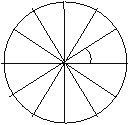
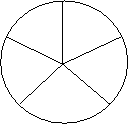


Fig 1 Fig 2
In fig 1, there ar 5 equal sectors in the circle. The angle of each sector is 72o.
In fig 2, there are 12 equal sectors in the circle. The angle of each sector is 30o.
If there are 18 sectors, the angle of each sector would be 20o.
Therefore, the greater the number of sectors, the smaller the angle of each sector.
Similarity, if a car travels a certain distance, the greater its average speed, the less time it will take.
These are both examples of inverse variation, or inverse proportion. Sometimes known as indirect variation. In the first example, the size of the angle, , varies inversely with the number of sectors, n. in the second, thetime taken, T, is inversely proportional to the average speed, S. these statement are written:
T
Example 1
If and = 72 when n = 5, find
- when n = 12
- n when = 8
First: find the relation between and n
means where k is a constant.
When = 72, n = 5
Thus, 72 =
K = 5 x 72 = 360
Thus,
When n = 12,
= 30
- If then .
When = 8,
Joint Variation
The mass of a sheet of metal is proportional to both the area and the thickness of the metal. Therefore M At (where M, A and t are the mass, area and thickness). This is an example of joint variation. The mass varies jointly with the area and thickness.
Example 1
Y varies inversely as X2 and X varies directly as Z2. Find the relationship between Y and Z, given C is a constant.
From the first sentence:
Y and X Z2
Or Y = and X = BZ2
Where A and B are constants.
Substituting BZ2 for X in Y =
Y =
Or Y = where C is a constant = ()
Thus Y varies inversely as Z4.
(Alternatively, YZ4 = C)
EVALUATION
- A rectangle has a constant area, A. its length is l and its breadth is b.
- Write a formula for l in terms of A and b
- Write a formula for b in terms of A and l.
- Does l vary inversely or directly with b?
Partial Variation
When a tailor makes a dress, the total cost depends on two things: first the cost of the cloth; secondly the amount of the time it takes to make the dress. The cost of the cloth is constant, but the time taken to make the dress can vary. A simple dress will take a short time to make; a dress with a difficult pattern will take a long time. This is an example of parital variation. The cost is partly constant and partly varies with the amount of time taken. In algebraic from, C= a + kt, where C is the cost, t is the time taken and a and k are constants.
Example 1
R is partly constant and partly varies with E. when R = 350, E = 1,600 and when R = 730, E = 3,600.
- Find the formula which connects R and E.
- Find R when E = 1300
a.From the first sentence,
R = c + KE where c and k are constants. Substituting the given values gives two equations.
530 = c + 1600k (1)
730 = c + 3600k (2)
These are simultaneous equations.
Subtract (1) from (2)
200 = 2000k
K = =
Substituting in (1),
530 = c + 1600 x
530 = c + 160
Thus, c = 370
Thus, R = 370 + E is the required formula.
b. R = 370 +
when E = 1300,
R = 370 +
= 370 + 130
= 500
EVALUATION
- The cost of a car service is partly constant and partly varies with time it takes to do the work. It cost N3, 500 for a 5 hour service and N2, 900 for a 4-hour service.
- Find the formula connecting cost, NC with time, T hours
- Hence find the cost of a 7 hour service.
- Find the formula connecting cost, NC with time, T hours
- X is partly constant and partly varies as y. when y = 2, x = 30, and when y = 6, x = 50.
- Find the relationship between x and y.
- Find x when y = 3
GENERAL EVALUATION
- If a man cycles 15km in 1 hour, how far will he cycle in two hours if he keeps up the same rate?
- A piece of string is cut into n pieces of equal length l.
- Does n vary directly or inversely with l?
- The mass of rice that each woman gets when sharing a sack varies inversely with the number of women. When there are 20 women, each gets 6kg of rice. If there are nine woman, how much does each get?
READING ASSIGNMENT
New General Mathematics SSS 1 pages 220 Exercise 18a 11 – 15
WEEKEND ASSIGNMENT
x when y = 7 and z = 3, x = 42.
- Find the relation between x, y and z A. y = xz B. x = y/z C. x = 18y/z D. y = 18xz
- Find x when y = 5 and z = 9 A. 20 B. 5 C. 2 D. 10
- Which of the following give the correct expressions for inverse variation A. x = ky B. x = k/y C. x = kyz D. x = 1/y
- If r 1/T and T = 8 when R = 4, find the relationship between R and T A. R = 32/T B. R = 32T C. R = T/32 D. 32 = R
- If D varies inversely as T use the symbol to show a connection between d and t. A. d t B. d 1/t C. d = 1/2t D. d = 1/t
THEORY
- The number of bricks, b, that a man can carry varies inversely with the mass of each brick, m kg, find the relationship between b and m. hence find the number of 3 bricks that he can carry.
- If x – 3 is directly proportional to the square of y and x = 5 when y = 2, find x when y = 6


