

JSS 3 FIRST TERM HOME ECONOMICS E-LEARNING NOTES
SCHEME OF WORK
- Origin of Fabrics
- The Importance of Studying Textile
- Manufacturing Processes
- Laundering- Types of Stains
- Sewing Machine
6 & 7. Dress Sense
- Elements of Design
- Good Hygiene and Safety
- Responsible Food Management
- Revision and Examination
- Examination
REFERENCE BOOKS
- Home Economics New Concept for Schools. Book 3 by Popoola O.O.
- Home Economics for Junior Secondary School. Book 1-3 by Anykoha
WEEK 1
TOPIC- ORIGIN OF FABRICS
- Origin of Fabrics
- Types of Fabrics
- Properties, Uses and care of Fabrics
Origin of Fabrics
Fabrics are made from either natural or artificial sources. A knowledge of the origin, manufacture and properties of the different laundering of articles made from them.
SOURCES OF FABRICS
Fibre is the basic unit from which a fabric is made. Fibres are tiny hair like structures or strands used for making fabrics are classified according to their sources. They are:
1. Natural fibres of vegetables and animal sources.
2. Man-made artificial or synthetic fibres
Fabrics are essential in our daily life. They are used for personal clothings, household items, soft furnishing, needlework and dress making
TYPES OF FABRICS
1. Natural fibres. (a) Animal fibre e.g wool, silk. (b) Vegetable fibres e.g cotton and linen
2. Man-made, artificial fibres. (a) Cellulose based e.g Rayon, acetate. (b) Non-cellulose based e.g nylon, polyesters
WOOL
This is obtained from the fleece of sheep, hair of camels and other animals. Angora goats and sheep can also be used. Wool is produced in the temperate countries like Britain, Australia, New Zealand and Argentina.
PROPERTIES OF WOOL
- It has good absorbent property
- It stretches easily
- It shrinks when wet
- It is flammable
- It is stronger when dry than when it is wet
USES
- It is suitable for cold weather and temperate countries.
- It can be used for both heavy and light clothing including nightwear, blanket and carpets.
CARE
- Use mild soaps or solutions
- Avoid rubbing when washing to prevent pulling out of shape.
SILK
Silk is an animal fibre and it is produced from the cocoon of silk worms. The look of the silk material depends on the type of finishing. Some are glossier than others. It is expensive.
PROPERTIES OF SILK
- It is easily dyed
- It is very strong
- It is weak when wet
- It hangs and drapes well
- It burns under hot iron
USES
It is used for making clothings like dresses, blouses, scarves, ties and shirts
CARE
- Wash the same as wool
- Press with cool iron when slightly damp
Evaluation
- State three properties of wool
- Classify the fabric with two examples each.
COTTON
Cotton is a vegetable fibre. It is made from cotton balls (bolls) of cotton plants. Cotton plants grow in the northern part of Nigeria and many other countries such as Egypt, China, America, India, Asia etc.
PROPERTIES OF COTTON
- It washes easily
- It is cool and comfortable to wear
- It is strong and durable
- It absorbs moisture quickly
- It can withstand hot water and as a result it can be boiled.
USES OF COTTON
It can be used for other personal clothes such as underwear, furnishing, bedsheets, pillowcases, tablecloths etc.
CARE OF COTTON
Cotton material can withstand heavy washing treatment such as boiling, squeezing and bleaching.
LINEN
It is a vegetable fibre. It is obtained from the stem of a flax plant. Flax plants are not grown in Nigeria but in France, Belgium, Russia and Northern Ireland.
PROPERTIES OF LINEN
- It is smooth and shiny.
- It is quite strong
- It absorbs moisture rapidly
- It creases and frays e5asily
- It washes well
CARE OF LINEN
- Wash it with mild soap.
- Do not starch or boil
- Press with hot iron while still damp
Evaluation questions
- State the origin of fabrics.
- State the types of fabrics
- Explain the use and care of cotton, silk and linen
MAN-MADE FABRICS
These are fabrics obtained from artificial sources e.g Rayon, glass fibre, nylon, polyester, Terylene etc.
RAYON
Rayon is made by treating wood pulp or cotton lints with certain chemicals. It can therefore be called regenerated cellulose fibre. There are other types of rayon such as cur ammonium rayon.
PROPERTIES
- Rayon is soft, weak when wet
- Washes well but is very flammable
- Rayon frays easily
USES
It can be used for outer garments, underwears, curtains and carpets.
CARE
Wash by hand using warm water, mild soap and detergent. Iron while slightly damp.
GLASS FIBRE
PROPERTIES
- It has silky brittle feel
- It drapes well
- It does not shrink or stretch.
- It is not attacked by mildew or moth
- It is flammable
- It is not absorbent.
- It dries quickly after wash and does not require ironing
NYLON
- Nylon material is very fine and strong.
- It is elastic and light in weight.
- It does not absorb moisture.
- It is weak when wet.
- It does not shrink when washed.
- It is crease resistant
- It requires very little ironing
USES
It is used for outer and under garments, vests, slips, household linens, furnishing, stockings, gloves, nets, carpets etc.
CARE
- Wash in hot water with soap or soapless detergents.
- Drip dry.
- Iron with cool iron.
POLYESTER TERYLENE
PROPERTIES
- It dries quickly.
- The fibre is soft and strong.
- It increases resistant.
- It is hard wearing and suitable for most purposes.
USES
It is used for garment and underwears, carpets, curtains and overalls.
CARE
- Wash with soap and warm water.
- Use moderately hot iron.
GENERAL EVALUATION
- What is man-made fibre?
- State three examples
- Explain the uses of cotton.
- Mention the properties of linen.
- State the properties of silk
READING ASSIGNMENTS
Reference Book- Home economics New concept Book 3 page 3-4
WEEKEND ASSIGNMENT
- ___ fabrics is made by treating wood pulps with chemicals. A. Cotton B. Wool C. Linen D. Rayon
- ___ is elastic, light and requires little or no ironing. A. Acetate B. Nylon C. Wool D. Cotton
- ___ materials can be boiled and bleached. A. Nylon B. Cotton C. Artificial fibre D. All of the above
- Which of the following are not types of fabrics? A. Animal and vegetable B. Natural and artificial C. Natural and synthetic D. Wool and iron
- Which of the following is not a source of fabric? A. Vegetable B. Animal C. Chemical D. Iron and rubber
THEORY
- List three sources of fabrics.
- Explain how you can care for polyester.
WEEK 2
TOPIC: THE IMPORTANCE OF STUDYING TEXTILE
Content:
- Reasons for Studying Textile
- Ways of producing fabrics
- Uses of fabrics
Reasons for Studying Textile
- Household linen from textile is part of the household articles that are used daily for various purposes. As a result of this we must a good knowledge of its characteristics so as to enjoy the money spent on purchasing them.
- To recognize the characteristics of the fabrics so as to know how to use and handle it.
- To know the wearing quality either it will be durable enough or not in relation to its price.
- To know the types, texture and comfort that can be derived from such fabric so as to know the particular season or time to use them
- To help us develop good buying motives and make the right choice.
- To help us know the best way of taking care of them in terms of the use, washing and ironing.
- To know the origin of each fabric and uses of different fibres.
- To select suitable fabrics for different occasions and seasons.
- To identify and develop interest in various careers in clothing and textiles.
- You can develop in clothing and textiles careers.
Ways of producing Fabrics
- Weaving- it involves interwoven two sets of yarns at right angles on a 100m. woven products are created with one of the three basic weaves such as pain weaves, satin weave or twill weave. Woven cloth can be plain or can be woven in decorative design.
- Knitting- it is a method by which thread or yarn is turned into cloth. Knitting maybe done by hand with needle or by machine
- Crocheting- it is a process of creating fabrics from yarn thread or other materials stands using a crochet hook. Hooks can be made of materials like metals, woods or plastics.
- Felting- it is a non-woven cloth that is produced by matting condensing and pressing woolen fibers.
- Knotting- it is a method of fastening or securing linear material such as rope by typing or interweaving
- Braiding- it is a process of forming pattern by intertwining three or more sands of flexible materials such as textiles fibres.
EVALUATION
- State the meaning of the following:-
- Crocheting
- Knitting
- Braiding
- Mention two reasons why we study textile.
Uses of Fabrics/Textiles Textiles are used for various purposes such as:- 1. They are used as clothes for covering our bodies such as underwears, skirts, dress etc. 2. They are used for making items for interior decoration such as tents, canopies. 3. They are used for protecting the body from rain or mud e.g. rain coats. 4. They are used for making household linen like curtains, pillow case. 5. They are used for making medical materials e.g. cotton wool, bandages etc.
GENERAL EVALUATION 1. State three properties of polyester. 2. Mention two types of fabrics. 3. State two uses of fabrics. 4. Explain the following: (a) Braiding (b) Knotting
READING ASSINGMENT Topic: Importance of Studying Textiles Reference Book: Home Economics new concepts book 3 by Popoola O.O pages 2-4
WEEKEND ASSIGNMENT 1. Knitting is to needle while crocheting is to _______ A. machine B .mat C. hook D. metal 2. Weaving is to ________ as knotting is to rope. A. mat B. crotchet C. wood D. loom 3. One of the following is a non-woven cloth that is produced by matting condensing and pressing woolen fabric A. Braiding B. Felting C. Knotting D. Knitting 4. ______ is the process of forming patterns by intertwining three or more stands of flexible materials A. Crocheting B. Braiding C. Knotting D. Weaving 5. The process of fastening materials by inter-weaving is called _____ A. knotting B. felting C. knitting D. braiding
THEORY 1. Mention two uses of textiles. 2. State two reasons for studying textile.
WEEK 3 Date: . . . . . . .
TOPIC – Textile Manufacturing Processes CONTENT: (i) Manufacturing Processes of Cotton (ii) Manufacturing Processes of Wool (iii) Manufacturing Processes of Rayon (iv) Manufacturing Processes of Nylon
Manufacturing Processes of Cotton 1. Ginning- is the process of separating or removing cotton fibre from the seeds. 2. Baling- is the process whereby the ginned cotton is pressed into bales. The bales are sent to factory or mill. 3. Carding- at this stage, many shorter fibres are removed. The longer ones are formed into thick ropes. The ropes are called silvers. 4. Combing- This is the process of removing short fibres. 5. Drawing- is the process of twisting the ropes and making them ready for spinning. 6. Spinning- is the process of making twisted fibre into yarn or thread. 7. Breaking and Scotching- These are mechanical treatment that break and remove the woody matter and impurities from the fibre. 8. Retting- This is the process of softing the flas stem by letting them in ponds or special retting tanks. 9. Scouring- The process of washing the fibre in soapy alkaline water to remove dirt’s and grease.
10. Carbonising- The process of washing or removing vegetable matter from the fibre by treatment with acid heat and pressure.
Processes in Making Fabrics (wool) Wool fibres are processed into two forms i. Worsted yarn :- This is made from long fibres ii. Woolen yarn :- This is made from short fibres
The major steps for the manufacturing of forms are
- Clipping :- The fibres (fleece) from the sheep. This is cutting the hair. The fleece is then packed in bales and transported to the factories.
- Sorting :- The process of grading and separating fibres according to length.
- Scouring :- The process of washing the fibres in soapy alkaline water to remove dirt and grease.
- Carbonizing :- The process of removing all vegetable matter from the fibres by treatment with acid, heat and pressure.
- Carding :- This process of separate matted fibres.
- Spinning :- This is the process of twisting the fibres into worsted or woolen yarns.
- Weaving :- The process of making the wool fabrics from the yarns.
EVALUATION
- State three manufacturing process of cotton.
- Mention two ways wool fibres can be processed.
Manufacturing Process of Rayon
- The cellulose (wood pulp or cotton writers is first purified).
- The cellulose is then treated with the right chemicals. It is then changed into a thick liquid.
- The liquid is then forced through a nozzle containing many fine holes called a spinneret. The rayon fibres are produced.
- The fibres are spin into yarns and then woven into fabrics.
Manufacturing of Nylon Nylon is made through a complex series of chemical processes, using coal or petroleum, water and air. It can be made into continuous filament or short lengths. GENERAL EVALUATION 1. State the origin of fabric 2. State three uses of fabric. 3. Mention two important reasons for studying textiles.
4. State the manufacturing process of rayon.
READING ASSIGNMENT Laundering of Fabrics: Home Economics new concepts book 3 by Popoola O.O. Pgs 18-26.
WEEKEND ASSIGNMENT
- The process of separating cotton fibres from the seeds is called _____ A. Bailing B. Cleaning C. Gining D. Carding
- The process of twisting the ready-made fibre into yarns is called _____ A. Carding B. Drawing C. Spinning D. Weaving
- Washing the fibres in alkaline soapy water to remove dirt and natural oil and grease called ____ A. Clipping B. Scouring C. Carding D. Spinneret
- Removal of vegetable matter from the fibres with acid heat and pressure is called ___ A. Scouring B. Carbonizing C. Clipping D. Carding
- A nozzle of many holes through which liquid is forced is called ___ A. Spinneret B. Carding C. Retting D. Spinning
THEORY
- Briefly explain the manufacturing of nylon.
- List and explain two form of wool procession.
WEEK 4
TOPIC: LAUNDERING OF FABRICS
CONTENT:
- Factors to be Considered in Laundering a Fabric
- Reason for the Care of Clothing
- Laundry Agent and Equipment
- Types of Stain.
Factors to be Considered in Laundering a Fabric.
In washing and finishing clothes, we must consider the following factors.
- The properties of different fabrics.
- Fabrics finishes must be known.
- The correct laundry agent to be used for each fabrics.
- The laundry procedure to be used based on the properties of the fabrics.
- The weather condition should be considered.
Reasons for Caring for our Clothes
- To improve the appearance of the wearer and the clothes.
- It makes the clothes last longer.
- It helps to maintain good health.
- It keeps to the clothes fresh and durable.
- To make it smart and well tidy.
- To make them look new.
- To make them readily available for use any time.
Laundering Agent
There are the materials that help/aid in keeping our clothes clean.
Examples of Laundry Agents
- Soaps
- Synthetic detergents
- Bleaches
- Stiffening agents
- Laundry blue
- Water
- Disinfectants.
Laundering Equipment
These are tools that are used during laundering process. They can be classified according to their uses.
- Equipment and tools for clothing dirty clothes:- These include linen basket or bins, laundry bags.
- Equipment and tools for washing:- These include basins, buckets and laundry tubs.
- Equipment and tools for drying:- These include clothes linen, pegs, moveable clothes houses or hangers etc.
- Ironing or pressing equipment:- These include the iron, ironing board, ironing pad etc.
EVALUATION
- State two factors to be considered in laundering a fabric.
- Mention three reasons for caring for clothes
- Mention four agents of laundry.
TYPES OF STAINS
There are different types of stains. They are
- Vegetable stains- These are stains from juices, grass, tea, coffee, cocoa and beer.
- Protein stains- These are stains from blood, eggs and milk etc.
- Grease stain:- These are from hair oil, fats, lipsticks etc.
- Paint stains:- From paints, nail varnish etc.
- Other stains from ink, sweat or perspiration.
HOW TO REMOVE STAINS
One of the important aspects of laundering fabrics is stain removal. Any article to be washed must be examined for any possible stain before washing. Different types of stains can be removed through different method and by using stain removal agents.
Before removing any stain the following must be borne in mind.
- What kind of stain do I want to remove?
- Which is the most suitable agent for removing different stains?
The following are possible ways of removing different types of stains.
VEGETABLE STAIN
(a) Sprinkle salt over the damp stain to stop it from spreading. Pour boiling water on it in a basin wash and rinse.
(b) Soak the material in warm water with borax solution (1 teaspoon 1 litre of water)
GREASE STAIN
(a) scrape the grease and soak in a very hot. If the fabric can withstand heat.
(b) Add synthetic detergent to emulsify the grease.
PAINT STAINS
Oil paints can be removed by placing the material over blotting paper and dabbing it with paraffin on a rag, wash with detergent. In removing cellulose and nail varnish stains sponge the material with acetone, wash and rinse.
INK STAIN
writing ink- spread lemon juice and salt on the stain, wash and rinse.
Red ink- soak in ammonia or borax, wash and rinse.
WASHING AND IRONING FABRICS
cotton and linen materials can be washed easily in water because they are not easily harmed by common cleaning agents and they can withstand the friction of rubbing to remove dirt. Household cotton and linen materials which are colour fast and white can be soaked in cold water with detergent to loosen the dirts.
Silk requires very great Care in its handling to make it last long.
Woolen fabric requires more careful washing than silk, cotton and linen.
Synthetic fibres are affected by chemicals. Therefore, chemicals that will react on the fabric should not be used to remove stains.
IRONING
There are usually ironing labels stuck to dresses to indicate how to iron them. For cotton, linen and rayon you iron with hot iron that is with temperature of 210°C. The sum by for hot iron is.
For cool and polyester mixtures you with arm iron at a temperature of 160°C. The symbol for warm iron is
For acrylic acetate you iron with cool iron at a temperature of 120°C. The symbol for cool iron is
COOL IRON
while
DO NOT IRON
GENERAL EVALUATION
- State the types of stain.
- Give an example of types of stains stated in question (1) above.
- State the symbol for hot and ironing not necessary.
- Mention four agents of laundry.
- State three reasons for caring for clothes.
READING ASSIGNMENT
Topic- sewing machine
Reference Book- Home economics new concepts book 3 by Popoola O.O. pgs 43-51
WEEKEND ASSIGNMENT
- Egg stain is an example of___ stain. A. Vegetable B. Protein C. Chicken D. Animal
- ___ is an example of vegetable stain. A. Coffee B. Nail varnish C. Eggs D. Blood
- ___ is an example of grease stain. A. Hair oil B. Eggs C. Tea D. Blood
- Stands for ____ A. Hot iron B. Warm iron C. Cool iron D. Ironing not necessary
- This structure stands for___ A. Hot B. Warm C. Cool D. Very hot.
THEORY
- State the types of stains and give and example of each.
- What are the symbols for hot iron and ironing not necessary?
WEEK 5
TOPIC: Sewing Machine
(The sewing machine, types, parts and cave)
CONTENT
Sewing Machine
There are different types of sewing machines. Sewing machine is one of the equipment used in garment construction.
Types of Sewing Machines
- Hand sewing machine
- Treadle sewing machine
- Electric sewing machine
Hand sewing machine
This is the oldest and the slowest type of sewing machine. It is operated with one hand while the other hand holds and direct the fabric being sewn.
Treadle sewing machine
This machine is faster to use than the hand sewing machine. The treadle is being turned by one or both legs while the cloth is being controlled with both hands.
Electro sewing machine
This is the fastest sewing machine. It has a motor and a chard for power connection.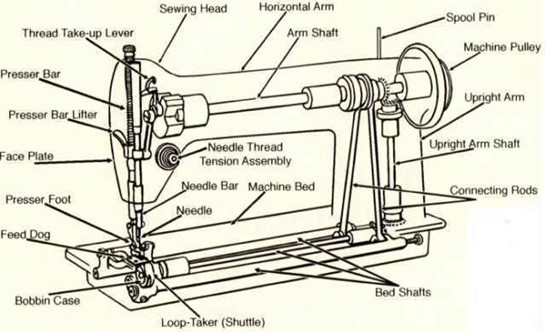
Parts of sewing machine
S/N | PARTS | FUNCTIONS |
1 | Balance wheel | It is rotated by means of handle, treadle or electric motor. When this is done the machine starts working |
2 | Presser foot | This holds the material while sewing. |
3 | Presser foot lifter | This lifts up and lowers down the presser foot. |
4 | Feed dog | It helps to push the material forward or backward while sewing |
5 | Needle bar | This is a long bar in which needle is fixed. |
6 | Needle clamp | Used for tightening the needle to the needle bar. |
7 | Bobbin | A mental spool on which the lower tread is wound. |
8 | Bobbin winder | Used for wounding the tread on the bobbin |
9 | Bobbin case | A case that holds the bobbin and the tread. |
10 | Slide plate | This is a movable flat plate that covers the bobbin and the bobbin case. |
11 | Tension screw | This is used for loosening or tightening the tread on the needle. |
12 | Stitch length regulator | This controls the length of the stitches. |
13 | Drive wheel | It rotates the balance wheel by means of a belt |
EVALUATION
- States types of sewing machine.
- State five different dresses for different occasions.
CARE AND MAINTENANCE OF SEWING MACHINE.
It is very necessary to take care of our sewing machines.
Below are some points to follow on the care of sewing machine.
- Anyways keep the machine covered when not in use.
- Tighten up any loose screw before operating the machine.
- Ok the machine regularly.
- Place a pad of cloth between the slide plate and the pressor foot. This is to protect the needle when the machine is not in use.
- Do not operate sewing machine without correctly placing the fabric.
- Use the correct size of needle and thickness of thread.
- After using a treadle sewing machine disconnect the belt.
TOPIC- GENERAL USE OF A SEWING MACHINE AND MACHINE FAULTS
General rules in the use of sewing machine include
- Place the machine in a convenient place.
- Thread the machine correctly.
- Place the bobbin and the bobbin case correctly.
- Test the stitch on a piece of material before sewing.
- Correct the length of stitch if necessary.
- Place the bulk of the clothes on the left hand side where there is space for it.
- Keep all pins away from fabric when sewing.
- Do not hurry the machine to pull the material as it passes under the presser foot.
- Make sure you raise the presser foot and needle to their highest position when sewing is complete pull the material gently to avoid breaking or bending the needle.
EVALUATION
- State and explain for rules in the use of sewing machines.
- State five parts of sewing machines.
- State three types of sewing machines.
COMMON CAUSES OF SEWING MACHINE FAULTS.
- Fault breaking of needle causes;
- Sewing over pins left on the fabric.
- Pulling the fabric when sewing without raising the needle.
- Using won’t needle size for fabric e.g small or fine needle on heavy seams.
Fault:
Breaking of Thread
Causes:
- Improper threading of machine.
- Tension to tight.
- Needle set incorrectly.
- Balance wheel backwards while sewing.
- Poor quality thread.
Fault:
Shipping of stitches.
Causes:
- Needle not accurately set.
- Needle may be bent or blunt.
GENERAL EVALUATION
- State two machine fault.
- Explain two caused of the started faults in sewing.
- State four instructions on the care of sewing machine.
READING ASSIGNMENT
Dresses for different occasions.
Reference book- WAP Junior Secondary Home Economics Bk 3, pages 45-49.
WEEKEND ASSIGNMENT
- ____ is the uses for loosening the thread on the needle A. Tension screw B. Drive wheel C. Slide plate D. Feed dog
- ___ tire is sewing machine is the slowest. A. Treadle B. Electric C. Hand D. Embroidery
- ___ is the long bar in which the needle is fixed. A. Needle bar B. Needle clamp C. Bobbin case D. Bobbin
- — type of sewing machine is the fastest. A. Electric B. Treadle C. Hand D. Commercial
- ___ is a case that holds the bobbin and the thread. A. Bobbin winder B. Bobbin case C. Bobbin D. Balance wheel
THEORY
- State three general rules in the use of sewing machine.
- State two uses of cloth.
WEEK 6 & 7
TOPIC- DRESS SENSE
- Understanding the use of clothing
- Dresses for different occasions
- Figure types and pattern
DRESS SENSE
the dress you wear tells people alot about the type of person you are. It also gives you self confidence. It is therefore important that you wear the right dress at the right time.
USES OF CLOTHINGS
Clothing is anything you put on the body in order to protect, beautify or adorn it. Clothing include dresses, accessories, hairdo, make-ups, handbags, shoes etc. Clothes are the dresses or garments you put on such as gowns, skirts, blouses, trousers, shirts. Accessories are the additionally things we wear to supplement our clothing. These include; shoes, mats, gloves, stockings, jewelry, cufflinks, ties, pins, handkerchiefs, scarves. Styles are the characteristic distinctive outlines or shapes of dresses. A style is popular or in vogue at a given time if is popular at the very time.
USES OF CLOTHING
- For protection from heat cold insect bites, bad weather etc.
- To beautify or adorn the body or improve.
- It shows our status of position in the society e.g Obas, Emirs, Obis, Ozos, Queens, Kings.
- It shows the role or work we do in the society e.g Police, nurse, soldier etc
- It shows or cultures or where we come from e.g Igbos, Yorubas, Hausas.
- Shows our mood e.g mourning dresses.
- It shows modesty and covers the naked body.
ELEMENTS OF DESIGN
This has to do with the various colour combinations considering the various classes of colour; primary colours, secondary colours and tertiary colour.
LINES
Line is another element of design that is very important in choosing the right style of clothes for your figure.
There are different types of effects on the figure
(a) Vertical line- these add height. They make a short stout person appear slimmer and taller.
(b) Horizontal line- these add to the appearance of width and reduce height.
(c) Diagonal line- These should appear from left to right when looking at a garment. Take the eye downward in a slimming line.
(d) Curve line- These create soft lines that are usually flattering.
DRESSES FIRE DIFFERENT OCCASIONS
(a) SCHOOL CLOTHES
- Fabrics for all school clothes should be durable, washable, colourful and comfortable
- The style skills be loose enough to allow for school activities without straining the seams.
- Shoes should be durable, comfortable and easy to clean.
(b) CLOTHES FOR WORK
The type of work determines the type of clothes needed.
Important points about clothes for work
- The fabric should be clean and washable
- The fabric should be comfortable smart and simple.
- Overdressing should be avoided.
- Only simple accessories are needed.
- Clothes should not be too tight or revealing.
(c) CLOTHES FOR HOUSEWORK/ACTIVITIES
Clothing for housework activities should be comfortable suitable washable of a simple style and durable fabric. An apron or an overall can be worn over dress to protect it.
(d) CLOTHES FOR SLEEPING (Nightgown or Pajamas)
- Fabrics should be soft textured and flame resistant.
- Clothes should be comfortable and loose
- A house coat can be worn over the Nightgown outside the bedroom.
(e) CLOTHES FOR SPORTS, PICNICS AND RELAXATION
The Clothing to choose will depend on the type of sports.
(f) CLOTHES FOR RELIGIOUS WORSHIP
- It should be decent.
- Overdressing should be avoided.
- Noisy shoes and bangles that are conspicuously coloured, fabric and outsized hair-gear and heavy make up should be avoided.
(g) CLOTHES FOR TRAVELING
- The clothes shelf be comfortable and not tight.
- They should be washable.
- Fabric should not crease easily.
EVALUATION
- Define dress sense.
- List the various dresses for different occasions.
- State any four (4) uses of clothing
- State three guidelines for choosing pattern in clothing
- State any three (3) points to consider when choosing colour in clothes .
FIGURE TYPES OF PATTERNS
we have the following figure types
Short and plump,short and slender,tall and slender,tall and plump/full figured
STYLES OF CLOTHES FOR DIFFERENT FIGURE TYPES
There are certain designs and patterns which are very suitable for different body figure types.
Short and plump should wear the following:
- Loose fitting clothes
- Plain skirts
- V-neck or rectangular neck clothes
- Dresses with vertical shapes
Short and plump should avoid the following
- Large flowery design or print
- Short jackets or waist coats
- Wide and short skirt
- High heeled shoes
- Plain dark trousers
Tall and slender should wear the following
- Fabrics that have large flowery prints or design
- Dresses with horizontal stripes
- Pleated or gathered skirt
- Light coloured or check trousers
Tall and slender should avoid the following
- Dresses with vertical stripes
- Dark colours
- Shows with very high heels
Full figured/tall and plump should wear the following:
- Dressed with vertical lines or stripes
- Narrow sleeves
- Coats hat are fitting
- Trousers which are dark or black
Full figured/tall and plump should avoid the following
- Pocket on the hips
- Wide sleeves
- Pleated or gathered skirt
- Narrow trousers
COLOUR COMBINATIONS AND THEIR EFFECTS WE WEAR
One of the things that bring out our appearance is the colour of the garments we wear
- Black can be used with all colours except with very dark brown colour .
- White goes with very colour
- Grey is a natural and Is good with red,yellow,blue,green,orange and purple
It is important to note that we have primary colours which are: red, yellow and blue secondary/intermediate colours which are orange,green and purple
Mixed colours are dark-green,reddish-brown etc.
In the choice of our clothes,we should consider our complexion e.g.very dark people should choose very light colours .
EVALUATION
- Define figure types
- State the figure types
- What should a short and plump girl wear ?
READING ASSIGNMENT
Topic: Element of design
Reference Book:Home Economics New Concept by Popoola O.O book 3 page 27-32
WEEKEND ASSIGNMENT
1.________ refers to the personal shape and appearance of an individual
(a) fitting (b)figure types (c) personal size (d) short and slender
2. We have_______figure types
(a) four (b) five (c) seven (d) eight
3._______should wear vertical stripes,V-neck clothes
(a) tall and slender (b) short and plum (c) none of the above (d) all of the above
4. Short and plump should wear heavily pleated gown or skirts
(a) true (b) false (c) not too sure (d)none of the above
5.________ is a natural colour
(a) red (b) black (c) purple (d) none of the above .
THEORY
- Define figure types
- State the figure types
WEEK EIGHT
TOPIC : ELEMENTS OF DESIGN
CONTYENT: Colours and Colour wheel
Colour schemes
Principle of Designs
The basic Elements of Design
- Line: This refers to the outline on the object. These are different typrs of lines and each has different type of effect on the figure. The linen includes:
- Vertical line- add height. They make a shorter and stout person appear slimmer and taller.
- Vertical line- add height. They make a shorter and stout person appear slimmer and taller.
- Horinzontal lines- these add to thr appearance of width and reduce height.
- Diagonal line- these dhould appear from left to right ehen looking at a garment. They taje the eyes downward in slimming line
- Curve lines- these create soft that are usually flattering
- Shape: This refers to the form of a solid object which is created when lines are combined.
- Space: This refers to the three dimensional rea that is to be designed. It is the entire area within a garment.
- Texture: this is the way the surface of a fabric looks and feel.
- Colour: This is one of the most important elements. It has many visual effects and its own langusge.
Colours
Special terms are used to describe colours such as:
Hue- specific colour name e.g red and green.
Value- is use described the lightness or darkness of a colour.
Shade- is a darker value obtained by adding black to a colour.
Intensity– is the brightness of dullness of a colour.
Colour wheel
This is an arrangement of colours in a circle to show how they are related
- Primary colours: red, yellow and blue. They are mixed to get other colour.
- Secondary Colours: They are gotten from mixture of equal parts of primary colour. E.g orange, green and violet or purple.
- Tertiary/intermediate colours: These are six in number. They are gotten from the mixture of primary and secondary colours
- Warm colours: These are yellow and orange
- Cool colours: These are blue, green, purple etc.#
Colour schemes
It is the act of combining two ir more colours to produce a pleasing colour harmony/scheme for an outfit. These includes:
- Monochronic colour scheme: Uses different shades of the same colour or one colur wiyh black and white.
- Contrasting Colour scheme: This uses two or more different colours with varying.
- Toning Colour Scheme: This uses two or more similar colour e.g Purple and blue.
EVALUATION
- Explain the following terms (a) Shape (b) Texture
- Define colour wheel.
Points to remember when choosing colours
- Cool and dark colkour make one look smaller than normal.
- Warm and bright colours makes one looks longer than normal
- Bright contrasting colours draws attention to the figure
- Black and white goes with every with every colour provided not on very dark brown is used sparingly
- Grey is a natural colour it harmonizes colours like red,yellow,blue,green,orange and purple
Principles of Design
It is the guidelines that enable us to combine effectively in clothing .These principles focus on proportion, balance, rhythm and emphasis. Proportion and emphasis are associated with clothing while rhythm and balance are related to interior decoration
- Emphasis:it draws attention to the point of greatest interest for instance a contrasting collar could use colour to draw attention to the wearer’s face
- Proportion: This is the way one part of a design relates in size ,shape or space to another part and to the whole design .clothing should also be in proportion to a person’s size .
GENEVRAL EVALUATION
- List three points to remember when choosing colour
- Explain the following terms
- Hue
- Shade
- What are principles of design?
- Define colour scheme
READING ASSIGNMENT
Topic: Food Hygiene and Safety
Reference Book: Home Economics New Concept by Popoola O.O. book 3 page 106-165
WEEKEND ASSIGNMENT
- The colour scheme that uses different shades of the same colour is called _______A. tone B. shade C. monochrome D. Contrasting
- The colour scheme that uses two or similar colour is ________ A. toning B. Shadding C. contrasting D.Monochrome
- The Additional things we wear to supplement our dressing is called ________ A. Dresses B.Garments C. Accessories D. Scarves
- Fat people should avoid wearing ________ A. vertical lines B. cool coloursC. horizontal lines D. dark colours
- Which of the following is not a cool colour_______ A. blue B. green C. blue-green D. yellow
THEORY
- What is colourwheel ?
- Explain the following and give examples
- Primary colours
- Secondary colours
- Tertiary colours


