


Waves II Questions
1. (a) (i) Distinguish between stationary and progressive waves
(ii) State a reason why a closed tube or pipe produces less quality sound than an open one
(b) The figure below shows a piston inside a glass tube
Air inside is made to vibrate producing a fundamental note. Find the fundamental frequency
to be produced
(c) If the glass tube is made open by removing the piston and opening the other end, what is
the new fundamental frequency?
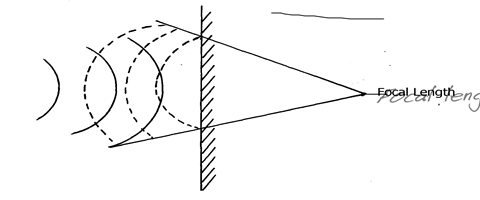
 2. The figure below shows circular waves approaching a straight reflector. Complete the sketch
to show what happens when the waves hit the reflector.
3. (a) State one difference between the way sound waves and electromagnetic waves are
transmitted.
(I) A mine worker stands between two vertical cliffs 400 m from the nearest cliff.
The cliffs are X distance apart. Every time he strikes the rock once he hears two echoes,
the first one comes after 2.5 sec. while the 2nd follows 2sec. later. From this information;
Calculate;
(i) Speed of sound in air.
(ii) The value of X.
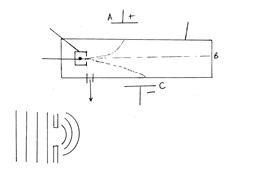
(b) The figure below shows waves starting from two coherent sources S1 and S2.
What would be observed at P if the waves are
(i) light waves. (ii) Sound waves.
(c) State the conditions for diffraction of light to occur.1 mk
4. The diagram below represents plane wave fronts produced in a ripple tank.
|
|
Given that the distance AB is 15 cm, determine the wavelength of the wave
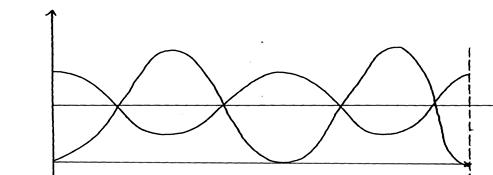
5. (a) The figure below shows a wave profile with velocity 340m/s
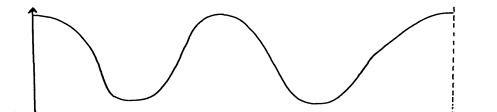

Determine: (i) The frequency of the wave (ii) The period of the wave (b) On the same diagram in (b) above sketch a wave profile of another wave with same
frequency, greater amplitude but 180o out of phase with the one in (b)
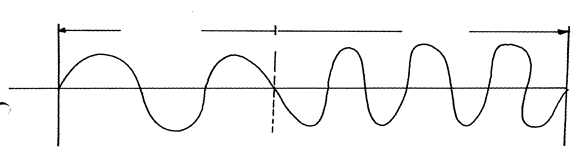
6. Figure 3 shows the displacement of a particle in a progressive wire incident on a boundary between deep and shallow region
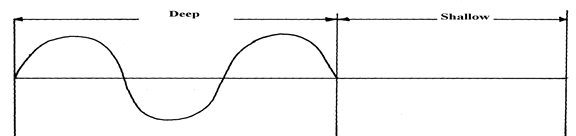
Complete the diagram to show what is observed after bounding. (Assume no loss of energy)
7. (a) Explain the difference between progressive waves and stationary waves
(b) State any two conditions necessary for the establishment of a stationary wave
(c) (i) The figure below shows two loudspeakers L1
and L2 connected to a signal generator
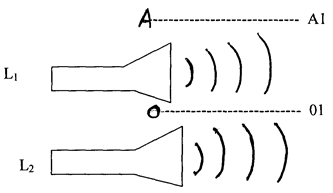
An observer walks along the line 0-01 (equidistant from L1 and L2) and another along the
Line AA1.Explain the observation made by each and give reasons to your answer
(d) If a wave is propagated at a velocity of 50m/s; determine its frequency if the distance
travelled by the wavelength in 2 cycles is 1.25m
(e) State one condition necessary for interference to occur
8. Give conditions necessary for diffraction of waves to occur
9. Distinguish between diffraction and refraction of waves
 10.
10.




Determine the frequency of the wave
11. The figure below shows a wave profile.
Determine the frequency of the wave.

12. The following shows a diagram of displacement against time cure of a standing wave
reflected its own pith
Determine the period of the wave (3mks)
13. A student touches the surface of water in a big pan at point A at regular intervals and observes
the ripples as in the diagram below. Explain the pattern of the ripples observed.
14. In the figure below shows a series of plane wires approaching a gap. Complete the diagram
to show the wire after passing through the gap if
15. (a) (i) State the difference between mechanical and electromagnetic waves
(ii) Give one example of each of the above waves
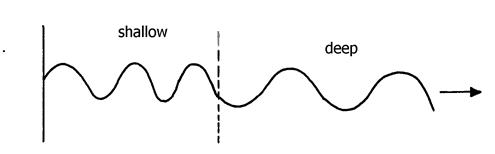
(b) The figure below shows water waves crossing a boundary between deep and shallow water
Complete the diagram to show the wave in the deep region
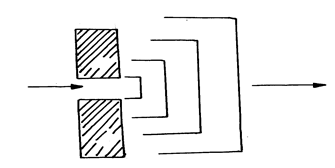
(c) (i) Complete the diagram below to show the shape of the wave fronts after passing
through the deep gap
(ii) What is the relationship between periodic time and frequency of a progressive wave?
(iii) Explain why radio waves reception is better than T.V reception in mountainous regions
16. a) i) Distinguish between stationery waves and progressive waves. In terms of their propagation.
ii) State a reason why a closed pipe produces less quality sound than an open pipe.
b) The Fig. 10 represents an oscillation taking place at a particular point while a sound wave
in a gas passes the point. The vertical axis is labeled displacement.
Fig. 10
i) Explain what is meant by displacement in this context.
ii) From the figure determine: I. The period. II. The frequency
c) Calculate the wavelength of the sound wave in the figure. Take the velocity of sound
in the gas to be 34m/s d) State two factors that can. increase the speed of sound in. solids
Waves II Answers
1. (a)(i) – Stationary wave:- waveform do not move through the medium and therefore energy is
transferred from the source to the same point away.
- Progressive wave- wave forms more though the medium and therefore energy is transferred form the source t the same point away.
(ii) Open pipe has both odd and even harmonics.
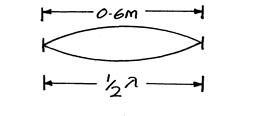
(b) (i) For closed pipe
½ = 0.6
- = 1.2m
- V= fo, fo = V = (340)Hz = 283.3Hz
1.2
(ii) For open pipe, one end open
End correction ignored,
- If ¼ = 0.6
= 0.6 x 4 = 2.4m
fo = V = (340)Hz
2.4
= 141.7Hz
 .
.
2.
3. a) i) Sound is transmitted as a longitudinal wave electromagnetic is transmitted as a transverse
wave. 1 mk
(ii) S = 2d
1 mk
t
= 2 x 400 = 800
1 mk
2.5 2.5
= 320m/s 1 mk
iii) Let distance from mine worker be furthest cliff by y. then
S = 2d
t y = 1440
320 = 2y
1 mk 2
2 x 2.5 = 720 m 2
2y = 320 x 4.5 total distance = 720 + 400
2y = 1440 x = 1120m 1 mk
b) i) Bright fringe. 1 mk
ii) Loud sound. 1 mk
c) slat must be very narrow (less than the wavelength of light)
4. 6λ = 15 cm
1 λ = 1 x 15
1 mk
6
= 2.5 cm. 1 mk
5. (a) i) = 8/2 = 4m
f = V/X
= 340/4
= 80HZ
ii) T = I/F
= 1/80
= 0.0125 seconds √
 b)
b)
6.
 7. (a) In aprogressive wave, all particles have the same amplitude and each particle is out of
phase with the particle next to it. In stationary wave, vibrations of particles at pooints
between successive nodes are in phase and the ampllitude of particles between nodes is
different
(b) Must have:- (i) Same speed
(ii) Same frequency
(iii) Same of nearly equal amplitudes


 (c) OO1 – Loud sound (constructive interference) waves arrive in phase
 AA1 – Loud and soft sound (Destructive and constructive interference)

(d) f = V
= 1.25 = 0.625
 2
2
f = 50
 0.625
0.625
= 80HZ
 (e) – Constant phase difference
– Nearly same amplitude
 8. The width of the opening must be smaller than the wavelength of the wave.
 9. – Diffraction- is the spreading waves beyond obstacle openings (1mk)
– Refraction- is the bending of waves when they change the medium
10. Period T = 16 x 10-2 (read off)
 Frequency = 1/T
 = 1/16x10-2 Hz
= 6.25Hz
11. ½ oscillations = 0.2 seconds
0.2 seconds = 0.5 oscillations
1 second = 0.5 = 1
0.2 0.4
= ¼ x 10 = 0.25 x 10
= 2.5Hz
12. Time for one complete cycle = 0.5seconds
 T = 0.5seconds
 f = 1
f = 1
T
= 1
 0.5
0.5
= 2Hz
13. From A to X is shallow since the ripples are close to one another.
 14.
14.
15. (a) (i) Electromagnetic waves travel though a vacuum while mechanical waves
need a medium
(ii) Mechanical waves – sound waves
– water waves
– shock
– electromagnetic waves – light waves
– radio waves
-X-rays, gamma rays (any 1)
(b)
(c) (i)
(ii) f = 1 /T where
f = focal length and T is the periodic time
(iii) Radio reception is better because radio waves have longer wavelength hence easily diffracted
unlike TV waves which have shorter wavelength


