


535/1 PHYSICS PAPER 1 Nov./Dec. 20022¼ hours | UGANDA NATIONAL EXAMINATION BOARD Uganda Certificate of Education PHYSICS Paper 1 Time: 2¼ hours |
2002 PAPER-1 SECTION-A
(02.A.Q.1) Two forces of 3N and 4N act at point at right angles to
Each other. The magnitude of their resultant force is
(a) 25N (b) 7N (c) 5N (d) 1N
(02.A.Q.2) Which one of the above sketches represents uniformly accelerated motion?
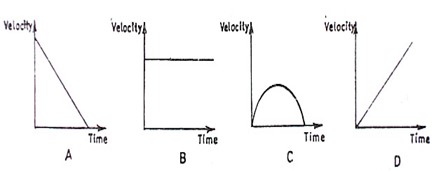
(02.A.Q.3) State the radiations that may be emitted by a radioactive substance
(a) Alpha, gamma and x-rays (b) Cathode rays, x-rays and beta (c) gamma, alpha and Beta (d) Cathode rays, x-rays and alpha
(02.A.Q.4) A 240 V mains transformer has 1000 turns in the primary. The number in the secondary if it is used to supply a 12V, 24W lamp is
(a) 2.0×10⁴ (b) 500 (c) 50 (d) 20
(02.A.Q.5) The figure shows a coil connected to a center zero galvanometer, G. The poles produced at the ends X and Y of the coil when the north pole of the magnet approaches it, is
(a) X-north pole Y-south pole (b) X-south pole Y-north pole (c) X-north pole Y-north pole (d) X-south pole Y-south pole

(02.A.Q.6) Three cells each of e.m.f 2V and negligible internal resistance are connected to two resistors as shown in the circuit in the figure. The reading of the ammeter is
(a) 0.40 A (b) 0.83 A (c) 1.20 A (d) 7.20 A

(02.A.Q.7) Which one of the sketches represents the wave form observed in a C.R.O connected across an a.c supply when the time-base of the C.R.O is
(02.A.Q.8) The focal length of a concave mirror is the
(a) Distance between the pole of the mirror and the focal point
(b) Distance between the center of curvature and the mirror
(c) Distance between the object and the image
(d) Diameter of the mirror
(02.A.Q.9) The mass of a cuboid of dimensions 4m x 2m x 3m is 48kg. The minimum pressure it can exert is
(a) 20 Nm-2 (b) 40 Nm-2 (c) 60 Nm-2 (d) 80 Nm-2
(02.A.Q.10) Which of the following are properties of X-rays? They
(i) carry no charge
(ii) are longitudinal waves
- are not deflected by the magnetic and electric fields
- (iv) travel in straight lines.
(a) (i), (ii) and (iv) only (b) (i), (ii) and (iii) only
(c) (ii), (iii) and (iv) only (d) (i), (iii) and (iv) only.
(02.A.Q.11)

A uniform wooden beam of weight W is pivoted at a distance 1/5 of its length from the end A and kept in equilibrium by applying forces of 4N and 5N in the figure. The force exerted by the pivot on the beam is
(a) 16 (b) 15 (c) 10 (d) 8
(02.A.Q.12) The volume of a fixed mass of gas at 27.00C and a pressure of 750 mm of mercury is 300 cm3. What is its volume when the pressure is raised to 900 mm mercury and the temperature is 3270C?
(a) 125 cm3 (b) 180 cm3 (c) 500 cm3 (d) 720 cm3
(02.A.Q.13) What is the cost of running five 200 W lamps for 8 hours if electrical energy costs Sh.140 per unit?
(a) Sh.1120 (b) Sh.700 (c) Sh.224 (d) Sh.28
(02.A.Q.14) A stick with one end immersed in a liquid appears bent at the liquid surface due to
(a) Diffusion (b) Reflection (c) Interference (d) Refraction
(02.A.Q.15) The negative plate of a simple cell gradually goes into solution because of
(a) Polarization (b) Local action (c) Charging (d) Gassing
(02.A.Q.16) The maximum efficiency that can be obtained with four pulleys and a mechanical advantage of 3 is?
(a) 100% (b) 75% (c) 12% (d) 1.33%
(02.A.Q.17) The number of complete oscillations made per second is referred to as
(a) Periodic time (b) Amplitude (c) Wavelength (d) Frequency
(02.A.Q.18) The device which disconnects the mains when there is a sudden increase in voltage is
(a) Fuse (b) Switch (c) Earth wire (d) Circuit breaker
(02.A.Q.19) The phenomenon by which electrons are released from a metal surface when radiation falls on it is known as
(a) Radioactivity (b) Photoelectric effect
(c) Thermionic emission (d) Reflection
(02.A.Q.20) A magnetic material can be magnetized by
(i) Stroking with a permanent magnet
(ii) Using a direct current
(iii) By induction
(a) (i) only (b) (i) and (ii) only
(c) (ii) and (iii) only (d) (i), (ii) and (iii)
(02.A.Q.21) The brightness of the spot of the C.R.O. screen is controlled by
(a) X-plates (b) Anode
(c) Grid (d) Cathode
(02.A.Q.22) Points on a stationary wave which are permanently at rest are called
(a) Crests (b) Troughs
(c) Nodes (d) Anti-nodes
(02.A.Q.23) The half-life of a radioactive substance is 10s. How long will it take for a mass of 16g of that substance to reduce to 2g?
(a) 40s (b) 30s
(c) 20s (d) 10s
(02.A.Q.24) Water flows over a large waterfall of height 15m at a rate of 200 kg s-1 and runs a generator of efficiency 80%. The power of the generator in watts is
(a) 2.5×10⁴ (b) 8.0×10⁴
(c) 2.5×10⁵ (d) 8.0×10⁵
(02.A.Q.25) The velocity of sound in air at a constant pressure, A
(a) Increases with loudness
(b) Decreases with loudness
(c) Increases with temperature
(d) Decreases with temperature
(02.A.Q.26) The amount of heat required to raise the temperature of 0.5 kg of iron from 250C to 500C is (specific heat capacity of iron is 460 joules kg-1 K-1)
(a) 0.5 x 460 / 25 (b) 460 x 25 / 0.5 (c) 0.5 x 25 x 460 (d) 0.5 x 25 / 460
(02.A.Q.27) When a pinhole camera is moved nearer an object, the size of the image
(a) Remains the same (b) Becomes smaller (c) Becomes larger (d) Becomes diminished
(02.A.Q.28) Length, mass and current are
(a) Units of measurement (b) Derived quantities
(c) Fundamental quantities (d) Measured in metres, Newtons and amperes respectively
(02.A.Q.29) Convert 25 cm3 into m3
(a) 2.5 x 10⁵ (b) 2.5 x 10² (c) 2.5 x 10⁻¹ (d) 2.5 x 10⁻⁵
(02.A.Q.30) Which one of the following diagrams represents the correct electric field pattern for two oppositely charged points?

(02.A.Q.31) Which one of the following statements is true about energy transformation?
(a) A steam engine changes heat energy to mechanical energy
(b) A thermopile changes electrical energy to heat energy
(c) A dynamo changes electrical energy to mechanical energy
(d) A microphone changes electrical energy to sound energy
(02.A.Q.32) When transmitting electrical power over long distances, the voltage is stepped up in order to
(a) Transmit it (b) Reduce power loss
(c) Increase current for transmission (d) Prevent electric shocks
(02.A.Q.33) Which one of the following radiations undergoes the largest diffraction when passed through a narrow aperture?
(a) Radio waves (b) Gamma rays (c) Yellow light (d) Infra-red light
(02.A.Q.34) Two solid cubes have the same mass but their edges are in the ratio 4:1. What is the ratio of their densities?
(a) 1:4 (b) 1:8 (c) 1:16 (d) 1:64
(02.A.Q.35) The sensitivity of a moving coil galvanometer can be increased by using
(a) Smaller coil (b) Weaker magnet (c) Weaker hairspring (d) Fewer turns of wire on the coil
(02.A.Q.36) An electric heater is connected to a 200 V supply. The heating element has a resistance of 10 Ω. The cost of using the heater for 4 hours if each unit of energy costs Sh.35 is
(a) Sh.5600 (b) Sh.1400 (c) Sh.560 (d) Sh.140
(02.A.Q.37) The resistance of a metal in the form of a wire increases with
(a) Decrease in length (b) Increase in temperature (c) Decrease in temperature (d) Increase in cross-sectional area
(02.A.Q.38) The length of the mercury column of a thermometer at ice point and steam point are 2.0 cm and 22.0 cm respectively. The reading of the thermometer when the mercury column is 9.0 cm long is
- 45.00C (b) 40.90C (c) 35.00C (d) 31.80C
(02.A.Q.39) In a hydraulic machine
(a) An object displaces its own weight of fluid
(b) The pressure transmitted in the fluid is the same in all directions
(c) The volume of fluid compressed is proportional to the applied force
(d) An object experiences an upthrust equal to the weight of fluid displaced
(02.A.Q.40) The induced current in a generator
(a) Is a maximum when the coil is vertical
(b) Is a minimum when the coil is horizontal
(c) Changes direction when the coil is horizontal
(d) Increases when the speed of rotation increases
SECTION B
(02.B.Q.41) (a) State two factors which affect terminal velocity
(b) Explain briefly how a person is able to drink using a straw
(02.B.Q.42) (a) State the principle of moments
(b)

The figure, a uniform metre rule AB balances at F when the mass at A is 35g. Calculate the mass of the meter rule
(02.B.Q.43) In a dam, 2 x 10³ kg of water falls every second through a height of 20 cm to operate an electric generator
(a) Calculate the power input into the generator
(b) State the energy changes which take place
(02.B.Q.44) (a) Define density
(b) A balloon is filled with hydrogen and sealed. Explain what happens when the balloon is released in air.
(02.B.Q.45)

The diagram in the figure shows an arrangement for determining the size of an oil molecule.
(a) State two assumptions made in the experiment
(b) If 1.8 x 10⁻⁴ cm3 of oil spreads to form a patch of area 150 cm2, calculate the thickness of the patch.
(02.B.Q.46)

The figure shows temperature versus time curve for a liquid. State what is happening along BC
(b) Use the kinetic theory of matter to explain what is happening along OA.
(02.B.Q.47) (a) Define the following terms
(i) Strain
(ii) Stress
(b)

The curve in the figure shows the force versus extension graph for a copper wire. Describe what is happening between points A and B.
(02.B.Q.48) (a) (i) What is meant by nuclear fission?
(ii) Give one method of starting the process in (a)(i).
(b) (i) Account for the energy released in nuclear fission?
(ii) State one use of nuclear energy.
(02.B.Q.49) (a) What is a neutral point in a magnetic field?
(b)

The diagram in the figure shows a straight conductor carrying current vertically upwards placed near a bar magnet. Sketch the magnetic field pattern around the wire and magnet.
(02.B.Q.50) (a) Define the volt.
(b)
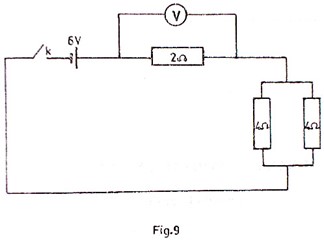
(i) What is the effective resistance in the circuit in the figure? (The cell has negligible resistance.)
(ii) What will be the reading of the voltmeter when the key K is closed?
**********


