


535/1 2¼ hours | UGANDA NATIONAL EXAMINATION BOARD Uganda Certificate of Education PHYSICS Paper 1 Time: 2¼ hours |
UNEB 1994 SECTION A
1. Permanent magnets are made from
A. diamagnetic materials B. Ferromagnetic materials
C. paramagnetic materials D. dielectric materials
2. A bullet of mass 0.1 kg is fired from a rifle of mass 5 kg. The rifle recoils at a velocity of 16 m/s. Calculate the velocity with which the bullet is fired.
A. 66 m/s B. 110 m/s C. 210 m/s D. 800 m/s
3. Vectors KL and LM are added to give KM. Which one of the diagrams correctly represents the vectors?
********
4. A notch on a material spreads more rapidly when the metal is
A. in tension B. in compression C. prestressed D. reinforced
5. An object of mass 2 kg dropped from the top of a building hits the ground with a kinetic energy of 900 J. The height of the building is
A. 30 m B. 45 m C. 90 m D. 180 m
6. When a room is filled with smoke, the smoke tends to concentrate
A. around the walls B. close to the walls
C. close to the roof D. midway between the roof and the floor
7. Capillary rise in a tube dipped in water is due to
A. surface tension
B. high vapour pressure
C. adhesive force being greater than cohesive force
D. atmospheric pressure acting on the surface of the water
8. A block of mass 10 kg accelerates uniformly at a rate of 3 m/s2 along a horizontal table when a force of 40 N acts on it. Find the frictional between the block and the table.
A. 10 N B. 13.3 N C. 30 N D. 70 N
9. An atom has a mass number 88 and atomic number 38. Which of the following statements are correct about the atom?
(i) it has 38 protons and 50 neutrons (ii) it has 38 protons and 38 electrons
(iii) it has 50 protons and 38 neutrons
A. (i) and (ii) B. (i) and (iii)
C. (ii) and (iii) D. (i), (ii) and (iii)
10.
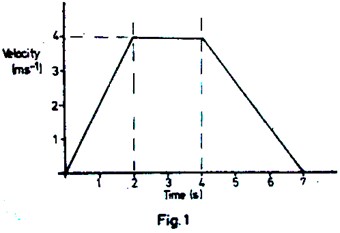
Use the velocity-time graph in the figure to find the distance over which there is deceleration.
A. 4 m B. 6 m C. 8 m D. 10 m
11. Which one of the following quantities is the odd one out?
A. force B. velocity C. momentum D. kinetic energy
12.
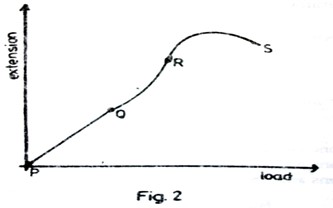
The graph above represents the extension of a wire with increasing load. Where does the yield point occur?
A. between points P and Q B. between points Q and R
C. between points R and S D. at point S
13.
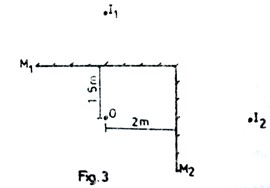
The images of an object O placed 2 m and 1.5 m from plane mirrors m1 and m2 respectively are L1 and L2 as shown in the above figure. Find the shortest distance between L1 and L2.
A. 2.5 m B. 3.5 m C. 5 m D. 7 m
14. The leaf of a charged electroscope gradually collapses with time due to
A. leakage to the surroundings
B. surrounding magnetic field
C. pressure variations in the surroundings
D. similar charges from the surroundings
15. The count rate of a radioactive isotope falls from 600 counts per second to 75 counts per second in 75 minutes. The half-life of the radioactive isotope is
A. 8 min B. 19 min C. 25 min D. 75 min
16. In a hydraulic press, the area of the piston on which the effort is applied is made smaller in order to
A. facilitate the movement of the piston downwards
B. transmit a force as large as possible to the load
C. transmit pressure equally throughout the liquid
D. obtain a pressure as large as possible.
17. A force of 50 N moves an object through a distance of 200 m in 40 s. Find the power expended.
A. 100 W B. 160 W C. 200 W D. 250 W
18. 23592U + 10n → 14456Ba + 9036Kr + 2x
The equation above represents a nuclear reaction. Identify X.
A. proton B. neutron
C. alpha particle D. beta particle
19. An input voltage of 250 V is connected to a transformer with 100 turns. Calculate the power of the secondary coil if an output of 15 V is required.
A. 1000/(250 – 15) B. 1000/(250 + 15)
C. (1000 × 15)/250 D. (1000 × 250)/15
20. When sound waves pass through a metal bar, the atoms of the metal
A. rotate in circles B. move along the bar
C. expand and contract D. vibrate about fixed points
21.
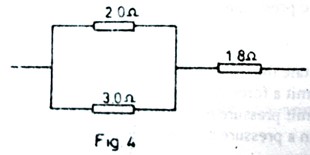
Calculate the effective resistance for the arrangement in figure 4.
A. 0.7 Ω B. 2.8 Ω C. 3.0 Ω D. 6.8 Ω
22. Which one of the following best describes the pattern of circular waves reflected from a concave reflector?
|
|
|
|
A | B | C | D |


23. The frequency of a radiowave is 6.6 × 10⁵ Hz. Find the wavelength (velocity of light is 3.0 × 10⁸ m/s).
A. 2.20 × 10⁻³ m B. 4.55 × 10² m
C. 3.60 × 10³ m D. 1.98 × 10¹² m
24.
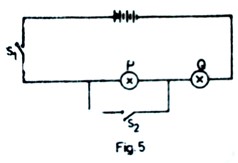
Which one of the following statements is true about the circuit in figure 5?
A. When S1 and S2 are closed, both bulbs P and Q light.
B. When S1 is open and S2 is closed, both bulbs P and Q do not light.
C. When S2 is open and S1 is closed, bulb P lights but bulb Q does not.
D. When S1 and S2 are open, both bulbs P and Q light.
25. A mass of 2.4 kg rests on the floor. If the area of contact with the floor is 6 cm2, what pressure does the mass exert on the floor?
A. 0.4 N/m2 B. 4.0 N/m2 C. 4.0 × 10³ N/m2 D. 4.0 × 10⁴ N/m2
26. Which one of the following is not true about a body moving with a constant velocity?
A. Its acceleration is zero B. Its momentum is constant
C. Its kinetic energy is constant D. There is a resultant force on it
27. Which one of the following statements is true?
A. The average kinetic energy of the molecules of the gas depends on temperature.
B. Each molecule of a gas at a given temperature has a different speed.
C. The pressure of a fixed mass of gas decreases as temperature increases.
D. The volume of a fixed mass of gas increases as temperature increases.
28.
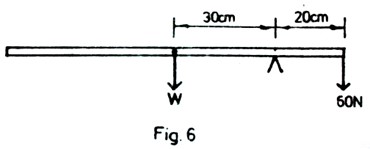
Find the weight W of a uniform metre rule if a force of 60 N at one end balances it as shown in the above figure.
A. 24 N B. 40 N C. 90 N D. 100 N
29. Which one of the following diagrams shows the correct arrangement of the magnetic domains in a magnetised material?
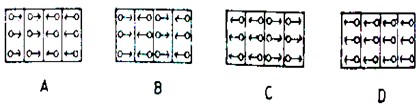
30. What device could be connected to the secondary of a transformer in order to get a d.c. in the output?
A. Diode B. Resistor C. Rheostat D. Thermostat
31. Dispersion of light is
A. the rectilinear propagation of light
B. the spreading of light around an obstacle
C. the splitting of white light into its constituent colours
D. the changing of direction by light when it moves from one medium to another
32. Which one of the following graphs represents the current-voltage variation for a tungsten filament wire lamp?
********
33. Metals are good conductors of heat because
A. they are ductile B. they contain free protons
C. they contain loose electrons D. their atoms can be easily displaced
34. A sinusoidal wave is observed on a cathode ray oscilloscope when
A. A cell is connected to the Y plates with the time base off
B. A low frequency alternating voltage is connected to the Y plates with the time base on
C. A high frequency alternating voltage is connected to the Y plates with the time base on
D. A cell is connected to the Y plates with the time base on
35. Which one of the following is the most economical means of transmitting electricity over long distances?
A. At a high voltage and a low current B. At a high voltage and a high current
C. At a low voltage and a low current D. At a low voltage and a low current
In each of the questions 36-40, one or more of the answers given may be correct. Read each question carefully and indicate the correct answer A, B, C or D according to the following:
A. If 1, 2, 3 only are correct
B. If 1, 3 only are correct
C. If 2, 4 only are correct
D. If 4 only is correct
36. A radioactive element may emit
1. Alpha particles 2. Gamma rays 3. Electrons 4. Protons
37. Which of the following statements about states of matter is/are true?
1. A liquid has a definite volume but not a definite shape.
2. A vapour has no definite volume and no definite shape.
3. A solid has a definite volume and shape.
4. A gas has a definite volume and shape.
38. The magnitude of the force on the coil of a d.c. motor depends on
1. The strength of the magnetic field 2. The number of turns on the coil
3. The current through the coil 4. The mass of the coil support
39. X-rays
1. Can ionise a gas 2. Readily penetrate matter
3. Are affected by an electric field 4. Have no effect on photographic plate
40. Total internal reflection occurs when
1. The incident angle is equal to the critical angle
2. Light travels from a dense to a less dense medium
3. Light travels from a less dense to a dense medium
4. The incident angle in a dense medium is greater than the critical angle
SECTION B (1994)
1. (a) A stone is thrown vertically upwards from a point above the ground. It reaches the highest point and then drops to the ground. Sketch the distance-time graph for the motion.
(b)
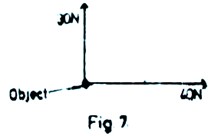
Two forces of 10 N and 40 N act perpendicularly on an object of mass 10 kg as shown in the above figure. Calculate the magnitude of the acceleration of the object.
2. An object 4 cm high is placed vertically on the principal axis of a converging lens of focal length 8 cm. If the object is 32 cm from the lens:
(a) Locate by graphical method the position of the image.
(b) Find the magnification.
3.
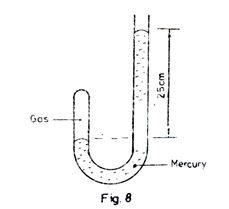
(a) The above figure shows a gas trapped by a mercury column in a J-tube. If the atmospheric pressure is 1.0 × 10⁵ Pa and the density of mercury is 1.36 × 10⁴ kg/m3, find the pressure at which the gas is.
(b) What would happen if the closed end of the J-tube was opened?
(c) Would it have been better to use water instead of mercury in the J-tube? Give a reason for your answer.
4. (a) List four different sources of e.m.f.
(b) State two advantages of a secondary cell over a primary cell.
5. (a) Distinguish between a strut and a tie.
(b)
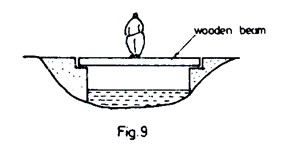
The diagram in the above figure shows a simple bridge on a stream.
- Mark the neutral axis.
(ii) Label the part that will be in tension.
- Indicate on the diagram how the bridge can be strengthened.
6. (a) Sketch the magnetic field pattern around a straight conductor carrying a current in the plane of paper.
(b) A bulb is rated 6 V, 12 W. Calculate:
(i) the current it takes.
(ii) the energy it supplies in 30 s.
7. (a) Explain why a pen rubbed with a piece of cloth attracts pieces of paper.
(b) A positively charged metallic ball is held above a hollow conductor resting on the cap of a gold leaf electroscope as shown in the figure below.
(c) Explain what happens to the leaf of the electroscope as the ball is lowered into the conductor.
8.
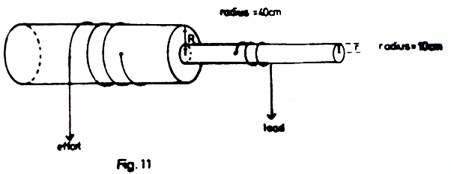
(a) The above figure shows a wheel and axle system. When an effort of 300 N is applied, a load of 900 N is raised through a distance of 1.0 m. Calculate:
(i) the velocity ratio.
(ii) the efficiency of the system.
9.
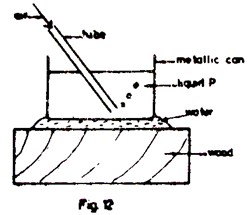
(a) Air is blown into a liquid P of low boiling point as shown in the above figure.
(i) State what is after a long time.
(ii) Explain your observations in (a)(i).
(b) A liquid is heated to 120°C and allowed to cool. It starts solidifying after 5 min when its temperature is 80°C and takes 10 min to solidify. Sketch the cooling curve for the liquid.
10. (a) A girl at a distance of 165 m from a high wall clapped her hands once but heard two claps.
(i) Explain why the girl heard two claps.
(ii) Find how long it took her to hear the second clap.
(The speed of sound in air is 330 m/s.)
(b) Give one practical application in which the principle in (a) is used.
**********


