


The forestry industry in Uganda Notes
A forest is a close stand of trees that form a canopy or canopies on top.
Forestry refers to the management and harvesting of forest resource. The forests in Uganda play a major role in protecting the environment and in the economic development of the country.
Uganda has got two types of forests i.e. natural and artificial forests. The natural forests in Uganda are sub-divided into; tropical rainforests, mountain forests, woodlands and riverine forests.
The natural forests include; Mabira in Mukono district, Bugoma and Budongo in Masindi and Hoima, Kibale, Kalinju, Kitomi, Maramagambo, Mgahinga, Bwindi impenetrable, all in south and western Uganda, Zoka, Wiceri, Mt. Elgon forests, Mt. Rwenzori forests, etc.
Artificial forests include; Lendu in Nebbi, Kateera in Kiboga, Muko in Kabale, Ayere in Gulu, Rwomo in Ntugamo, Mafuga, Agwata, Abera, etc.
There also savannah woodlands especially in northern Uganda.
Distribution of forests in Uganda

Status of the forestry industry
- Most of the country’s forest cover comprises natural forests.
- Savannah woodland forests are the most widespread forest types in the country.
- Most Uganda‘s forests exist outside protected areas and on private land.
- There is high rate of deforestation of the natural forests like in Kyenjojo district.
- Some forests have been de-gazatted up to 23.6% like Namanve.
- The common planted tree species are pine and eucalyptus trees.
- All protected forests in the country are managed by National Forestry Authority (NFA) and Uganda Wildlife Authority (UWA).
- The most deforested areas are those which are heavily settled and cultivated.
- Uganda loses her forest cover at a rate of 1.8% per year.
- Much of the deforestation occur in well stocked high forests and woodland forests at a rate of 2% per annum.
- The country’s forest cover now covers 7.4 million hectares, down from 50 million hectares in 1900 only 9% down from 11% in 1995.
- Government encouraging afforestation under Agro-forestry.
Importance of forests in Uganda
The importance of forests in Uganda can be categorized into two i.e. productive importance and protective importance.
- Forests protect against erosion i.e. the leaves of the trees break the force of rain drops before they reach the ground. Also the fallen leaves help to mulch the soil hence protecting it from erosion like those on Elgon slopes.
- Tree roots bind the soil particles together making them less liable to erosion. Also tree branches act as wind breakers hence reduce the strength of wind that would have carried the top soil like on Mt. Rwenzori.
- Forests facilitate the formation of rainfall through the process of evapo-transpiration. This has led to rainfall in areas where forests are found like in Mabira-Mukono. Such rainfall has facilitated the growth of sugar canes at Lugazi sugar estate.
- Forests provide a habitat for wild animal and birds, protecting the rare species of animals such as gorillas in Bwindi that has boosted tourism industry for jobs to Ugandans.
- Forests help to prevent desertification through modification of the climate as they form rainfall in the process of evapo-transpiration like in Mabira-Mukono which in turn has favored tea growing at Kasaku.
- Trees provide oxygen in atmosphere and absorb carbon dioxide which reduces global warming. Forests like Mabira have absorbed pollutions from Namanve and Jinja industries.
- Forests like Budongo and Kalinju provide fuel in form of biomass in terms of fire wood and charcoal used for both industrial and domestic purpose. Industries like bakeries, brick laying factories like in Kajjansi use fire wood from Ssese forests.
- Timber derived from the forests such as Ssese and Mabira is used for a variety of purposes. Foristance making furniture, paper and pulp, matches, construction purpose, all of economic importance to Uganda through job provision and revenue to the government.
- Forests like Aber and Agwata provide poles for telephone and rural electrification. Eucalyptus tree poles are usually used, and also for construction purpose. This has led to increased industrialization in Uganda.
- Tropical rain forests of Mabira, Mgahinga and Bwindi act as tourist attraction potentials and this promotes the tourism industry thus earning foreign exchange for further development.
- Provision of employment opportunities as lumbermen in saw mills, forest rangers, officials in the tourist industry, furniture makers, etc. such Ugandans earn a lot of incomes improving on their standards of living.
- Forests contributes to the clean environment by reducing pollution of all types especially Mabira in Namanve industrial area i.e. absorbing carbon dioxide and producing oxygen. This increases the quality of life of Ugandans.
- Forests like mabira and Wiceri provide medicine in form of herbs that help to cure several diseases like moringa tree products, cinchona and aloe Vera which all cure diseases. This has improved on the life span of Ugandans.
- Forests like Kibale and Bugoma are source of food products such as fruits, honey, mashrooms, bee wax and gum. Also wild coffee is harvested mainly in Kibale forests and sold for cash. This improves on the incomes of Ugandans.
- Forests like Mabira and Ssese are used for research and study purpose by scholars of higher institutions. Foristance Makerere University uses forests for research.
- Forests are catchment areas for rivers as well as contributing rainfall into river channels. Forinstance Mt. Elgon forests Support River Manafa and Masaba. This helps to support aquatic life hence development of the fishing industry.
- Forests provide a good environment for recreation through picnics, hunting and beach games like at Botanical beach forests in Entebbe. This support tourism for foreign exchange.
- Forests are source of government revenue as well as foreign exchange from exportation of bamboo poles to Germany. The exchange is used for further development.
- Summary of positive importance i.e. Contributes gross domestic products, source of energy, provides valuable timber, yields valuable medicine, raw materials for art and craft industry, source of food (fruits), employment opportunities, income, revenue, urban growth around saw mills, promotes industrialization, foreign exchange, habitat for game/wildlife, tourist attraction, research promotion, catchment areas for rivers, positive modification of climate, protect soils from erosion, diversify the economy, promotes environmental purification, soil conservation through agro-forestry, act as wind breakers, promotes infrastructural development.
Short comings of forests include;
- Most forests like Malabigambo in southern Uganda do not appear in pure stand due to a variety of tree species they posses thus making their exploitation, felling and selection of logs difficult.
- Forests do habour dangerous pests and diseases like mosquitoes and tsetse flies. Also snakes and lions are a threat to forest exploitators.
- Thick forests like Bwindi impenetrable act as a barrier to communication especially in construction and maintenance of roads through the forest. This explains why some parts of Kisoro are remote.
- Summary: promotes remoteness, habit dangerous animals, habit pests and diseases, hide out for wrong doers, promotes drying of wetlands, hinder road construction, accidents are common during exploitation, etc.
- Summary: promotes remoteness, habit dangerous animals, habit pests and diseases, hide out for wrong doers, promotes drying of wetlands, hinder road construction, accidents are common during exploitation, etc.
Factors that have limited the exploitation of natural forests in Uganda
- Some forests like Marabigambo and Mafuga are located in remote and inaccessible areas especially during rainy seasons. This makes transportation and labor mobility for exploitation of the forest hard.
- The heavy rains received in such forests of Mabira and Budongo contribute to the outbreak of pests and diseases like mosquitoes and tsetse flies which are a threat to lumbermen.
- Tropical rain forests grow buttress roots which hinder effective felling of trees. Also trees are inter-connected by strong creepers and tree climbers. This makes tree felling difficult like in Ssese forests.
- The valuable tree species in forests like Maramagambo, Budongo and Mabira do not appear in pure stand. This makes it difficult in selection and felling of valuable tree species such as mahogany, ebony and mvule.
- Inefficient handling facilities after the logs have been felled. Lumbermen use manual rifting of logs to the nearest transportation centre like in Budongo forest.
- Shortage of capital to invest in the forestry industry for purchasing modern machines like electric saws, tractors to exploit big forests like Budongo and Bugoma. Few investors today have invested in the forestry industry since the business is less profitable.
- Limited market of Uganda‘s timber since it is hard wood timber. These face a lot of competition from foreign countries with soft wood products.
- Inefficient transport networks to transport forestry products to market centres. Roads are destroyed by heavy rains within the forested areas.
- Shortage of skilled labour and managerial skills in the forestry industry to exploit forests like Kalinju and Bwindi. The unskilled labourers lead to felling of young trees.
- Floods especially during rainy seasons like by river Sezibwe in Mabira forest make its utilization difficult.
- The increasing population like in kibale has encroached on forest reserves for settlement and agricultural purpose. This is evident in kibale forest reserve.
- Political instabilities has affected exploitation of forests like the ADF affected Rwenzori forests and Mt. Kei and Otze in the north affected by LRA rebels.
- Steep slopes on mountains like Elgon and Rwenzori limit access to such forests for exploitation.also forests like maramagambo located in lowlands with soft soils limit transport facilities for exploitation.
- Inadequate research to identify and exploit trees of commercial value in Budongo, Bugoma and other forests. There is also limited modern technology to exploit forests and the use of primitive tools like axes cannot support commercial exploitation.
Deforestation in Uganda
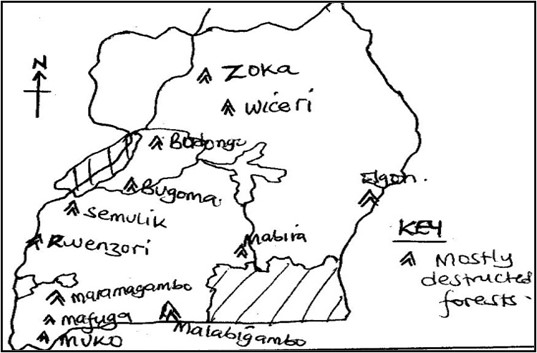
Deforestation is the increased extinction of the forest resource. In Uganda the forests are on a decrease. About 100 years ago, the land of Uganda was having 12% covered by forests but now is estimated at 5%.
It should be noted that currently 21% of the original forests is remaining and 79% cleared. Most of the cleared forests are found in central region and in the west.
Map of Uganda showing mostly destructed forests.
Factors/causes of deforestation in Uganda
- Rapid population growth, Uganda experiences a high population of 34.4 million people and the increasing population in areas such as kigezi, Mbale, Bugishu has led to high demand for land for settlement thus destroying forests like Mabira, Kibale, mt. Elgon forests, etc.
- Forests are major sources of biomass in form of fire wood and charcoal especially in rural areas. This has led to cutting down forests like Mabira, Bugongo and Maramagambo.
- The increasing demand for timber for furniture, building and construction has led to clearing parts of Kibale forest, Kalinju and Budongo which are accessible.
- Burning of forests especially by hunters, farmers and grazers has destroyed Mwenge forest reserve, mt. Rwenzori forests and Luwero forests. Also many hectares of forests of Aber and Opit in Gulu were burnt in 1982 by locals.
- Ignorance of the people especially in the rural areas like in Kibale and Kigezi, who have inadequate knowledge about the value of forests. Such simply destroy forests because they look at them as obstacles to more meaningful land use.
- Corruption in the forest department in form of bribes, illegal sale of timber, illegal lumbering, thus clearing mostly soft wood trees like Mafuga.
- Political insecurity where forests have been cleared to check on insecurity like in 1980s Luwero forests were cut down, Nyamityobora forest in Mbarara, etc for security reasons.
- Limited resources invested in the forest department leading to inefficient equipments used, limited rangers, wardens and other staff to monitor forests and reduce on encroachment on forests like Mabira, Budongo and others.
- Pests and diseases which have led to clearing forests to destroy tsetse flies like in southern Busoga, Bunya forest in Mayuge and kibale forests.
- Over grazing of both domestic and wild animals like kadama forest reserves, Timu and Morongole in Karamoja area. Also Aber and Agwata forests are facing illegal grazing by the Iteso pastoralists.
- The use of traditional and rudimentary tools in felling trees like axes and pangas has caused deforestation. Foristance Mafuga and Muko forest reserve have been destroyed by felling immature trees.
- The need for more land for cultivation like Bugala forest was cut down by BIDCO to plant palm oil trees, and Kakira and Lugazi sugar estates cleared part of Mabira forest for sugar cane plantations.
- Industrial establishment where forests are cut down to provide land for industrial set up like in Namanve and to get fire wood for tea processing in Ankole tea estate, firing bricks in Butende and Uganda clays in Kajjansi.
- Mining activities foristance gold mining in kitaka-kamwenge, Buhweju-Bushenyi has led to clearing of forests in such areas for the activity.
Effects of deforestation in Uganda
- Deforestation has led to the decreased amount of rainfall and also became unreliable. Foristance the area around Mt. Elgon have had their rain seasons changed simply because of forest destruction.
- It increases the amount of carbon dioxide in the atmosphere especially in urban centres of Kampala and Jinja and this is responsible for increased temperatures and global warming.
- Deforestation especially on steep slopes of Mt. Elgon and Kigezi hills has led to increased soil erosion and mass wasting. This has reduced soil productivity hence low crop yields.
- The uncontrolled cutting down of trees has led to scarcity of wood and its products in many parts of Uganda especially in Masaka, Bushenyi, and Kigezi south western Uganda.
- Forests act as habitats for wildlife therefore their destruction means destruction of wildlife. For example the white rhinos are now extinct just because its habitant was destroyed.
- Man depend on forest for survival directly or indirectly therefore forest destruction means that such people like lumbers and herbalists in Mukono and Ssese islands will lose a base for their livelihood.
- It has affected water supply in rivers and lakes since forest destruction lowers the water table and rainfall received in areas of kigezi, Hoima and Manafa.
Measures to conserve forests in Uganda
- The government of Uganda has established the ministry in charge of environment protection. This ministry has put special emphasis on the conservation of wildlife, wetlands and forests. There are now policies that are being followed by forest exploiters.
- The forest department has evicted many encroachers on the forest reserves like on Mabira and Kibale. Foristance the people who were occupaing 200ha had been evicted in Kibale.
- Education concerning the vitalness of forests has been carried out through mass media and other local authorities.
- Re-forestation programs are being carried out in various parts of the country. Foristance in Mbarara, Kabale, Arua, Mbale and Tororo.
- Afforestation programs are carried out, like planting of eucalyptus trees have been practiced in Ruhama, Mbarara, Ibuje in Apac, etc.
- Developments of other sources of energy like bio-gas, HEP, etc. in addition energy saving stoves which use less charcoal and fire wood have been introduced.
- The forest department through National Forestry Authority (NFA) has set up and maintained nursery beds to provide trees to farmers for planting and all this is intended to encourage people plant trees.
- Regular patrols by forest rangers to curb down illegal cutting of forests. This is limited in Uganda due to limited resources in the forest department.
- Forest boundaries have been planted with fire wood tree species in densely populated areas.
- Since 1986 the security situation in Uganda has been greatly improved. This improvement has helped to preserve the forests especially in eastern, central, western and southern Uganda.
- Family planning programs especially in rural areas have been encouraged to reduce on the rapid population growth rate which has cleared forests for other land use.
- Agro-forestry is being encouraged by farmers.


