


Probability Questions
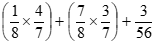
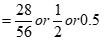
1. During inter-school competitions, rugby and football teams from Ranje sec school took part. The probability that the rugby would win their first match was ⅛ while that the handball team could lose was . Find the probability that;
(a) Both teams won their first matches. (1 mk)
(b) At least one team won the first match (3 mks)
2. Two identical baskets A and B contain white and red balls. Basket A contains 7 white balls and 3 red balls while basket B contains 5 white balls and 5 red balls. A bag is chosen at random and 2 balls picked from it one after another without replacement.
(a) Illustrate this information using a tree diagram. (2mks)
(b) Find the probability that:-
(i) The 2 balls picked are of the same colour. (2mks)
(ii) The two balls picked are of different colours. (2mks)
(iii) Only one of the balls picked is red. (2mks)
(iv) At least one white ball is picked. (2mks)
3. The probability that a girl goes to school by bus is 1/3 and by matatu is ½ .If she uses a bus, the probability that she is late to school is 1/5 and if she uses a matatu the probability that she is late to school is 3/20 . If she uses other means of transport, the probability of being late is 1/20.
a) Draw a probability tree diagram to represent this information. (3mks)
b) What is the probability that she will be late to school. (3mks)
c) What is the probability that she will be late for school if she does not use a matatu. (2mks)
d) What is the probability that she will not be late to school. (2mks)
4. If a certain unfair coin is tossed, the chance of obtaining a tail is 25%. Find:-
a) The probability of getting two heads when the coin is tossed twice. (2 mks)
b) The probability of obtaining at least one tail when the coin is tossed twice. (2 mks)
5. A bag contains 3 black balls and 6 white ones. If two balls are drawn from the bag one at a time,find;
(a) The probability of drawing a black ball and a white ball.
(i) Without replacement.
(ii) With replacement.
(b) Drawing two white balls.
(i) Without replacement.
(ii) With replacement.
6. A cupboard has 7 white cups and 5brown cups all identical in size and shape.
There is a blackout in the town and Mrs. Bett has to select three cups one after another
without replacing the previous ones.
(a) Draw a tree diagram for the information
(b) Calculate the probability that she chooses;
(i) Two white cups and one brown cup
(ii) Two brown cups and one white cup
(iii) At least one white cup
(iv) three cups of the same colour
7. A two digit number is formed from the first four prime numbers.
a) Draw the table to show the possible outcomes, if each number can be used only once.
b) Calculate the probability that a number chosen from the digit numbers is an even number
8. The probability that a boy goes to school by bus is 1/3 and by matatu is ½. If he uses a bus,
the probability that he is late to school is 1/5 and if he uses a matatu, the probability of being
late is 3/10. If he uses other means of transport, the probability of being late is 1/20
(a) Draw a probability tree diagram to represent this information
(b) What is the probability that he will be late for school
(c) What is the probability that he be late for school if he does not use a matatu
(d) What is the probability that he is not late for school
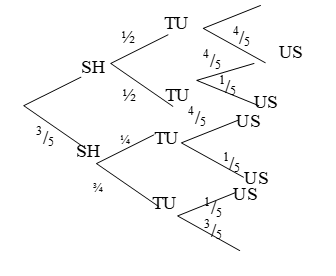
9. One day during inspection in a certain secondary school, it was discovered that there was a
probability of 2/5 that a students had shaggy hair, if a student had shaggy hair, there was
a probability of ½ that he had torn uniform. But if he had properly combed hair, there was
a probability of ¼ that he had a torn uniform. If a student had torn uniform there was a probability
of 4/5 that he had unpolished shoes. Otherwise there was a probability of 3/5 that he had
polished shoes.
a) Represent this information in a probability tree diagram
b) Find the probability that:-
i) a student had all the three faults
ii) a students had exactly two faults
iii) a students had no faults at all
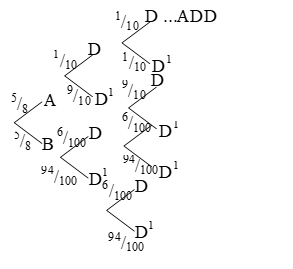
10. A shop is stocked with plates which are from two suppliers A and B. They are brought
in the ratio of 3:5 respectively. 10% of plates from A are defective and 6% of plates from
B are de
11. In a science class 2/3 of the class are boys and the rest are girls. 80% of the boys and 90% of
the girls are right handed and the rest are left handed. The probability that a right handed student
will break a test-tube in any session is 1/10 and the corresponding for the left handed student is 3/10, their probability being independent of the student sex .
- Complete the probability tree diagram given below
b) Using the tree diagram, find the probability that :
i) A student chosen from the class is left handed ii) A test-tube is broken by a left handed student
iii) A test-tube is broken by a right handed student
iv) A test-tube is not broken in any session
12. Students who performed well in an examination are to be given an outing. A student
has to throw two dice. If he gets a sum greater than 8, he gets a two-days outing,
otherwise he gets a one day outing.
(a) Find the probability that a student gets a two-day outing
(b) A student who qualifies for a two-day outing throws a die and a coin to decide
whether he gets pocket money for the two days or for only one day. If he gets a
head and a multiple of 3 he gets pocket money for two days. Find the probability
that he is given a two-day outing but given pocket money for only one day
(c) If a student gets a one-day outing, he throws a die to decide if he gets pocket
money or not. If he gets a number greater than 4 he gets the pocket money.
Find the probability that:-
(i) A student gets pocket money for two days
(ii) A student gets pocket money
13. A bag contains 6 red beads and 4 white ones. Two beads are selected from the bag at random
without replacement.
(a) Draw a tree diagram to represent the above information.
(b) Calculate the probability that:
(i) Both beads are white.
(ii) Both beads are of the same colour.
(iii) At least a red bead is picked.
(iv) The two beads are of different colours.
14. A bag contains blue, green and red pens of the same type in the ratio 8:2:5respectively.
A pen is picked at random without replacement and its colour noted.
a) Determine the probability that the first pen picked is;
(i) blue
(ii) either green or red.
b) Using a tree diagram, determine the probability that;
(i) the first two pens picked are both green.
(ii) Only one of the first two pens picked is red.
c) (i) Draw the probability space for the possible outcomes when a coin is tossed and a die
thrown simultaneously
(ii) Determine the probability of getting a head and an even number.
15. A box contains five red balls and four black balls all identical. Three balls are drawn without
replacement from the box at random;
(a) Draw a tree diagram to show the situation
(b) use the tree diagram to find the probability that;
(i) the balls picked are of the same colour
(ii) more red balls were picked
(iii) at least a black ball was picked
(iv) atmost 1 red ball was picked
16. A bag contains 10balls of which 3 are red, 5 are white and 2 are green. Another bag contains
12balls of which 4 are red, 3 are white and 5 are green. A bag is chosen at random and then a
ball chosen at random from the bag. Find the probability that the ball so chosen is red
17. In a certain science class 2/3 of the class are boys and the rest girls. 4/5 of the boys and 9/10
of the girls are right handed, and the rest are left handed. The probability that a right handed
student will break a test-tube in any session is 1/10 and the corresponding probability for a left
handed student is 3/10, these probabilities being independent of the student’s sex.
(a) Represent this information on a tree diagram
(b) Using the diagram above;
(i) determine the probability that a student chosen at random form the class is left handed
(ii) determine the probability that a student chosen at random from the class is right handed
and will break a test tube in any session
(c) determine the probability that a test tube is broken in any session
18. A box contains 5 red biro pens, 4 black biro pens and 6 green biro pens. If three pens are
picked once at random, find the probability that:
(i) all the biro pens are red
(ii) the biro pens are of the same colour
(iii) the biro pens are one of each colour
(iv) none of the biro pens is red
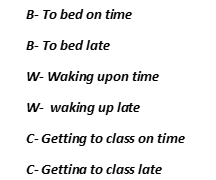
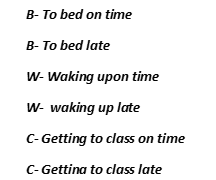
19. The probability that Chebet goes to bed on time ¾ . If she goes to bed on time, the probability
that she wakes up on time is 5/6 , otherwise her probability of waking up on time is 1/3.
(a) (i) Find the probability of Chebet getting to bed on time and waking up on time by use
of diagram
(ii) Waking up late
(b) If Chebet wakes up late, her probability of getting to class on time is 1/5 otherwise, her
probability of getting to class on time is 3/5.
(i) Find the probability of Chebet getting to bed on time and gets to class late
(ii) Getting to bed late and get to class on time
Probability Answers
1 | a) b) | B1 M1 M1 A1 | |
4 | |||
2. |
(b) (i) ( ½ x 7/10 x 2/3) + ( ½ x 3/10 x 2/9) + ( ½ + 4/9 x ½ ) + ½ x ½ x4/9) = 22/45 (ii) 1 – 22 45 = 23 45 (iii) ( ½ x 7/10 x 1/3) + ( ½ x 3/10 x 7/10) + ( ½ x ½ x 5/9) + ( ½ x ½ x ½ ) 7/60 + 7/60 + 5/36 + 5/36 = 23/45 (iv) 1 – 23 = 22 45 45 | B2 U1 A1 M1 A1 M1 A1 B1 A1 | |
10 |
 and
and 

 or
or  or
or 



1. (a) (i) Total balls = 3 + 6 = 9
= P(BW) or P(WB)


 = 3 x 6 + 6 x 3
9 8 9 8
= 18 + 18 = 36
72 72 72
= ½
(ii) = P(BW) or P(WB)
= 3 x 6 + 6 x 3
9 9 9 9
= 18 + 18
81 81
= 36 = 4
- 9
(b) (i) P(WW) = 6 x 5
9 8
= 30 = 5
72 12
(ii) P(WW) = 6 x 6
9 9
= 4
9
2. P(W) = 7/12 P (B) = 5/12
(2 white and one brown)
=(WWB or WBW or BWW
= ( 7/12 x 6/11 x 5/10) + (7/12 x 5/11 x 6/10)+ ( 7/12 x 7/11 x 6/10 )
= 22/44
(ii) P(BBW or BWB or WBB)
= ( 5/12 x 4/11 x 7/10 ) + ( 5/12 x 7/11 x 4/10 ) + ( 7/12 x 5/11 x 4/10 )
= 7/22
(iii) P (at least one white cup)
= (1-P(BBB) = 1-(5/12 x 4/11 x 3/10)
= 21/22
(iv) P (same colour) = P(BBB or WWW)
= (7/12 x 6/11 x 5/10) + (5/12 x 4/11 x 3/10 )
= 9/44
3. a) 2 3 5 7
2 32 52 72
3 23 53 73
5 25 35 75
7 27 37 57
b) P(E) = 4
16
= ¼
4.
(a) P(late) = (1/3 x 1/5) + ( ½ x 3/10) + ( 1/6 x 1/20)
= 1/15 + 3/20 + 1/120
= 9/40
(b) P = 1/3 x 1/5) + ( 1/6 x 1/20)
= 1/15 + 1/20
= 3/40
(c) P= (not late) = (1- 9/40)
 5. a)
5. a)
b) i) P(all faults)= P( SH and TU and US)
= 2/5 x ½ x 4/5 = 4/25
ii) P(exactly two) = 2/5 x ½ x 1/5 + 2/5 x ½ x 1/5 + 3/5 x ¾ x 1/5
6.
Both defective
= 3 x 1 x 1 + 5 x 6 x 6
8 10 10 8 100 100
= 3 + 180
800 80000
= 24
4000
= 3
500
7. a)

b) i) P (BL or GL) = 2/3 X 1/10 + 1/3 X 1/10
= 2/15 + 1/30 = 5/30
ii) P( BL break or GR break)
= 2/3 X 1/5 X 3/10 + 1/3 X 1/10 X 3/10
= 2/50 + 1/100 = 4+1/100 = 5/100
iii) P( BR break or GR break)
= 2/3 X 4/5 X 1/10 + 1/3 X 9/10 X 1/10
= 8/150 + 9/300 = 16+9/300 = 25/300
iv) 1 – (5/100 + 25/300) = 1 – 15+25/300
= 260/300
8.
1 2 3 4 5 6 |
1 2 3 4 5 6 7 |
2 3 4 5 6 7 8 |
3 4 5 6 7 8 9 |
4 5 6 7 8 9 10 |
5 6 7 8 9 10 11 |
6 7 8 9 10 11 12 |
P( a two days outing) = 10/36 = 5/18
(b) 1 2 3 4 5 6
H H1 H2 H3 H4 H5 H6
T T1 T2 T3 T4 T5 T6
P(2days and one day pocket money)
= 5 x 10
18 12
= 25
108
(c) (i) 5/18 x 2/12
= 5/108
(ii)
P(get pocket money)
= 5/18 x 2/12 + 5/18 x 10/12 + 13/18 x 2/6
9. (a) (i) P( W W) = 4 x 3
10 9
= 2
15
(ii) P (W W) or (R R) = 4 x 3 + 6 x 5
10 9 10 9
= 2 + 1 = 7
15 3 15
(iii) P (at least Red) = 1 – P(WW)
= 1 – 2
15
13
15
(iv) P(WR) or P(RW) = 3 x 4 + 2 x 2
5 9 5 3
= 8
15
10. a) i) 8/15
ii) 2/15 + 5/15 = 7/15
b) i)
Gh = 2/15 x 1/14 = 2/210 = 1/105
ii) RG or RB
3/21 + 7/45 = 45 + 147
945
= 192
945
(c)(i)
H | T | |
1 | 1H | 1T |
2 | 2H | 2T |
3 | 3H | 3T |
4 | 4H | 4T |
5 | 5H | 5T |
6 | 6H | 6T |
11. (a)
(b) (i) same colour = 5/9 x 4/2 x 3/7 + 4/9 x 3/8x 2/7
= 5/42 + 1/7
= 11/42
(ii) more red balls = 5/89 x ½ x 3/7 + 5/9 x ½ x 4/7 + 5/9 x ½ x 4/7
= 5/42 + 10/63 = 10/63
= 5/42 + 20/63= 15 + 40 = 55
126 126
(iii) at least black ball was picked
= 1- 5/9 x ½ x 3/7
= 1 – 5/21
= 16/21
(iv) Atmost 1 red ball picked
= 5/9 x 4/2 x 3/7 + 4/9 x 5/8 x 3/7 + 4/9 x 3/8 x 2/7
= 5/42 + 5/92 + 1/21
= 5 + 5 + 2
42
= 12/42
= 2/7


 12.
12.
P (Red) = ( ½ x 3/10) + ( ½ x 4/12)= 19 60


 13. (a)


bi) P (left handed)
= 2/3 x 1/5 + 1/3 x 1/10
= 2/15 + 1/3
= 5/30 = 1/6
ii) P ( Right handed and will break)
= 2/3 x 4/5 x 1/10 + 1/3 x 1/9 x 1/10
= 8/150 + 9/300
= 25/300 = 1/18
c) P (= 2/3 x 4/5 x 1/10 + 2/3 x 1/5 x 3/10 + 1/3 x 9/10 x 1/10 + 1/3 x 1/10 x 3/10
14. (i) P (RRR) = 5 X 5 X 5
15 15 15
= 125
3375
= 1
27
(ii) 125 + 64 + 216
3375 3375 3375
= 405
3375
= 3
25
(iii) P (RBG) + P (GRB) + P(BGR)
5 X 4 X 6 + 6 X 5 X 4 + 4 X 6 X 5
15 15 15 15 15 15 15 15 15
= 120 + 120 + 120
3375 3375 3375
= 24
(iv) P(BBB) + P(GGG) + P(BBG) + P (GGB)
= 4 X 4 X 4 + 6 X 6 X 6+ 4 X 4 X 6 + 6 X 6 X 4
15 15 15 15 15 15 15 15 15 15 15 15
= 64 + 216 + 96 + 144
3375 3375 3375 3375
= 520 + 104
3375 3375
 15.
15.





- (i) P(Bnw) = ¾ x 5/6
= 5/8
ii) P( Waking up late)


 ¾ x 1/6 + ¼ x 2/3
= 1 + 1 = 3 + 4
8 6 24
= 7
24
b) (i) P (BW~C) or P(B~W~C)

3 x 1 x 4 + 3 x 5 x 2


 4 6 5 4 6 5
1 + 1 = 4 + 10
10 4 40
= 7
20
ii) P (~B ~C) = 1 x 1 x 3 + 1 x 2 x 1
4 3 5 4 3 5
= 1 + 1 = 3 + 2 = 5
20 30 60 60
= 1
12


2 Comments