


1. a) Describe with aid of a labeled diagram an experiment to determine the focal length of the lens when provided with the following: an illuminated object, convex lens, a lens holder, a plane mirror, and a metre rule. (5 marks)
b) A small vertical object is placed 28 cm in front of a convex lens of focal length 12 cm. On the grid provided, draw a ray diagram to locate the image. The lens position is shown. (Use a scale; 1 cm represents 4 cm) (5 marks)
Determine the image distance.
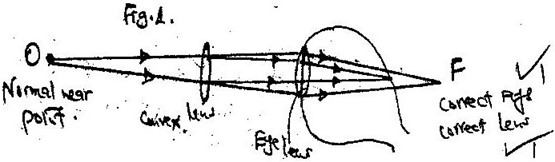
c) Fig 1 shows a human eye with a certain defect.
(i) Name the defect.
(ii) On the same diagram, sketch the appropriate lens to correct the defect and sketch rays to show the effect of the lens. (2 marks)
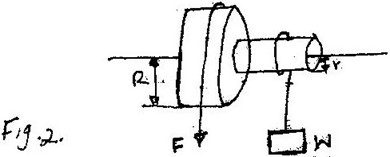
2. a) Fig 2 shows a wheel and axle being used to raise a load W by applying an effort F. The radius of the large wheel is R and of the small wheel r as shown.
(i) Show that the velocity ratio (V.R) of this machine is given by R/r. (3 marks)
(ii) Given that R = 8 cm, r = 5 cm, determine the effort required to raise a load of 20 N if the efficiency of the machine is 80%. (4 marks)
(iii) It is observed that the efficiency of the machine increases when it is used to lift large loads. Give a reason for this. (1 mark)
3. When the switch is closed determine the:
(i) Ammeter reading.
(ii) Charge on each conductor. (3 marks)
b) Fig 5 shows the circuit of a rectifier using four diodes D1, D2, D3, and D4.
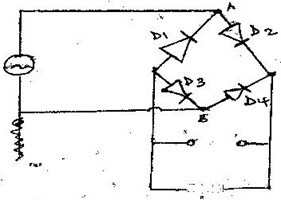
Fig 5.
(i) Explain how a rectified output is produced from the set-up when an a.c input is connected across AB. (4 marks)
(ii) On the axis provided, sketch the graph of output voltage against time for the rectifier. (1 mark)
(iii) A capacitor is now connected across XY. Explain the effect of the capacitor on the output. (2 marks)
c) A transistor in a common-emitter amplifier has β = 120. A signal in the input causes the base corresponding change in the output voltage if the load resistance is 100 Ω. (4 marks)
5. (a) State Hooke’s law. (1 mark)
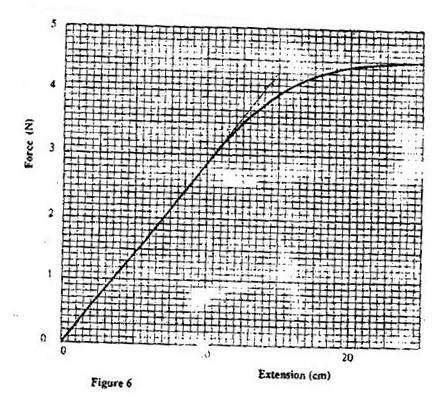
(b) One piece of rubber was fixed to a rigid support and the other end pulled with a force of varying magnitude. The graph in Fig 6 shows the relationship between the force (N) and the extension (cm).
Using the graph, determine:
- (i) The stretching force at the elastic limit.
- (ii) The tensile stress in the rubber at an extension of 5 cm if the cross-section of the rubber is 0.25 cm2.
- (iii) The tensile strain in the rubber at an extension of 5 cm if the original length was 2 m. (3 marks)
c) In Fig 7, girders AB, BC, CD, ED, EB, and BD were joined to make the rigid structure shown. The load W hangs from the structure as shown.
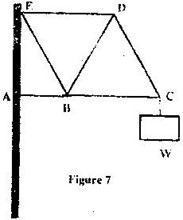
Which of the girders can be replaced with strings without affecting the structure? (2 marks)
SECTION II (15 MARKS)
Answer ONE question from this section in the spaces provided at the end of questions seven.
6. (a) Define the term angular velocity. (1 mark)
(b) A body moving with uniform angular velocity is found to have covered an angular distance of 170 radians in t seconds. Thirteen seconds later it is found to have covered a total angular distance of 300 radians. Determine t. (3 marks)
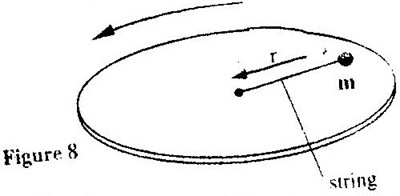
c) Fig 8 shows a body of mass m attached to the centre of a rotating table with a string whose tension can be measured. (The device for measuring the tension is not shown in the figure.)
The tension, T, on the string was measured for various values of angular velocity, ω. The distance r of the body from the centre was maintained at 30 cm. Table 1 shows the results obtained.
Table 1
| ω2 | 4.0 | 9.0 | 16.0 | 25.0 | 36.0 |
|---|---|---|---|---|---|
| Angular velocity ω (rad/s) | 2.0 | 3.0 | 4.0 | 5.0 | 6.0 |
| Tension T (N) | 0.04 | 0.34 | 0.76 | 1.30 | 1.96 |
(i) Plot the graph of T (y-axis) against ω2 (x-axis). (5 marks)
(ii) From the graph, determine the mass, m, of the body given that T = mω2 – C, where C is a constant. (4 marks)
(iii) Determine the constant C and suggest what it represents in the set-up. (2 marks)
7. (a) What is meant by radioactivity? (1 mark)
(b) With the aid of a labeled diagram, explain the working of a Geiger-Muller tube as a detector of radiation. (5 marks)
(c) In an experiment to determine the half-life of a certain radioactive substance, the activity in disintegrations per minute was measured for some time. Table 2 shows the results obtained.
| Time in Minutes | 0 | 10 | 20 | 30 | 40 | 50 | 60 | 70 | 80 |
|---|---|---|---|---|---|---|---|---|---|
| Activity in disintegrations | 152 | 115 | 87 | 66 | 50 | 38 | 20 | 12 | 6 |
On the grid, plot a suitable graph and use it to determine the half-life t½ of the substance. (7 marks)
(d) At time t = 40 minutes, the activity of a sample of a certain radioactive isotope with a half-life of 12 minutes is found to be 480 disintegrations per minute.
Determine the time when the activity was 3840 disintegrations per minute. (2 marks)


