SECTION 1 (65 MARKS)
Answer all the questions in this section in the spaces provided
(a) A body accelerates uniformly from its initial velocity, u, to the final velocity, v, in time t. The distance traveled during this time is S. If the acceleration is denoted by the letter a, show that:
(i) v = u + at (2 mks)
(ii) S = ut + ½ at2 (3 mks)
(iii) v2 = u2 + 2aS (2 mks)
(b) A body moving initially at 50 m/s decelerates uniformly at 2 m/s-2 until it comes to rest. What distance does it cover from the time it started to decelerate? (3 mks)
(a) Given a bar magnet, an iron bar, and a string:
- Describe a simple experiment to distinguish between the magnet and the iron bar (4 mks)
- State with reasons the observations that would be made in the experiment (4 mks)
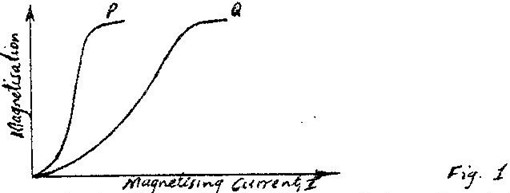
(b) In an experiment to magnetize two substances P and Q using electric current, two curves (graphs) were obtained as shown in Figure 1:

Using the information in Fig 1, explain the difference between the substances P and Q with reference to the domain theory (6 mks)
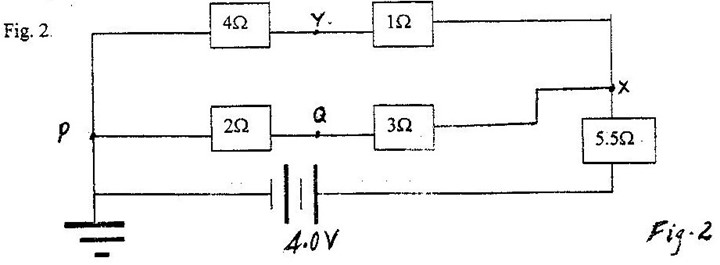
Determine:
(i) The total resistance of the circuit (3 mks)
(ii) The potential difference between Y and Q (2 mks)
(a) (i) Describe the experiment to determine the specific heat capacity C of a block of aluminium with two holes drilled in it to accommodate a thermometer and an electric immersion heater (2 mks)
(ii) State the measurements required in the experiment and show how they would be used to obtain C (5 mks)
(iii) State two precautions that should be taken in this experiment (2 mks)
(b) A copper calorimeter of mass 60 g is filled with 100 g of water at 25°C. Steam at normal temperature and pressure (N.T.P) is passed through the water until a temperature of 45°C is attained. The final mass of the calorimeter and the contents was found to be 163.5 g. Calculate the specific latent heat of vaporization ‘l’ of water (6 mks)
Specific heat capacity for water is 4200 J/kg·K and for copper is 378 J/kg·K
(a) (i) What is the difference between longitudinal and transverse waves? (1 mk)
(ii) State two distinctions between the way sound waves and electromagnetic waves are transmitted (2 mks)
(b) A mineworker stands between two vertical cliffs 400 m from the nearest cliff. The cliffs are X meters apart. Every time he strikes the rock once, he hears two echoes, the first one after 2.5 s, while the second follows 2 s later. From this information, calculate:
(i) The speed of sound in air (2 mks)
(ii) The value of X (3 mks)
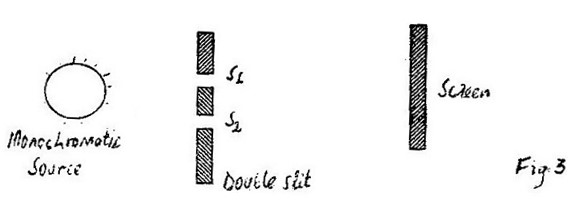
(c) In an experiment to observe interference of light waves, a double slit is placed close to the source. See Figure 3:
(i) State the function of the double slit (1 mk)
(ii) Describe what is observed on the screen (2 mks)
(iii) State what is observed on the screen when:
I. The slit separation S1S2 is reduced (1 mk)
II. White light source is used in place of monochromatic source (1 mk)
SECTION II (15 MARKS)
Answer any two questions from this section in the spaces provided after question 7
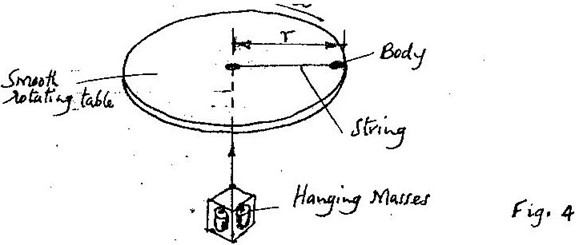
(a) The Fig. 4 shows the diagram of a setup to investigate the variation of centripetal force with the radius r of the circle in which a body rotates:
Describe how the setup can be used to carry out the investigation (5 mks)
Table 1
Mass, m (g) 60 50 40 30 20 Radius, r (cm) 50 41 33 24 16 Table 1 shows results obtained from an investigation similar to the one in part (a)
- Plot a graph of force, F (y-axis) on the body against the radius, r (in meters) (5 mks)
- Given that the mass of the body is 100 g, use the graph to determine the angular velocity (5 mks)
(a) Describe, with the aid of a diagram, an experimental setup for observing the photoelectric effect.
(b) Table 2 shows the relationship between the wavelength, λ, of radiation falling on the surface and the energy, K, of the emitted electrons:
λ (m) × 10-7 20 1.5 1.0 0.5 K (J) × 10-19 10 13 20 40 - Plot a graph of energy K (y-axis) against the frequency, f, of the incident light.
- Determine the work function Φ of the surface used (5 mks)
Speed of light, c = 3.00 × 10⁸ m/s; Planck’s constant h = 6.63 × 10⁻³⁴ J·s