


1. Figure 1 shows a measuring cylinder containing some liquid
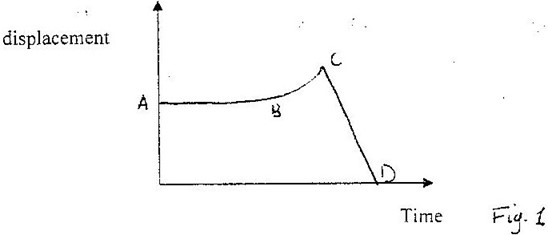
Figure 1
Another 5cm3 of the liquid is added into the cylinder. Indicate on the diagram the new level of the liquid.
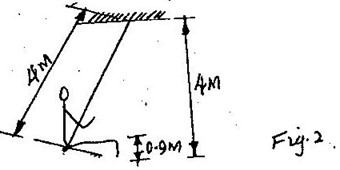
2. Two identical spring balances R and S each weighing 0.5N are arranged as shown in Figure 2.
Figure 2
What is the reading on balance R?
3. Figure 3 shows two identical trolleys with loads A and B. The loads are identical in shape and size.
Figure 3
Given that the density of A is greater than that of B, explain why the trolley in figure 3(ii) is more suitable.
4. The reading on a mercury barometer at a place is 700mm. What is the pressure at the place in Nm-2 (Density of mercury is 1.36 x 10⁴ kgm-3)?
5. Explain the cause of random motion of smoke particles as observed in Brownian motion experiment using a smoke cell.
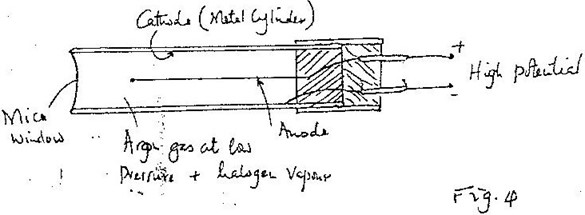
Figure 4
Explain this observation.
7. When a Bunsen burner is lit below wire gauze, it is noted that the flame initially burns below the gauze as shown in Figure 5(i). After some time, the flame burns below as well as above the gauze as shown in Figure 5(ii).
Explain this observation.
8. Figure 6 shows a ray of light being reflected from a mirror.
Figure 6
What is the angle of reflection?
Figure 7
Explain this observation.
10. State one advantage of a lead–acid accumulator over a nickel–iron (NiFe) accumulator.
11. One of the factors that affect the surface tension of a liquid is the presence of impurities. State one other factor.
12. Figure 8 shows a bar of soft iron placed near a magnet.


Figure 8
On the same diagram, sketch the magnetic field pattern due to the setup.
13. Give a reason why the core of the electromagnet of an electric bell is made of soft iron and not steel.
14. Figure 9 shows a uniform bar in equilibrium under the action of two forces.
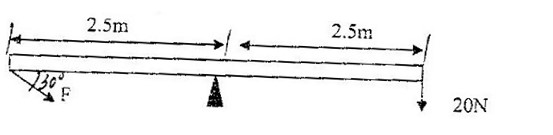
Figure 9
Determine the value of F.
15. One of the conditions for total internal reflection to occur is that the angle of incidence must be greater than the critical angle of the medium. State the other condition.
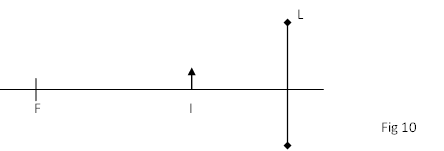
On the same diagram, draw appropriate rays to locate the position of the object. Determine the object distance.
17. An electric bulb is rated 75W, 240V. Determine the resistance of the bulb.
18. The following equation shows part of a radioactive decay process.
 234TPa90 → 23491
Name the radiation x.
19. Pure silicon can be changed into p-type semiconductor by adding an impurity. Explain how this is achieved.
20. When a piece of metal is placed on water, it sinks. But when the same piece of metal is placed on a block of wood, both are found to float. Explain this observation.
21. A girl standing 600m away from a cliff bangs two pieces of wood together and hears an echo 3.5 seconds later. Determine the speed of sound in air at that place.
22. On the axes provided in Figure 11, sketch a graph of velocity (V) versus time (t) for uniformly accelerated motion given that when t = 0, v is greater than zero.
Figure 11
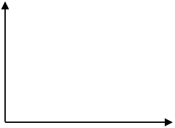
t fig. 11
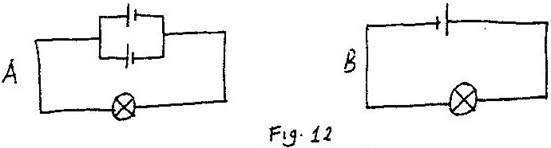
23. In the circuit diagram shown in Figure 12, the lamps are identical and the cells are also identical.
Figure 12.
State with reason, in which circuit the lamp will be lit for a longer period.
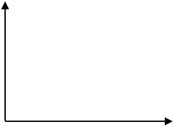
24. On the axes provided in Figure 13, sketch a graph of pressure (p) against reciprocal of volume (1/V) for a fixed mass of an ideal gas at constant temperature.
p
1/V fig. 13
25. Give a reason why the target in an X-ray tube is made of tungsten or molybdenum.
26. Two identical stones A and B are released from the same height above the ground; A falls through air while B falls through water.
Figure 14.
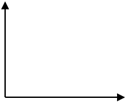
KE
t
On the axes provided in Figure 14, sketch the graphs of kinetic energy (KE) against time (t).
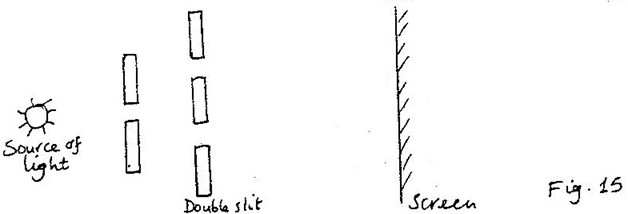
27. Figure 15 shows an experimental arrangement for determining the wavelength of light.
State and explain the difference in the patterns observed on the screen other than the difference in colour when the source of red light is replaced by a source of violet light.
28. A heating element rated 2.5 kW is used to raise the temperature of 3.0 kg of water through 50oC. Calculate the time required to effect this. (Specific heat capacity of water is 4200 J/kgK)
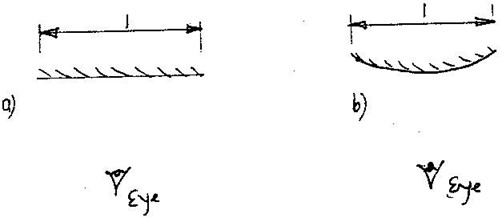 Figure 16
By sketching a pair of incident and reflected rays for each (a) and (b), show how the convex mirror provides to the eye a wider field of view than the plane mirror.
30. A resultant force F acts on a body of mass m causing an acceleration a1 on the body. When the same force acts on a body of mass 2m, it causes an acceleration a2. Express a2 in terms of a1.
31. Arrange the following in order of increasing frequency:
- Visible light
- Infrared radiation
- X-rays
- Ultraviolet radiation
- Radio waves
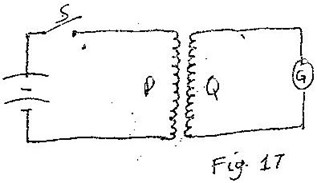 Two identical copper coils P and Q are placed close to each other as shown in Figure 17. Coil P is connected to a D.C. power supply and coil Q is connected to a galvanometer, G.
Use this information to answer questions 32 and 33.
32. State and explain what would be observed on the galvanometer immediately the switch S is closed.
33. State with reason the difference that would be noted in the observation made in question 32 if the number of turns in coil Q were doubled.
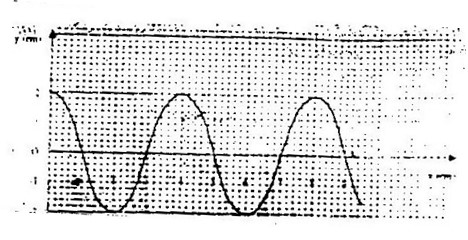
34. Figure 18 shows the pattern produced by an A.C voltage on a CRO screen.
Figure 18.
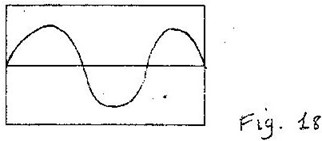
On the same figure, sketch the pattern produced by the same voltage when the time base is switched off.
35. The minimum frequency of radiation necessary to cause photoelectric effect on a certain metal surface is 9.06 x 10¹⁴ Hz. Determine the work function of the metal. (Planck’s constant h = 6.63 x 10⁻³⁴ Js)
36. Figure 19 shows a pith ball placed in a flask. When a jet of air is blown over the mouth of the flask as shown, the pith ball is observed to rise from the bottom.
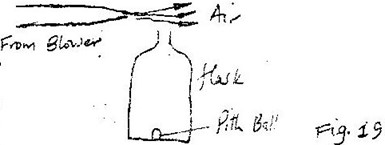 Figure 19
Explain this observation.
37. Figure 20 shows three capacitors connected between two points A and B.
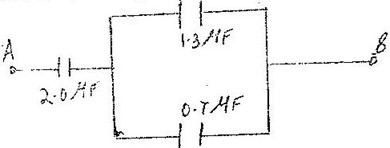 Figure 20
Determine the capacitance across AB.


