


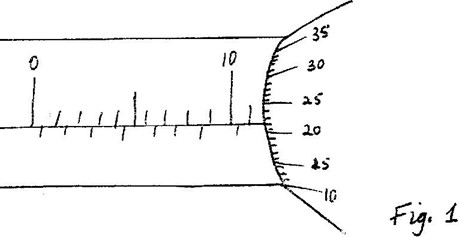
 1. Fig one shows a micrometer screw gauge being used to measure the diameter of a metal rod.
The thimble scale has 50 divisions.
What is the reading shown?
2. Fig. 2 represents a rock balanced at point O. G is the center of gravity of the rock. Use this information to answer questions 2 and 3.
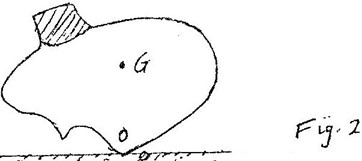
Draw and label on the figure the forces acting on the rock.
3. If the portion of the rock represented by the shaded part is chopped off, explain why the rock may topple to the right.
4. A current of 0.70 A flows through a wire when a p.d of 0.35 V is applied at the ends of the wire. If the wire is 0.5 m long and has a cross-sectional area of 8.0 x 10⁻³ m2, determine its resistivity.
5. The total weight of a car with passengers is 25,000 N. The area of contact of each of the four tyres with the ground is 0.025 m2. Determine the minimum car tyre pressure.
6. When an inflated balloon is placed at equal in a refrigerator, it is noted that its volume reduces. Use the kinetic theory of gases to explain this observation.
7. An electric heater is placed at equal distances from two similar metal cans A and B filled with water at room temperature. The outer surface of can A is shiny while that of can B is dull black. State with reasons which can will be at a higher temperature after the heater is switched on for some time.
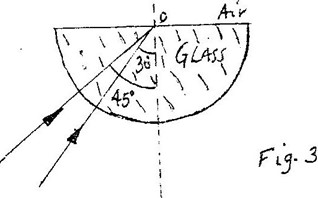 8. Fig. 3 shows two rays A and B entering a semi-circular glass block which has a critical angle of 42o. The rays are incident at an air–glass boundary at point O.
Complete the path of the two rays from point O. Label A’ and B’ the corresponding rays.
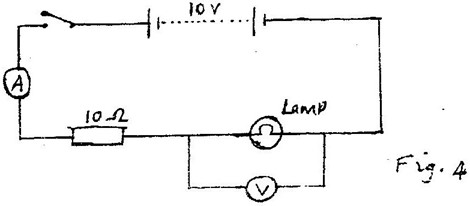 9. Fig. 4 shows an electrical circuit. When the switch is closed, the ammeter reading is 0.3 A.
Determine the voltmeter reading.
10. Fig. 5 shows a wire A and a spring B made of the same material. The thickness of the wire is the same in both cases. Masses are added on each at the same intervals and the extension noted each time.
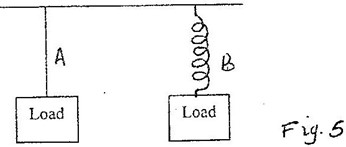
On the same axes provided, sketch the graphs of extension against load for each. (Hooke’s law is obeyed.)
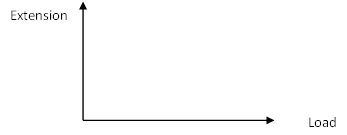
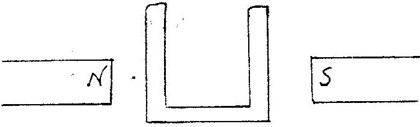 Figure 6
Sketch the magnetic field pattern.
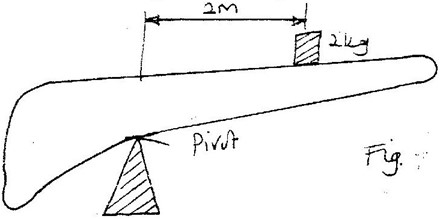 12. Fig. 7 shows a non-uniform log of mass 100 kg balanced on the pivot by a 2 kg mass placed as shown.
Determine the distance of the center of gravity of the log from the pivot.
13. Fig. 8 shows two parallel thick copper conductors connected to a D.C. power supply. A rider made from a thin copper wire is placed on the conductors.
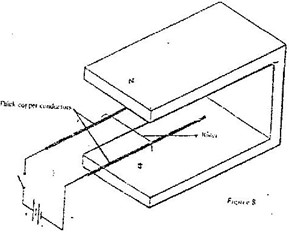
State and explain what is observed on the rider when the switch is closed.
14. Fig. 9 shows a speed–time graph for the journey of a motorcar.
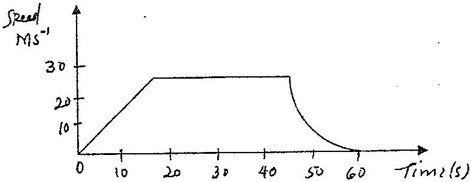
Determine the distance the car travels in the first 40 seconds.
15. Fig. 10 shows how the potential energy (P.E) of a ball thrown vertically upwards varies with height.
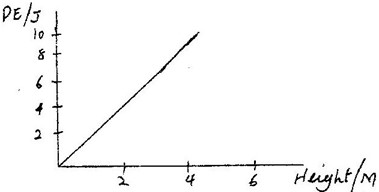
On the same axes, plot a graph of the kinetic energy of the ball.
16. The chart below shows an arrangement of different parts of the electromagnetic spectrum.
| RADIO | INFRARED | VISIBLE | A | X – RAYS | GAMMA RAYS |
Name the radiation represented by A.
17. Name two factors other than tension, which determine the frequency of sound from a stretched wire at room temperature.
18. An electric bulb with a filament of resistance 480 Ω is connected to a 240 V mains supply.
Determine the energy dissipated in 2 minutes (3 marks).
19. An immersion heater rated 90 W is placed in a liquid of mass 2 kg. When the heater is switched on for 15 minutes, the temperature of the liquid rises from 20oC to 30oC. Determine the specific heat capacity of the liquid. (Assume no heat losses)
20. A high jumper usually lands on a thick soft mattress. Explain how the mattress helps in reducing the force of impact.
21. Fig. 11 shows part of the circuit containing two capacitors of 2 mF and 3 mF respectively.
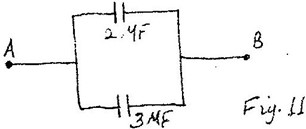
Determine the p.d across AB given that the total charge in the capacitors is 1 x 10⁻⁴ Coulombs.
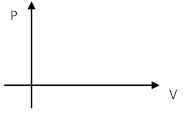
22. On the axes provided, sketch the P-V graph for a gas obeying Boyle’s law.
23. Fig. 12 shows water waves incident on an aperture AB.
On the same diagram, sketch the waves after going through the aperture.
24. The audible frequency range for a certain person is 30 Hz to 16,500 Hz. Determine the largest wavelength of sound in air the person can detect. (Speed of sound in air = 330 m/s)
25. A block of glass of mass 250 g floats in mercury. What volume of glass lies under the surface of the mercury? (Density of mercury is 13.6 x 10³ kg/m3).
26. A small object moving in a horizontal circle of radius 0.2 m makes 8 revolutions per second.
Determine its centripetal acceleration.
27. Cobalt 60 is a radioisotope that has a half-life of 5.25 years. What fraction of the original atoms in a sample will remain after 21 years?
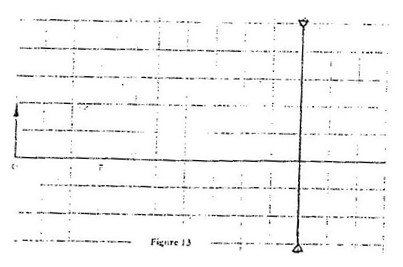 28. Fig. 13 represents an object O placed 10 cm in front of a diverging lens. F is the focal point of the lens.
Draw rays to locate the position of the image. Determine the image distance.
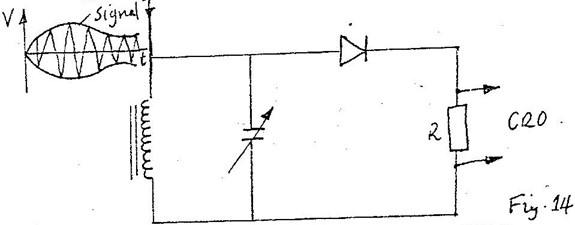
29. The circuit in figure 14 represents a simple radio receiver.
 V
V

30. The following table shows electrical appliances to be used in a house. The electrical rating for each appliance is shown. The following fuses are available: 5 A, 15 A, 30 A, and 45 A.
Appliances Voltage (V) Power (W)
T.V 250 300
Iron box 250 750
Electrical kettle 250 2,000
Determine which one of the fuses is suitable for the house.
31. A nucleus is represented by 10742X. State the number of neutrons in the nucleus.
32. State the property of X-rays which makes it possible to detect cracks in bones.
33. Fig. 15 shows a wire XY placed in a magnetic field.
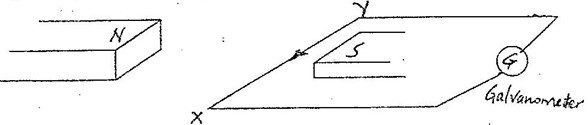
State the direction in which the wire must be moved for the current to move in the direction shown.
34. Light of a certain wavelength strikes the surface of a metal. State what determines the maximum kinetic energy of the electron emitted.


