


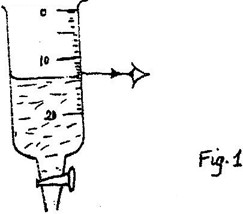
 1. Fig. 1 shows a burette partly filled with a liquid. The burette was initially full to the mark O. If the quantity of the liquid removed has a mass of 22 g, determine the density of the liquid.
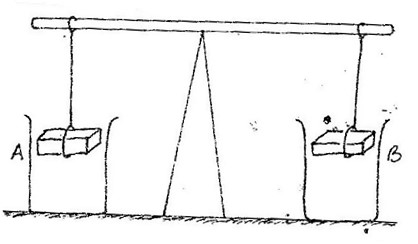 2. Fig. 2 shows a uniform bar in equilibrium.
Figure 2
When water is added into the beakers A and B until the weights are submerged, it is observed that the bar tips towards B. Explain this observation.
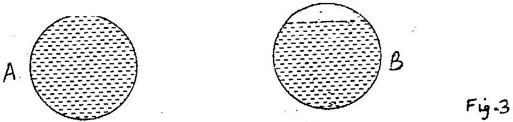 3. Fig. 3 shows two identical hollow spheres. Sphere A is completely filled with the liquid while B is partly filled with identical liquid.
When the two spheres are rolled gently on a horizontal surface, it is observed that sphere B stops earlier than sphere A. Explain this observation.
4. State the reason why it may not be possible to suck liquid into your mouth using a drinking straw on the surface of the moon.
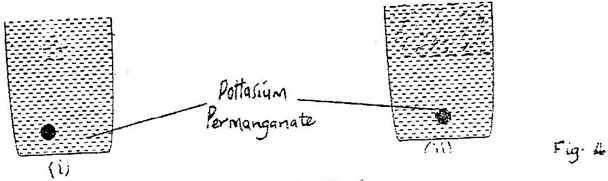
Fig. 4(ii) shows the appearance of the liquid after about 30 minutes. Explain how this appearance was caused.
Fig. 5 shows a flask fitted with a glass tube dipped into a beaker containing water at room temperature. The cork fixing the glass tube to the flask is airtight.
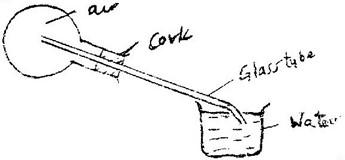
Use the information and the figure to answer questions 6 and 7.
6. State what is observed when ice-cold water is poured on the flask.
7. Give a reason for the observation in question 6.
8. Fig. 6 shows an object O being viewed using two inclined mirrors M1 and M2.
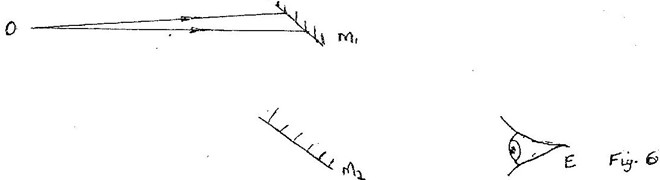 Complete the diagram by sketching rays to show the position of the image as seen by the eye E.
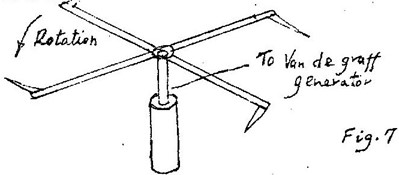 9. Fig. 7 shows a “windmill” which, when connected to the dome of a positively charged Van de Graaff generator, is observed to rotate as indicated. A, B, C, and D are sharp points.
Figure 7.
Explain how this rotation is caused.
10. Explain how polarization reduces current in a simple cell.
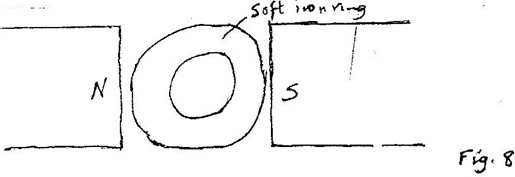
11. Fig. 8 shows a soft-iron ring placed between the poles of a magnet. On the same diagram, sketch the magnetic field pattern.
12. Fig. 9 shows a uniform light bar one meter in length in equilibrium under the action of forces F1, F2, F3, and F4. All the forces are in the same plane. Use the information on the figure to answer questions 12 and 13.
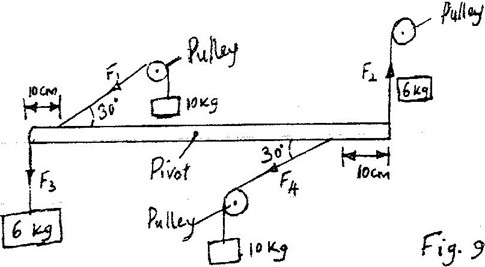
12. Name one set of forces on the figure that constitutes a couple.
13. Determine the moment of the couple named in question 12.
14. A bullet moving at a velocity of 300 m/s hits a tree trunk of diameter 50 cm. It emerges from the opposite side with a velocity of 150 m/s. Determine the average deceleration of the bullet in the trunk.
15. A certain machine raises 2.0 tonnes of water through 22 metres. If the efficiency of the machine is 80%, how much work is done on the machine? (Acceleration due to gravity g = 10 m/s2)
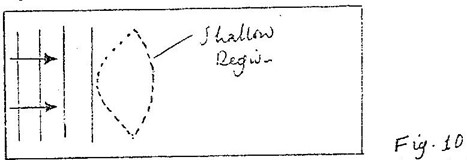 16. Fig. 10 shows water waves incident on a shallow region of the shape shown with a dotted line.
On the same diagram, sketch the wave pattern in and beyond the shallow region.
When the switch S is closed, the ammeter reads 0.01 A. Determine the internal resistance of the battery.
18. An electric heater rated 240 V, 300 W is to be connected to a 240 V mains supply through a 10 A fuse. Determine whether the fuse is suitable or not.
19. Fig. 12 shows two identical containers A and B into which a copper rod is fitted. The containers are well lagged.
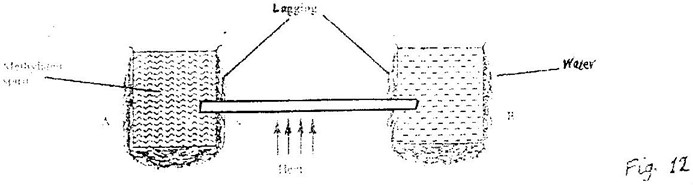
Figure 12
The liquids in the containers were initially at the same temperature. If heat is applied continuously at the position shown, state with reason the container through which the loss of heat is likely to be higher.
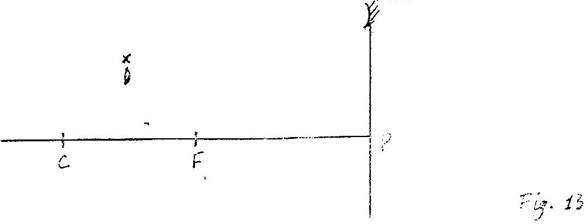
20. Fig. 13 shows a point object O placed in front of a concave mirror.
Draw appropriate rays to locate the image of the object.
21. Fig. 14 shows a ray of light incident on a glass prism.
If the critical angle of the glass is 39°, sketch on the same diagram the path of the ray until it emerges from the prism.
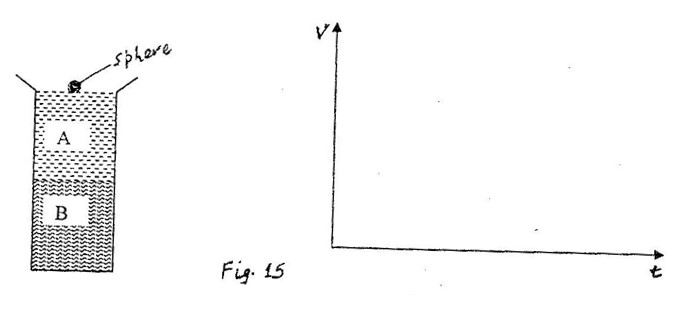
On the axes provided, sketch the velocity–time graph for the motion of the spheres through the fluids.
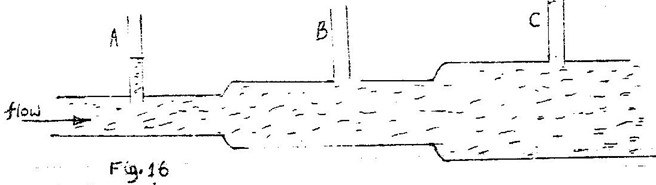 23. Fig. 16 shows a non-viscous fluid flowing through a pipe along which vertical tubes A, B, and C have been fitted.
Complete the diagram by indicating the possible levels of the fluid in tubes B and C.
24. Two identical containers A and B are placed on a bench. Container A is filled with oxygen gas and container B with hydrogen gas such that the two gases have equal masses. If the containers are maintained at the same temperature, state with reason the container in which the pressure is higher.
25. Fig. 17(i) shows a stretched string AB vibrating in its fundamental mode.
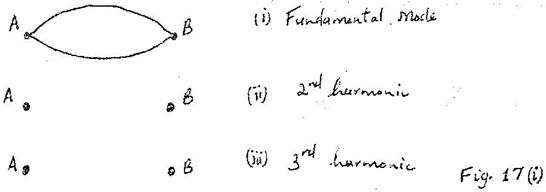 Figure 17(i)
Sketch in Fig. 17(ii) and (iii) the 2nd and 3rd harmonics of the string respectively.
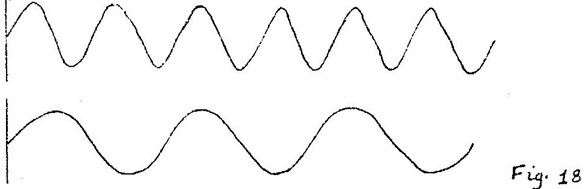
Determine the beat frequency.
27. State the reason why radio wave signals are easier to receive than TV (television) signals in a place surrounded by hills.
28. Fig. 19 shows two spheres made of wax each of mass 0.10 kg held in a liquid by strings A and B.
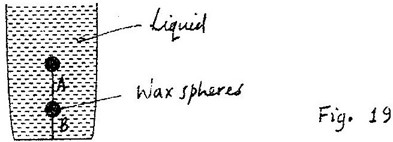
If the upthrust on each sphere is 1.05 N, determine the tension in each string. (Acceleration due to gravity g = 10 m/s2)
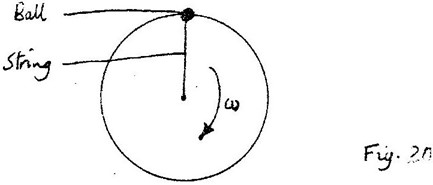 29. Fig. 20 shows a ball being whirled in a vertical plane.
Sketch on the same figure the path followed by the ball if the string cuts when the ball is at the position shown in the figure.
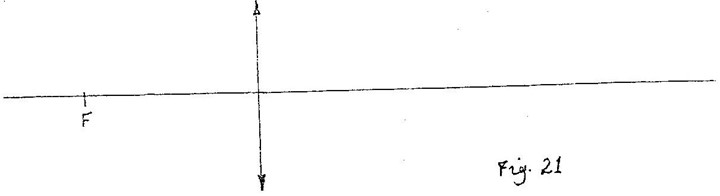 30. Fig. 21 shows a converging lens whose focal point F is marked.
An object is placed in front of the lens such that the lens forms a real magnified image.
Sketch on the same diagram a ray diagram to represent this.
31. The lens and object are connected to a cathode ray oscilloscope (CRO).
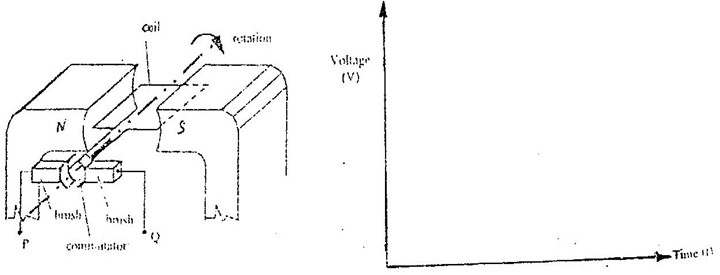
Sketch on the axes provided the graph of the voltage output as seen on the CRO, given that when t = 0 the coil is at the position shown in the figure.
32. A 60 W bulb is used continuously for 36 hours. Determine the energy consumed. Give your answer in kilowatt-hour (kWh).
33. State the factor that determines the hardness of the X-rays produced in an X-ray tube.
34. The following reaction is part of a radioactive series:
 120 Y 210 c
83 4 b
Identify the radiation r and determine the values of b and c.


