


PHYSICS 2011 PAPER 2
QUESTIONS AND MARKING SCHEMES
Section 1 (25 marks)
Answer all the questions provided in this section in the space provided.
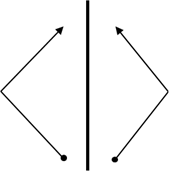
- Figure 1 shows an object placed in front of a plane mirror.

Figure 1
Sketch the image of the object as seen in the mirror.

- Figure 2 shows two identical pithballs A and B suspended with insulated threads. They are separated by an insulator X. A is positively charged while B is negatively charged. The quantity of charge on A is three times the quantity of charge on B.
Figure 2
Sketch on the space beside the figure the final position of the pithballs after the insulator is removed. (1 mark)

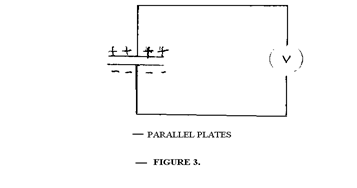
- Figure 3 shows a voltmeter connected across two charged parallel plates.
When a thin sheet of mica is inserted between the plates, the voltmeter reading is observed to reduce. Explain this observation. (3 marks)
Mica has high permittivity/dielectric constant, raises capacitance hence lowers potential difference since V = Q/C but Q is constant.
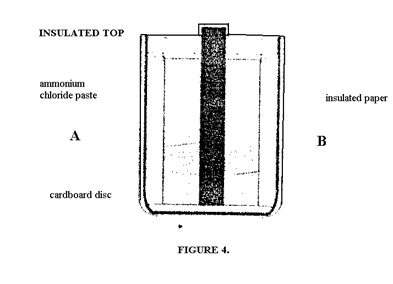
- Figure 4 shows the cross-section of a dry cell. Use the information on the figure to answer questions 4 and 5.
- Name the parts labeled A and B. (2 marks)
A – carbon rod/graphite
B – manganese (IV) oxide + powdered carbon
- State the use of the manganese (IV) oxide in the cell. (1 mark)
Manganese (IV) oxide is a depolarizer/oxidizing agent; it oxidizes hydrogen to water/reacts with hydrogen to form water.
- Name the parts labeled A and B. (2 marks)
- One method of producing a weak magnet is to hold a steel rod in the North-South direction and then hammer it continuously for some time. Using the domain theory of magnetism, explain how this method works. (2 marks)
Hammering causes domains/dipoles to vibrate/disturb. As they settle, some face North-South due to Earth’s magnetic field.
Figure 5 shows a motor connected to a magnetic switch called a relay operated by an ordinary switch S1. Use the information in the figure to answer questions 7 and 8.

- Explain how the relay switches on the motor when S1 is closed. (3 marks)
When S1 is closed, current flows in the solenoid magnetizing the iron; this attracts the iron armature closing the contacts. This causes current to flow in the motor circuit/contact closes/switches on the motor/motor keeps running continuously.
- State with a reason the effect on the motor if the iron core is replaced with a steel core and switch S1 is put on and then off. (2 marks)
Steel would remain permanently magnetized causing current in motor circuit to remain on when S1 is open.
Reason: Takes a longer time to start; once switched on motor runs continuously. Not easily magnetized and demagnetized. Hard magnetic material/permanent magnet.
- Figure 6 shows standing waves on a string. It is drawn to a scale of 1:5.
- Indicate on the diagram the wavelength of the standing wave.
- Determine the wavelength of the wave.
25A = 10 x 5 = 20 cm / 0.2 m

- Figure 7 shows two rays of light incident normally on face PQ of a glass prism, whose critical angle is 42°.
Complete the diagram to show the paths of the two rays as they pass through the prism. (3 marks)

- A 4Ω resistor is connected in series to a battery of e.m.f 6V and negligible internal resistance. Determine the power dissipated by the resistor. (2 marks)

- Table 1 shows radiations and their respective frequencies.
Table 1
Type of radiation Yellow light Gamma rays Radio waves Microwaves Frequency (Hz) 1 x 10¹⁵ 1 x 10²² 1 x 10⁶ 1 x 10¹¹ Arrange the radiations in the order of increasing energy. (1 mark)
Radio waves, microwaves, yellow light, gamma rays



- State the reason why electrical power is transmitted over long distances at very high voltages. (1 mark)
High voltage leads to low current hence low power (I²R) losses/energy loss.
- State the meaning of the term “threshold frequency” as used in photoelectric emission. (1 mark)
The minimum frequency of incident radiation to cause emission of photoelectrons/photoemission/to eject/dislodge/remove electrons.
SECTION B (55 marks)
Answer all the questions in this section in the spaces provided.
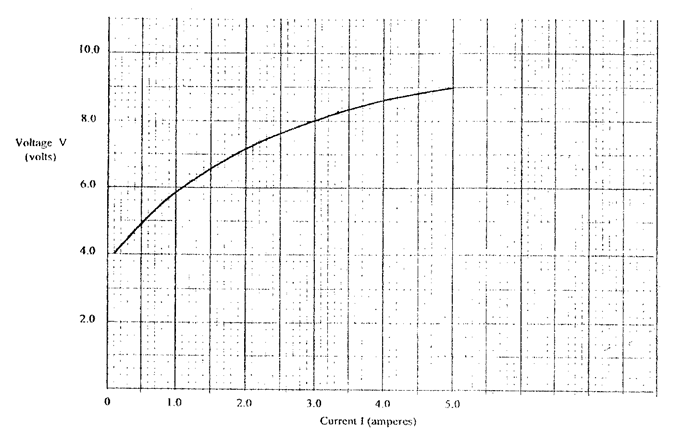
- Figure 8 shows graph of potential difference V (volts) against current (ampere) for a certain device.
From the graph:
(i) State with a reason whether or not the device obeys Ohm’s law. (2 marks)
Does not obey Ohm’s law. The graph is not a straight line through the origin (non-linear). Current is not directly proportional to potential difference.
(ii) Determine the resistance of the device at I = 1.5A.
R = gradient at I (showing the tangent) = (9.2 – 4.8) / (3.6 – c)
(iii) Determine the resistance of the device at I = 3.5A.
R = gradient of tangent at I (showing the tangent) = (9.4 – 7.2) / (5.4 – 1.5) = 2.2 / 3.9 = 0.56 Ω (approx. 0.46 – 0.66)
(iv) From the results obtained in (ii), state how the resistance of the device varies as the current increases. (1 mark)
Resistance decreases as the current increases.
(v) State the cause of this variation in resistance. (1 mark)
Change (increase) in temperature/temperature is constant.
- Three identical dry cells each of e.m.f. 1.6V are connected in series to a resistor of 11.4Ω. A current of 0.32A flows in the circuit. Determine:
(i) the total e.m.f. of the cells; (1 mark)
Vtotal = 1.6 + 1.6 + 1.6 = 4.8 V = E
(ii) the internal resistance of each cell. (3 marks)

- (a) State the meaning of the term “principal focus” as applied in lenses. (1 mark)
– a biconvex lens and lens holder.
– a lit candle.
– a white screen.
– a metre rule.
(i) Draw a diagram to show how you would arrange the above apparatus to determine the focal length of the lens.
(ii) Describe the procedure you would follow.
Candle is placed at a certain distance from the lens. The distance between the screen and the lens is adjusted until a sharp image is focused on the screen/clear image.
(iii) State two measurements that you would take. (2 marks)
The distance of candle from lens (u) is measured.
The distance of screen from lens (v) is also measured.
(iv) Explain how the measurements in (iii) would be used to determine the focal length.
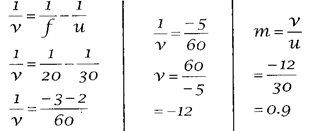
(c) An object is placed 30 cm in front of a concave lens of focal length 20 cm. Determine the magnification of the image produced. (4 marks)


- State what is meant by “electromagnetic induction”. (1 mark)
The production of induced emf when the magnetic flux linking a circuit is changed.
- Figure 9 shows a simple electric generator.
- Name the parts labeled P and Q. (2 marks)
P – brushes/carbon/graphite
Q – slip rings
- Name the parts labeled P and Q. (2 marks)

- Sketch on the axes provided a graph to show how the magnitude of the potential difference across R changes with time. (1 mark)

- State two ways in which the potential difference produced by such a generator can be increased. (2 marks)
Increasing number of turns/coils.
Increasing speed of rotation/rate of rotation.
Winding coil on soft iron core.
Increasing area/size.
- In a transformer, the ratio of primary turns to secondary turns is 1:10. A current of 500 mA flows through a 200Ω resistor in the secondary circuit. Assuming that the transformer is 100% efficient, determine:
(i) the secondary voltage; (1 mark)
Vs = 200 × 0.5 = 100 V
(ii) the primary voltage; (2 marks)
NP/NS = VP/VS
VP = 100 × 1 / 10 = 10 V
(iii) the primary current. (2 marks)
VP = IS × IP = 0.5 × 100
VS = IP × 10
I = 5 A
- (a) State two differences between cathode rays and electromagnetic radiations. (2 marks)
– Cathode rays are deflected by magnetic or electric fields; electromagnetic radiations cannot be deflected.
– Cathode rays are produced by thermionic emission while electromagnetic radiations originate from changes in the nucleus.
– Cathode rays have charge but electromagnetic radiations do not.
– Cathode rays are particles and have mass but electromagnetic radiations are waves.
– Cathode rays travel at a speed depending on the accelerating voltage; electromagnetic radiations travel at the speed of light in vacuum.
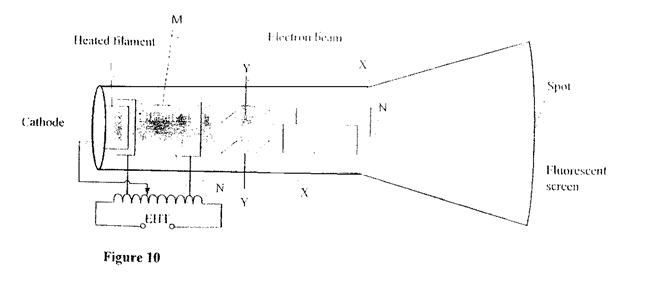
- (b) Figure 10 shows the main features of a cathode ray oscilloscope (CRO).
- Name the parts labelled M and N. (2 marks)
M – grid
N – accelerating anode/anode
N – vacuum space/evacuated space
- Explain how electrons are produced in the tube. (2 marks)
Cathode is heated by filament; electrons are released from cathode by thermionic emission/hot filament emits electrons.
- When using the CRO to display waveforms of voltages, state where the following should be connected:
- The voltage to be displayed on the screen; (1 mark)
Across y-plates/horizontal plates.
- The time base voltage (1 mark)
Across x-plates/vertical plates.
- State why the tube is highly evacuated. (1 mark)
To reduce collisions (hence ionization) with air molecules in the tube.
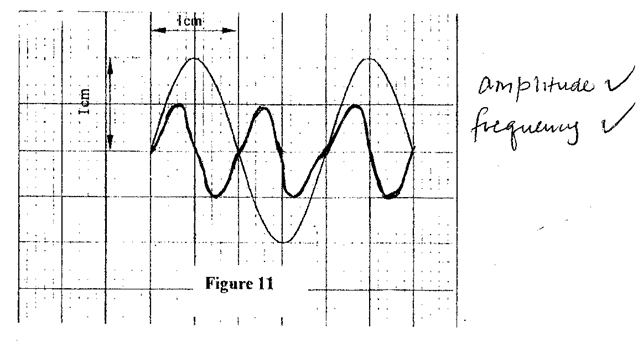
- (c) Figure 11 shows the waveform of a voltage displayed on the screen of a CRO. The Y-gain calibration was 5 V per cm.
(i) Determine the peak-to-peak voltage of the Y-input. (1 mark)
Peak-to-peak voltage = 5 × 2 = 10 V
(ii) Sketch on the same figure the appearance of the waveform after the voltage of the input signal is halved and its frequency is doubled. (2 marks)
- x-radiation / Alpha 42 He2+
Short range with intense ionization hence tracks/massive/high ionization.
- When a radiation was released into a diffusion cloud chamber, short thick tracks were observed. State with a reason the type of radiation that was detected. (2 marks)
(b) The half-life of an element X is 3.83 days. A sample of this element is found to have an activity rate of 1.6 × 101 disintegrations per second at a particular time.
Determine its activity rate after 19.15 days. (2 marks)

(c) State what is meant by an extrinsic semiconductor. (1 mark)
A semiconductor in which impurities have been added to change conductivity/improve/enhance conductivity. Pure semiconductor which has been doped. Impure semiconductor.
(d) Figure 12 shows a depletion layer in an unbiased p-n junction.
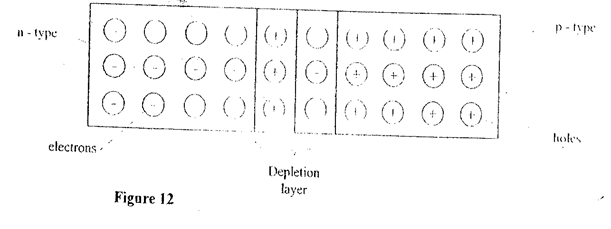
State how a battery can be used to make the depletion layer narrower. (1 mark)
By connecting it in forward bias mode (i.e., p to + and n to -).
(e) Figure 13 shows an incomplete circuit of a full wave rectifier.
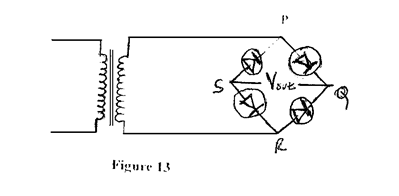
(i) Draw in the figure two more diodes to complete the circuit. (2 marks)
(ii) Show on the figure the points across which the output of the rectifier should be obtained.


