

SETS (Theme 1)
Week I
Lesson 1 and 2
Review of types of sets.
A set is a collection of well defined members or elements.
TYPES OF SETS (Review)
- Empty set or null set.
This is a set without any members.
 Symbol: or Ф
e.g. Pupils in a class without heads.

__________________________________________________________
- Equivalent sets
These are sets with the same number of members but the members may be different.
Symbol: ó
e.g. A = b,c,d,e B = 0, 1, 2, 3set A is equivalent to set B
A ó B
N.B. <≠> means “not equivalent to”
- Equal sets
These are sets with the same number of members which are exactly the same.
Symbol: =
e.g. K = a, b, c, c L = b, a, cSet K is equal to set L because they have the same number and the same members.


K = L
__________________________________________________________
- Disjoint sets
These are sets without any common members.
e.g. M = 6, 7, 8 N = 2, 3, 4, 5Set M and set N don’t have any common members.
REF: Primary MTC Bk 4 pg 1


- Understanding MTC bk 4 pg 1
- Primary MTC Bk 4 pg 9
- Primary school MTC bk 4 pg 1
UNION, INTERSECTION AND NUMBER OF MEMBERS
UNION SETS (Review)
This is a set which contains all the members in the given sets.
N.B. Common members are written once.
Symbol: U
e.g. Set P = { a, e, , o, u }
Q = { 2, 4, 6, 8 }
Set P U Q = { a, e, , o, u, 2, 4, 6, 8 }
__________________________________________________________
INTERSECTION SET (Review)
This set with the common members of the given set.
Symbol: “∩”
e.g. P = { 1, 2, 3, 4, 5 }
B = { 0, 1, 3, 4, 5}
Find:
- P ∩ B = { 2, 3, 4, 5}
- P U B = { 0, 1, 2, 3, 4, 5}
__________________________________________________________
- A = {Banana, Orange}
B = {Apple, Orange}
Find:
- A ∩ B = { Orange}
- A U B = { Banana, Orange, Apple }
__________________________________________________________
Week two lesson one
NUMBER OF MEMBERS (Review)
Symbol: n ( )
Examples
- P = { a, b, c}
How many members are in set P.
n(P) = 3 members.
__________________________________________________________
- M = { days of the week }
Find n(M)
M = {Mon, Tue, Wed, Thur, Fri, Sat, Sub}
Find: n(M) = 7
__________________________________________________________
REF: – Understanding
- Primary MTC bk 4 pg 14 – 15
- Kenya Primary MTC Bk 4 4 pg 15 – 16
__________________________________________________________
Week two lesson two
VENN DIAGRAM (Review)
Representing information on a Venn diagram:
 P Q
P Q
Members Members of
Of Set P P∩Q Set Q only
Only
Example:
Given P = {0, 2, 4, 6, 8}
P = {1, 2, 3, 4, 5, 78}
Find: P∩Q = { 2, 4}
A U B = {0, 1, 2, 3, 4, 5, 6, 7, 8 }
Represent the sets on a Venn diagram.
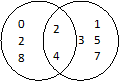 P Q
P Q
REF: MK bk 5 Pg 12
Primary MTC for Uganda bk 4
Pg 60 – 62
MK Bk 4 Pg 11 – 14
Week two lesson three
Shading Venn Diagrams (Review)
Example:
A-B N-M
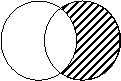
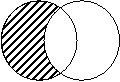 A B M N



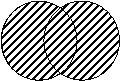 A A B K L P
AUB A∩B KUL P∩B
Getting information from a Venn Diagram (Review)
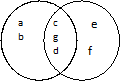
A B
List down all members of Set;
A = { a, b, c, d, g}
B = { c, g, d, e, f}
A∩B = {c, d, g}
A U B = { a, b, c, d, g, e, f }
n(A∩B) = 3 members
REF: MK Bk 5 pg 7
MK Bk 4 pgs 11 – 14
Week two lesson four
Difference of sets (Review)
P – Q means members of set P which are not in Set Q, that is, members found in Set P only.
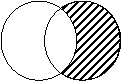
 P Q P Q
P – Q Q – P
Example:
Given : P = {2, 3, 4, 6, 8, 9}
Q = {1. 2, 5, 6, 7, 10}
Find: P – Q = {3, 4, 8, 9}
Q – P = 1, 5, 7, 10}
Example II
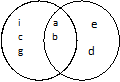 M N
M N
Find: M – N = {i, c, g}
N-M = { d, e}
Week two lesson five
SUBSETS
A subset is a small set got from the main set.
Symbol: “C”
“¢” means not a subset of.
__________________________________________________________
Example:
Given; E = {all pupils in P.4}
K = { all boys in P.4}
B = {all girls in P.4}
Set B and set K are subsets of set E
Example
If: D = {1, 2, 3, 4}
T = {2, 4}
S = {1, 3}
K = {5, 6}
T is a subset of D
(T C D)
S is a subset of D
(S C D)
K is not a subset of D
(K ¢
D)
__________________________________________________________
Given: B = {s,t,v} Form subsets from set B
{ s }, { t }, { v }, { s, t}, {t, v }, {s, v}, {s, t, v}, { }
N.B. – An empty set is a subset of the main set.
– A set itself is a subset of that set.
__________________________________________________________
Using a Venn diagram to represent a subset
Using a Venn diagram to represent subsets.
 Q
Q
Set P is a subset of set Q
P c Q
Given: M = {a, b, c, d, e}
N = {a, e}
__________________________________________________________
Represent the sets on a Venn diagram.
 M
M
Find: M∩N = { a, e}
MUN = { a, b, c, d, e }
n(MUN) 5 Members
__________________________________________________________
 Q What is the relationship between P and
B?
B is a subset of P
Find: P∩B = {3, 4}
REF: MK Bk 4 pg 17 (old edition)
MK Bk 4 pg 17 (new edition)
__________________________________________________________
NUMERACY (theme 2)
Week three lesson one
Whole Numbers
Place value and value of whole numbers (Review)
Numeral | Hundred Thousands | Ten thousands | Thousands | Hundreds | Tens | Ones |
7041 | 7 | 0 | 4 | 1 | ||
24,678 | 2 | 4 | 6 | 7 | 8 | |
132,407 | 1 | 3 | 2 | 4 | 0 | 7 |
Finding the place value of the given digits.
What is the place value of 4 in 642?


 6 4 2
6 4 2
Ones
Tens
Hundreds
:. The place value of 4 is Tens.
__________________________________________________________
Find the place value of each digit in 6738.


 6 7 3 8
Ones
Tens
Hundreds
Thousands
:. The place value of 6 is Thousands
The place value of 7 is Hundreds
The place value of 3 is Tens
The place value of 8 is Ones
__________________________________________________________
REF: – Primary School MTC Bk 4 pg 8
– Learning MTC Bk 4 pg 5
– MK Bk 4 pg 20 (Old edition)
__________________________________________________________
Week three lesson two
Value of wholes(Review)
Value = digit x place value
Find the value of each of the digits in 672
H T O
6 7 2


2 x 1 = 2
7 x 10 = 70
6 x 100 = 600
__________________________________________________________
Find the value of 0 in 6042
 6 0 4 2
0 x 100 = 0
__________________________________________________________
What is the value of 2 in 432?
H T O
4 3 2
2 x 1 = 2
__________________________________________________________
REF: MK Bk 4 pg 20
Learning MTC Bk 4 pg 6
Primary Science MTC Bk 4 pg 8
Week three lesson three
Application of values and place values
Example:
Find the sum of the value of 2 and 3 in the number 623.
H T O
6 2 
 3
3
3 x 1 = 3
2 x 10 = + 2 0
2 3
__________________________________________________________
What is the sum of the place value of 6 and 2 in the number 632?
H T O
6 3 2


Ones = 1
Hundreds = + 100
101
__________________________________________________________
Find the product of the value of 2 and place value of 3 in 362.
H T O
3 6 2


2 x 1 = 2
Hundreds = 100
= 2 x 100
= 200
__________________________________________________________
The place value of 2 is tens. What is its value.
Value = Digit x Place value
= 2 x 10
= 20
__________________________________________________________
Week three lesson four
Writing whole numbers in words(Review)-up to thousands
- Write 6438 in words.
Thousands | Hundreds | Units |
6 | 4 | 38 |
6438 à Six thousand four hundred thirty eight.
- Write 14,008 in words
Thousands | Hundreds | Units |
14 | 0 | 08 |
14,008à Fourteen thousand eight.
- Express 240,402 in words
Thousands | Hundreds | Units |
240 | 4 | 02 |
240,402 à Two hundred forty thousand four
Hundred two.
__________________________________________________________
REF: MK Bk 4 pg 22
Learning MTC Bk 4 pg 6
Understanding MTC Bk 4 pg 11
Week three lesson five
Writing in figures (Review)
Write “three thousand six hundred in figures”.
Three thousand 3000
Six hundred +600
3600
__________________________________________________________
Write in figures; “Sixty thousand five hundred twenty.
Sixty thousand 60000
Five hundred 500
Twenty + 20
60,520
__________________________________________________________
REF: Understanding MTC bk 4 pg 13
Primary School MTC BK 4 PG 8
Learning MTC bk 4 pg 6
MK Bk 4 pg 23
__________________________________________________________
Week four lesson one
Writing numerals in expanded form(Review)
Expand 3485 using place values
3485 = (3 x 1000) + (4 x 100) + (8 x 10) + (5 x 1)
Expand 3485 using values
3485 = 3000 + 400 + 80 + 5
Expand: 46,246
46,246 = 40,000 + 6000 + 200 + 40 + 5
__________________________________________________________
REF: – MK Bk 4 pg 23
– Learning MTC Bk 4 pg 6
– Understanding MTC Bk 4 pg 14
Week four lesson two
Writing the expanded numbers in short. (Review)
Find the number which has been expanded to get;
- 4000 x 200 x 40 x 7 4 0 0 0
2 0 0
4 0
+ 7
4 3 4 7
- (5 x 100) + (6 x 1000)+ (4 x 1)
500 + 6000 + 4
6 0 0 0
5 0 0
+ 4
6 5 0 4
- (9 x 10000) + (4 x 1000) + (7 x 10)
90000 + 4000 + 70
9 0 0 0 0
4 0 0 0
+ 7 0
9 4 0 7 0
REF: – Learning MTC Bk 4 pg 6
– Understanding MTC bk 4 pg 4
__________________________________________________________
Week four lesson three
ROMAN NUMBERALS (Review) – up to one hundred.
Basic Roman Numerals are;
1 = I 50 = L 1000 = M
5 = V 100 = C
10 = X 500 = D
Roman numerals from 1 to 1000
Hindu Arabic | Roman numeral | Hindu Arabic | Roman numeral | |
1 | I | 8 | VIII | |
2 | II | 9 | IX | |
3 | III | 10 | X | |
4 | IV | 50 | L | |
5 | V | 100 | C | |
6 | VI | 500 | D | |
7 | VII | 1000 | M |
Roman numerals got by repeating 1 and X;
Examples: 2 = 1 + 1 = II
3 = 1 + 1 + 1 = III
20 = 10 + 10 = XX
30 = 10+10+10 = XXX
300 = 100+100+100= CCC
Roman numerals got by adding.
6 = 5 + 1 7 = 5 + 2
= V + I = V + II
= VI = VII
60 = 50 + 10 700 = 500 + 200
= L + X = D + CC
= LX = DCC
Roman numerals got by subtracting from 5, 50, 100, 500 and 1000:
4 = (1 subtracted from 5)
= IV
40 = (10 subtracted from 50)
= XL
90 = (10 subtracted from 100)
= XC
400 = (100 subtracted from 500)
= CD
900 = (100 subtracted from 1000)
= CM
REF: MK Bk 4 pg 32
Primary MTC for Uganda Bk 4 pg 14-17
__________________________________________________________
Week four lesson four
Expressing Roman numerals into Hindu Arabic numbers.
Convert the following to Hindu Arabic numerals:
- XIV = X + IV
= 10 + 4
= 14
- XXXIX = XXX + IX
= 30 + 9
= 39
- XLV = XL + V
= 40 + 5
= 45
- XCVIII = XC + VIII
= 90 + 8
= 98
- DCCVII = DCC + VII
= 700 + 7
= 707
REF: – MK Bk 4 pg 34
– Primary MTC for Uganda Bk 4 pg 17
Week four lesson five
Writing Hindu Arabic in Roman numerals
Examples
- Change 25 into Roman numerals
- = 20+5
= XX +V
= XXV
2.Express 49 in Roman numerals
49 = 40+9
= XL + IX
=XLIX
REF: – MK Bk 4 pg 34
– Primary MTC for Uganda Bk 4 pg 17
__________________________________________________________
Week five lesson one
Topical questions: MK Bk 4 pg 35
__________________________________________________________
Week five lesson two
OPERATION ON NUMBERS
Addition:
Words used in addition include; Sum, Total, Increase, Altogether, Add, e.t.c.
Examples:
- Find the sum of;
a) 7 4 6 4 b) 1 4 6 7 0 8
+ 4 4 2 5 + 5 2 6 1 4
11 8 8 9 1 9 9 3 2 2
- There are 469 goats, 943 cows and 6401 chicken on the farm. How many animals are there altogether?
4 6 9
9 4 3
+ 6 4 0 1
7 8 1 3
:. There are 7813 animals altogether.
REF: – Primary MTC for Uganda Bk 4 pg 23
– MK Bk 4 pg 38
– Primary School MTC bk 4 pg 14
__________________________________________________________
Week five lesson three
Subtraction of wholes numbers
Words used include; Reduce, Decrease, Difference, e.t.c.
- Subtract:
a) 8 4 3 2 b) 5 3 2 8 6 7
– 4 7 3 2 – 3 1 4 6 5 8
3 7 0 0 2 1 8 2 0 9
- Subtract 94 from 342.
3 4 2
– 9 4
2 4 8
- What is the difference of 143 and 36?
1 4 3
– 3 6
1 0 7
- Okot had Shs. 630. He bought a toy car for Shs. 560. How much money remained?
Sh. 6 3 0
– Sh. 5 6 0
Sh. 0 7 0
REF: – Primary MTC Bk 4 pg 30
- Primary MTC for Uganda bk 4 pg 20-32
- Understanding MTC Bk 4 pg 18-25
__________________________________________________________
Week five lesson four
Multiplication of wholes.
Multiplying of a 3/2 digit number by 1 digit number.
- 1 3 2. 4 3 3. 12 0
x 2 x 4 x 5
2 6 1 7 2 6 0 0
REF: Primary MTC for Uganda bk 4 pg 36
MK Bk 4 pg 46
__________________________________________________________
Week five lesson five
Multiplying numbers by 10 and 20.
- 4 2 2. 5 4 3. 3 2
x 1 0 x 1 0 x 2 0
4 2 0 5 4 0 6 4 0
REF: MK bk 4 pg 50
__________________________________________________________
Week six lesson one
Multiplying 2-digit numbers by 2 digit numbers
- 1 3 OR; 1 3
x 1 2 1 2 à 10 + 2
0 2 6 (13 x 10) + (13 x 2)
1 3 0 30 + 26
1 5 6 1 3 0
+ 2 6
1 5 6
- 4 5 4 5
x 1 2 x 1 2 à 10 + 2
0 9 0 45 x 10 4 5 0
4 5 0 45 x 2 + 9 0
5 4 0 5 4 0
Week six lesson two
Multiplying using lattice method:
e.g. 13 x 12
 1 3
1 3
1 | 0 3 |
2 |
6 |


= 156
REF: Primary MTC for Uganda bk 4 pg 40
MK Bk 4 pg 50
Understanding MTC BK 4 pg 26-30
__________________________________________________________
Week six lesson three
MULTIPLICATION OF NUMBERS ON A NUMBERLINE
E.g.
- 3 x 4 4 + 4 + 4




0 1 2 3 4 5 6 7 8 9 10 11 12
= 12
- 4 x 3
3 + 3 + 3 + 3





0 1 2 3 4 5 6 7 8 9 10 11 12
= 12
Week six lesson four
Divisions of 3 digit numbers by one digit
Use of long division
 Exp: 1 4 6 8 ÷ 2
 2 3 4 x 2
2 4 6 8 0 0
2 x 2=4 1 2
0 6 2 4
2×3= 0 6 3 6
0 8 4 8
4×2= 0 8 5 10
0 0 6 12
7 14
8 16
9 18
Exp: 2 Share 570/= among 5 girls

 1 1 4 x 2
5 5 7 0 0 0
1 x 5=5 1 5
0 7 2 10
1×5= 0 5 3 15
2 0 4 20
4×5= 2 0 5 25
0 0 6 30
7 35
8 40
9 45
= 114
Week six lesson five
DIVISIBILITY TEST
Divisibility test of 2:
A number is divisible by 2 when the last digit is even.
e.g. 50, 22, 94,108, etc.
Divisibility test of 3:
A number is divisible by 3 when the sum of digits is divisible by 3.
e.g. a) 21 b) 144
= 2 + 1 = 1 + 4 + 4
= 3 = 9
= 3 ÷ 3 = 9 ÷ 3
= 1 = 3
Divisibility test of 5:
A number is divisible by 5 when the last digit is 5 or 0.
e.g. 95, 240,
Week seven lesson one
INTRODUCTION OF COMBINED OPERATIONS
Use BODMAS
B – Brackets
O – Of
D – Division
M – Multiplication
A – Addition
S – Subtraction
Exp. 1. Work out: 4 + 1 – 2
= (4 + 1) – 2
= 5 – 2
= 3
2. Simplify: 4 + 2 + 5
= 4 + (2 x 5)
= 4 + 10
= 14
Week seven lesson two
Properties of zero:
- 0 x 0 = 0
- Zero multiplied by any number gives 0.
i.e. 0 x 25 = 0 k x 0 = 0
7 x 0 = 0
- Zero added to any number gives the number to itself.
i.e. 0 + 40 = 40
8 + 0 = 8
- Any number to the power of zero gives one.
i.e. 40 = 1
1000 = 1
- Zero divided by any number gives zero.
i.e. 0 ÷ 5 = 0
0 = 0
21
Properties of one:
- Any number multiplied by one give the number itself.
i.e. 1 x 20 = 20
y x 1 = y
0 x 1 = 0
- Any number divided by one except zero gives the same number.
i.e. 4 = 4
1
y ÷ 1 = y
Week seven lesson three
Magic square:
Identify the sum or magic number.
Exp. Given the magic square below, find the values of the
letters.
6 | a | 8 |
b | 5 | c |
2 | d | 4 |
Magic number = 2 + 5 + 8
= 15
a = 15 – (8 + 6)
= 15 – 14
= 1
Week seven lesson four
ARRANGING NUMBERS IN ASCENDING OR DESCENDING ORDER.
Ascending order (from small to big)
- 10, 25, 8, 125
8, 10, 25, 125
- 75, 38, 146, 238
38, 75, 146, 238
Descending order (from big to small)
- 68, 29, 180, 140
180, 140, 68, 28
- 758, 587, 857, 875
875, 857, 758, 587
Week seven lesson five
FORMING NUMBERS FROM GIVEN DIGITS UP TO THOUSANDS
Examples:
- 1, 3, 2
123, 132, 213, 231, 312,321
- 2, 5, 1, 4:
Find the smallest and highest number formed.
1245, 1254, 1425, 1452, 1524, 1542, 5421,
The smallest is 1245
The highest is 5421
Week eight lesson one
Estimating number
Examples to tens:
- 23 ≈ 20
- 46 ≈ 50
- 125 ≈ 130
Examples to hundreds:
- 142 ≈ 100
- 361 ≈ 400
N.B. Use a number line.
Rounding off:
- Round off to the nearest tens:
- 47 T O4 7

+ 1 0
5 0 47 ≈ 50
- 63 T O6 3

+ 0 0
6 0 63 ≈ 60
- Round off to the nearest hundreds.
- 349 H T O3 4 9


+ 0 0 0
3 0 0 349 ≈ 300
- 473 H T O4 7 3


+ 1 0 0
5 0 0 473 ≈ 500
Week eight lesson two
INTRODUCTION TO POWERS / INDICES
Using the formula for area of a square:
e.g. A = 5 x 5
= 52
- 42 = 4 x 4
= 16
- 102 = 10 x 10
= 100
- 32 = 3 x 3
= 9
- 52 = 5 x 5
= 25
Week eight lesson three
NUMBER PATTERNS AND SEQUENCE
A multiple is a product got after multiplying factors.
6 is a multiple of 2 since 2 x 3 = 6 where 2 and 3 are factors.
18 is a multiple of 1, 3, 6, 9 and 2 since
1 x 18 = 18
2 x 9 = 18
3 x 6 = 18
__________________________________________________________
List down all the multiples of 5 less than 27.
M5 = (1 x 5), (2 x 5), (3 x 5), (4 x 5), (5 x 5)
= 5 10 15 20 55
.: M5 = {5, 10, 15, 20, 25}
REF: Learning MTC bk 4 pg
MK Bk 4 pg 67
__________________________________________________________
Week eight lesson four
Finding the Lowest Common Multiples
- List down 7 multiples of 6 and 3
M6 = {6,12,18,24,30,42…}
M3= {3,6,9,12,15,18,21}
__________________________________________________________
- Find the Common multiples from the above set of multiples.
- Find the L.C.M. of 3 and 6
The L.C.M of 3 and 6 is 6
__________________________________________________________
REF: MK Bk 4 pg 67
Understanding MTC bk 4 pg 101
Learning MTC Bk 4 pg 19
__________________________________________________________
Week eight lesson five
FACTORS
Example
- List down all the factors of 6.1 x 6 = 6
2 x 3 = 6
F6 = {1, 2, 3, 6}
- List down all the factors of 12.1 x 12 = 12
2 x 6 = 12
3 x 4 = 12
F12 = {1, 2, 3, 4, 6,12}


- List down all the factors of 48.
 1 x 48 = 48
2 x 24 = 48
3 x 16 = 48
4 x 12 = 48
6 x 8 = 48
F12 = {1, 2, 3, 4, 6, 8, 12, 16, 24, 48}
REF: MK Bk 4 pg 73
__________________________________________________________
Week nine lesson one
GREATEST COMMON FACTORS
Find the G.C.F. of 12 and 15

 F12 F15
1 X 12 1 X 15
2 X 6 3 X 5
3 X 4
F12 = {1, 2, 3, 4, 6, 12} F15 = {1, 3, 5, 15}
G.C.F. = 3
__________________________________________________________
REF: MK Bk 5 pg 82
Week nine lesson two
OF TYPES NUMBERS
- Whole numbers
These start from 0: {0, 1,2,3,4,5,6,7……..}
- Counting numbers
Start from one: {1, 2,3,4,5,6,7,8….}
- Even numbers
These are numbers which are exactly divisible by 2 or a number when divided by 2 leaves 0 as a remainder.
{2, 4, 6, 8, 10,….}
N.B. The first even number is 2.
__________________________________________________________
REF: MK Bk 4 pg 60
Supplementary MTC Bk 4 pg
Learning MTC Bk 4 pg 17
__________________________________________________________
- Odd numbers
These are numbers which are not exactly divisible by 2 or when divided by 2 leave a remainder as one.
Example: {3, 5, 7,9,11,13,15,17 …}
- Prime numbers
A prime number is a number which has only two factors, that is, one and itself.
Prime numbers less than 50 are:
{2,5,7, 11, 13, 17, 19, 23, 29, 31, 37,41, 43, 47 }
- Composite numbers
These are numbers that have more than two factors.
Example: {4,6,8,9,10,12,14,15,……}
__________________________________________________________
REF: Supplementary MTC bk 4 pg
__________________________________________________________
SEQUENCE
- What is the next number in the sequence?2, 6, 10, 14, 18, 22 i.e. 18
+ 4
+4 +4 +4 +4 +4 +4 22
- What is the next number in the sequence?21, 18, 15, 12, 9 i.e. 12
– 3
-3 -3 -3 -3 -3 9
- Find the missing number.
2, 3, 5, 7, 11 (Prime numbers)


- Find the missing number;
64, 32, 16, 8, ____________
- Find the next number.
1, 3, 9, 27, ______________
REF: Understanding MTK Bk 4 pg 38
__________________________________________________________
ALGEBRA
Week two lesson one
Addition and subtraction of letters
- Add: (2y + 3y) + 4y
= 5y + 4y
= 9y
- Subtract: 10k – k
= 10 k – 1k
= 9k
REF: MK Bk 4 pg 248
Understanding MTC Bk 4 pg 157
Learning MTC Bk 4 pg 102
Week three lesson one
Collecting like terms
- Collect like terms: 4x + 8y + 2x + 5y
= (4x + 2x) + (8y + 5y)
= 6x + 13y
- Collect like terms: 9m + 7n – 2m – 3n
= (9m – 2m) + (7n – 3n)
= 7m + 4n
REF: MK Bk 4 pg 252
Understanding MTC Bk 4 pg 156
Week four lesson one
Substitution
Substitution means to replace:
- If x = 3, y = 4 and z = z = 5, Find the value of
= x + y + z
= (3 + 4) + 5
= 7 + 5
= 12
- If h = 12, find the value of 5h
5h means 5 x h
= 5 x 2
= 10
REF: MK Bk 4 pg 253 – 254
Learning MTC bk 4 pg 102 – 103
Week five lesson one
Solving equations involving addition
- Find the missing number + 3 = 9

 + 3-3 = 9 – 3
 = 6
= 6
:. The missing number is 6
2. Solve for k
K + 4 = 9 If 3 + m = 8
K + 4-4 = 9 – 4 What is m?
K = 5 3 + m = 8
3 – 3 + m = 8 – 3
m = 5
REF: MK Bk 4 pg 246 – 247
Understanding MTC Bk 4 pg 159
Week six lesson one
Forming and solving equations with addition
Wamala had some books. He got 3 more books. Altogether he had 7 books. How many books did he have before?
8 – 159
Let the books he had be x.
x + 3 = 7
x + 3-3 = 7 – 3
x = 4
:. He had 4 books.
REF: MK Bk 4 pg 257
Understanding MTC Bk 4 pg 159
Week seven lesson one
Equations involving subtraction
- If – 4 = 6, Find the value of what is in the box – 4 = 6, – 4+4 = 6+4 = 10
:. The value of what is in the box is 10.
- Solve for m:
m – 3 = 2
m – 3+3 = 2+3
m = 5


REF: MK Bk 4 pg 247
Forming and solving equations with subtraction
Mulloli had some goats. When he sold them he remained with 9 goats. How many goats had he before?
Let the number of goats he had be g.
g – 5 = 9
g – 5 + 5 = 9 + 5
g = 14
:. He had 14 goats.
REF: MK Bk 4 pg 258
Week eight lesson one
Equations involving multiplication
- If x 3 =12, What is in the box? x 3 =12 x 3÷3 =12÷3 x 1 = 4 = 4
:. The box has got 4
- If 3P = 21, Find P
3P = 21
3P = 21
3 3
P = 7


REF: MK Bk 4 pg 225
Understanding MTC Bk 4 pg 160
Forming equations with multiplication
There are 4 groups in a class. Each group has the same number of pupils. Altogether there are 40 pupils. How many pupils are in each group?
Let the pupils in each group be c.
4 x c = 40
4c = 40
4 4
C = 10
:. Each group has 10 pupils.
REF: MK Bk 4 pg 259
Week nine lesson one
Equations involving division
- If ÷ 2 = 4, What is in the box? ÷ 2 = 4 ÷ 2×2 = 4×2 ÷ 1 = 8 = 8
:. The box has got 8
- Solve for x:
x ÷ 3 = 6
x = 6
3 1


x x 1 = 3 x 6
x = 18
- a/2 = 3a = 3
2 1
a x 1 = 2 x 3
a = 6


REF: MK Bk 4 pg 256
Forming equations involving division
Nakandi had some balls. She divided them into 4 groups. If there were 12 balls in each group, how many balls did she have altogether?
Let the balls she had be b.
b ÷ 4 = 12
b ÷ 4 x 4 = 12 x 4
b = 48
:. She had 48 balls altogether.
Week ten lesson one
Equations involving more than one operation
- Solve for y. 2. Solve for m
2y + 5 = 17 3m – 9 = 12
2y + 5- 5 = 17-5 3m – 9+9 = 12 + 9
2y = 12 3m = 21
2y = 12 3m = 21
2 2 3 3
y = 6 m = 7
REF: MK Bk 5 Pg 278 – 279 End of Algebra
GEOMETRY
Week two lesson one
Drawing line segments using rulers.
LINES
A line is a set of points illustrated as

Ray
A ray is a line with one end point.

A line segment has two end points.
A line segment is named by its end points
 __
__
A B AB
Parallel lines
Parallel lines are lines which do not meet.
They have the same distance apart at every point.
 A
A
 B
B
 C
C
REF: MK BK 5 PG 175
Week three lesson one
Naming lines, rays and line segments.
Lines are named according to the points through which they pass.
Name the following: ___


 Line AB or AB
A B


 Ray AB or AB
A B

A B Line segment AB
Drawing rays and lines
Example
Draw ray AB


A B
Draw line CD



C D
Drawing line segments of given length
Instruments to use:
- A sharp pencil
- A ruler
- A pair of compasses
Example:
Draw a line segment of length 3 cm.
Procedure:
- Draw a line of any length
- Mark a point at the beginning of the line.
- Place a ruler on the marked point such that the point is marked “0” cm on t he ruller is a marked point on the paper.
- Measure 3 cm.3 cm

Measuring line segments
Instruments used:
- Ruler
Example:
Measure line AB

A B
Procedure:
- Place the ruler at A such that the point marked 0cm is at point A.
- Take the reading which corresponds with point B, i.e.,
- AB = 5cm
REF: Understanding MTC Bk 4 pg 7
Week four lesson one
Drawing and naming quadrilaterals.
These are 4 sided figures e.g. squares, rectangles, rhombus, parallelograms, kites, trapeziums, etc.
- Square
- It has 4 equal sides
- It has 4 lines of symmetry.
- Rectangle
- It has 4 sides
- Opposite sides are equal
- Has two lines of symmetry
-
- Rhombus
- It has 4 equal sides
- It has 2 lines of symmetry.
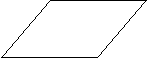
-
- Parallelogram
- It has 4 sides
- Opposite sides are equal and parallel
- Has one line of symmetry.
-
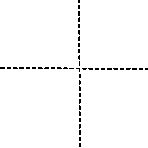







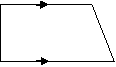
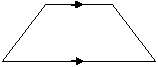
- Trapezium


- Kite

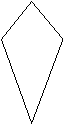


- Opposite sides are equal
- Has one line of symmetry


REF: MK BK 5 pg 184.
Understanding MTK bk 4 pg
Week five lesson one
Parts of a circle.
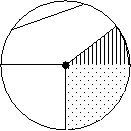 K PK – Chord
P XO – Radius
XY – Diameter
X O Y Shaded part- Sector
Dotted part – Quadrant
Week six lesson one
Finding diameter when radius is given.
D = r x 2
e.g. Find the diameter of circle whose radius is 5cm
Diameter = r x 2
= 5 cm x 2
= 10 cm
- Finding radius when diameter is given.
R = D ÷ 2
e.g. Find the radius of circle whose diameter is 14cm
Radius = D ÷ 2
= 14 cm ÷ 2
= 7 cm
Week seven lesson one
Drawing circles using a ruler and a pair of compass.
Exp. Construct a circle of radius 3cm.
- Draw a line and mark a point to be the centre of the circle.
- Open the compass to radius of 3cm.
- Draw a circle round the centre. 3cm


Week eight lesson one
Types of angles:
- Acute angle:
It is an angle which measures between 00 and 900.
e.g. 300, 450, 150, 890, etc.
- Right angle:
It is an angle measuring exactly 900.
Symbol used:
Right angle - Obtuse angle.
It is an angle which measures more than 900 but less than 1800.
- Reflex angle.
It is an angle which measures more than 1800 but less than 3600.
e.g. 1850, 2400, 3500, etc.
REF: MK BK 5 pg 193.
Week nine and ten
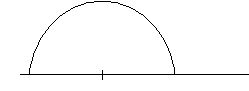
Drawing and measuring angles using a protractor.
- Using outer scale.
Procedure:


- Draw a line
- Mark a point on the line
- Place the protractor such that its centre is on the point marked on the line.
- Take the reading starting from zero clockwise.

- Using inner scale.
Procedure:
- Draw a line
- Mark a point on the line
- Place the protractor such that its centre is on the point marked on the line.
- Take the reading starting from zero anticlockwise.



REF:
MK Mathematics Bk 5 pg 195
Understanding MTC BK 4 pg 87.


