


COORDINATE GEOMETRY
– Is the conic section whose eccentricity is equal to zero.
– Coordinate geometry is the study of representation of geometric figures either in two or three dimensions under one of the following steps.
1. DISTANCE BETWEEN TWO POINTS
Consider point A  and B
and B  on the XY-plane. We need to find the distance from A to B.

Pythagoras theorem:

But  and
and  and
and 
Now,



For the case of three dimensions:

MID-POINT
A midpoint of a line segment is the point that bisects the line segment.
OR
It is the point which divides a certain line into two equal parts.
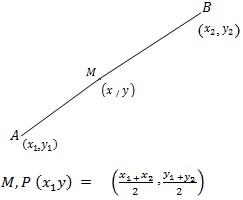
Proof:
Consider points A(x1, y1), B(x2, y2) and R(x, y).
Consider the figure below:

From similarities of ΔADR and ΔRCB:

But,

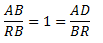


From equation:


But
AD = x – x1
RC = x2 – x
For X:


For Y:


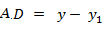
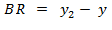
Then,

EXAMPLES
- Find the distance between A
 and B .
 - Show that the points , , and are vertices of an isosceles triangle.
- Show that the points , , and are vertices of right-angled triangles.
- Show that the points , , and (0, 1) are vertices of a square.
 and B
and B  .
. ,
,  , and
, and  are vertices of an isosceles triangle.
 ,
,  , and
, and  are vertices of right-angled triangles.
 ,
,  , and (0,
  1) are vertices of a square.
Solution
Given:

Since  and
and 
Then the points A (1, 2), B (3, 5), C (4, 4) are vertices of an isosceles triangle.
Hence shown.
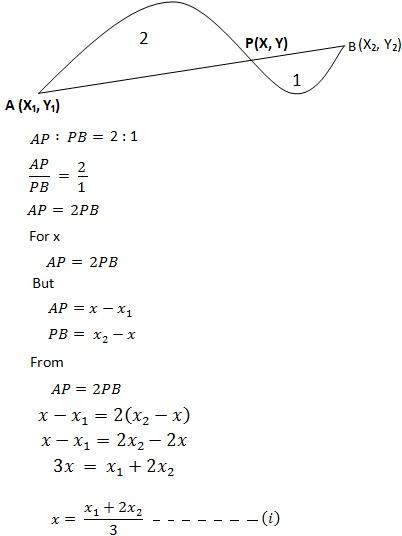
TRI-SECTION
Is the process of dividing a certain line into three sections or equal parts.

Where the coordinate P intersection depends on the two conditions:
- i) When P is close to A
- ii) When P is close to B

RATIO THEOREM
Is the theory based on a division of a line segment either internally or externally.
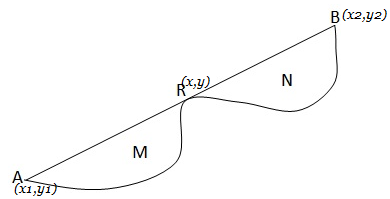
1. INTERNAL DIVISION
Is a division of a line segment internally under the given condition of ratio.
Let line AB be divided at R in ratio M: N.

Ratio M: N.
2. EXTERNAL DIVISION
Is the theory based on a division of a line segment externally under the given ratio.
Let A (X1, Y1), B (X2, Y2) and R (X, Y) under ratio R (X,Y).
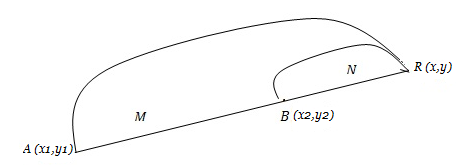
Consider the graph below.

EXAMPLES
- Find the coordinate of point and divided internally or externally in the ratio .
- Find the point of intersection of a line joining points and if P is close to A.
- Find the coordinate of intersection of a line AB at point P if B is closer to A given that A and B .
 and
and  divided internally or externally in the ratio
  .
. and
and  if P is close to A.
 and B
and B  .
.SOLUTIONS
1. For internal division

GRADIENT
Is the ratio expressed as vertical change over horizontal change.
OR
Is the ratio between change in Y over change in X.
Mathematically, gradient denoted as  i.e
i.e 
However, the gradient can be explained by using three different methods:
- Gradient from angle of inclination
- Gradient from the curve (calculus method)
- Gradient between two points
Consider the figure below:

GRADIENT FROM ANGLE OF INCLINATION
Let θ be the angle of inclination.

GRADIENT FROM THE CURVE
This is explained by using calculus notation where;
of a curve at a given point.
However, gradient can be obtained directly from the equation of a straight line as coefficient of x from the equation in form of
y = mx + c
BEHAVIOUR OF GRADIENT BETWEEN TWO POINTS
Let two points be  which can be used to form the line AB.
(i) If  , and
, and  the line increases from left to right implying positive slope.

(ii) If  the line decreases from right to left implying negative slope.

(iii) If  the line is horizontal with zero gradient.

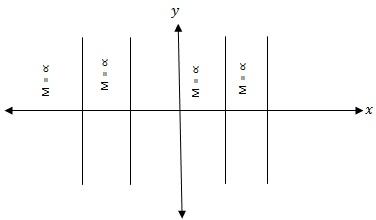
(iv) If  the line is vertical with infinite gradient.
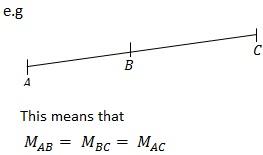
COLLINEAR POINTS
Are points which lie on the same straight line.

Where A, B, and C are collinear.
The condition for collinear points is that they have the same slope/gradient.
Note:
If A (x1, y1), B (x2, y2) and C (x3, y3) are collinear then the area of triangle ABC = 0.
Example 1
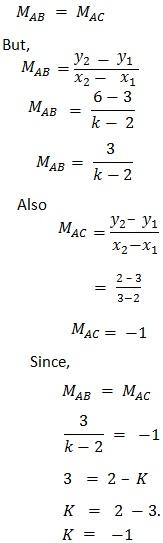
- Determine the value of K such that the following points are collinear:
- a) , , and
- b) , , and
- a)
- Show that the points , , and are collinear.
- The straight line cuts the curve at P and Q. Calculate the length PQ.
- If A and B are products of OX and OY respectively. Show that xy=16. If the area of is 8 units square.
 , and
, and  ,
,  , and
, and 
 ,
,  are collinear.
 cuts the curve
  at P and Q. Calculate the length PQ.
 is 8 units square.
Solution:
A  B
B  C
C  are collinear points.
For collinear points:
Equation of the Line
Mostly depends on different formats under one of the following:
1. Equation of a Point and Slope
Let point be  and slope be M.
Let the two points be denoted as A  and B
and B  .
.
Consider the figure below:
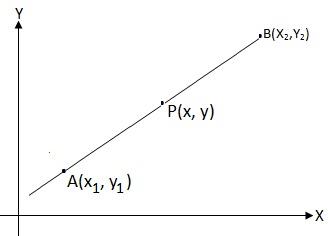
For the line only if
 =
= 
Multiply both sides by  .
.
3. Equation of Slope and Y-Intercept Form
Consider the slope  and y-intercept
  .
.

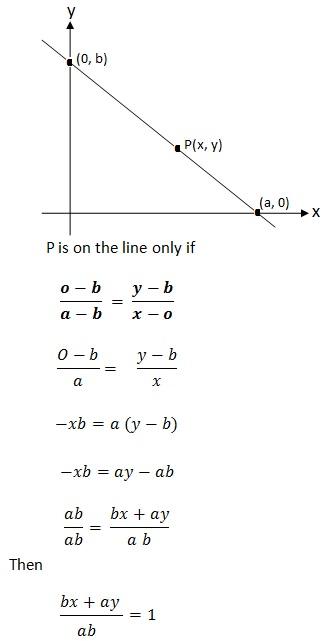
4. Equation of 2 Intercepts Form
Consider X-intercept C, and Y-intercept B.
FAMILY EQUATION
Is the equation formed from intersection of two lines passing through certain points.
Example: Equation for intersection of L1 and L2 passing through points (a,b) can be obtained by using the formula:

Where K is constant.
Important steps of determining family equation:
- Solve for K by regarding equations of two lines and the point passing through.
- Form family equation by using the value of K without regarding the point passing through.
Example
Find the equation passing through the point (2,3) from the intersection provided.

Solution
Point  .
.
But,



PARALLEL AND PERPENDICULAR LINES
(a) PARALLEL LINES
Are lines which never meet when they are extended.

Means that  is parallel to
  symbolically
  //
//
However, the condition for two or more lines to be parallel states that they possess the same gradient.

(b) PERPENDICULAR LINES
Are lines which intersect at right angles when extended.
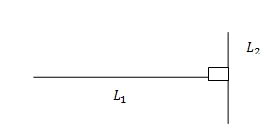
Means that is perpendicular to  .
.
Symbolically is denoted as L1 ⊥ L2.
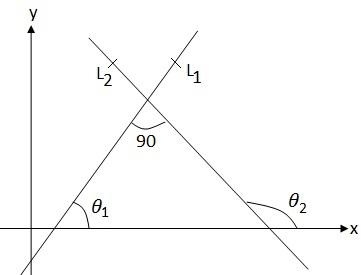
However, the condition for two or more lines to be perpendicular states that “The product of their slopes should be equal to -1”.
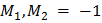
Consider the figure below:
NOTE:
- The equation of the line parallel to the line passing through a certain point is of the form . Where is constant.
- The equation of the line perpendicular to the line passing through a certain point is of the form when is constant.
- The calculation of K above is done by substitution of certain point passing through.
 passing through a certain point is of the form
  . Where
  is constant.
 passing through a certain point is of the form
  when
when THE EQUATION OF PERPENDICULAR BISECTOR
Let two points be A and B.
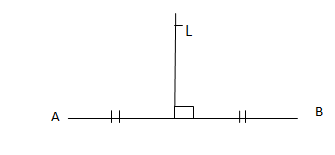
Line L is perpendicular bisector between points A and B.
Now our intention is to find the equation of L.
IMPORTANT STEPS
- Determine the midpoint between points A and B.
- Since L and are perpendicular to each other then find slope of L.
- Get equation of L as equation of perpendicular bisector of by using slope and midpoint of A and B.
 are perpendicular to each other then find slope of L.
THE COORDINATE OF THE FOOT OF PERPENDICULAR FROM THE POINT TO THE LINE
Our intention is to find the coordinate of the foot (x,y) which acts as the point of intersection of and .
Consider the figure below.

IMPORTANT STEPS
- Get slope of formatted line i.e. and then use it to get slope of L2. Since .
- From equation of by using and point provided.
- Get coordinate of the foot by solving the equations and simultaneously.
 .
. and point provided.
 and
and EXAMPLE
- Find the acute angle θ between lines and .
- Find the acute angle between the lines represented by .
- Find the equation of the line such that the X-axis bisects the angle between the lines .
- Find the equation of perpendicular bisector between A and B .
- Find the coordinate of the foot of perpendicular from the line .
- Find the equation of the line parallel to the line 3x – 2y + 7 = 0 and passing through the point .
- Find the equation of the line perpendicular to the line and passing through the point .
- Find the equation of perpendicular bisector of AB where A and B are the points and respectively.
 and
and  .
. .
. .
. and B
and B  .
. .
. .
. and passing through the point
  .
. and
and  respectively.
Solution
Given:

Consider:

THE SHORTEST/PERPENDICULAR DISTANCE FROM THE POINT TO THE LINE
Introduction:
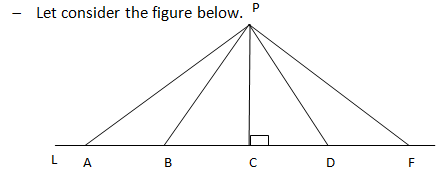
From the figure above, PC is the only one that possesses the shortest distance as it is perpendicular to the line. Our intention is to get the shortest/perpendicular distance from point P to the line.
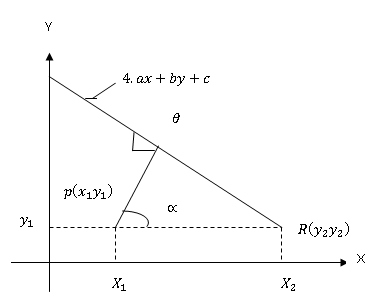
Our intention is to find the shortest distance from point  to the line
  .
.
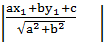
From

Since

Then

THE EQUATION OF ANGLE BISECTOR BETWEEN TWO LINES
Consider the figure below.
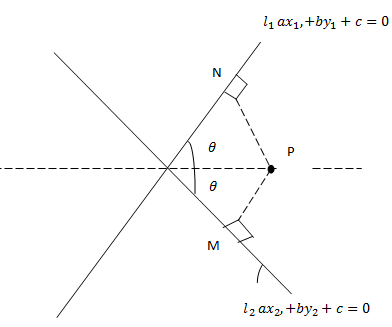
Where PM and PN are perpendicular distances from point P, which are always equal.

Since

Then
THE AREA OF TRIANGLE WITH THREE VERTICES
By geometrical method.
Consider the figure below.

Our intention is to find the area of  .
.
Now,
Area of  = area of trapezium ABED – area of trapezium ACED.
But area of trapezium ABED and area of trapezium DCEF are:

Then

But simplification the formula becomes:

TERMINOLOGIES OF TRIANGLE
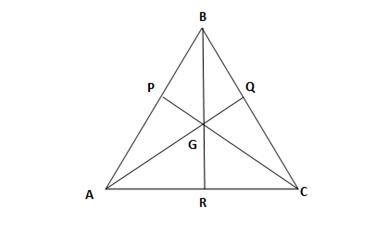
Median is the line which divides sides of triangle at two equal points.
Where AQ, BR and CP are the medians of the triangle. Also G is the centroid of the triangle.
CENTROID FORMULA
Consider the figure below with vertices A (x1, y1), B (x2, y2) and C (x3, y3).
Let line BM be divided by point G in ratio M: N = 2:1 internally.

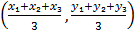
The centroid formula is:
ALTITUDE OF TRIANGLE
Are the perpendiculars drawn from vertices to the opposite side of the triangle.
ORTHO CENTRE
Is the point of intersection of altitudes of a triangle.
CIRCUM CENTRE
Is the point of intersection of perpendicular bisectors of the sides of a triangle.



3 Comments