


ALGEBRA
Indices (Law of Exponents)
Three basic rules including the Indices are:
- i) (a^m times a^n = a^{m+n})
- ii) (a^m div a^n = a^{m-n})
- iii) ((a^m)^n = a^{mn})
Negative Indices
Consider (a^5 div a^2 = a^{5-2} = a^3)
Also, (a^2 div a^5 = a^{2-5} = a^{-3})
In general, (a^{-m} = frac{1}{a^m})
Fractional Indices
Consider (a^{frac{1}{2}} = sqrt{a})
Similarly, (a^{frac{m}{n}} = sqrt[n]{a^m})
Zero Exponents
Consider (a^m times a^0 = a^{m+0})
Since (a^m times a^0 = a^m), it follows that (a^0 = 1)
Laws of Logarithm
If (a) and (b) are two positive numbers, there exists a third number (c) such that
(a^c = b)
Then (c) is the logarithm of (b) to base (a), i.e., (log_a b = c)
Definition
Logarithm of (x) to base (a) is the power to which (a) must be raised to give (x).
If (p = log_a x) and (q = log_a y), then (p + q = log_a (xy)).
Properties
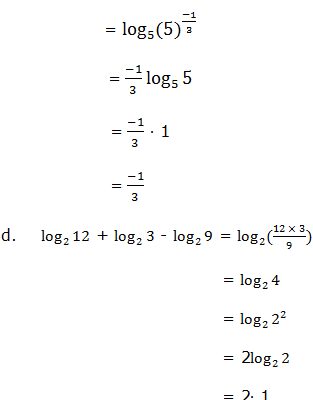
- (log_a (xy) = log_a x + log_a y)
- (log_a left(frac{x}{y}right) = log_a x – log_a y)
- (log_a (x^n) = n log_a x)
Change of Base
If (y = log_a x), then (y = frac{log_b x}{log_b a})
Example
1. Solve for (x), ( log_2 (x+1) = 3 )
Solution:
(x + 1 = 2^3 = 8)
(x = 7)
Series
A series is the sum of a sequentially ordered finite or infinite set of terms.
Finite Series
Has defined first and last term, e.g., (1 + 3 + 5 + 7 + ldots + 21) is a finite series.
Infinite Series
Has defined first term but no last term, e.g., (1 + 3 + 5 + 7 + ldots)
In both cases, the first term is 1.
The Sigma Notation
(sum) stands for “sum of”.
Example:
(sum_{k=1}^n k = 1 + 2 + 3 + ldots + n)
Exercise
Discuss the following and find the sum if (n = 8):
(sum_{k=1}^n k), (sum_{k=1}^n k^2), (sum_{k=1}^n k^3)
Sum of the First (n) Natural Numbers
(sum_{k=1}^n k = frac{n(n+1)}{2})
Sum of Squares of the First (n) Natural Numbers
(sum_{k=1}^n k^2 = frac{n(n+1)(2n+1)}{6})
Sum of Cubes of the First (n) Natural Numbers
(sum_{k=1}^n k^3 = left(frac{n(n+1)}{2}right)^2)
Example
I. If (a_n = n^2 + 3n + 1), determine an expression for (n).
II. If (a_n = n^3 + 2n^2 + 4n), evaluate:
- (a_1)
- (a_4)
- (a_n) for general (n)
Proof by Mathematical Induction
Example: Prove that (n(n^2 + 5)) is divisible by 3 for all positive integers (n).
Proof:
- Base case: (n=1), (1(1^2 + 5) = 6 = 3 times 2)
- Assume true for (n=k), i.e., (k(k^2 + 5) = 3p) for some integer (p).
- For (n = k+1), show ((k+1)((k+1)^2 + 5)) is divisible by 3.
- Expand and use induction hypothesis to conclude divisibility.
Principle of Proof by Mathematical Induction
If (s_1, s_2, s_3, ldots, s_n) is a sequence of statements and:
- (s_1) is true
- For all (n), (s_n Rightarrow s_{n+1}) is true
Then all statements (s_1, s_2, ldots, s_n) are true.
Example
Prove by induction that (2 + 4 + 6 + ldots + 2n = n(n+1)).
Solution:
- Base case: (n=1), LHS = 2, RHS = (1 times 2 = 2)
- Assume true for (n=k), i.e., (2 + 4 + ldots + 2k = k(k+1)).
- Show true for (n=k+1): (2 + 4 + ldots + 2k + 2(k+1) = (k+1)(k+2)).
Roots of a Polynomial Function
If (alpha) and (beta) are roots of a quadratic equation, then
((x – alpha)(x – beta) = 0)
Expanding gives
(x^2 – (alpha + beta)x + alpha beta = 0)
Given quadratic equation (ax^2 + bx + c = 0), where (a, b, c) are constants, the sum and product of roots are:
- Sum of roots: (alpha + beta = -frac{b}{a})
- Product of roots: (alpha beta = frac{c}{a})
Example
Given (alpha) and (beta) as roots of (4x^2 + 8x + 1 = 0), form an equation whose roots are (alpha^2) and (beta^2).
Solution:
Sum of roots: (alpha^2 + beta^2 = (alpha + beta)^2 – 2alpha beta)
Product of roots: (alpha^2 beta^2 = (alpha beta)^2)
Form the quadratic equation with these roots.
Roots of Cubic Equations
If (alpha, beta, gamma) are roots of a cubic equation, then
((x – alpha)(x – beta)(x – gamma) = 0)
Expanding gives
(x^3 – (alpha + beta + gamma)x^2 + (alpha beta + beta gamma + gamma alpha)x – alpha beta gamma = 0)
Example
The equation (3x^3 + 6x^2 – 4x + 7 = 0) has roots (alpha, beta, gamma). Find the equation with roots:
- (alpha + 1, beta + 1, gamma + 1)
Remainder and Factor Theorem
Definition: A polynomial is an expression of the form
(a_n x^n + a_{n-1} x^{n-1} + ldots + a_1 x + a_0)
where (a_n, a_{n-1}, ldots, a_0) are real numbers called coefficients.
To divide polynomial (P(x)) by (D(x)) means finding polynomials (Q(x)) and (r(x)) such that
(P(x) = D(x) Q(x) + r(x))
where (r(x)) is the remainder and degree of (r(x) <) degree of (D(x)).
Remainder Theorem
When a polynomial (P(x)) is divided by a linear factor ((x – a)), the remainder is (P(a)).
Proof:
Let (P(x) = (x – a) Q(x) + R), where (Q(x)) is a polynomial and (R) is the remainder.
Substitute (x = a):
(P(a) = (a – a) Q(a) + R = R)
Thus, the remainder is (P(a)).
Factor Theorem
If (a) is a zero of (P(x)), then ((x – a)) is a factor of (P(x)), i.e., (P(x) = (x – a) Q(x)).
Examples
1. Find the remainder when (x^5 + 4x^4 – 6x^2 + 3x + 2) is divided by (x + 2).
Solution:
(P(-2) = (-2)^5 + 4(-2)^4 – 6(-2)^2 + 3(-2) + 2 = -32 + 64 – 24 – 6 + 2 = 4)
Remainder is 4.
2. Find the remainder when (4x^3 – 6x^2 – 5) is divided by (2x – 1).
Solution:
Rewrite divisor as (x – frac{1}{2}), so (a = frac{1}{2}).
Calculate (Pleft(frac{1}{2}right)).
Synthetic Division
Synthetic division is a shortcut method to find the remainder when a polynomial is divided by a factor (x – a).
Example
Use synthetic division to divide (2x^3 + x^2 – 3x + 4) by (x + 3).
Solution:
Set (a = -3) and perform synthetic division.
Rational Zero Theorem
Let (p(x) = a_n x^n + ldots + a_0) with integral coefficients. If (frac{p}{q}) (in lowest terms) is a zero of (p(x)), then (p) divides (a_0) and (q) divides (a_n).
Example
Find zeros of (2x^3 – x – 3).
Possible zeros are factors of (-3) over factors of 2: (pm 1, pm 3, pm frac{1}{2}, pm frac{3}{2}).
Partial Fraction (Decomposition of Fraction)
The process depends on the denominator factors:
- For each linear factor (ax + b), corresponds a fraction (frac{A}{ax + b}).
- For repeated factors ((ax + b)^n), corresponds fractions (frac{A_1}{ax + b} + frac{A_2}{(ax + b)^2} + ldots + frac{A_n}{(ax + b)^n}).
- For quadratic factors, corresponds fractions of the form (frac{Ax + B}{quadratic}).
- If degree numerator ≥ degree denominator, perform division first.
Example
Express (frac{3x + 7}{(x + 4)(x – 2)}) in partial fractions.
Solution:
(3x + 7 = A(x – 2) + B(x + 4))
Equate coefficients and solve for (A) and (B).
Quadratic Inequalities
Quadratic inequalities are of the form:
- (ax^2 + bx + c < 0)
- (ax^2 + bx + c leq 0)
- (ax^2 + bx + c > 0)
- (ax^2 + bx + c geq 0)
where (a, b, c) are real numbers and (a neq 0).
Solving Quadratic Inequalities
Change inequality to equality to find roots, then test intervals.
Example
Solve (x^2 + x – 2 leq 0).
Solution:
Factor: ((x + 2)(x – 1) leq 0)
Test intervals to find solution: (-2 leq x leq 1).
Rational Inequalities
Examples:
Solve inequalities involving rational expressions by finding zeros of numerator and denominator and testing intervals.
Absolute Value Inequality
Examples:
- Solve (|2x – 3| < 5)
- Solve (|x – 2| > -3)
- Solve (|2x + 3| < 6)
Determinant of a 3 x 3 Matrix
Let
[
begin{vmatrix}
a & b & c
d & e & f
g & h & i
end{vmatrix}
= a(ei – fh) – b(di – fg) + c(dh – eg)
]
Example
Find the determinant of
[
begin{vmatrix}
1 & 2 & 3
4 & 5 & 6
7 & 8 & 9
end{vmatrix}
]
Solutions to System of Equations
Cramer’s Rule
For system:
[
begin{cases}
a_1 x + b_1 y + c_1 z = d_1
a_2 x + b_2 y + c_2 z = d_2
a_3 x + b_3 y + c_3 z = d_3
end{cases}
]
Use determinants to solve for (x, y, z).
Example
Use Cramer’s rule to solve the system:
[
begin{cases}
x + 2y + 3z = 9
2x + 3y + 7z = 24
4x + 5y + 6z = 27
end{cases}
]
Inverse of a 3 x 3 Matrix
If (A) is a square matrix, (B) is its inverse if (AB = I), where (I) is the identity matrix.
Transpose of a Matrix
The transpose of matrix (A) is denoted by (A^T), obtained by swapping rows and columns.
Example
Find (A^T) if
[
A = begin{bmatrix}
1 & 2 & 3
4 & 5 & 6
7 & 8 & 9
end{bmatrix}
]
Co-factor Matrix
Matrix of cofactors (C) is formed by minors with appropriate signs.
Example
Find the cofactor matrix of
[
begin{bmatrix}
1 & 2 & 3
0 & 4 & 5
1 & 0 & 6
end{bmatrix}
]
Binomial Theorem
Pascal’s triangle coefficients for expansion of ((a + b)^n):
1
1 1
1 2 1
1 3 3 1
1 4 6 4 1
1 5 10 10 5 1
Example
Give the expanded form of ((a + b)^4).
Find the value of ((1.025)^4) correct to 3 decimal places using the first three terms of the expansion.
Binomial Series
If (n) is a positive integer,
[
(a + b)^n = sum_{r=0}^n binom{n}{r} a^{n-r} b^r
]
Note
- If (n) is a positive integer, the series terminates at (x^n).
- If (n) is not a positive integer, the series is infinite and converges only when (|x| < 1).
Example
Expand ((1 – 2x)^6) in ascending powers of (x). Taking (x = 0.002), find ((1.9998)^6) to four decimal places.
Questions
- Show that if (x) is small enough to neglect (x^3) and higher powers, then ((1 + x)^n approx 1 + nx + frac{n(n-1)}{2} x^2).
- Given (alpha) and (beta) are roots of (ax^2 + bx + c = 0), write expressions for (alpha + beta) and (alpha beta) in terms of (a, b, c). State conditions for roots equal in magnitude but opposite in sign. Find (k) such that (x^2 + kx + 9 = 0) has roots equal in magnitude but opposite in sign.



6 Comments