


Machines & inclined planes Questions
1. An inclined plane of length 5m is used to raise a body of mass 60kg to the back of a lorry. If the
plane is inclined at an angle 25° from the horizontal, calculate the efficiency of the system given
that a constant force of 650 N is used to push the body up the plane
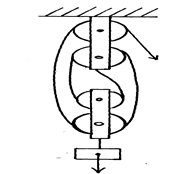
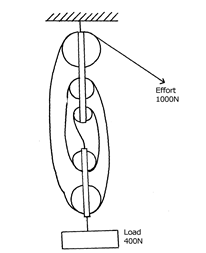 2. Vicky performed an experiment using a pulley system as shown in the figure.




(a) What is the V.R. of the system?
 (b) Determine the M.A. of the system. *
(c) Calculate the efficiency of the system.
(d) Explain why efficiency of a practical machine is always less than 100%
(e) If the load moves a distance of 5 cm. Find the work done on the load.
3. The figure below shows a pulley system being used to raise a load. Use the information given
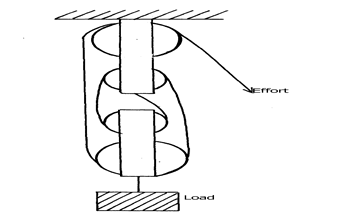 in the figure to answer questions (a) and (b)

(ii) If a load of 100N is raised by applying an effort of 48N, determine the efficiency of
the system.
4. (a) (i) Define the term velocity ratio (V.R)
(ii) Name one machine that has a velocity ratio of less than one (V.R < 1)
(b) The figure below shows a set-up used to find the mechanical advantage of a pulley system
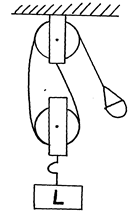
On the axes provided sketch a graph of mechanical advantage (M.A) against load (L)
(c) A hydraulic machine is used to raise a load of 100kg at a constant velocity through a height
of 2.5m. The radius of the effort piston is 1.4cm while that of the load piston is 7.0cm. Given
that the machine is 80% efficient, calculate:-
(i) The effort needed
(ii) The energy wasted in using the machine
5. (i) complete the diagram below to show how the pulley can be used to raise a load L by
applying an effort E
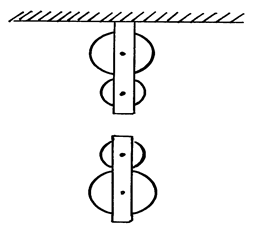
(ii) The pulley system above has a mechanical advantage of 3. Calculate the total work done
when a load of 60N is raised through a height of 9M
Machines & inclined planes Answers
1. M.A = 600M = 0.92307
650M
V.R = 1 = 2.366
Sin 25
= M.A = X 100
V.R
= 0.92307 X100
2.366 = 39.01%
2. (a) V.R = 5
 (b) MA = L
E
 = 4000
1000
 = 4
= 4

(c) eff. = M.A x 100%
 VR
VR
 = 4/5
= 4/5
= 80%
(d) Some work is done overcoming friction or lifting the moving parts

 (e) W = F x d
= 40,000 x 0.05 = 2000J
3. VR = 4
A = L = 100
E 48
u = M.A x 100%
 V.R
V.R
 = 100 x ¼ = 52.08%
48
4. (a) (i) Velocity ration is the distance moved by the effort to the distance moved by the load
in the same time
(ii) – Pulley belts
– Gears (any one)
(b) Graph
(c) (i) V.R = R2 = 7x 7 = 25
r2 1.4 x 1.4
Efficiency = M.A x 100%
V.R
M.A = r x V.R = 80 x 25 = 20
100
E = KL = 100 x 10 = 50N
M.A 20
(ii) EH = work output x 100%
Work input
Work output =mgh
= 100 x 10 x 2.5
= 2500J
80 = 2500 x 100
Work output
Work out put = 2500 x 100 = 3125J
80
Energy lost = 3125 – 2500
= 625J
5. i)
ii) E = L/M.A
= 60/3
= 20N
Total work done by effort
= E x Distance moved by effort
= 20 x 9 x V.R
= 20 x 9 x 4
= 720J


