

KISUMU DISTRICT CHEMISTRY PRACTICAL QUESTIONS
CONFIDENTIAL
INSTRUCTIONS.
In addition to ordinary apparatus in the laboratory each candidate will require;
- 2g Solid A
- 100cm3 solution B – Hydrochloric acid
- 200cm3 solution C – Sodium hydroxide
- Burette
- Pipette
- Two 250ml conical flask
- Methyl orange indicator
- 100ml measuring cylinder
- 10ml measuring cylinder
- Distilled water
- Means of labelling
- 30cm3 solution S
- 50cm3 solution S- Hydrochloric acid
- 50cm3 solution T-Sodium hydroxide
- Ten test tubes
- Rack
- 100ml
- Thermometer
- Source of heat
- Solid U
- Spatula
- Red and blue litmus paper
- Filter funnel
- Filter paper
Access to the following:-
- 2M Sodium hydroxide
- 2M potassium iodine
- 2M Nitric acid
- 2M Ammonia hydroxide
- Solid A – Per student measure [0.32g CaCO3 + 1.68NaCl]
- Solution B – [0.5M HCl]
- Solution C – [0.4M NaOH]
- Solution S -[1.0M HCl]
- Solution T – [1.0M NaoH]
- Solid U – [One spatula CuCO3 + one spatula Pb(NO3)2
QUESTION 1.
You are provided with:
- 2g of an impure calcium carbonate, solid A
- Hydrochloric
- Hydrochloric acid, solution B
- 16g per litre solution of sodium hydroxide, solution C
You are required to determine;
- Concentration of solution B in moles per litre
- Percentage of the carbonate in mixture A
PROCEDURE I:
Pipette 25.0cm3 of solution C into a 250ml flask. Add 2-3 drops of methyl orange indicator.
Titrate solution C with the hydrochloric acid solution B. Repeat this procedure two more times
and record your results in table I below:-
Table I:-
Titration | I | II | III |
Final burette reading (cm3) | |||
Initial burette reading (cm3) | |||
Volume of solution B (cm3) used |
Calculations:-
(a) (i) Calculate the average volume of solution B used
(ii) Calculate the number of moles of sodium hydroxide solution C pipetted
(iii) Calculate the number of moles of hydrochloric acid solution B that reacted
with sodium hydroxide in (a) (ii) above
(iv) Calculate the molarity of hydrochloric acid solution B
PROCEDURE II:
(a) Place all the 2g of solid a provided into a conical flask and add 25.0cm3 of hydrochloric
acid solution B to it using a clean pipette. Swirl the contents of the flask vigorously until
effervescence stops. Using a 100ml measuring cylinder, add 175cm3 of distilled water to
make up the solution up to 200cm3 of solution. Label this solution D. Using a clean pipette,
transfer 25.0cm3 of solution D into a conical flask and add 2-3 drops of methyl orange indicator. Titrate solution D with sodium hydroxide solution C. Repeat the procedure two more times and record your in the table II below:-
table II:
Titration | I | II | III |
Final burette reading (cm3) | |||
Initial burette reading (cm3) | |||
Volume of solution C (cm3) used |
(b) (i) Calculate the average volume of solution C used
(ii) Calculate the number of moles of sodium hydroxide solution C present in the average volume
(iii) Calculate the number of moles of hydrochloric acid
present in the original 200cm3
of solution D
(iv) Calculate the number of moles of hydrochloric acid solution B contained in the original
25.0cm3 of solution B used
(v) Calculate the moles of calcium carbonate that reacted with hydrochloric acid solution D
(vi) Calculate the mass of calcium carbonate in 2g of solid A
(vii) Calculate the percentage of calcium carbonate present in the mixture (solid A)
2. You are provided with :-
- Solution of hydrochloric acid, S
- 1.0M solution of sodium hydroxide, solution T
You are required to:
(i) Calculate the heat of molarity of hydrochloric acid, solution S
(ii) Determine the heat of reaction for mole of hydrochloric acid with sodium hydroxide.
PROCEDURE
- Place six test tubes on a test tube rack. Using a 10ml measuring cylinder, measure and
pour 5cm3 of solution T into each of the test tubes
- Measure 20.0cm3 of solution S and pour into a 100ml beaker. Measure the temperature
of this solution and record in table III below.
- Pour the first portion of the 5cm3 of solution T into the beaker containing the 20.0cm3
of solution S. Stir the mixture carefully using a thermometer and record the highest
temperature reached in table III.
- Pour the second portion immediately into the mixture in the beaker, stir carefully and
record the highest temperature in table III continue this procedure with the remaining
portions of solution T to complete table III.
Table III:
(a)
Titration | 0 | 5 | 10 | 15 | 20 | 25 | 30 |
Volume of solution T added (cm3) | |||||||
Volume of solutions S + T (cm3) | |||||||
Temperature of mixture (oC) |
(c) From the graph, determine:-
(i) The volume of solution T required to react completely with solution S
(ii) The highest temperature change, T
(d) Calculate the heat change for the reaction
(Heat change = M x 4.2Jg-1
oC -1 x t, assume the density of the solution to be 1g/cm3)
(e) Calculate the number of moles of the sodium hydroxide solution T used in the experiment
(f) Calculate the number of moles of the hydrochloric acid, solution S used in the experiment
(g) Determine the heat of reaction per mole of hydrochloric acid, solution S
3. You are provided with solid U, carry out the test below. Record your observations and
inferences in the table. Identify any gas(es) evolved .
(a) Heat a spatula end full of mixture U in a test tube.
(b) (Dissolve a part of mixture U in abort 10cm3 of distilled water
(c) Filter the mixture and retain both filtrate and the residue. Divide the filtrate into two portions.
(i) To the first portion, add sodium hydroxide drop wise until in excess
ii) To the second portion, add Potassium iodide solution
(d) Divide the residue into two parts:-
(i) Put one part in a test tube and add dilute nitric acid until the residue just dissolves
(ii) Divide the resulting solution into two parts. To part one, add dilute sodium hydroxide solution
drop wise until in excess
(iii) To part two, add aqueous ammonia drop wise until in excess
KISUMU DISTRICT CHEMISTRY PRACTICAL ANSWERS
1.
1 | 2 | 3 | |
Final burette reading (cm3) | |||
Initial burette reading (cm3) | |||
Vol. of sol. C used (cm3) | 22.9 | 22.9 | 22.9 |
. (i) C. T
(ii) D.P ½ mk
(iii) Ac 1mk
(iv) AV 1mk
(v) F ½ mk
(a) (i) Average volume of B (above
(ii) Moles of NaOH solution C = 25 x 0.4 = 0.01
1000
(iii) Moles of HCl solution B
NaOH + HCl H2O + NaCl
Ratio base : acid = 1: 1
HCl = 0.01
(ii) Molarity of HCl
= 0.01 x 1000 = ans, (a(iv)
Ans (a) (i)
Table 1
(b) (i) 1.2 + 12 + 12 = 12 (above)
3
(c) (ii) Moles of NaOH solution C
Ans (b) (i) x 0.4 = ans b(ii)
1000
iii) Calculate the number of moles of hydrochloric acid in 200cm3 solution D
NaOH(aq) + HCl(aq) NaCl +H2O
Mole ratio Acid: base = 1:1
In 25.0cm solution of HCl = Ans b(ii)
Moles of hydrochloric acid solution B contained in 25.0cm3 of B
200 x ans (ii) = ans (iii)
25
iv) Moles o hydrochloric acid solution B contained in 25.0cm3 of B= 25 x ans a(iv)
1000
= ans. (b)(iv)
v) Moles of HCl that reacted with Calcium Carbonate
= ans (b) (iv) – ans (b)(iii) ( ½ mk)
CaCO3 + 2HCl CaCl2 + CO2 + H2O
Mole ratio Carbonate: acid = 2:1 ½mk
Mole of calcium carbonate = ans.(b)(iv) – ans. (b) (iii) ( ½ mk)
2 = ans. (b)(v)
(vi) RMM = 100g
Mass in mixture = 100 x ans (b) (v) ½
= ans. (b) (vi) ( ½ mk)
vii) % of calcium carbonate in the 2g mixture = ans (b) (vi) x 100 ½
2
= ans. (vii) ½
2.
Volume of T added (cm3) | 0 | 5 | 10 | 15 | 20 | 25 | 30 | |
Volume of S + T (cm3) | 20 | 25 | 30 | 35 | 40 | 45 | 50 | |
Temperature of mixture (oC) | ||||||||
CT 1mk
DP1 1mk
AC 1mk
(b) Graph
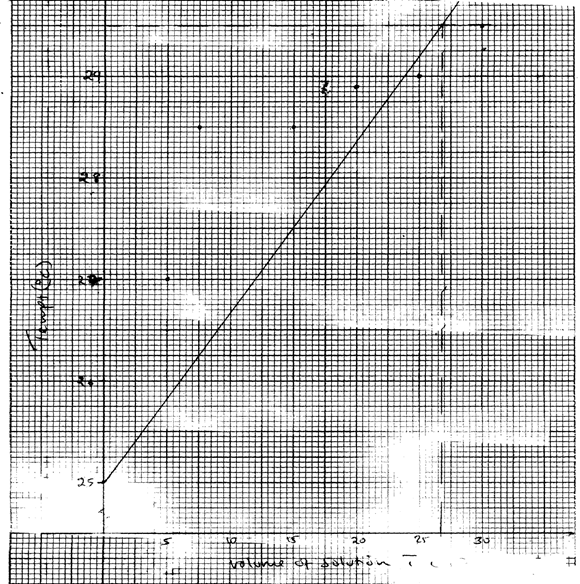
 Label of axes ½
Scale ½
Plot 1 ½
Shape ½]





c) (i) from graph ½
(ii) Highest temp- lowest temp (from graph)
(d) 50x{[ac(ii)] x 4.2 = ans. D
(e) No. of moles of T used = c(i) x 1
1000
= ans. (e)
(f) No. of moles used
NaOH + HCl NaCl + H2O
Mole ratio 1:1
= ans (e) = ans (f)
(g) and (f) moles liberate (and d) J
1 mole and (d) x 1
Ans (f) x 1000
= -Ans (g) KJmole-1
3.
Observation | Inference |
(a) Brown gas formed ½ Blue litmus paper turns red/red litmus paper remains red | NO–3 present ½ |
| Soluble and insoluble salt |
(c) (i) Partly soluble in excess
| Al3+ / Pb2+/Zn2+ Pb2+ |
(d) (i) Effervescence
| CuO32- suspected Cu2+ suspected |
(e) Blue ppt, dissolves ½ Deep blue solution | Cu2+ confirmed |

 (b) Partly dissolves/blue ppt do not dissolve ½
  (ii) Yellow ppt
 (ii) Blue ppt, insoluble in excess


