


SECTION A (25 MARKS)
Answer all the questions in this section in the spaces provided
- State the number of images formed when an object is between two plane mirrors placed in parallel (1 mk)
- Figure 1 shows a ray of light incident on a mirror at an angle of 450. Another mirror is placed at an angle of 450 to the first one as shown

Sketch the path of the ray until it emerges (2 mks)
- A conductor is slowly brought near the cap of a positively charged electroscope. The leaf first collapses and then diverges. State the charge on the conductor. (1 mk)
- Give a reason why it is necessary to leave the caps of the cells open when charging an accumulator. (1 mk)
- An electromagnet is made by winding insulated copper wire on an iron core. State two changes that could be made to increase the strength of the electromagnet. (2 mks)
- Figure 2 shows how the displacement varies with time for a certain wave
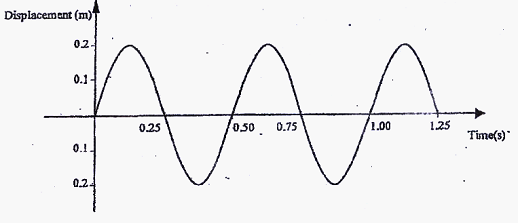
Determine the frequency of the wave (3 mks)
- Determine the speed of light in water given that the speed of light in air is 3.0 x 10⁸ ms-1 and the refractive index of water is 1.33 (3 mks)
- Figure 3 shows part of an electrical circuit. The current through the 18Ω resistor is observed to be 2A.
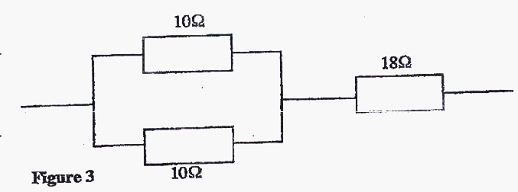
State the value of the current through each of the 10 Ω resistors (1 mk)
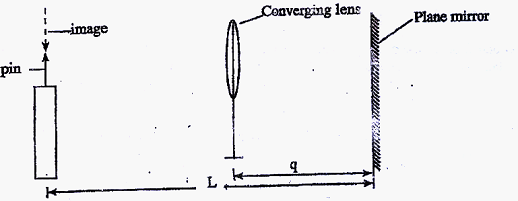
- In an experiment, a pin, a converging lens and a plane mirror are arranged as shown in figure 4. The distance between the pin and the plane mirror is L cm while the distance between the lens and the plane mirror is q cm. The position of the pin is adjusted until its tip coincides with its real image.
State the focal length of the lens (1 mk)
……………………………………………………………………………………
……………………………………………………………………………………
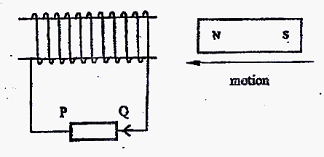
10. Figure 5 shows a magnet being moved towards a stationary solenoid. It is observed that a current flows through the circuit in a direction Q to P.
Explain:
- (i) How the current is produced (2 mks)
- (ii) Why the current flows from Q to P (1 mk)
11. In an X-ray tube it is observed that the intensity of X-rays increases when potential difference across the filament is increased. Explain this observation (3 mks)
12. A boy standing in front of a cliff blows a whistle and hears the echo after 0.5s. He then moves 17 metres further away from the cliff and blows the whistle again. He now hears the echo after 0.6s. Determine the speed of sound.
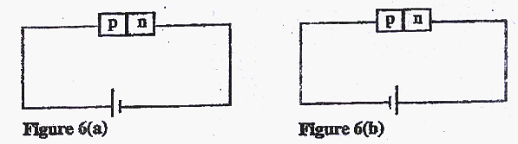
13. Figure 6 (a) and figure 6 (b) show a p-n junction connected to a battery. It is observed that the current in figure 6 (a) is greater than the current in figure 6 (b)
SECTION B (55 MARKS)
Answer all the questions in this section in the spaces provided
- (a) Figure 7 shows a pair of parallel plates of a capacitor connected to a battery. The upper plate is displaced slightly to the left.
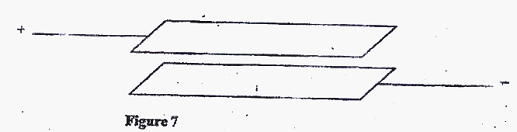
State with reason the effect of this movement on the capacitance (2 mks)
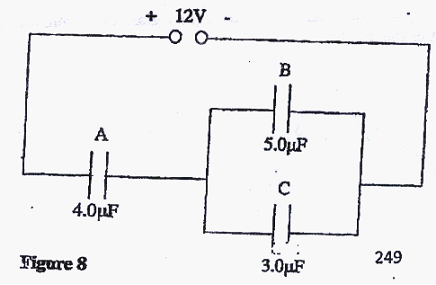
- (b) Figure 8 shows an electrical circuit with three capacitors A, B and C of capacitance 4.0 μF, 5.0 μF and 3.0 μF respectively connected to a 12V battery
Determine:
- The combined capacitance of the three capacitors (3 mks)
- The charge of capacitor A (2 mks)
- The potential difference across capacitor B (2 mks)
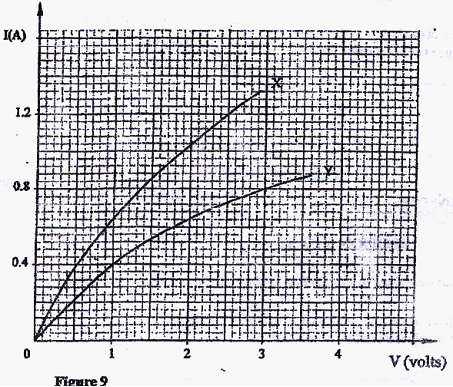
- Figure 9 shows the graph of the relationship between current I and potential difference V for two tungsten filament lamps X and Y. The normal working voltages for lamp X and lamp Y are 2.5V and 3.0V respectively.
(a) Explain the change in the shape of the curves as the current increases (2 mks)
(2 mks)
(b) Determine the resistance of lamp X at the normal working voltage (3 mks)
(c) The lamps are now connected in a series circuit in which a current of 0.4 A flows. Find the potential difference across lamp Y (1 mk)
(d) Determine the power at which lamp Y operates under normal working voltage (2 mks)
- (a) Figure 10 shows a ray of light incident on a triangular glass prism and white screen S placed after the prism
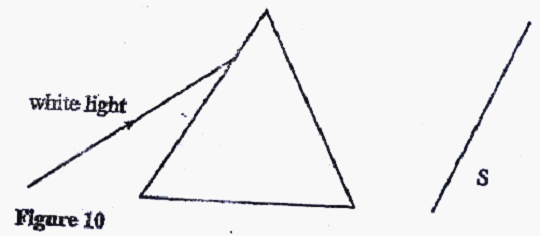
- Complete the path of the ray through the prism to show how a spectrum is formed on the screen (3 mks)
- A thermometer with a blackened bulb is placed at various parts of the spectrum. State with reason the region where the thermometer indicates the highest reading (2 mks)
- A pin is placed at the bottom of a beaker of depth 11.5 cm. The beaker is then filled with kerosene. By using another on the side of the beaker and observing from the top, the distance of the image of the pin in the beaker is found to be 3.5 cm from the bottom. Determine the refractive index of kerosene. (4 mks)
- (a) Figure 11 shows the path of radiation from a radioactive source. The field is perpendicular to the paper and directed out of the paper.
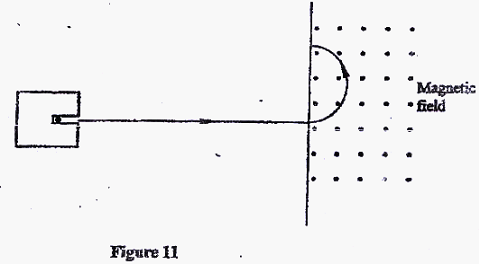
Identify the radiation (1 mk)
……………………………………………………………………………
- Radiation from a radioactive source enters a G.M tube
(i) State the effect of the radiation on the gas inside the tube (1 mk)
(ii) Explain how the large discharge current is created (2 mks)
- The following is a nuclear equation for a fission process resulting from the reaction of a neutron with a Uranium nucleus
1 235 141 y 1
0n+ 92U → 56A+ xQ + 3 0n
(i) Determine the values of x and y (2 mks)
(ii) State the source of the energy released (1 mk)
- Explain how this reaction is made continuous in a nuclear reactor (2 mks)
- (a) It is observed that when ultraviolet radiation is directed onto a clean zinc plate connected to the cap of a negatively charged leaf electroscope, the leaf falls
(i) Explain this observation (2 mks)
(ii) State why this observation does not occur if the electroscope is positively charged (1 mk)
(iii) Explain why the leaf of the electroscope does not fall when infrared radiation is directed onto the zinc plate (1 mk)
- State the effect on the electrons emitted by the photoelectric effect when:
(i) The intensity of incident radiation is increased (1 mk)
(ii) The frequency of the incident radiation is increased (1 mk)
- The maximum wavelength required to cause photoelectric emission on a metal surface is 8.0 x 10⁻⁷ m. The metal surface is irradiated with light of frequency 8.5 x 10¹⁴ Hz.
Determine:
(i) The threshold frequency (2 mks)
(ii) The work function of the metal in electron volts (3 mks)
(iii) The maximum kinetic energy of the electrons (2 mks)
Take: 1 eV = 1.6 x 10⁻¹⁹ J.
Speed of light = 3.0 x 10⁸ ms-1
Planck’s constant, h = 6.63 x 10⁻³⁴ Js
- Figure 12 shows a setup for observing interference of waves from two sources S1 and S2. The points C and D represent positions of the constructive and destructive interference respectively as observed on the screen
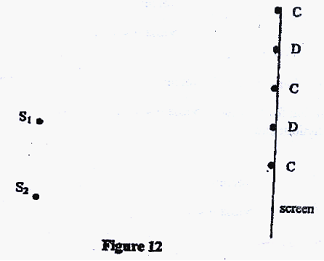
- If the observation was made in a ripple tank, describe:
(i) How the constructive and destructive interferences are identified (1 mk)
- Explain how the constructive interference C and the destructive interference D patterns are produced. (2 mks)
……………………………………………………………………………………
…………………………………………………………………………………….
Draw:
(i) The line joining all points where waves from S1 and S2 have traveled equal distance. Label it A (1 mk)
(ii) The line joining all points where waves from S2 have traveled one wavelength further than the waves from S1. Label it B. (1 mk)


