


KCSE BIOLOGY PAPER 1 2011
- Name two kidney diseases.
2. (a) Write the dental formula of an adult human.
3. Give three reasons for classifying organisms.
4. State one use for each of the following apparatus in the study of living organisms.
(a) Pooter
(b) Pitfall trap
5. The figure below illustrates a food web in a certain ecosystem.
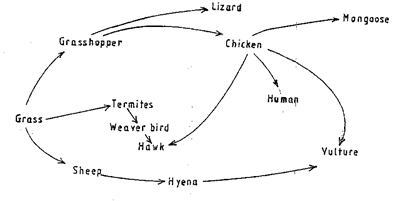
From the food web:
- Draw the shortest food chain;
- Identify the organisms with the highest
(i) Number of predators
(ii) Biomass
6. What is meant by the following terms?
(a) Ecology
(b) Carrying capacity
7. The diagrams below show an experiment set up to investigate a certain process in a plant tissue.
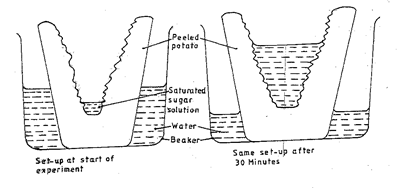
Explain the results obtained after 30 min.
8. State three characteristics of the class crustacean.
9. The diagrams below illustrate the organs of some flowering plants.
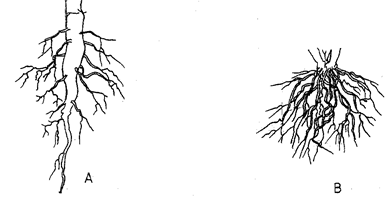
State the classes of plants to which each belong.
A
B
10. (a) Give two differences in the products of anaerobic respiration between plants and animals.
(b) Name the site of anaerobic respiration in a cell.
11. State two functions of the following parts of a light microscope.
Fine adjustment knob
Stage
12. The diagram below represents a certain organism.
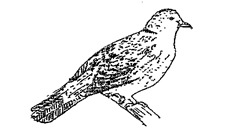
State the phylum and class of carbohydrates in the human body.
14. The diagram below represents a certain plant.
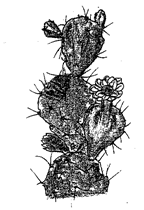
- What is the likely habitat of the plant?
- Give two reasons for your answer in (a) above.
15. Give reasons for carrying out the following procedures when preparing temporary wet mounts of plant tissues.
(a) Making thin plant sections
(b) Adding water on the plant section.
16. (a) Describe the condition known as varicose veins.
(b) What is the role of blood platelets in the clotting process?
17. The diagram represents part of the human digestive system.
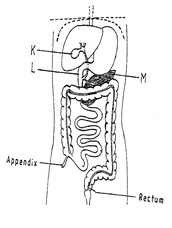
- Name the organs labeled L and M.
L
M
- (i) Name the substance named in b (i) above.
19. (a) Apart from the lungs, name two gaseous exchange surfaces in a frog.
(b) Write an equation that summarizes the process of aerobic respiration.
20. The number of stomata on the lower and upper surface of two leaves from plant X and Y were counted under the field of view of a light microscope. The results were as shown in the table below.
| Leaf | Number of stomata | |
|---|---|---|
| Upper surface | Lower surface | |
| X | 4 | 12 |
| Y | 20 | 23 |
- Which of the leaves would be expected to have a lower rate of transpiration?
- Give a reason for your answer in (a) above.
21. (a) What is meant by convergent evolution?
(b) State two limitations of fossils as evidence of evolution.
22. State the difference in content of oxygen and carbon (IV) oxide in the air that enters and leaves the human lung.
23. The diagram below represents a transverse section of an ovary from a certain flower.
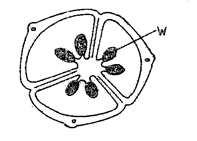
- (i) Name the structure labeled W
(ii) Name the type of pollination illustrated in this diagram.
24. (a) Difference between the following terms:
(i) dominant gene and recessive gene;
(ii) continuous variation and discontinuous variation
- What would be the expected results from a test cross?
25. State one economic importance of each of the following plant excretory products.
(a) Tannin
(b) Quinine
(c) Caffeine
26. Name the gamete cells that are produced by the ovaries.
27. The diagram below represents features of a joint mammal.
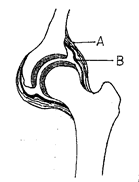
- Name the part labeled A
- State the function of the part labeled B
28. (a) What is a tropic response?
(b) State two ways by which auxins regulate growth in seedlings.
29. State four reasons why water is significant in seed germination.


