

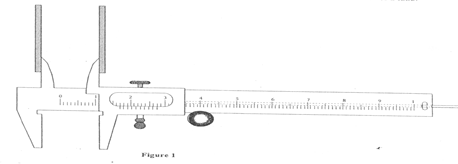
Figure 1 shows a vernier caliper being used to measure the internal diameter of a tube.

A stopwatch started 0.50 s after the start button was pressed. The time recorded using the stopwatch for a ball bearing falling through a liquid was 2.53 s. Determine the time of fall.
Some water in a tin can was boiled for some time. The tin can was then sealed and cooled. After some time it collapsed. Explain this observation.
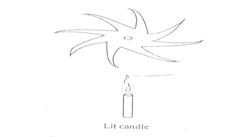
A paper windmill on a horizontal axis was placed above a candle as shown in Figure 2.
When the candle was lit, the paper windmill began to rotate. Explain this observation.
When a liquid is heated in a glass flask, its level at first falls, then rises. Explain this observation.
Figure 3 shows a uniform metre rule pivoted at the 30 cm mark. It is balanced by a weight of 2 N suspended at the 5 cm mark.
5 cm 30 cm2 N
Determine the weight of the metre rule.

 5 cm 30 cm
Figure 4 shows a horizontal tube with two vertical tubes X and Y. Water flows through the horizontal tube from right to left. The water level in tube X is higher than water in tube Y.
Explain this observation.
A cart of mass 30 kg is pushed along a horizontal path by a horizontal force of 8 N and moves with a constant velocity. The force is then increased to 14 N. Determine:
- The resistance to the motion of the cart.
- The acceleration of the cart.
When a drop of oleic acid of known volume is dropped on the surface of water in a large trough, it spreads out to form a large circular patch. State one assumption made when the size of the molecule of oleic acid is estimated by determining the area of the patch.
The weight of a solid in air is 5.0 N. When it is fully immersed in a liquid of density 800 kg/m3, its weight is 4.04 N. Determine:
- The upthrust in the liquid.
- The volume of the solid.
11. When a bicycle pump was sealed at the nozzle and the handle slowly pushed towards the nozzle, the pressure of the air inside increased. Explain this observation. (1 mark)
12. Figure 5 shows a mass of 200 g connected by a string through a hollow tube to a mass of 0.5 kg. The 0.5 kg mass is kept stationary in the air by whirling the 200 g mass round in a horizontal circle of radius 1.0 metre.
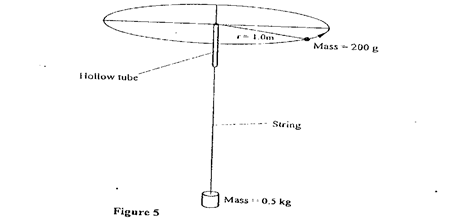
Determine the angular velocity of the 200 g mass. (3 marks)
13. State the SI unit of a spring constant (NB in words). (1 mark)
14. Figure 6 shows an athlete lifting weights while standing with the feet apart.
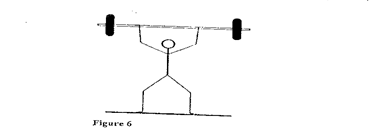
Explain why standing with the feet apart improves an athlete’s stability. (1 mark)
SECTION B (Marks)
Answer all the questions in this section in the spaces provided.
15. a) A cyclist initially at rest moved down a hill without pedalling. He applied brakes and eventually stopped. State the energy changes as the cyclist moved down the hill. (1 mark)
b) Figure 7 shows a mass of 30 kg being pulled from point P to point Q with a force of 200 N parallel to an inclined plane. The distance between P and Q is 22.5 m. In being moved from P to Q the mass is raised through a vertical height of 7.5 m.
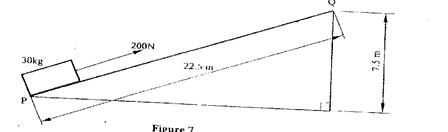
i) Determine the work done:
I by the force (2 marks)
II on the mass (2 marks)
ii) Determine the efficiency of the inclined plane. (2 marks)
c) Suggest one method of improving the efficiency of an inclined plane. (1 mark)
16. In an experiment to determine the density of sand using a density bottle, the following measurements were recorded:
Mass of empty density bottle – 43.2 g
Mass of density bottle full of water – 66.4 g
Mass of density bottle with some sand – 67.5 g
Filled up with water – 82.3 g
Use the above data to determine the:
a) Mass of the water that completely filled the bottle: (2 marks)
b) Volume of water that completely filled the bottle: (1 mark)
c) Volume of the density bottle: (1 mark)
d) Mass of sand
e) Mass of water that filled the space above the sand. (1 mark)
f) Volume of the sand:
g) Density of the sand (2 marks)
17. a) Explain why it is advisable to use the pressure cooker for cooking at high altitudes. (2 marks)
b) Water of mass 3.0 kg initially at 20°C is heated in an electric kettle rated 3.0 kW. The water is heated until it boils at 100°C. (Take specific heat capacity of water 4200 J/kg·K, heat capacity of the kettle = 450 J/K, specific latent heat of vaporization of water = 2.3 MJ/kg)
Determine:
i) The heat absorbed by the water. (1 mark)
ii) Heat absorbed by the electric kettle. (2 marks)
iii) The time taken for the water to boil. (2 marks)
iv) How much longer it will take to boil away all the water. (2 marks)
18. Figure 8 shows a stone of mass 4.0 kg immersed in water and suspended from a spring balance with a string. The beaker was placed on a compression balance whose reading was 85 N. The density of the stone was 3000 kg/m3 while the density of the liquid was 800 kg/m3.
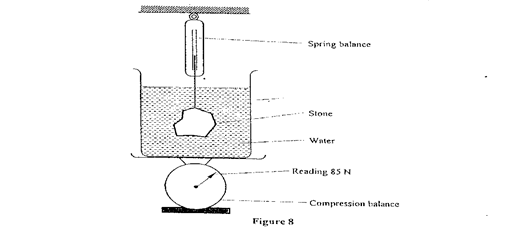
Determine the:
a) Volume of the liquid displaced. (2 marks)
b) Upthrust on the stone. (4 marks)
c) Reading of the spring balance. (2 marks)
d) Reading of the compression balance when the stone was removed from the water. (2 marks)
19. a) Figure 9 shows a velocity-time graph for the motion of a certain body.
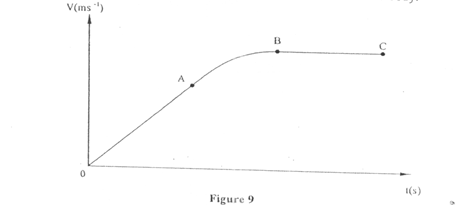
Describe the motion of the body in the regions:
i) OA (1 mark)
ii) AB (1 mark)
iii) BC (1 mark)
b) A car moving initially at 10 m/s decelerates at 2.5 m/s2.
i) Determine:
I its velocity after 1.5 s;
II the distance travelled in 1.5 s (2 marks)
III the time taken for the car to stop (2 marks)
ii) Sketch the velocity-time graph for the motion of the car up to the time the car stopped. (1 mark)
iii) From the graph, determine the distance the car travelled before stopping. (2 marks)


