


K.C.S.E 2007 BIOLOGY PAPER 2
SECTION A (40 marks)
Answer all questions in this section in the spaces provided
1. The diagram below represents some gaseous exchange structures in humans
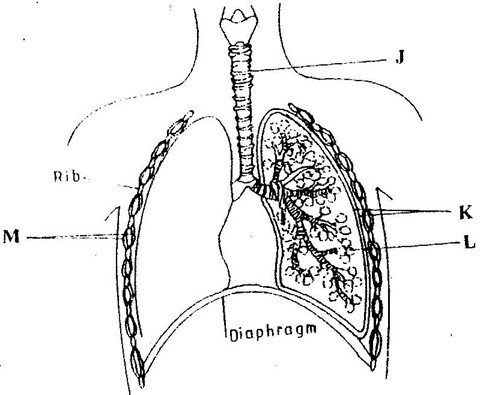
(a) Name the structures labeled K, L, and M (3 marks)
K…………………………………………………………………………….
L…………………………………………………………………………….
M……………………………………………………………………………
(b) How is the structure labeled J suited to its function? (3 marks)
(c) Name the process by which inhaled air moves from the structure labeled L into blood capillaries (1 mark)
(d) Give the scientific name of the organism that causes tuberculosis in humans (1 mark)
2 (a) Explain what happens to excess amino acids in the liver of humans (3 marks)
(b) Which portion of the human nephron are only found in the cortex? (3 marks)
(c) (i) What would happen if a person produced less antidiuretic hormone? (1 mark)
(ii) What term is given to the condition described in (c)(i) above (1 mark)
3 (a) What is meant by the following terms:
(i) Protandry (1 mark)
(ii) Self sterility? (1 mark)
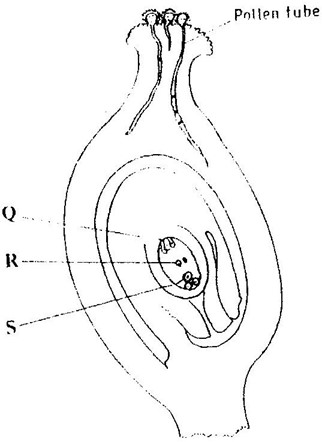
(i) Name the parts labeled Q, R, and S (3 marks)
Q
R
S
(ii) State two functions of the pollen tube (2 marks)
(c) On the diagram label the micropyle (1 mark)
4 (a) Name the three types of muscles found in mammals and give an example of where each of them is found (3 marks)
| Type of muscle | Where found |
|---|---|
| (i) | |
| (ii) | |
| (iii) |
(b) State the difference between ball and socket and hinge joint (1 mark)
(c) State the functions of synovial fluid (2 marks)
(d) State two advantages of having an exoskeleton (2 marks)
5. In maize the gene for purple colour is dominant to the gene for white colour. A pure breeding maize plant with purple grains was crossed with a heterozygous plant.
(a) (i) Using letter G to represent the gene for purple colour, work out the genotype ratio of the offspring (5 marks)
(ii) State the phenotype of the offspring (1 mark)
(b) What is genetic engineering? (1 mark)
(c) What is meant by hybrid vigour? (1 mark)
SECTION B (40 MARKS)
Answer question 6 (compulsory) in the spaces provided and either question 7 or 8 in the spaces provided after question 8
6. In the experiment to determine the effect of ringing on the concentration of sugar in phloem a ring of bark from the stem of a tree was cut and removed. The amount of sugar in grammes per 16cm3 piece of bark above the ring was measured over a 24 hour period. Sugar was also measured in the bark of a similar stem of a tree which was not ringed. The results are shown in the table below.
| Time of the day | Amount of sugar in grammes per 16cm3 piece of bark | |
|---|---|---|
| Normal stem | Ringed stem | |
| 06 45 | 0.78 | 0.78 |
| 09 45 | 0.80 | 0.91 |
| 12 45 | 0.81 | 0.01 |
| 15 45 | 0.80 | 1.04 |
| 18 45 | 0.77 | 1.00 |
| 21 45 | 0.73 | 0.95 |
| 00 45 | 0.65 | 0.88 |
(a) Using the same axes, plot a graph of the amount of sugar against time (6 marks)
(b) At what time was the amount of sugar highest in the
(i) Ringed stem (1 mark)
(ii) Normal stem? (1 mark)
(c) How much sugar would be in the ringed stem if it was measured at 03 45 hours? (1 mark)
(d) Give reasons why there was sugar in the stems of both trees at 06 45 hours (2 marks)
(e) Account for the shape of the graph for the tree with ringed stem between:
(i) 06 45 hours and 15 45 hours (3 marks)
(ii) 15 45 hours and 00 45 hours (2 marks)
(f) Name the structures in phloem that are involved in the translocation of sugars (2 marks)
(g) Other than sugars name two compounds that are translocated in phloem (2 marks)
7. Describe the structure and functions of the various parts of the human ear (20 marks)
8. Describe causes and methods of controlling water pollution (20 marks)


