

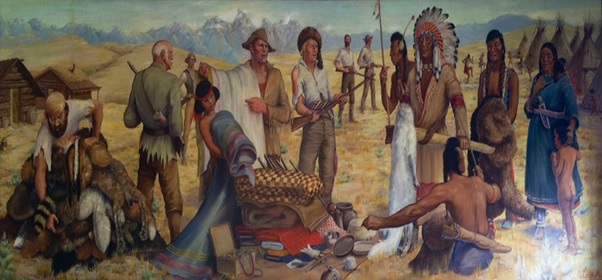
Interaction was a state in which people from one community got into contact with one another. The contacts among African people resulted from their various struggles to meet their daily requirements and further social and economic development. Before colonialism, African communities had social and economic interactions.
East Africa belongs to four main language groups namely the Khoisan, the Cushites, the Nilotes and the Bantu.Historical evidences show that the earliest inhabitants of East Africa were of Khoisan origin. Their speech is described as had “click” sound. It was similar to the language of present day KhoiKhoi and San of South Africa. They were nomadic hunters and gathers. These early large groups interacted with the larger Cushites, Bantu and the Nilotes communities that began settling in East Africa from the first century A.D. The remnants of them include Sandawe and Hadzabe of Tanzania and the Okiek (Dorobo) of Kenya. The origin home kind of the Nilotes was in the Nile valley in Sudan. Some Bantu communities of East Africa included Nyamwezi, Sukuma, Chagga and Pare of Tanzania, kikuyu, Kamba. Luhya of Kenya and Baganda, Basoga and Banyoro of Uganda. Through interaction of one community practiced medicine interacted with another led to some changes such as introduction of iron technology in East Africa.
due to economic factors such as crafts, trade, farming and pastoralism.
- Loss of originality: in the process of migrations and trade interactions people moved from one place of their origin to various destinations, through this interactions probably there was interactions of new values, customs and beliefs.
- Emergence of new language. As people of different languages like Bantu, Nilotes and Khoisan meet with other groups; they developed new languages which were based on those new related groups of Swahili language developed in East Africa having most of the Bantu vocabularies.
- Inter marriage. When people moved from their original areas and established settlement in new areas they got married with the natures and established new social relations. These involved social conflicts since people were united together.
- Population increased. The places which were attractive for people’s settlements become highly populated. Those regions immigration was common than emigration.
- Growth of towns and cities. Trading activities stimulated the emergence of urban centers along the trade natures and centers. Areas that produced trade commodities in West, North and East Africa become remarkable urban center; example Taghaza, Timbuktu, Gao, Kumbisaleh in West Africa, Alex and Rial in Tripoli and Cairo in north Africa, Malindi, Mombasa. Bagamoyo, Zanzibar, Tabora and Ujiji in East Africa.
- Exposure of Africa to the external world. The African coast and interior areas were invalided to the outside world. People were engaged in trading activities and slowly they created trading contacts with the Europeans. African was producing goods that were observed by the outside world.
- Intensification of agricultural production. Due to good manufacturing and use of better tools and high demands of food stuffs; cash crops and animals products became very important among Africans.
- Development of technical skills and new areas. Trading activities stimulated the emergency and growth of technical skills. Africans were able to process gold, iron smelting and cloth making.
- Over exploitation of African resources. Trade items such as ivory, gold, copper and animal
s skins, supplied within African and later to outside world. Later on those resources were highly demanded by the outside world like Asia and Europe. Therefore traders take them to outside world of large quantities. - The decrease of manpower. Many people in the Western Sudan and East Africa interior were captured as slaves to meet the high demands of slaves by long distance and Trans-Saharan trade.
- Emergence of classes: The interactions of people on Africa resulted into classes of rich and poor; those who engaged in trade and agricultural activities became economically powerful than those who did not engage in these activities.
Ngoni people originated in Kwazulu land and Natal region in the sent by the public of South Africa. Ngoni are the one who speak Nguni language in the 19th century; Zulu kingdom got new king called Tshaka. Tshaka through frequent war campaigns succeeded to expand his empire. The tribe defeated by Tshaka was recruited into his military service. Through this contradiction many other tribes fled northward to Mozambique, South Africa, Tanzania, Malawi and Zambia. Due to contradictions and political ambition Tshaka was assassinated by his brother Dingane 1828.

Eastern side of Lake Malawi (Nyasa) finally settled in present day Songea district.
Lake Nyasa in 1840.Hence Zwangedaba died in 1845.
in order to protect their traditional way of life they decided to move northwards to central and Eastern Africa.
4. Zulu expansion: The use of Shaka as a leader in Zulu nations contributed greatly to the Ngoni migration. He was a political ambitious and an aggressive ruler who believed in the expansionism policy. He waged frequent wars against neighbouring states. The Ngoni moved northwards to search new areas; they succeeded due to their large number and good military techniques. The Ngoni army was highly disciplined with short stubbing spears known as Assegai clubs, sharp small areas and tough cow-hide-shield.
- Conquest of weak states: Ngoni conquered weak states and subdivided them in the military areas they passed through Theha and Zinza.
- They brought unity to some societies of Tanzania. There was change of rule in the regions they had passed. For instance the Hehe, Sangu and Bena united together to fight with the Ngoni invaders.
- Formation of agreement. In 1881 Mkwawa fought with the Ngoni. In this war the losses on both sides were so great that they entered into political treaty not to fight again until their sons become adults.
- Changes in Military techniques.
- Depopulation: Many people died in fighting and many were taken as war captives by the Ngoni.
- Marriage: The Ngoni people married women from the communities they conquered. Sometimes marriages were forced, where they took the women belonging to the captives and made them their wives.
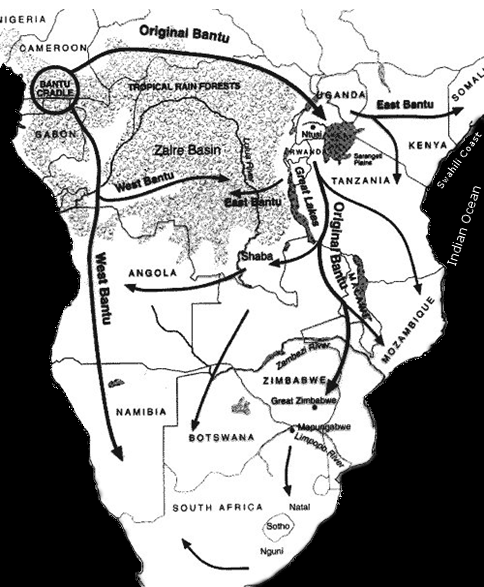
A SKETCH MAP SHOWING INTERACTIONS AMONG THE PEOPLE OF AFRICA.
ECONOMIC EFFECTS
- Trade network between the traders of the east coast and the interior communities such as the Yao and Nyamwezi were disrupted by the Ngoni raids. Commodities could therefore not reach the communities that needed them.
- The Ngoni warriors destroyed both human life and livestock. Thus, they made some communities such as Ndebele economically disadvantaged.
- Due to insecurity, agricultural activities were disrupted. This caused food shortages.
- A lot of valuable time was wasted as young people prepared for war. There was therefore shortage of labor for economic activities such as agriculture, hunting and fishing.
- New technological skills
were introduced, especially in iron working as the long spears were replaced by short stabbing spears.
- Zulu clan under Senzangakara.
- Mthethwa under Dingiswayo.
- Ngwane under Sobhuza.
- Ndwandwe under Zwide.
- Need for land – Zulu needed more land for farming and grazing.
- Rise of Zulu – Shaka fights the other clans in order to expand his kingdom.
- Population growth in Natal causes conflict.
- Clans denied expanding boundaries in order to make a large territory.
- Expansion of Boers from cape to Natal.
CANE.
- Depopulation in Natal because of death.
- Empire building e.g. Ndebele Empire under Msilikazi in Zimbabwe, and Ngoni under Zwangedaba.
- Mfecane caused insecurity because of fighting.
- Mfecane helped the Boer to settle in large areas.
- Caused destruction of properties, crops and buildings.
- The rise of defensive kingdoms e.g. Basulo, Swazi and Bapendi.
SOCIO-ECONOMIC DEVELOPMENT AND PRODUCTION IN PRE – COLONIAL AFRICA
- Social organization: Refers to the mode of production existing in a particular place at particular time. It constitutes productive forces and relation of production.
- Modes of production: Is the relationship between production and productive forces include the following; human labour, surplus production, instrument of labour, objective of labour and population.
- Human labor: Is the consciousness and purposeful activity of people to produce material wealth.
- Production: Is a major in the series of economic processes that brings goods and services to people. It includes creation, distribution and consumption.
- Means of labour: Are the things used in production such as hoes, machines, roads, buildings etc.
- Objective of labour: Are things upon which man’s labour is applied (mostly land).
- Productive forces: These are means of production created by a society especially objects and instrument of labour.
- Relation of production: Are simple and direct relations which people enter to one another in actual production process either exploitive or exploited class.
- Class struggle: Are conflicts that developed between exploitative mode and non – exploitative modes example capitalism and socialism.
- The Tindiga and Hadzabe of Singida and Lake Manyara and Central Tanzania.
- The Dorobo (Okiek) of Maumau forest and Tesoin Uganda.
- The Mbali found in the equatorial rain forest of the Congo DRC.
- The bushman (san) of South Africa.
- The KhoiKhoi of Kalahari desert of Botswana
- The Tur of Ghana.
- Absence of exploitation.
- Low level of production.
- Dependence on nature.
- Communal ownership.
- Hunting and gathering.
- Subsistence economy.
- Lack of specialization.
- People in communal society treated each other equally. There was no standing armies and ruling classes; even elders were not lords or rulers.
- Learning by doing: people in communal societies shared knowledge. This was acquired through learning by doing, youth and children obtained knowledge and skills from their elders.
- Neolithic revolution: Is the term for the first agricultural change describing the transition from nomadic, hunting and gathering to permanent settlement. Neolithic revolution brought socioeconomic changes such as establishment of permanent settlement, extension of division of labor based on age and sex, emergence of specialization, surplus production and spread of diseases due to permanent settlement.
- Advanced in science and technology. This was the turning point that gave improvement in agricultural production. The tools produced were sharper and stronger than the older ones. The improvement of tools led to the expansion of socioeconomic activities above and beyond hunting and gathering.
- The reliable rainfall and fertile land. Allowed the expansion of agriculture especially the cultivation of permanent crops such as banana in Uganda.
- Population growth by either natural increase through giving birth or artificial means through immigration which was associated with transformation of the social organization and forming of strong empire.
- Egypt where they constructed dams and pyramids.
- Chagga, Haya, Ganda, Hehe. Kerewe and Sambaa in East Africa interior.
- Along the coast of East Africa slaves were used in carrying loads buildings, cities, constructing dams and irrigation scheme. Slavery in Africa never existed as an institution except in Egypt Muslim communities and on the coast of East Africa.

- Existence of two classes that is the slave masters who were exploiters and the slaves who were exploited group.
- Private ownership of the major means of production. The slave masters owned slaves, cattle and all implements of production.
- Low productive force under the slave mode of production, the productive forces were still low though more advanced compared to those used during communalism.
- Existence of surplus production. There were extra products due to the use of advanced tools and improved skills of man to control his environment. The slave masters owned surplus production produced by slaves.
- Existence of political institutions; these began to emerge and existed in various areas example slave masters had state apparatus such as army, prisons and police which were employed in exploiting and suppressing slaves.
- Class struggle existed between slaves and slave masters; the slaves started to resist in form of strikes, rebellions, idling and running away.

- Labour rent; existed in form of labour or service in which peasants (serf) were required to work for three days in week for the land lords.
- Rent in kind: The serfs regularly had to deliver the quantities of his products to the land lords. The products could be in form of grain, cattle or vegetables.
- Money rent: Was the system in which money used as a major means of paying rent.
- Exploitation of man by man example peasants (serf) were exploited by land lords and the distribution of production was not equal.
- Little freedom to peasant; peasants were tired due to various restrictions as they were treated as children.
- Private ownership of major means of production such as land, mining sites, houses and cattle all these belonged to feudal lords.
- Division labour based on sex where men specialized in military while women specialized in farming and taking care of children.
- Existence of classes; landlords as exploiters and serfs as exploited class.
- Existence of strong political institutions in form of kingdoms and empires example Bunyoro, Buganda and Karagwe.
- Nyarubanja system. In this form of feudalism the major means of production was land. Under Nyarubanja system in Buhaya and Karagwe there was two classes, that is the Batwazi (ruler) and Batwana (serfs). These two classes had to pay rent in kind and rent in labour services to the land lords.
- Umwinyi system was another form of feudalism found along the coast of East Africa. Wamwinyi controlled the productive forces such as land, serfs and tenants; also monopolized the political and economic power. The serfs and tenants were given land by Wamwinyi (feudal lords) to live on them in return of labour services and tributes which were paid to Wamwinyi. Before Arabs colonization The Mwinyi mkuu was the greatest land lords and ruled Zanzibar with the help of Shehe in Unguja and Diwani in Pemba.
- Ubugabire system was another form of feudalism practiced among the Tutsi and Hutu in Rwanda and Burundi. The Tutsi (donor) also known as SEBUJA could transfer their cattle to the Ifutu (recipient) as sometimes known as BUGABIRE. The Omugabire and his family were obliged to perform several duties for the masters including house building cultivating.
- Ntemi system: This was practiced among the Nyamwezi and Sukuma. The power of ruler was based on the control of land The Mtemi organized his people to open up new land wherever it was available. The process of opening up new land was known as Kutema.
MERITS OF FEUDALISM
The following are some of merits of feudalism;
1) The weaker people in the society were protected by the king or the rich land owners. For example, among the Rwandans, the Tutsi had an obligation to protect their tenants, the Hutu.
2) The land owners gave all poor people in the society a piece of land to cultivate. This way, everyone had a means of earnin
g a living.
3) There was a piece in the state as the rich classes maintained law and order.
4) The rich supported the poor with food during drought and famine.
5) The society were highly stratified, with each class of people knowing their position and role. In this way, the feudal societies were very organized.
DEMERITS OF FEUDALISM
1) The rich exploited labour force of the poor.
2) Only a few people in society owned land.
3) There was inequality in society between the rich and the poor.
4) The peasant were forced to undertake military duties and endanger their lives for their landlords.
5) It encouraged inter-community warfare as landlords fought in order to increase their land and vassals.


18 Comments