


Gas laws Questions
1. A sample of unknown compound gas X is shown by analysis to contain Sulphur and Oxygen. The
gas requires 28.3 seconds to diffuse through a small aperture into a vacuum. An identical number
of oxygen molecules pass through the same aperture in 20seconds. Determine the molecular mass
of gas X (O= 16, S= 32)
2. (a) State Graham’s Law of diffusion
(b) Gas V takes 10 seconds to diffuse through a distance of one fifth of a meter. Another
gas W takes the same time to diffuse through a distance of 10 cm. if the relative molecular
mass of gas V is 16.0; calculate the molecular mass of W
3. (a) State Charles’ Law
(b) The volume of a sample of nitrogen gas at a temperature of 291K and 1.0 x 10⁵ Pascals
was 3.5 x 10⁻²m3. Calculate the temperature at which the volume of the gas would be
2.8 x 10⁻²m3 at 1.0 x 10⁵pascals.
4. 60 cm3 of oxygen gas diffused through a porous partition in 50 seconds. How long would it take
60 cm3 of sulphur (IV) oxide gas to diffuse through the same partition under the sane conditions?
(S = 32.0, O = 16.0)
5. (a) State Graham’s law of diffusion
(b) 30cm3 of hydrogen chloride gas diffuses through a porous pot in 20seconds. How long
would it take 42cm3 of sulphur(IV) oxide gas to diffuse through the same pot under
the same conditions (H =1 Cl = 35.5 S = 32 O =16)
6. a) State Boyles law
b) Sketch a graph that represents Charles’ law
c) A gas occupied a volume of 250cm3 at -23ºC and 1 atmosphere. Determine its volume
at 127ºC when pressure is kept constant.
7. A factory produces Calcium Oxide from Calcium Carbonate as shown in the equation below:-
CaCO3 (s) CaO (s) + CO2 (g)
(a) What volume of Carbon (IV) Oxide would be produced from 1000kg of Calcium
Carbonate at s.t.p (Ca = 40, C = 12, O = 16, Molar gas volume at s.t.p = 22.4dm3)
8. A fixed mass of gas occupies 200cm3 at a temperature of 23oC and pressure of 740mmHg.
Calculate the volume of the gas at -25oC and 780mmHg pressure
9. Gas K diffuses through a porous material at a rate of 12cm3 s-1 where as S diffuses through
the same material at a rate of 7.5cm3s-1. Given that the molar mass of K is 16, calculate the
molar mass of S
10. (a) State Gay Lussac’s law
. 11. (a) What is the relationship between the rate of diffusion of a gas and its molecular mass?
(b) A sample of Carbon (IV) Oxide takes 200 seconds to diffuse across a porous plug.
How long will it take the same amount of Carbon (II) Oxide to diffuse through the
same plug?(C=12, O=16)
12. Below are structures of particles. Use it to answer questions that follow. In each case only
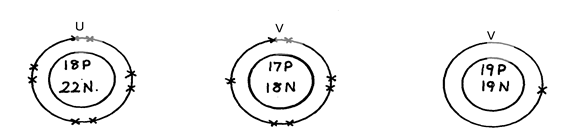 electrons in the outermost energy level are shown
key
P = Proton
N = Neutron
X = Electron
(a) Identify the particle which is an anion
(b) Choose a pair of isotopes. Give a reason
13. The figure below shows two gases P and Q diffusing from two opposite ends 18 seconds after
the experiment
(a) Which of the gases has a lighter density?
(b) Given that the molecular mass of gas Q is 17, calculate the molecular mass of P
14. Identify the particles that facilitate the electric conductivity of the following substances
(i) Sodium metal
(ii) Sodium Chloride solution
(iii) Molten Lead Bromide
15. Gas B takes 110 seconds to diffuse through a porous pot, how long will it take for the
same amount of ammonia to diffuse under the same conditions of temperature and pressure?
(RMM of B = 34 RMM of ammonia = 17)
16. A gas occupies 5dm3 at a temperature of -27oC and 1 atmosphere pressure. Calculate the
volume occupied by the gas at a pressure of 2 atmospheres and a temperature of 127oC
17. A fixed mass of gas occupies 200 cm3 at a temperature of 230c and a pressure of 740 mm Hg.
Calculate the volume of the gas at -250c and 790 mm Hg pressure.
18. (a) State the Graham’s law
(b) 100cm3 of Carbon (IV) oxide gas diffused through a porous partition in 30seconds.
How long would it take 150cm3 of Nitrogen (IV) oxide to diffuse through the same
partition under the same conditions? (C = 12.0, N = 14.0, O = 16.0)
Gas laws Answers
1. X: t1= 28.3sec RMM = ?
 Q2: t2= 20.0sec RMM=32
T MM
T 1
= X
T2 32


28.3
2 = X
 T2 32
T2 32
X = 28.32 x 32
 400
400
X = 64
2. (a) The rate of diffusion of a gas is inversely proportional to the square root of its density under the same conditions of temperature and pressure
(b) Rate of gas V= 1/5 x 100cm
10sec
 = 2cm/sec
Rate of W = 10cm
 10sec
10sec
= 1cm/sec
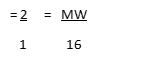 RV = MW
RW MV
2
2 = MW
1 16
4 = MW = 4 x 16
1 16 1
MW = 64
 3. (a) The volume of a fixed mass of a gas is directly proportional to its absolute temperature at
constant Pressure
(b) Apply combined gas law; P1V1= P2V2
T1 T2
 V1 = 3.5 x10⁻² m3 V2 = 2.8 x 10⁻²m3
P1 = 1.0 x 10⁵Pa P2= 1.0 x 10⁵Pa
T1 = 291K T2= ?
T2 = P2V2T1
P1V1
T2 = 1.0 x 105Pa x 2.8 x 10-2m3 x 291K
 1.0 x 105Pa x 3.5 x 10-2m3
T2 = 232.8k
4. TsO2 = R.M.N.SO2
½
TO2 R.M.MO2
SO2 = 32 + (16 x 2) = 64 ½
O2 = (16 x 2) = 32 ½
TsO2 = 64
½ = 70.75 ½
50 32
5. a) The rate of diffusion of a fixed mass of a gas is inversely proportional to the square root of it
density at constant temperature and pressure
b) RHCl = 30 cm 3 = 1.5 cm 3 see
20 se
RHCL = √MSO2
RSO2 =√MHCL
(1.5 ) 2 √64
RSO2 = √ 36.5
(RSO2)2 = 2.25 x 36.5
64
RSO2 = √ 2.25 x 36.5
64
1.133 cm/ sec
1.133 cm3 ____________ 1 sec
42 cm 3 = 42 x 1
1.133
= 37 sec
6. a) Boyles’ law For a fixed mass of a gas, volume is inversely promotional to pressure
at constant temperature
b)
c) P1V1 = P2V2
½ V2 = P1V1 X T2
½
T1 T2 T1 P2
250 X 273 – 23
273 + 127 ½
= 156.5cm3
7. a) RFM of CaCO3 = 40 + 12 + 48
= 100kg. √½
∴ 100 kg of CaCO3
≡ 22.4dm3 of CO2(g)
1000 kg ” ” ?
= 22.4 x 1000
√1 = 224 dm3
√½
100
8. T1 = 23+273 =296 T2 = -25+273 = 248
V1 = 200cm3 V2 = ?
PI = 740mmHg P2 = 780mmHg
P1V1 = P2V2
T1 T2
740×200
√1=780x? √1
- 248
x = 740 x 200 x 248
296 x 780
= 158.974 cm³√ 1 (penalize ½ mark for units)
9. Rk = Ms
Rs Mk
12 = x√ ½
7.2 16
X = 122 x 16√ ½
7.22
= 44.464√
 10. (a) When gases combine they do so in volume which bear a simple ratio to one another and to
the product if gaseous under standard temperature and pressure
11. a) Rate of diffusion is whereby proportional to molecular mass of a gas. √1
b) TCO2 = MCO2
TCO MCO √½

 ⇒ 200 = 44 = 44 √½
T 28 28

⇒
200 = 11
T 7
⇒ T = 7
- 11
⇒ T = 200.0.79772√½ = 159.5 Seconds. √½
12. a) Y √1
b) Z and W √1 have same atomic number but different mass number. √1
13. (a) Gas P
(b) RQ = RMMP
RP RMMQ
18 = x
 54 17
54 17
12 = x
32 17
1 = x
9 17
9x = 17
x = 17/9
x = 1.88
Q = It
= 5 x 386 = 1930C
(b) Pb2+(l) + 2e Pb(s) (½mk)
If 2 x 96500C = 207 ( ½ mk)
1930C = 1930 x 207 ( ½ mk)
2 x 96500
= 399510 (½mk)
193000C
= 2.07g (½mk)
14. i) Delocalized electrons
ii) Mobile ions
iii) Mobile ions
15. TNH3 MNH3
TB MB ½
TNH3 = 17
TB 34
TNH3 = 17 ½
110 34
TNH3 = 110 X 17 ½ = 77.78 seconds ½
34
16. P1 V1 = P2 V2
T1 T2
1×5 = 2 xV2
246 400
V2 = 400 x1 x 5
2 x246
= 4.065 dm3
17. a) V1 = 200 cm3 V2= ?
T1 = 296 K T2 = 284K
P1 = 740 mmHg P2 = 780 mm Hg
P1VI = P2V2
T1 T2
V2 = P1V1T2 = 740 mm Hg x 200cm3 x 248K
T1P2 296K x 780 mm Hg
= 158.97 cm3
b) 60 l 1
18. a) Grahams law states
Under the same conditions of pressure and temperature, the rate of diffusion of a gas is
inversely proportional to the square root of its density
b) Time CO2 = MrCO2
Time NO2 MrNO2
Where 100cm3 of CO2 takes 30 seconds
150cm3 of CO2 takes 30/100 x 150
= 45 seconds√
452 = 0.975
TNO2
45 = 44 ____ TNO2 = 45
TNO2 46 0.978
TNO2 = 46 sec
OR
RCO2 = MrNO2
RNO2 MrCO2
But RCO2 = 100cm3 = 3.33 cm3 per sec
30 s
3.33 = 46
RNO2 44
= 1.0225
RNO2 = 3.33
1.0225
= 3.26 cm 3 per second
Time for No = 150 cm3
3.26cm sec -1 = 46 secs


