TRADE CYCLE
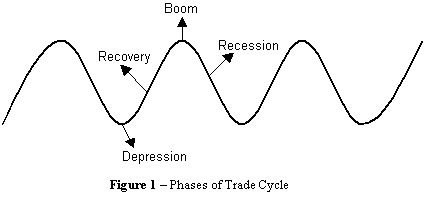
Trade cycles can well be called Business cycles.
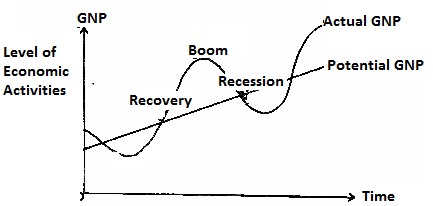
It means the rise and fall in the level of economic activities in an economy over time.
Trade cycle means ups and downs (fluctuations) in the level of economic activities in an economy.
A trade cycle simply means the whole course of trade or business activity which passes through all phases of prosperity and adversity.
The level of economic activities in any economy does not remain constant but changes as factors upon which they are based also change.
Features of Trade cycles
- Trade cycles are wave-like structures; their occurrence is like the shape of waves.
- Expansion and contraction in trade cycles are cumulative in effects.
- Trade cycles differ in timing and level of fluctuations.
- Trade cycles have common patterns of phases which are sequential in nature.
- A downward movement of trade cycle is more sudden and violent than the change from downwards to upwards.
- Trade cycles occur in aggregate variables such as output, income, prices, etc.
TYPES OF TRADE CYCLE
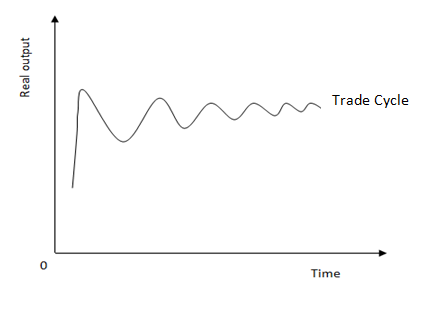
A damped Cycle
The fluctuations become smaller and smaller over time.
An explosive cycle
The fluctuations become larger and larger over time.
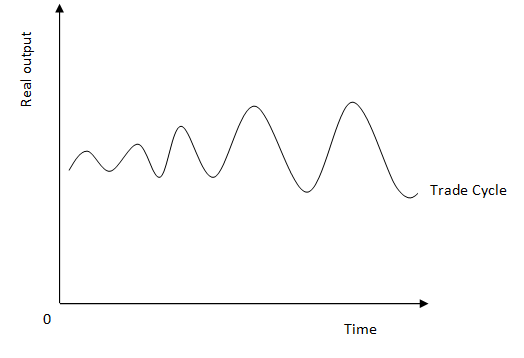
PHASES OF TRADE CYCLES
Trade cycles have four (4) phases which are arranged in order as below:
- Depression (trough/slump)
- Recovery (revival/expansion)
- Boom (peak/prosperity)
- Recession (downturn/contraction)
Characteristics of phases of trade cycles
This is a period when economic activities are at the lowest level. Therefore, it is the period where there is maximum decline in the level of economic activities.
Characteristics of Depression
- Lowest level of investments
- Highest level of unemployment
- Lowest level of income
- Lowest level of consumption
- Prices are very low
- People lose confidence in their government
- Lowest standard of living
- Banks and businesses are bankrupt, etc.
This is a period when the economy starts to improve from a depression.
Characteristics of Recovery
- Investment starts to increase
- Unemployment starts to reduce
- Standard of living starts to improve
- Incomes and prices start to increase
- Banks start providing credit and people start saving
- Consumption starts to increase
- People start to gain confidence in their economy
Boom
This is a period when the economy is at the highest level and therefore economic activities are at the most desirable level.
Characteristics of Boom
- Highest level of investment
- Lowest level of unemployment
- Highest standard of living
- Social, economic, and political stability
- High incomes
- High effective demand
Recession
This is a phase where there is a decline in the level of economic activities.
Characteristics of a recession
- Decline in investment
- Increase in unemployment
- Decrease in incomes
- Decline in effective demand
- Decrease in the standard of living
- Tax revenue falls, etc.
Causes of Trade cycles
- Changes in climatic conditions
When climate is favorable, agricultural activities and other related ones such as agro-based industries are stimulated which results in expansion in output, employment opportunities, incomes, etc., and hence an expansion in economic activities. However, with unfavorable climate such activities contract and hence decline in employment, income, output, etc.
- Change in the age of capital
When machines are new, they tend to be more efficient and hence more output, income, employment opportunities, and hence expansion in the levels of economic activities. But over time, machines become older through depreciation, which reduces efficiency and hence fall in output, incomes, employment opportunities, and finally a contraction in economic activities.
- Technological innovation
When a new technology is discovered, it results in better methods of production and hence output, incomes, employment opportunities, etc., and hence expansion in the level of economic activities. But when innovations do not take place regularly, fluctuations in the level of economic activities occur.
- Changes in government policy
Government policy is also responsible for fluctuations in the level of economic activities. If the government opts for expansionary fiscal and monetary policies such as decrease in taxes and increase in government expenditure, it will result in expansion of economic activities. However, if the government opts for contractionary monetary policy such as increase in taxes and decrease in government expenditures, it will result in contraction in economic activities.
- Changes in marginal efficiency of capital
The level of investment is an important factor regarding the level of economic activities, but this depends primarily on the marginal efficiency of capital. When marginal efficiency of capital increases, investment expands, output increases, employment and incomes also increase, and hence expansion. On the other hand, when marginal efficiency of capital declines, it results in decline in investments, output, employment, etc., and hence a decline in the level of economic activities.
- Changes in political climate
When there is political stability, investment expands and hence increase in output, employment opportunities, incomes, and hence expansion in the level of economic activities. On the other hand, with political instability, economic activities decline.
- Unpredictable changes in business investment depending on business optimism and pessimism (Psychological factor)
When entrepreneurs are optimistic, they have confidence and hope for better business and profit; then they are motivated to increase investment and hence expansion in the level of economic activities.
Theory of Trade cycles
- Climatic theory (Harvest Theory) / Sunspot theory
According to the theory, trade cycles occur due to changes in climatic conditions. When climate condition is favorable, it leads to economic expansion. Conversely, unfavorable climate causes a decline in outputs in agriculture and agro-based industries, leading to economic decline.
Jevons sunspot theory: According to Stanley Jevons, spots appear on the face of the sun at regular intervals. These spots affect the emission of heat from the sun, which in turn conditions the degree of rainfall. The rain affects agriculture, which affects trade and industry.
- Monetary theory
According to this theory, trade cycles occur due to changes in money supply and money demand.
Change in money supply
- Increase in money supply: When money supply increases through increased provision for credits, investments are encouraged and thus employment, incomes, effective demand increase as well as the standard of living. This is a period of boom or economic recovery.
- Decrease in money supply: When money supply decreases, it discourages investment; as a result, employment, income, and effective demand fall, hence an economic recession occurs.
Changes in money demand
- Increase in money demand: An increase in money demand for transaction motive causes an economic expansion.
- Decrease in money demand: A decrease in money demand for transaction motive discourages effective demand and production; therefore, it results in a recession or depression.
3. Over-investment theory
According to this theory, trade cycles occur due to over-investment. Over-investment occurs due to the following reasons:
– Fall in the rate of interest: When the rate of interest is low, investors are encouraged to borrow money for investment; hence more investments are created leading to economic growth.
– Technological innovations: Invention of new technology causes an increase in production and economic expansion.
– Increase in effective demand: When effective demand increases production, the economy undergoes economic growth.
4. Psychological Theory
Attempts are made by some economists to explain trade cycles in terms of psychology. There are moods of optimism alternating with moods of pessimism. At some stage, people just think trade is good and that it is going to remain good. Business activity is intensified and becomes flourishing. Then all of a sudden, people start thinking that the period of prosperity has lasted long enough and adversity is around the corner. Thus, although no valid reason for depression to come about, it is brought about by the people themselves. It is all psychological.
The psychological theory lacks any sound basis. There is a conjectural element in it. There is no doubt that individual fluctuations are affected by the waves of optimism and pessimism and are intensified by them. But they do not explain the cause of the trade cycles or their periodic aspect.
5. Under-consumption theory
According to under-consumption theory, there is too much saving during a boom and further additions to saving reduce the level of consumption. A reduction in the level of consumption in the case of increasing productive capacity must sooner or later lead to the collapse of the boom.
The under-consumption or over-saving theory contains an element of truth. But it cannot be the adequate explanation. For example, if the under-consumption theory were exclusively relied on, we would expect the consumption goods industries to fluctuate more than investment goods industries. But exactly the reverse is the case in real life during a trade cycle.
6. Keynes Theory
According to Keynes, trade cycle is caused by changes in the rate of investment. The rate of investment is caused by the marginal efficiency of investments, i.e., profitability of investments. If the rate of profit declines, investors are discouraged to increase investments, the economy falls into a recession; and if the rate of profit increases, investors are encouraged to increase investments and therefore the economy will experience recovery.
7. Political Theory
According to this theory, fluctuations in economic activities are caused by:
- Actions of politicians who apply expansionary monetary and fiscal policy for their political interest, i.e., to gain popularity. This policy leads to economic prosperity in the short run, but after winning elections, politicians apply contractionary monetary and fiscal policies which lead to economic contraction.
- Political stability and instability: When there is political stability, investors are encouraged to increase investments causing economic growth. In contrast, when there is political instability, investors are discouraged to invest and thus the economy falls into recession.
8. Modern Theory
According to this theory, trade cycles occur due to multiplier and accelerator processes. An increase in investments leads to an increase in income which stimulates further increase in investments through the accelerator process, and increase in investments stimulates further increase in income. Therefore, economic recovery or a boom is caused by the effectiveness of the multiplier and accelerator processes, while economic recession is caused by ineffectiveness of these processes.
MEASURES TO CONTROL BUSINESS CYCLES
- Expansionary monetary policy
This involves the central bank, through commercial banks, increasing money in circulation in order to deal with a depression and recession. Under this, the central bank will reduce the bank rates, reduce legal reserve requirements, and so on, which will encourage banks to lend more to customers and businessmen. This will result in more investments, increase in aggregate demand, which will finally result in expansion of economic activities.
- Expansionary fiscal policy
Under this, the government should opt for the following in order to deal with a depression and recession:
– Increase in government expenditure, especially in productive areas such as construction of roads, which will result in increase in money supply and stimulation of business activities.
– The government should also lower direct and indirect taxes, which will stimulate aggregate demand for goods and services, hence stimulation of economic activities.
- The government can also employ direct controls in order to ensure proper allocation of resources to bring about price stability and economic stability. Such controls will take different forms such as:
- Exchange rate policy: Under this, the government evaluates its currency in order to encourage exports which helps to boost domestic production.
- Price and wage control: Under this, the government fixes minimum prices in order to encourage production. It can also increase wages to increase aggregate demand.
- Monopoly control: Under this, the government can monitor the operation of monopoly firms so that they do not limit output, which helps to stimulate production.