


INORGANIC CHEMISTRY
Is the chemistry of all the elements and their compounds with the exception of most carbon compounds out of which only the oxides, cyanides and carbonates are considered as inorganic compounds. Inorganic chemistry can also be defined as the study of the elements in the periodic table.
PERIODIC TABLE
Periodic table is the table of all the known elements arranged in order of increasing atomic numbers. The arrangement reflects the electronic configuration of the elements.
THE PERIODIC TABLE CLASSIFICATION OF THE ELEMENTS (MENDELEEV’S AND LOTHAR MEYER 1869)
The first comprehensive classification of elements was made independently by Mendeleev in Russia and Lothar Meyer in Germany in 1869. They tabulated all the known elements on the basis of relative atomic mass. The arrangement of elements in the early periodic table was according to the ordinary periodic law which states that ‘The properties of elements are periodic functions of their relative atomic masses’.
When elements were arranged in order of increasing atomic masses, elements with similar properties recurred at regular intervals. The recurrence or repetition of elements with similar properties at regular intervals in the periodic table is known as PERIODICITY.
Mendeleev and Lothar Meyer placed elements in horizontal rows (periods) which caused elements with similar properties to appear in the same vertical column (group). Some elements were not yet discovered and hence absent in that periodic table e.g. Noble gases, gallium, germanium etc.
On the basis of relative atomic mass three anomalies appeared in the early periodic table (Ordinary periodic table). The position of Potassium (39.1), Argon (39.9), Cobalt (58.94), Nickel (58.69), Tellurium (127.6) and Iodine (126.9) had to be reversed to bring them into correct placing on chemical grounds. The strict order of relative atomic mass would have separated the mentioned elements from closely related elements. For example, Potassium could have been separated from other alkali metals. These anomalies showed clearly that the relative atomic mass was not really the true basis of arranging or classifying elements in the periodic table.
The three anomalies stated above were due to ISOTOPE. For example, both Argon and Potassium exhibit isotopy. The principal isotopes of these elements are shown in the table below.


In the case of Argon, the heavier isotope is predominant (has higher abundance) giving an average atomic mass of 39.9. In Potassium, the lighter isotope predominates giving an average atomic mass of 39.1. The explanation is similar in the case of cobalt (no isotopes), nickel (five isotopes), tellurium (eight isotopes) and iodine (isotope).
Moseley discovered that atomic number was the proper criterion for arranging elements in the periodic table. The atomic number of an element determines the number of electrons in the atom and hence the arrangement and properties of the elements in the periodic table.
When atomic numbers are used instead of atomic masses, the anomalies observed between potassium, Argon, Cobalt, Nickel, Tellurium and Iodine disappear. The classification of the known elements in the periodic table is now based on the Modern Periodic law which states that “The properties of elements are periodic functions of their atomic numbers”.
NB: One can’t use R.A.M or Atomic mass for arranging elements but atomic number is the best.
STRUCTURE OF PERIODIC TABLE
The periodic table is very important in the study of inorganic chemistry. The relationship between the periodic table, atomic number and properties of elements enable us to obtain an overview of the many facts and features in inorganic chemistry.
The periodic table consists of boxes which are filled by elements. Each box contains the symbol, mass number, and atomic number of elements.
However, other data like electronegativity, boiling point, melting point, oxidation states values may be included or added. There are various layouts of the periodic table. The periodic table may be in the short or long form. Under this level the long form will be considered. The long form consists of all the elements of a period except the Lanthanide and Actinides.
The elements with similar properties occur in vertical columns called groups. The horizontal rows of elements in the periodic table are called periods. The long form of the periodic table is divided into four major blocks according to the sub shell in which the respective elements fill their electrons. The four major blocks are S-blocks, P-blocks, d-blocks, and f-blocks.
1. S-BLOCK ELEMENTS
The S-block consists of elements which fill their outermost electrons in the S-sub shell. These elements use their S-sub shell electrons for bonding. The S-block is constituted by the elements of Group IA and Group IIA e.g. Li, Na, K, Mg etc.
2. P-BLOCK ELEMENTS
The P-block elements consist of elements which fill their outermost electrons in the P-sub shell. This block consists of elements of group IIIA up to VIIA, example Carbon, Sulphur, Phosphorus, Nitrogen, Oxygen, Chlorine, Argon, Neon. Helium is not a P-block element.
The S- and P-block elements together form main group elements. These elements use only electrons of their outermost shell for bonding. Hence there are seven main groups which constitute main group elements (example IA, IIA, IIIA, IVA, VA, VIA and VIIA). The noble gases contain full outermost electrons in S and P-sub shells. Since this configuration is very stable, the noble gases are unreactive.
However, they form some compounds with strongly electronegative elements like Oxygen and Fluorine. Examples of noble gases include Helium, Neon, Argon, Krypton etc.
3. d-BLOCK ELEMENTS
The d-block consists of elements with partially or fully filled d-sub shell. They fill their electrons in the d-sub shell of the penultimate shell. They use electrons from S and d-sub shells for bonding. Examples: Scandium, Manganese, Iron, Radium, Nickel, Cobalt, Copper, Zinc etc.
4. f-BLOCK ELEMENTS
The f-block consists of elements which are called Lanthanides and Actinides. They are also known as inner transition elements. These elements have two partially filled sub-shells namely (n-1)d and (n-2)f. They all belong to III B because they are so similar that it is very difficult to separate one from another, example e.g. La, U, Np, Lw, Th etc.
NOTE:
- The atoms of all elements of the same period have the same number of shells which are partially or fully occupied by electrons.
- The number of the main groups is equal to the number of electrons in the outermost shell.
- The number of periods is equal to the principal quantum number (n) of the outermost shell and to the total number of electron shells of the elements in a given period.
PERIODIC TRENDS IN PHYSICAL PROPERTIES
1. DOWN THE GROUP
- The atomic size (Atomic Radius)
The atomic radius of an uncombined atom cannot be defined strictly because of the uncertain boundary of electron clouds. The distance between the nuclei of chemically or covalently combined atoms can be measured accurately by X-ray diffraction method.
Therefore, the atomic radius is defined as half the distance between the nuclei of two similar/identical atoms joined by a single covalent or metallic bond. There is a significant regular increase in atomic radii among elements down the group. This trend is due to increase of number of electrons and number of shells down the group.
The newly added electrons or shell must be at greater distance from the nucleus than that of the preceding element (i.e., a noble gas). Also the added electron is shielded by the inner electrons. Therefore, the added shells and electrons reduce the attraction force between the nucleus and the outer electrons leading to increase in atomic size down the group. The following is the trend down group IA.
 |  |  |  |  |
II. Ionic radii
The ionic radius of the atom of an element is measured in the same way as the atomic radius. The ionic radii like atomic radii increase down the group. The reasons for this are exactly the same as those quoted for atomic radii. The radius of a cation is shorter than the radius of the parent atom (neutral atom) because electron or electrons have been removed and hence the force of attraction from the nucleus has increased e.g. Na = 1.57 Å, Na+ = 0.97 Å.
In contrast, all anions are larger than the corresponding neutral atom because electrons have been added to complete the noble gas structure. The added electrons reduce the force of attraction from the nucleus and as a result the size of an anion increases. Example Cl = 0.99 Å and S2- = 1.81 Å. The repulsive force of inner electrons also contributes to increase in ionic size.
The table below shows the trend in ionic radii down group VIIA elements.
| |  |  |  |
NB: Ionic radius is half the distance between the nuclei of two ions in an ionic crystal.
III. Ionization energy
This is the energy required to remove an electron from a gaseous atom or ion. Hence the first ionization energy of an element, M, is the energy required to remove the first electron from it.

The second ionization energy is the energy required to remove the second electron from a gaseous ion.

The successive ionization energies are defined accordingly. The higher this energy, the tighter the electron is bound to the atom or ion. The ionization energy decreases down the group because due to the increase in atomic size of the element down the group, the increase in radii down a group correlates with the decreasing ionization energies.
The nuclear charge increases down the group but it is cancelled by shielding effect and screening effect of the electrons of the inner shells. The two effects increase down the group. Since the nuclear charge is affected by the increase of electrons, the atoms become larger down the group and therefore the outer electron(s) is easily removed as it is loosely bound. Thus for the alkali metals Li to Cs, the outermost electron is most readily removed for Cs which is the largest element in group IA. Fluorine having the smallest atomic size in group VIIA has the highest ionization energy.
IV. Electron affinity (E.A)
The electron affinity is the energy change which occurs when an electron is added to a gaseous atom or ion. The non-metallic element readily gains an electron to give a negative ion.

The energy associated with this process is termed as the electron affinity. The process may either absorb or evolve energy (example endothermic and exothermic respectively). Some elements evolve large quantities of energy i.e their electron affinities are large and negative. The more negative the electron affinity, the more the electron is attracted by the nucleus. Thus the first electron affinity is the energy change which involves the addition of the first electron to a gaseous atom.

The most negative electron affinity is found in Group VIIA elements (i.e., halogens). Halide ions are most easily formed as they possess high electron affinity. There is little variation in electron affinity down the group. Also there is no simple trend of electron affinity as shown in group VIIA. However, there is a general decrease in electron affinity down the group.
 |  |  |
NB: From the table above Chlorine has higher electron affinity than Fluorine. This is probably due to the relatively small atomic size of Fluorine compared to that of Chlorine. The higher electron cloud in small Fluorine atom exerts a great repulsive force to the incoming electron giving rise to a smaller value of electron affinity. Chlorine with larger atomic size has smaller repulsive force and as a result an electron can easily be added to it and hence high electron affinity. All the electron affinity values quoted for univalent ions are negative. To add an electron to a univalent anion may require a large amount of energy in order to overcome electrostatic repulsion between the second electron and the charge on the anion. For example, the second electron affinity of oxygen is positive.
The first electron is easily accepted.

The second electron is not easily accepted.

More energy is required to shift to a higher energy level to create space for incoming electron. Thus energy released is smaller than the energy gained.
IV. Electronegativity
This is the measure of the attraction which an atom exerts on the electron pairs of a covalent bond. It can also be defined as the power of an atom in a molecule to attract electrons to itself. The two atoms assumed to be involved in forming a single covalent bond where shared electrons are not equally attracted by the two atoms.

Electronegativity is directly proportional to effective nuclear charge and inversely proportional to atomic radius. Small atoms with relatively large effective nuclear charge tend to have large values of electronegativity. There is a general decrease in electronegativity as one goes down a group. Therefore, the first element in each group (main group element) is much more electronegative than the rest. This accounts for much of the differences between its properties and that of other elements e.g., Li is much more electronegative compared to other members of the group.
The following is the trend in electronegativity down group IA.
 |  |
2. ACROSS THE PERIOD
I. ATOMIC RADII (ATOMIC SIZE)
The atomic radii decrease steadily across each period. There is a step rise in atomic size from halogens to alkali metals.
Consider period 2 elements:
 |  |  |  |  |
From the table above, it is observed that there is a decrease in atomic radius from Li to F followed by an increase to Neon. This is probably due to the fact noble gases are monoatomic and their inter-nuclear distance is the distance between non-bonded atoms held together by weak Van Der Waal’s forces. The decrease in atomic size gets smaller and smaller as shown in the table above. The same trends are observed in other periods.
Generally atomic size (atomic radius) continues to decrease in passing along the period. Hence the alkali metal atom has the largest atomic radius than all the elements in each period.
The halogen atom has the smallest atomic radius of the elements in each period except iodine which has slightly larger radius than some of the transition metals in the middle of the period.
II. IONIZATION PERIOD
On moving horizontally along the periods we find that the first ionization energy increases. This is due to the increase in effective nuclear charge and decrease in atomic size. For a small atom the outermost electrons are firmly held by the nucleus and hence much energy is required to remove them.
Across period 2 and 3, a contraction in radius correlates with the rise in ionization energy values. Abnormally high ionization potential values in Beryllium, Magnesium, Nitrogen, and Phosphorus are explained on the basis of the extra stability associated with full S and half-filled P sub shell respectively.
A break is observed between Be and B in period 2 and between N and O in the same period. In period 3 we observe breaks between Magnesium and Aluminum and between Phosphorus and Sulphur.
These breaks can be accounted as follows:
- There is a large increase in the ionization energy as we pass from B to He. This is due to the stability of the double state of Helium.
- The break in the trend of increasing ionization energy between Be and B is due to extraordinarily large ionization energy of Be.
Be has two paired electrons in its 2S orbital. It needs energy first to split 2S electron pair and secondly to effect the electron removal. But for B there is only one electron in the 2P orbital which is easy to remove as it is more distant from the nucleus.
A comparable explanation accounts for the break between N and O. Their electronic configurations are as follows:


For Nitrogen there is extra stability due to half-filled P-sub shell. In Oxygen the 2P sub level has a pair of electrons which shields the other electrons rendering them easier to remove, hence an abnormally lower ionization energy for Oxygen. We may take almost similar account for the elements in period 3 where there is break between Mg and Al and also between P and S.

FACTORS AFFECTING IONIZATION ENERGY
- Effective nuclear charge: The greater the effective nuclear charge the greater the ionization energy.
- Shielding Effect and Screening Effect: The greater the shielding and screening effect, the less the ionization energy.
- Radius: The greater the distance between the nucleus and the outer electrons of an atom, the less the ionization energy.
- Sub level: An electron from a full or half–filled sub level requires additional energy to be removed.
III. IONIC RADII
Ionic radii like atomic radii vary periodically with atomic number. The anions are much larger than the corresponding atoms while cations are usually much smaller. The explanation of the trends in atomic radii applies also to the very similar trends in ionic radii. Example:

In period 4 the bivalent cations from Ti2+ to Zn2+ show a d-block contraction similar to but larger than the corresponding contraction for atomic radius. The same is true of the Lanthanide contraction for the trivalent cations La3+ to Lu3+ in period 6.
IV. ELECTRONIC AFFINITY
Electron affinity along the period can be discussed in terms of non-metals and metals. It is generally observed that non-metals have higher values of electron affinities than metals. Non-metals have higher values because they can readily gain an electron to give negatively charged ions. The process involving addition of electrons to neutral atoms is exothermic because energy must be lost in order that the formed ion is stable.
Generally there is increase of electron affinity across the group due to the increase of electronegativity which is a result of decrease in atomic radii of the respective elements. Also increase of effective nuclear charge increases electron affinity.
V. ELECTRONEGATIVITY
Electronegativity of the main group elements increases across each period. This is due to the increase in effective nuclear charge as well as decrease in atomic size. Therefore the halogen atom in every period has the highest electronegativity value than the rest members. Alkali metals are the least electronegative elements in each period.
VI. MELTING POINT
The melting point of an element is the measure of the amount of energy (heat) which must be supplied to break down the regular arrangement of atoms or molecules in crystal.
It is the temperature at which a substance changes from solid into liquid. There are different types of forces which hold atoms and molecules together, for example due to such variation in forces the melting point of the elements in a period do not change uniformly e.g., Period 3 elements. Melting point increases sharply from Na+ to Mg. Sodium atom contributes only one electron to the metallic crystals, but Mg contributes two electrons. This accounts for the lower melting point of Sodium compared to Magnesium.
All have three electrons in the outer valence shell but contribute only two of them to the “electron sea”. This is why it has melting point close to that of Magnesium. The third electron is held firmly to the extent that it does not contribute to the “sea of electrons”.
Silicon is a non-metal with some metallic properties like luster, electric conductivity and ability to form alloy with metals. Silicon has the highest melting point in period 3 due to its “giant covalent structure”. The silicon giant structure is comparable to that of Diamond.
Phosphorus and Sulphur have relatively low melting points because their molecules are held together by weak Van Der Waal’s forces. Sulphur has a higher melting point than Phosphorus due to the differences in sizes of their molecules i.e., S8 and P4.
Chlorine is diatomic and is a gas at room temperature. Its melting point is very low due to very low Van Der Waal forces holding the molecules.
PERIODIC TRENDS IN CHEMICAL PROPERTIES ACROSS PERIOD THREE (Na to Ar)
Chemical properties along the period depend on the change of the elements from strongly metallic to non-metallic. Sodium and Magnesium are strongly metallic while Aluminum is a weakly metallic element. Silicon, Phosphorus, Sulphur and Chlorine are non–metallic elements. Thus metallic properties decrease across the period from left side of the periodic table to the right.
a) HYDRIDES
The hydrides of period 3 elements include NaH, MgH2, AlH3, SiH4, PH3, H2S and HCl. Sodium hydride is strongly ionic while Magnesium hydride is largely ionic but the bonds are covalent. Aluminium hydride is covalent.
REACTION OF HYDRIDES WITH WATER
Sodium, Magnesium, and Aluminum hydrides yield hydrogen gas and metal hydrides; they are basic in nature because they react with water to form bases.

Silicon hydride (silane) evolves hydrogen with water in alkaline medium (catalyzes the reaction).

Phosphine (PH3) is a non–polar covalent compound and hence does not react with water. Phosphine is a non–polar covalent compound due to small difference in electronegativity values between Hydrogen and Phosphorus.

The hydrides of Sulphur (H2S) and Chlorine (HCl) are polar covalent compounds. They hydrolyze in water to form acid.

Therefore the hydrides of the strongly metallic elements tend to form alkaline solution with water while those of the non-metals form acidic solutions.
b) CHLORIDES
The Chlorides of period 3 elements include NaCl, MgCl2, AlCl3, SiCl4, PCl3, PCl5, SCl2. The Sodium and Magnesium chlorides are ionic salts. The rest of the chlorides are covalent in nature. As metallic character decreases along the period ionic character of the chlorides decreases.
REACTION OF CHLORIDES WITH WATER
When the ionic chloride is added to water, there is an immediate attraction of polar water molecules for ions in the chlorides. The solid chloride either dissolves to form free ions example NaCl or react to form new substances.
The hydrolysis of chlorides varies across the period. Sodium chloride is not hydrolyzed in water probably due to a large size of Na+ ion leading to low polarizing power for water molecules. The chlorides of the rest elements have covalent characters. As metallic character decreases along the period, ionic character of the chlorides decreases as well.
The extent of hydrolysis of chlorides varies across the period. Magnesium chloride is not hydrolyzed but its hydrated crystals undergo hydrolysis when heated to give hydrogen chloride and a basic Magnesium chloride salt.

Aluminum chloride is easily hydrolyzed by water to produce an acidic solution. Al3+ ion is very small in size and it is highly charged. Thus its polarizing power is high, due to its high polarizing power it forms hydrated ions ([Al(H2O)6]3+). The Al3+ ion strongly polarizes the O-H bond of the water molecules in the [Al(H2O)6]3+ ion to the extent that the bonds break to release the hydrogen protons. The solvent water molecules abstract protons from polarized water molecules to form the acidic hydroxonium ion H3O+. The H3O+ ion is formed as follows:


Note: As metallic character decreases along the period, ionic nature of the chloride decreases while the extent of hydrolysis increases.
c) THE HYDROXIDES
The hydroxides in period 3 include NaOH, Mg(OH)2, Al(OH)3, SiO(OH)2, P(OH)3, PO(OH)3, SO2(OH)2 and ClO3(OH), Cl(OH). The hydroxides from silicon to chlorine are not true hydroxides but they are oxy–acids.
Sodium and Magnesium hydroxides are the true hydroxides. They have strong tendency of releasing the OH– group. Aluminum hydroxide is amphoteric.
The acidic character of non-metal hydroxides is due to the tendency of releasing or donating H+ ion when dissolved in water. Silicon, Phosphorus, Sulphur and Chlorine are electronegative enough to withdraw electrons by inductive effect from the O-H bond thus, facilitating the release of hydrogen as a proton H+.
The acidity of the hydroxides of Si, P, S and Cl increases with the increase in the electronegativity of respective elements. Solubility decreases from NaOH to Al(OH)3 due to decrease in metallic character or ionic character of the hydroxides across the period.
d) OXIDES
Sodium and Magnesium are strongly metallic and their oxides are ionic. Aluminum oxide is ionic but not as basic as sodium and magnesium oxides.
The oxides of sodium and magnesium are strong bases while aluminum oxides are amphoteric. The oxides of the remaining elements are all acidic.
 |  |  |  |  |  |  |
REACTION OF OXIDES WITH WATER
Solubility of the oxides of period 3 elements decreases along the period as metallic properties decrease. The oxides of sodium and magnesium form hydroxide with water or steam because of the protective film of oxide. The oxides of phosphorus, sulphur and chlorine react with water to form acidic solution. Silica (SiO2) does not react with water but it’s acidic.
Example:

DIAGONAL RELATIONSHIP BETWEEN THE ELEMENTS
The first element in every group is the smallest and has the highest electronegativity compared to the rest group members. As a result, the first elements have properties which differ from the rest group members but similar to those at the next lower elements diagonally. The kind of relationship in which the elements which are diagonally located in the periodic table have similar properties is known as diagonal relationship.
Diagonal relationship may also be explained in terms of polarizing power of the diagonal elements. The polarizing power of an element is the ability of a positive ion to polarize the negative ion. When positive and negative ions approach each other their shapes are distorted. The extent by which the ion is able to undergo distortion is called polarizability. The effect of polarization is as follows:

NB: Polarization is the distortion or deformation of an electron cloud of an anion by a cation.
If polarization is quite small the ionic bond results and if it is high the electrons in the anion are drawn towards the cation to the extent that a covalent bond is formed. The polarizability and polarizing power of an ion is affected by:
- The size of the ion.
- The charge on the ion.
Thus polarizing power is high for a small ion which has high effective nuclear charge. On moving across a period from left to right, ionic radii decreases and effective nuclear charge increases. On descending a group ionic radii increases while the effective nuclear charge decreases. Hence the diagonal elements have similar polarizing power. Due to these elements have similar properties. The diagonal relationship can be represented as follows:
Element: Li Be B C N O F
Electronegativity: 1.0 1.5 2.0 2.5 3.0 3.5 4.0
Element: Na Mg Al Si P S Cl
Electronegativity: 0.9 1.2 1.5 1.8 2.1 2.5 3.0
The relationship is most significant in the following pairs: Li and Mg, Be and Al, Be and Si etc.
LITHIUM AND MAGNESIUM
Lithium resembles magnesium and differs from the other alkali metals as follows:

BERYLLIUM AND ALUMINIUM

QUESTION
Outline factors that enable elements to have diagonal similarities:
- Similar electronegativity
- Similar atomic and ionic sizes
- Have ions with similar polarization power
ANOMALOUS BEHAVIOUR OF THE FIRST ELEMENT IN A GROUP OF THE PERIODIC TABLE
The first element in every group of the period shows some properties which are not shown by other elements in the respective group. The element is said to show anomalous behavior when its properties differ from those of the rest group members. The anomalous behavior of the first element in a group is due to the following factors:
- The first element in a group has the smallest atomic and ionic size when compared with the rest group members.
- The first element in a group has the highest ionization energy.
- The first element in a group has the highest electronegativity.
- The first element in a group has the highest electron affinity.
ANOMALOUS BEHAVIOUR OF LITHIUM
- Lithium forms covalent compounds while other alkali metals form ionic compounds. Example: LiCl is a covalent compound while NaCl is ionic.
- Lithium reacts with nitrogen gas on heating to form ionic nitride while other alkali metals do not react.
- Lithium reacts slowly with cold water while other alkali metals react vigorously.
- Lithium forms hydrated chloride while the rest group members form anhydrous chloride. Example: LiCl·2H2O and NaCl (Li can polarize water due to high polarizing power).
- When burnt in air, lithium gives the monoxide while other alkali metals form peroxide and superoxide.
- Lithium does not form acetylide with ethyne (acetylene) while other alkali metals form acetylide with ethyne.
- Lithium is the only alkali metal whose salts may undergo hydrolysis.
- The hydroxides of lithium decompose on heating to monoxide and water while hydroxides of other alkali metals sublime undecomposed.
- Lithium nitrate decomposes on heating into lithium monoxide, nitrogen dioxide and oxygen while the nitrates of other alkali metals decompose into nitrites and oxygen.
- Lithium carbonate decomposes gently on heating into monoxide and carbon dioxide while the carbonates of other alkali metals are stable and decompose at higher temperature.
- Lithium hydroxide is less soluble in water and hence a much weaker base than sodium hydroxide and potassium hydroxide.
- Lithium chloride is deliquescent while chlorides of the rest group members aren’t deliquescent.
- Lithium sulphate does not form alums while the sulphates of the rest group form alums.
ANOMALOUS BEHAVIOUR OF BERYLLIUM
- Beryllium reacts with concentrated solution of alkali to form hydroxo-complexes and hydrogen gas while other alkaline earth metals do not react.
- The oxides and hydroxides of beryllium are amphoteric while those of other alkaline earth metals are basic.
- Beryllium chlorides hydrolyze in water while the chlorides of the rest group members do not.
- Beryllium chloride dimerizes in vapor state while the chlorides of the rest group members do not dimerize.
- Beryllium forms fluoro-complexes while other alkaline earth metals do not.
- The chloride of beryllium readily dissolves in organic solvents while the chlorides of other alkaline earth metals do not readily dissolve in organic solvents.
- Beryllium does not react with water or steam while other group members can react with either cold or boiling water or steam.
- Beryllium oxide does not react with water while the oxides of the rest group members react with water to form hydroxide.
- Beryllium does not react with either dilute or concentrated nitric acid while the rest group members react with both dilute and concentrated nitric acid.
- Beryllium carbide hydrolyzes in water to form methane while the carbides of other group members give ethyne.
- Beryllium chloride fumes in moist air while chlorides of the rest group members do not. The fumes are due to hydrolysis of BeCl2 in water where HCl is given out.
ANOMALOUS BEHAVIOUR OF FLUORINE
Like other first elements in every group fluorine exhibits some properties which differ from the rest group members.
The anomalous behavior of fluorine is due to:
- Its smaller atomic and ionic size.
- Absence of d-orbital.
- Its highest electronegativity value.
- Its higher electron affinity.
The anomalous behaviors of fluorine are as follows:
- Fluorine is monovalent while other halogens show covalencies of 3 and 5. Chlorine and Iodine also show a valence of 7. Fluorine is monovalent because it has no d-orbital while other members have d-orbitals.
- The elements in the periodic table show their highest oxidation states when combined with fluorine, example SF6 and SF8. This is due to highest electronegativity value of fluorine.
- Fluorine forms hydrogen fluoride molecules which are strongly hydrogen–bonded. The hydrides of the rest halogens do not form hydrogen bonds between their molecules.
- The solubility of fluorides often differs markedly from the solubilities of other halides of the same metal, example the alkaline earth metal halides are very soluble in water except the fluorides which are insoluble. On the other hand silver fluoride is the only soluble silver halide. The fluorides of alkaline earth metals have higher lattice energies than hydration energies.
- Metals show their highest degree of ionic character when combined with fluorine example NaF and KF are ionic but AlF3 and BF3 are covalent compounds.
- Hydrogen fluoride forms acidic salts containing the bifluoride ion (HF2–). The halides of rest halogens form normal salts only, example NaCl etc.
- Fluorine is the only halogen more electronegative than oxygen and it often behaves differently to other halogens in reaction with oxygen containing compounds example water (F displaces O from water unlike others). Fluorine liberates oxygen from water while other halogens do not.
- With cold dilute alkalis fluorine gives a fluoride and difluorine monoxide while chlorine forms chloride and hypochlorite.
- Fluorine combines directly with carbon while other halogens have no effect on it.
SELECTED COMPOUNDS OF METALS (i.e., COMPOUNDS OF Na, Mg, Ca, Al, Fe, Zn, Cu AND Pb)
METAL OXIDES
Definition: An oxide is a binary compound made up of oxygen and other elements, example MgO, PbO, Al2O3, H2O2, NO2, SO2 etc.
Therefore metal oxides are binary compounds made up of oxygen and metal, example PbO, FeO etc.
NOTE: The binary oxygen–fluorine compounds are not called oxides of fluorine, but are called fluorides of oxygen since fluorine is more electronegative than oxygen (example OF2 oxygen difluoride).
GENERAL METHODS IN PREPARATION OF METAL OXIDES
There are two methods of preparing metal oxides:
- DIRECT METHOD
- INDIRECT METHOD
A. DIRECT METHOD OF PREPARATION OF METAL OXIDES
In this method a metal reacts with a reagent or oxygen or air to give metallic oxide.
I) A metal oxide may be prepared by burning a metal in air or oxygen.

II) A metal oxide may be prepared by passing steam on red hot metal.

III) A metal oxide may be prepared by reacting a metal with an oxidizing agent like HNO3.

B. INDIRECT METHOD OF PREPARATION OF METAL OXIDES
In this method, the metal oxide is obtained by heating carbonates, hydroxides and nitrates etc.
Example:

TYPES OF METALLIC OXIDE
The metal oxides may be classified as follows:
- BASIC OXIDE
- ACIDIC OXIDES
- AMPHOTERIC OXIDES
- PEROXIDES
- SUPEROXIDE
- MIXED OXIDES
1. BASIC OXIDES
These are oxides which react with acids to form salt and water only. They also combine with acidic oxides to form salts. Basic oxides may be ionic or covalent.

2. ACIDIC OXIDE
Acidic oxides are formed by metals in their higher oxidation states, example:

These oxides are generally covalent in nature. They dissolve in water to form oxy-acids and hence are called acid anhydrides.

3. AMPHOTERIC OXIDE
These are oxides with both basic and acidic properties. They react with both acids and bases. Amphoteric oxides include ZnO, Al2O3, BeO, PbO, SnO2, Cr2O3.
i) AS BASES:
They react with acids to form salt and water only.

ii) AS ACIDIC OXIDES:
These react with bases to form salt and water.

4. PEROXIDES
Peroxides are compounds containing the peroxide ion O22-. Peroxides of alkali metals and alkaline earth metals can be prepared.
a) By heating the metal in the presence of excess oxygen or air.

b) By heating the monoxides of the metal alone or in the presence of oxygen/air.

c) By the action of oxygen or air on the metal dissolved in liquid ammonia. This method is for the preparation of K2O2, RbO2 and CsO2.
d) By the action of H2O2 on metallic salt solution in the presence of an alkali.

PROPERTIES OF PEROXIDES
- Stability of peroxides increases with increasing of the electropositive character of the metal.
- Peroxides are more stable in dry state than when they are in solution form.
- Many peroxides are highly hydrated due to hydrogen bonding, example Na2O2·8H2O, CaO2·8H2O, BaO2·2H2O etc.
- They dissolve in water to form alkaline solution and hydrogen peroxide.
- When treated with dilute mineral acids peroxides give H2O2.
- Peroxides give O2 on heating and hence act as oxidizing agents.
- Superoxides are paramagnetic in nature due to the presence of one unpaired electron in O2– ion.
6. MIXED OXIDES
These are oxides composed of two simple oxides. The two simple oxides may be of the same metal or different metals in different oxidation states, example Red–Lead (Pb3O4) is combination of 2PbO and PbO2. Due to this it can be written ionically.
Also magnetite (Fe3O4) (FeO·Fe2O3) is a combination of FeO and Fe2O3.
The mixed oxides with different metals are as follows:
Magnesium ferrite (MgFe2O4) MgO·Fe2O3
ZnFe2O4 ZnO·Fe2O3 (Zinc ferrite)
PROPERTIES
- It is a brilliant scarlet (bright red) solid insoluble in water.
- Red lead behaves chemically as if it were a loose compound of lead monoxide (PbO) and lead dioxide (PbO2).
- For example it reacts with dilute HNO3 on warming to give Pb(NO3)2 and water whereby PbO2 is left with no reaction.
- The reaction above is a redox reaction indicating that PbO2 is a reducing agent.
- Uses: Red-lead is used as pigment in oil paints.
FERROUS–FERRIC OXIDE (Fe3O4) (FeO·Fe2O3)
Fe3O4 occurs naturally as Magnetite. It may be prepared by heating iron with oxygen or steam.

PROPERTIES
- The compound is black in color.
- Very strongly ferromagnetic.
- The compound is inactive chemically.
- Reacts with acids as a double oxide giving a mixture of ferrous and ferric salts in solution.
HYDROXIDES OF THE METALS
These are compounds of metals which contain hydroxide ions (OH–) as the only negatively charged ion, example NaOH, Mg(OH)2, Zn(OH)2, Fe(OH)3.
PREPARATION OF METAL HYDROXIDES
There are two methods of preparation of metal hydroxides.
A) DIRECT METHOD OF PREPARATION OF METAL HYDROXIDES
The hydroxides which can be prepared by this method are those composed of strongly electropositive metals. Example LiOH, NaOH and Ca(OH)2.

B) INDIRECT METHOD OF PREPARATION OF METAL HYDROXIDES
In this method the metal hydroxide is prepared by:
- The action of water on the metal oxide; example:
NB: The metal hydroxides which are prepared by action of water on metal oxides are soluble in water.
b) Action of calcium hydroxide (milk of lime) on a solution of carbonate, example preparation of NaOH and KOH. These metal hydroxides are prepared by precipitating the unwanted ions and layering a solution of the alkali. For instance when potassium carbonate and Ca(OH)2 solution are mixed and then allowed to settle, a solution of potassium hydroxide may be decanted.

c) Precipitation of a metal hydroxide by adding ammonia solution or sodium hydroxide solution to a solution of salt of the metal.

PROPERTIES OF METAL HYDROXIDES OF THE SELECTED METALS
1. ALKALI METAL HYDROXIDES (MOH)
PHYSICAL PROPERTIES
- The hydroxides of group IA metals are white crystalline solids.
- They melt at moderate temperature without decomposition except LiOH.
- They are deliquescent solids.
- They are very soluble in water (form alkali solutions).
CHEMICAL PROPERTIES
- The basic strength of the alkali increases down the group, example calcium is the strongest base.
- When cold and dilute alkalis react with chlorine to form metal chloride and hypochlorite.
- When hot and concentrated alkalis react with chlorine to form metal chloride and chlorate (V).
In the two reactions chlorine undergoes disproportionation.
- Most NaOH and KOH absorb CO2 from the air whereby a metal carbonate is formed.
- The hydroxides of Group IA metals react with acids to form salts and water only, example undergo neutralization reaction.
USES OF HYDROXIDES OF Na AND K
- Owning to their highly basic character alkali metal hydroxides are used to absorb acidic gases, example CO2.
- Alkali metal hydroxides are used in neutralization reactions.
- Caustic soda (NaOH) is used in the manufacture of silk, paper and soap.
- Caustic potash (KOH) is used to manufacture soft soaps.
2. ALKALINE EARTH METAL HYDROXIDES (M(OH)2)
PHYSICAL PROPERTIES
- They are white crystalline solids.
- Solubilities increase considerably down the group from beryllium hydroxide (Be) to barium hydroxide (Ba). Beryllium hydroxide is insoluble in water.
- Solubility of calcium hydroxide decreases with rise in temperature, the others increase, magnesium slightly but strontium and barium hydroxide greatly. Increase in solubility down the group is due to the fact that lattice energy decreases faster than hydration energy (Be(OH)2 is essentially covalent because of the high polarizing effect of the small ion).
- Group IIA hydroxides are much less soluble.
- The hydroxides of Na and K precipitate some metals from their soluble salts (example, aqueous solutions of their salts) as hydroxides.
- Both NaOH and KOH liberate ammonia gas when added to ammonium salts.
REACTION WITH AMPHOTERIC METALS
Zinc, Aluminium, Lead and Tin react with hydroxides of sodium and potassium to form complexes, example aluminate, plumbate, zincate and stannate.

REACTION WITH CARBON DIOXIDE
When CO2 is bubbled through aqueous solutions of NaOH and KOH, carbonates are formed. With excess CO2, hydrogen carbonates are formed.

Of group IA elements due to the decrease in metallic character of the elements (example Group IA elements are more electropositive than their corresponding Group IIA elements). Also the decrease in solubility may be due to decrease ionic character of the hydroxides from Group IA to Group IIA.
NB: A suspension of slaked lime (calcium hydroxide) in water is called Milk of lime.
CHEMICAL PROPERTIES
1. ACTION WITH ACIDS AND ALKALIS
- Beryllium hydroxide is amphoteric. It reacts with excess sodium hydroxide forming a solution of sodium beryllate.

The other hydroxides of group IIA metals do not react with alkalis but react with acids to form salt and water only.

2. ACTIONS WITH CARBON DIOXIDE
- Moist hydroxides absorb CO2 from air forming carbonates.
- When CO2 is bubbled through lime water (Ca(OH)2) white precipitate of CaCO3 is formed. This causes the lime water to turn milky. The milky colour disappears when excess CO2 is bubbled through it. The milky colour disappears because calcium carbonate is converted into calcium hydrogen carbonate which is soluble in water.

3. ACTION OF HEAT
The temperature at which the hydroxides begin to decompose increases down the group from about 300°C for beryllium hydroxide and magnesium hydroxide to about 700°C for barium hydroxide.
Example:

4. ACTION WITH AMMONIUM SALTS
All the hydroxides except Be(OH)2 react with aqueous ammonium salts to give ammonia gas. The ammonia gas is easily identified because it turns alkaline to litmus paper.
Example:

5. ACTION WITH SULPHUR DIOXIDE
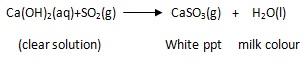
Sulphur dioxide turns lime water milky due to calcium sulphite formed. When excess SO2 is added the milky colour disappears (example, a clear solution is formed). The milky colour disappears due to the formation of calcium bisulphite which is soluble in water.
USES
- Lime water is used to test for carbon dioxide.
- A suspension of Magnesium hydroxide in water (milk of magnesium) is used as an antacid.
- Ca(OH)2 is used in making builders mortar (mixture of slaked lime, sand and water).
- A mixture of Ca(OH)2 is used in making bleaching powder.
- Ca(OH)2 is used for neutralizing acids in the soil.
- A mixture of Ca(OH)2 and water (white wash) is used for coating walls and ceiling.
- Ca(OH)2 is used in water softening.
- Ca(OH)2 is used in sugar refining filtered.


8 Comments