


THEORY OF MARKET
Meaning of market
Market refers to a situation where buyers and sellers are in close contact exchanging goods and services and the price of the commodity is being determined. Market can be a place or process.
Determinants or Essentials of a market
- Presence of a commodity
In a market there must be commodities which have been brought for sale.
- Presence of Buyers
The people who are able and willing to purchase the commodities being sold at a particular price and time.
- Presence of sellers.
The people who have brought their commodities for sale.
- Location or Presence of an area (region)
Refers to a particular locale where the transactions are taking place.
- The Price
One price should prevail for the same commodity at the same time.
Extent of the Market
Refers to the size of the market. The market may be wide or narrow.
The size of the market depends on the following factors:
- Character of the commodity
In order to have a wide market a commodity must be: (i) portable (ii) durable (iii) suitable for sampling, grading and exact description and (iv) such that its supply can be increased. Such commodities are wheat, gold, government securities etc.
Bulky articles like brick and perishable articles like fresh fruits and vegetables have a narrow market.
- Nature of Demand
A commodity which is in universal demand e.g. gold & silver will have a wide market. Similarly, a commodity of general consumption has a wide market.
- Means of transport and communication
The size of the market depends upon the extent to which means of communication and transport have been developed. Properly developed transport and communication systems enable commodities to be carried long distances and establish wide contact, thus widening the market.
- Peace and security.
Obviously, goods cannot be marketed in distant places unless peace and order prevail. In wartime, due to insecurity in war zones, markets get restricted. The extent of the market depends on the peace prevailing in the region.
- Currency and credit system.
If the currency and credit system of the country are well developed, marketing can be conveniently and profitably carried on over extensive areas. The extent of the market depends on the state of the currency and the confidence it inspires.
- Policy of the state.
Markets may be restricted by the policy of the state. Prohibitive duties and quotas restrict the market. The zoning system e.g. wheat zones, which allow free movement of goods only within a certain zone, has the same effect. Thus the government policy can also affect the extent of the market.
- Degree of Division of labor
We know that division of labor is limited by the extent of the market. The converse of this is also true. That is, the extent of the market also in its turn depends upon the degree of division of labor. The greater the division of labor, the cheaper the articles and wider the market.
FUNCTIONS OF A MARKET
- It facilitates the transaction by providing opportunity of buying and selling goods.
- It serves as an outlet for the goods produced by various manufacturers.
- It is a source of supply of goods of own consumer choice.
- It helps to establish contact among buyers and sellers.
- It helps to maintain prices at a specific level.
- The market for a commodity helps to determine the demand for that commodity. A greater demand encourages firms to produce more hence increase in production.
TYPES OF MARKETS
There are several ways of classification of markets. Some of these types are:
A. Classification of a market according to what is bought and sold
- Product market: Deals with selling and buying of final goods.
E.g.: markets of sugar, rice, beans, etc.
- Factor market: Deals with buying and selling of factors of production.
E.g. labor market, capital market, and market for land.
- Financial market: Deals with selling and buying (exchange) of currencies.
The currencies are being sold and bought. E.g. market for foreign currency in Bureau de change.
B. Classification of markets according to the place where the product is bought and sold
- Local market: This occurs when a commodity is produced and sold around the area of its production. E.g., local brew like “mbege” is sold around the areas of its production.
- National market: It occurs when a commodity is bought and sold within the country e.g. a commodity which faces a national market is soap found throughout Tanzania.
- International market: It occurs when a commodity is bought and sold in many countries of the world e.g. medicines fetch international market.
C. Classification of a market according to commodity
- General market: This type of market occurs when various commodities are bought & sold at any specific area. E.g. we can say Kariakoo is a general market.
- Specific market: It occurs when only one kind of commodity is being bought and sold at a particular place. E.g. Dar es Salaam Stock Exchange (DSE) where shares are only bought and sold.
- Grading market: This is a type of market which occurs when any commodity is sold & bought according to its grade.
D. Classification of markets according to time
- Day to day market: This type of market occurs when the price of any commodity is determined according to demand and supply conditions of that particular day.
E.g. Saturday market, Wednesday market. It means supply can be increased beyond the existing stock of that commodity.
- Short period market: It occurs when the price of a commodity is determined according to supply and demand conditions of that short period of time. In the short period a firm can have the variable inputs like labor, raw materials etc. In this case, the supply can’t be increased beyond the existing capacity of the present firms.
- Long period market: This kind of market occurs when the price of a commodity is determined according to the long run demand and supply conditions. In the long run period it is possible to change the amounts of factors of production such as establishing new firms, constructing buildings etc.
E. Classification of a market according to situation & structure of market
Market is based on the buyers and sellers (degrees, types of commodities which are differentiated, and if there are some barriers). Based on this classification, markets have the following structures:
- Perfect market (perfect competitive market)
Perfect market structure
A perfect market structure is the type of market structure with a high degree of competition in the market.
A market is said to be perfect when all the potential sellers and buyers are promptly aware of the price at which transactions take place.
This market structure is characterized by the following:
- Large number of buyers and sellers
Under this, there is a large number of sellers and buyers of the commodity in the market. Therefore a single buyer or seller cannot influence anything in the market, for example the price and the output.
- Homogeneous Products
The commodities produced by all firms are totally identical in all aspects. The commodities sold are similar in shape, colour, size, weight etc. Therefore a buyer has no specific preference to buy from a particular seller.
- Free entry and exit
Any new firm is free to join the market and any already existing firm is allowed to leave the market.
- Perfect knowledge
All sellers and buyers have full knowledge about the market condition such as the price of the commodity.
- Perfect mobility of factors of production
Factors of production such as labor and capital are perfectly mobile both geographically and occupationally. Mobility of factors of production is essential to enable firms and the industry to achieve an equilibrium position.
- Profit and utility maximization
The major goal of a firm is to maximize profit and that of the buyer is to maximize utility.
- No transportation cost
Under this market structure it is also assumed that there is no transport cost, for example in the movement of goods, raw materials and so on. If the cost of transport is to be there, the prices must differ from that existing in different sectors of the market.
- The price is constant
Under perfect market structure the price is constant, whereby:
P = AR
AR = (P × Q) / Q
AR = P
where AR = Average Revenue, P = Price, Q = Quantity
CRITICISM OF A PERFECT MARKET
A perfect market is a theoretical concept and does not exist in real life situations. The conditions under which a perfect market exists are unrealistic due to the following reasons:
- The number of buyers and sellers may be small.
- The commodities are differentiated or substitutes for almost every commodity.
- There are restrictions to entry and exit.
- There is no perfect mobility. There are some limitations to the factor mobility.
- There is preferential treatment; the suppliers discriminate price and provide special services to some customers.
- Single sellers may be able to influence the price e.g. in a monopoly single sellers may influence price.
- There is imperfect knowledge of the market situation; hence there is a need to advertise.
REASONS FOR STUDYING A PERFECT MARKET
- There are some markets which have a perfect market. E.g. the market for agricultural products.
- A perfect market provides a model for studying realistic market structures.
- It is applied when adopting price control.
PROFIT MAXIMIZATION UNDER PERFECT COMPETITION
In short run profit maximization:
- Under perfect market competition to maximize profit, the following conditions are most important:
- Marginal cost must be equal to marginal revenue i.e. MC = MR (necessary condition but not sufficient).
- Marginal cost curve must cut marginal revenue curve from below at highest level of output (sufficient condition).
- Price > AC.
Note: The firm makes super normal profit due to limited firms in the market.
TR = P × Q
Total revenue is a product of price and quantity.
Average revenue is revenue per unit of output. The ratio between revenue and output.
AR = TR / Q
And
TR = P × Q
AR = (P × Q) / Q
AR = P
Where TR = Total Revenue
MARGINAL REVENUE (MR)
Is the addition to the total revenue resulting from selling one extra unit of output.
The ratio between change in total revenue and change in output.
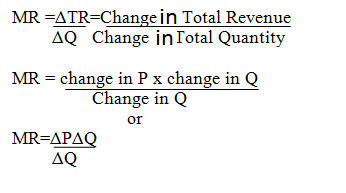
But price does not change hence MR = P.
6. In a perfect market there is perfect factor mobility i.e. the factors of production are free both occupationally and geographically.
7. There is perfect knowledge of the product situation in the sense that buyers are aware of the price and quality of the commodities hence no need for advertising of revenue.
8. No transportation costs, in the sense that the price remains uniform across all the market.
IMPERFECT MARKET STRUCTURE
The imperfect market structure is divided into the following markets:
- Monopoly
- Duopoly
- Oligopoly
- Monopolistic competition
OLIGOPOLY MARKET
Oligopoly
is the market structure which is characterized by few firms operating with significant barriers to entry of the firm.
Oligopoly comes to exist when economies of scale or advantages of large scale production exist on such a large dimension that only such a firm or firms have the advantage of extremely economic production which can produce on a scale.
FEATURES OR CHARACTERISTICS OF OLIGOPOLY
- Few, unequal competition among firms.
Each firm is faced with competition from other firms through market power and therefore cannot be a price taker.
- Non-price competition of advertising. If one firm reduces the price, others would do the same and all firms would end up losing.
- Firms are closely dependent on each other. A firm can reduce the price when other firms reduce the price.
- In most cases there is product differentiation.
- No easy entry into the industry.
- Price and output decisions are very difficult.
- Interdependency among various firms.
TYPES OF OLIGOPOLY
There are two important subtypes of oligopoly:
- Pure oligopoly or perfect oligopoly
- Imperfect oligopoly
ADVANTAGES OF OLIGOPOLISTIC MARKET
- Existence of competition leads to production of goods with quality and great quantity.
- Consumers enjoy a whole variety of products due to production of differentiated products (increase of important oligopoly).
- Stable prices are charged as there is price rigidity.
- Abnormal profits are enjoyed both in the short run and in the long run.
- It is a source of government’s revenue through taxation.
DISADVANTAGES OF OLIGOPOLY MARKET
- Production of excess capacity leading to underutilization of resources.
- There is unemployment of labor because of producing at excess capacity.
In the long run equilibrium is attained at a point where long run MC curve = MR output. OQ is produced and sold at OPC normal profit is earned by all firms.
Because of free entry of new firms in the long run the demand for the product is shared more.
Therefore the demand curve is tangent to the AC.
STRATEGIES USED BY OLIGOPOLY FIRMS TO AVOID PRICE WAR
- Collusion refers to an agreement among firms in an industry to decide the market output and fix the price i.e. agree on the price and output rates in order to decrease competition and increase profit.
- Formation of a cartel.
A cartel is a group of firms that agree to avoid competition, so they can act as a single monopoly and earn monopoly profit. Cartels are more collusive when the goods supplied are homogeneous e.g. oil, steel. Example of cartels is OPEC.
- There is consumer exploitation because there are few firms and each firm has control or influence over the market conditions.
- There is restriction of output because the supply of each firm depends on its capacity.
- It incurs high selling cost in terms of advertising and sales promotion.
THE THEORY OF KINKED DEMAND CURVE
The theory of kinked demand curve has been developed explaining the price inflexibility that characterizes oligopoly.
A kinked demand curve is a curve in the oligopoly market whose price is elastic above administered price and inelastic below administered price.
THE KINKED DEMAND CURVE
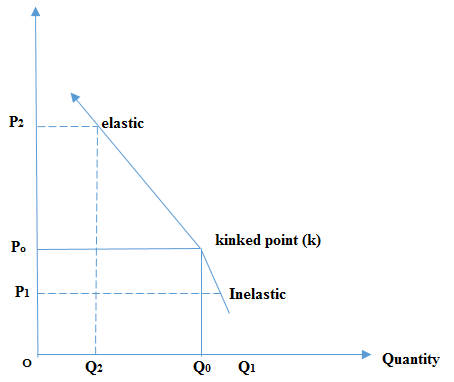
From the graph OPO is administered price and OQ2 is the output and K is the kinked point.
- If a firm in the oligopoly market lowers the price (OP1), other firms will also follow and lower their prices. The curve shows that the demand will be elastic.
- On the other hand, if a firm in an oligopoly market raises its price (OP2), other firms will not raise their prices thus demand will be highly inelastic.
ADVANTAGES OF MONOPOLISTIC COMPETITION
- Product differentiation enables consumers to get varieties of a product.
- Firms compete to make improvements on the quantity of product.
- In case one firm collapses, substitutes are available.
- The price change is lower than that of monopolist because of competition from the substitutes.
DISADVANTAGES OF MONOPOLISTIC COMPETITION
- There is underutilization of the firm in the short run and in the long run there is excess capacity.
- In the long run there is no profit to enjoy economies of scale.
- The price charged on buyers is higher than in perfect competition.
- In the long run there are no profits to invest in research since the firms earn normal (zero) profit.
- To maintain the market share the seller has to advertise thus increasing cost and price.
PROFIT MAXIMIZATION UNDER MONOPOLISTIC COMPETITION
COMPETITIVE MARKET
(How price and output determine monopolistic competition)
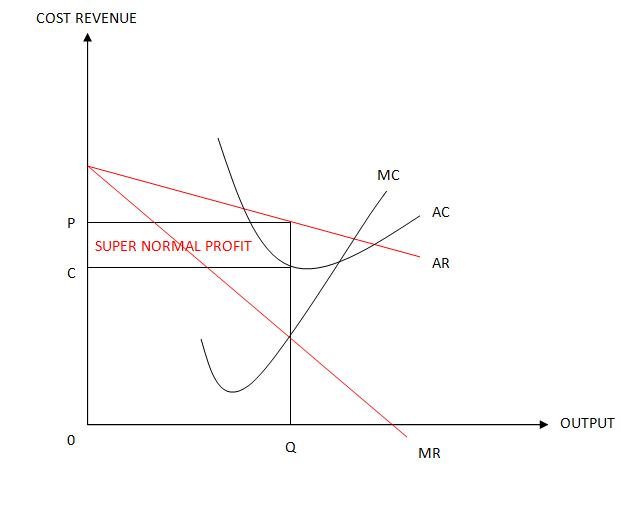
- IN THE SHORT RUN
– A firm maximizes profit when:
P = Price
MC = Marginal Cost
MR = Marginal Revenue
AC = Average Cost
- MC = MR
- MC curve should cut MR curve at the highest level of output.
- P > AC (AR > AC) and hence the firm earns abnormal profit.
- A firm produces at excess capacity because it produces less than the optimum point.
DIAGRAM
From the graph the firm maximizes profit equilibrium point where MR = MC.
SHOWS A FIRM MAKING SUPER NORMAL PROFITS
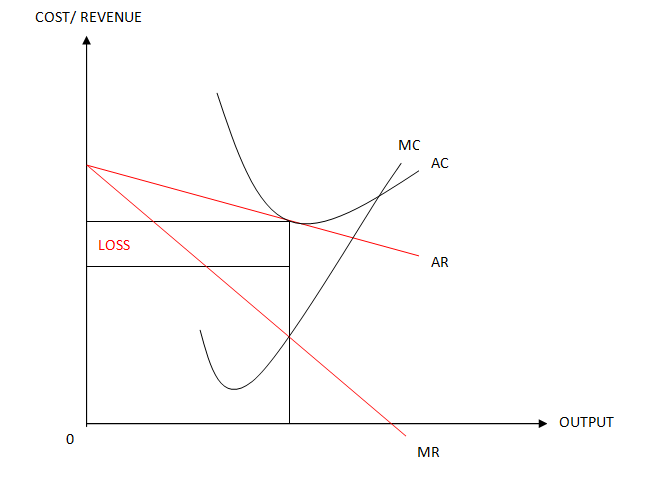
LOSSES ARISE WHEN COSTS RISE OR DEMAND DECREASES.
- IN THE LONG RUN
In the long run firms maximize profit when:
- LMC = LMR
- LMC must cut LMR at the highest level of output.
- P = LAC
DIAGRAM
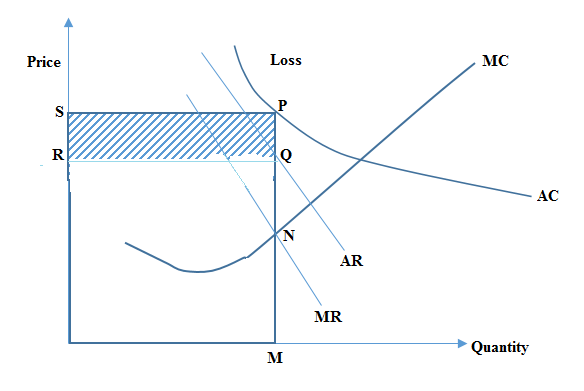
PQRS is the loss that is sustained by the monopolist in the short run period.
MONOPOLISTIC COMPETITION
Is a type of market structure which is characterized by many firms which are fewer than in perfect competition.
FEATURES OF MONOPOLISTIC COMPETITIVE MARKET
- There are many suppliers fewer than in perfect competition.
- Non-homogeneous goods (product differentiation) but they are close substitutes. Its differentiation may be in form of packing, design, quality, branding etc.
- There are barriers to entry which are insufficient to prevent other firms from entering in the long run.
- Firms have a degree of market power and therefore it forms a downward sloping demand curve.
DIAGRAM
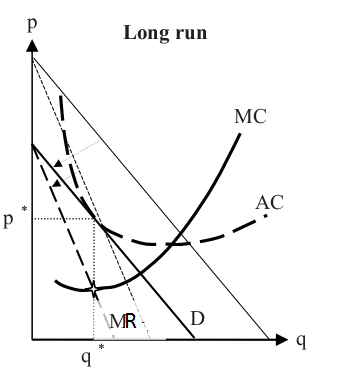
The demand curve in a monopolistic competition is more elastic than that of a monopoly because of the presence of substitutes. MR is below the AR as in case of monopoly, the demand curve is downward sloping because each firm has monopoly power over its product and is not a price taker.
- There is need for persuasive advertising in monopolistic competition.
DIAGRAM
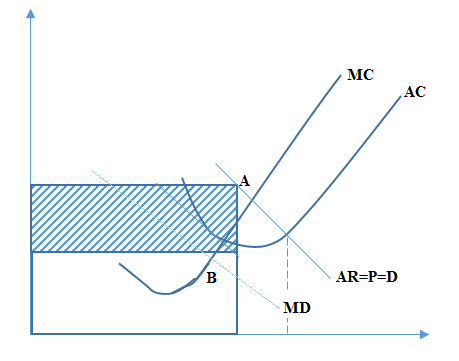
From the graph, the firm makes profit at output OQC. If the firm produces more than OQC it would make MC > MR thus equilibrium point is at B where marginal cost is equal to marginal revenue i.e. MC = MR.
A monopolistic firm produces at excess capacity i.e. OQ is below the lower point of AC curve which is at point O, since costs are still falling the firm could still produce more output to OQ. In order to keep the price up, it produces less than optimum.
A monopolistic firm has no supply curve because it is the sole controller of all the output and there is no unique relationship between market price and quantity supplied. In other words, monopoly firms are the same as industry.
WHEN MONOPOLIST FIRM MAKES LOSS
Sometimes monopoly makes loss even though its curve is downward sloping.
In the short run when demand and cost situation is not favorable the monopolist may undergo loss and it occurs when:
(i) MC = MR
P < AC
DIAGRAM
MR = (160 – 100Q)Q
MR = 160Q – 100Q2
MC = MR
-40 = 160Q – 100Q2
-40 = 160 – 200Q
200 = 200Q
Q = 1
For M = TR = (360 – 4Q)Q
MR = 360Q – 4Q2
MR = MC
360 – 8Q = -40
400 = 8Q
Q = 50
PK = 160 – 100Q
PK = 160 – 100
PK = 60
PK = 60 units
Price of Kanyama is 60 units.
PM = 360 – 4Q
But Q = 50
PM = 360 – 200
PM = 160 units
Price of Msichoke is 160 units.
HOW TANESCO MAXIMIZES PROFIT
MC = MR + MR2
-40 = 160 – 200Q + 360 – 8Q2
-40 = 520 – 208Q
208Q = 560
Q = 2.69
PROFIT MAXIMIZATION UNDER MONOPOLY MARKET STRUCTURE
The monopolists maximize profit when:
- MC = MR
- MC curve must cut MR curve from below at the highest level of output.
- NB: the firm makes super normal profit both in the short run as well as in the long run because there are barriers which restrict the entry of new firms in the market.
ADVANTAGE OF PRICE DISCRIMINATION
- It enables the poor to get essential services at low prices e.g. cheap houses for civil servants, doctor charges low price on poor patients.
- To the producer, it increases total revenue because output sold has increased.
- It is a one way in which the rich subsidize the poor thus a method of income redistribution.
- It increases sale and consumption.
- It helps countries to dispose surplus commodities e.g. dumping.
THE WORKED EXAMPLE BELOW
Tanesco offers electricity to two consumers Kanyama and Msichoke. The price of electricity for Kanyama is given by the equation PK = 160 – 100Q while that of Msichoke is given by the equation PM = 360 – 4Q.
If the production cost for two consumers is given by the equation TC = 100 – 40Q. Find:
- Among the consumers who demanded at the industrial rate and the demand at a domestic rate.
- Compute average fixed cost (AFC) in each market.
- Briefly explain the five conditions necessary for price discrimination to take place.
Solution
MR = (160 – 100Q)Q
MR = 160Q – 100Q2
MC = MR
-40 = 160Q – 100Q2
-40 = 160 – 200Q
200 = 200Q
Q = 1
For M = TR = (360 – 4Q)Q
MR = 360Q – 4Q2
MR = MC
360 – 8Q = -40
400 = 8Q
Q = 50
PK = 160 – 100Q
PK = 160 – 100
PK = 60
PK = 60 units
Price of Kanyama is 60 units.
PM = 360 – 4Q
But Q = 50
PM = 360 – 200
PM = 160 units
Price of Msichoke is 160 units.
- Msichoke demanded electricity at domestic rate due to high price while Kanyama demanded electricity at industrial price due to low price.
2. Discrimination according to sex or age i.e. charging low price on the young people than old.
3. It may be geographical e.g. dumping where commodities are sold cheaply in another country to drop off surplus.
4. Carried out according to the time of service e.g. tickets for videos are charged at higher price in afternoon where there are many people than in the morning hours where people are few.
5. Discrimination according to nature of product e.g. branded commodities are charged higher price than unbranded commodities of the same type.
6. Discrimination according to use of the product e.g. low transport charge for input and high transport charges on luxuries (for input and high transport and some distance).
7. Discrimination by differences of the commodities e.g. higher price on travelers in first class in the train and low charge for other classes.
CONDITIONS FOR PRICE DISCRIMINATION
- The commodities must be sold by the monopolist.
- The price elasticity of demand should be different in different markets i.e. a higher price should be charged where price is elastic.
- The cost to divide the market should be very low e.g. in case of dumping, cost of transportation should be low.
- Buyers should not know how much is charged in another market. This is possible especially where goods and services are sold on the other.
- It should be impossible for buyers to transfer the commodities from where the price is low to where the price is high.
NB
- Price discrimination may also be used to sell units of the same commodities at different prices to the same customer e.g. telephone charges high on first 3 minutes and then low in the other.
- Monopolist firm produces at excess capacity i.e. they underutilize their plant so as to produce less output and sell at a high price.
- Monopoly firm may charge higher price hence affecting consumption to low income earners.
- In case monopolist stops producing there will be shortage of commodities due to lack of substitutes.
- Monopolists tend to exert pressure on the government at times as they can influence decision making because they are the controllers of production.
MEASURES TO CONTROL MONOPOLY
- The government can fix prices of commodities.
- Taxation. The government can impose taxes on monopolist firms to take away the abnormal profit. However the monopolist can shift the burden of taxes on to the buyers in the form of raised prices.
- Anti-monopoly (anti-trust) registration i.e. laws should be imposed to control monopoly by the firms to raise price to inhibit competition.
- Nationalization of monopoly firms by the government.
- Subsidization. New firms can compete with the monopolist firm.
- Removing the basis of monopoly e.g. by removing tariffs so as to allow imported goods to compete with the home products.
PRICE DISCRIMINATION
Price discrimination is a process of charging different prices for the same commodity to different buyers.
Price discrimination exists when a commodity is sold at different prices irrespective of the cost of production.
FORM OF DISCRIMINATION
- Discrimination according to personal income.
Income differentiation among buyers e.g. doctors charging low price on the poor and high price on the rich for the same services.
2. Cost of production leads other firms to require large which is different to be raised.
3. Government franchise. Sometimes the government protects certain producers to be only sellers of a certain product e.g. Tanesco in Tanzania.
ADVANTAGES OF MONOPOLY MARKET
- There is no duplication of services e.g. If there is one hydroelectric power plant, there may not be the need to set up another one in the same area.
- Economies of scale can be exploited in firms because it is capable of expanding using an abnormal profit earned.
- There is a possibility of price discrimination i.e. selling the same commodity at different prices which benefits low income earners.
- Research can easily be carried out using the super normal profit.
- There is wastage of resources in persuasive advertising which leads to increase in price.
- Public goods like roads, telephone etc. are easily controlled by the government as a monopolist.
- Infant industries can grow up when there is monopoly as they are protected from competition.
DISADVANTAGES OF MONOPOLY MARKET
- The firms can become inefficient and produce low quantity product because of absence of competition.
DIAGRAM
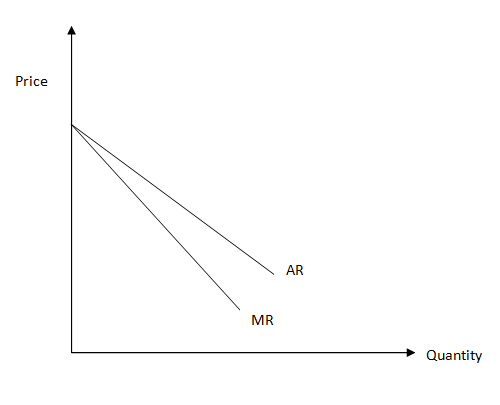
The MR curve for the monopolist firm slopes downward from left to right because when more commodities are put in the market the price falls therefore MR decreases.
Its demand curve is inelastic in nature because of changes of price in the market.
FACTORS WHICH GIVE RISE TO MONOPOLY
- Ownership of natural resource
E.g. Tanzania is the only supplier of tanzanite in the world because it is only found in Tanzania.
2. Function of monopoly association (Cartel) e.g. OPEC (Organization of Petroleum Exporting Countries).
Protectionism
The barriers are imposed on the product to exclude foreign competitors so that the producers may become monopoly.
- Protect rights e.g. writer of the book where the law forbids other firms dealing in the commodity.
- Advantages of large scale production which do not allow small competitors to compete successfully with large firms.
- Long distance between producers where each producer monopolizes the market in his/her locality.
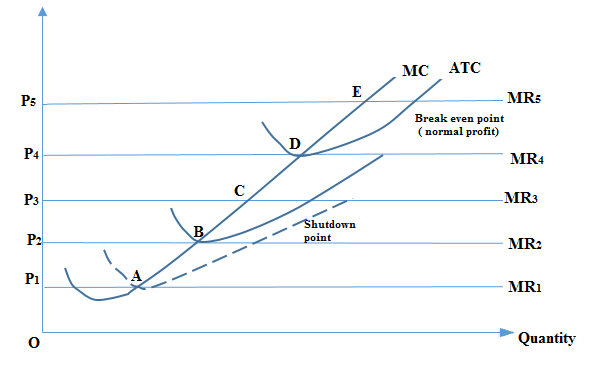
Shut down point
Is a point which occurs when the firm covers only the variable cost. At this point the firm is advised to close the firm.
DIAGRAM
MONOPOLY MARKET STRUCTURE
Monopoly is the market situation where there is one seller of a product which has no close substitute.
Monopoly is a word derived from Greek word “mono” which means one (single) and “poly” means seller or firm. Monopoly is an imperfect market structure where there is a single seller of a commodity.
NB: A monopoly firm is also an industry.
CONDITIONS FOR MONOPOLY
- There is one firm (single seller) which deals with a product that has no close substitute e.g. TANESCO, DAWASCO etc. in Tanzania.
- There are barriers / restrictions on entry by other firms into the industry.
- Monopolist is the price maker i.e. the supplier is the one who determines the price of the commodity.
- Demand curve slopes downward from left to right because the monopolist increases revenue he has to reduce price so that MR < AR because price is not constant.
DIAGRAM
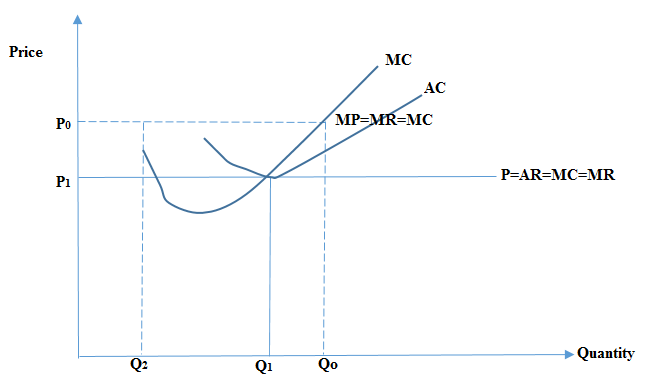
- From the curve the monopolist earns maximum profit at M where H it produces. Above this point, it makes losses because MC > MR.
- If it produces below this point (less than QQo) it would make less profit because of producing low output.
Thus for the firm to maximize profit, it should produce an output where MC = MR.
- Long run profit maximization.
The firm maximizes profit in the long run when:
- MC must be equal to MR.
- LP = LAC.
- Because of free entry of the firms, other firms are attracted by the abnormal profit to join the market and hence form the industry. As a result total output would be increasing leading to fall in price and fall in profit until when firm SRRT has normal profit.
DIAGRAM
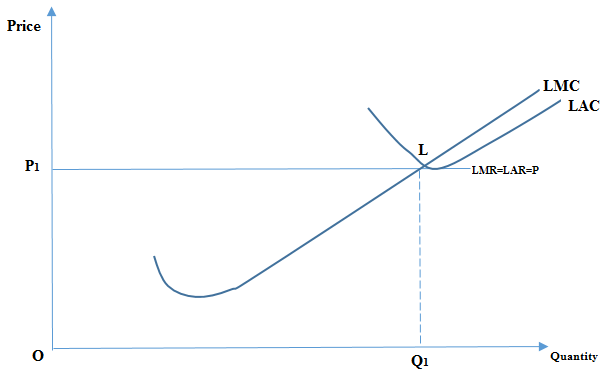
From the graph the firm maximizes profits at point L where LMC = LMR i.e. at an output QQ1.
THE SHUT DOWN POINT AND BREAK EVEN POINT
- Breakeven point.
Is a point which occurs when the firm covers all costs of production i.e., variable and fixed costs. That is firm’s total revenue is equal to firm’s total cost TR = TC.




5 Comments