


PRODUCTION
Production is the process of creating utility.
In production there are four types of utilities which are form utility, time utility, place utility and possession utility.
- To the general public, production refers to the process of making goods either for sale or for direct consumption, e.g., cultivation of maize partly for domestic consumption and other part for sale.
- In economics, production is the process of making goods for sale. It is also known as indirect production.
Direct production refers to the process of making goods and services for direct consumption or use.
General production involves employing the factors of production by combining them to produce goods and services which aim to satisfy wants.
TYPES OF PRODUCTION
There are two major types of production; these are:
- Direct production.
- Indirect production.
A. DIRECT PRODUCTION
Direct production
is the type of production carried by a person in order directly to satisfy his or her own wants or production for own consumption. It is mainly for subsistence of which the production is very low.
B. INDIRECT PRODUCTION
Indirect production
means production is not attempted to satisfy own wants directly except to a very limited extent. The production of goods is aimed for selling.
STAGES OR LEVELS OF PRODUCTION
There are three major levels of production, which are:
- Primary production.
- Secondary production.
- Tertiary production.
PRIMARY PRODUCTION
Involves extraction of natural resources and making them useful in their own form to human beings, e.g., agriculture, mining, fishing, and quarrying.
The output from the primary stage is used as inputs or raw materials in the secondary stage.
SECONDARY PRODUCTION
Involves transforming raw materials into semi-finished or finished goods. It includes manufacturing and construction. The output of primary production is used as inputs of secondary production. E.g., cotton produced in primary production is used in textile industries to produce clothes.
- Construction includes construction of roads, buildings, bridges, etc. The material used in construction industry is obtained from the primary production.
TERTIARY PRODUCTION
Involves provision of services. Production is incomplete till the final goods reach the final consumers or final users.
- It involves provision of services which will enable the final goods to reach the hands of their final users. These services are further divided into consumerism and personal service.
- Consumerism refers to the service of wholesalers, retailers, banks, insurance, transport, etc. Personal services refer to the services of doctors, advocates, teachers, etc.
SPECIALIZATION AND DIVISION OF LABOUR
DIVISION OF LABOUR
Is the process of splitting one particular job into several tasks, trades, or processes.
SPECIALIZATION
Is the process of assigning one task, trade, or process to one particular worker or a group of workers and the whole job accomplished with the help of several workers.
FORMS / NATURE OF SPECIALIZATION
- Specialization by gender: e.g., during the Old Stone Age, men were hunting and women were gathering.
- Specialization by process or complex specialization, e.g., in car assembling, manufacturing, etc.
- Regional / territorial specialization. Different parts of the country produce different crops depending on the climatic conditions of a place, e.g., in Tanzania:
- Mwanza – cotton
- Mbeya – rice
- Tanga – fruits
- Occupational specialization such as teachers, doctors, lawyers, etc.
- Specialization by product.
ADVANTAGES OF SPECIALIZATION AND DIVISION OF LABOUR
- It increases output.
- It improves the skills of the workers.
- The workers become more efficient.
- It helps to increase employment opportunities. The jobs create many tasks to be performed by several workers.
- Cost per unit is reduced as a result of large scale production.
- It leads to less fatigue to the workers, i.e., less tiredness due to repeating the same job now and then.
- It leads to employment of specialists. One will go to the real field for which he/she is competent.
- It enables the employment of facilities such as machines.
- It is easy to train a worker in one field rather than several fields of specialization.
- Time saving since it does not involve movements.
DISADVANTAGES OF SPECIALIZATION
- It can lead to unemployment, due to changes in demand for labour caused by changes in demand for goods or changes in technology.
- Loss of craftsmanship as a result of increased use of machines. The workers’ skills are reduced due to the use of machines.
- It results in high cost of production as a result of increased number of workers who have to be paid.
- Boredom. Doing the same thing now and then leads to one getting bored.
- Dulls the workers. The thinking capacity of the workers is reduced, i.e., they know very few things but lack knowledge of many others.
- Lack of responsibilities; in case anything goes wrong, there is no possibility of locating the source of the fault.
LIMITATION OF SPECIALIZATION
- Size of the firm.
For specialization to be economically feasible, the size of the firm must be large enough to keep the specialized labour, machines, or plants fully employed.
- The size or extent of the market.
The size of the market also presents the division of labour to take place beyond a certain unit. It shows the degree in terms of the area, length, range, or size of the markets for given products or goods and services.
FACTORS AFFECTING THE EXTENT OF THE MARKET
- Lack of improved mass communication.
- Change in the population size of a given area either through natural disasters or by net migration will affect the extent of the market.
- Inadequate monetary supply.
- Nature of some industries. Some industries by their nature have less scope per division of labour and may be forced to be used for different tasks; otherwise, the workers are underutilized.
- Willingness and ability of labour to work in different places and climates.
- Availability of training facilities and employment security.
- Nature of demand of some products, i.e., if the production is for individual demand, production can take place on a small scale hence limited division of labour.
FACTORS OF PRODUCTION
These are resources or inputs which are used during the production process.
The factors of production are classified into:
- Land
- Labour
- Capital
- Entrepreneurship
LAND
Refers to all unworked natural resources which are found either in or on the earth’s surface and used in the production of goods and services. It includes mineral resources, water bodies, soils, vegetation, etc.
FEATURES OF LAND
- Land is a gift of nature; it is not a product of human labour. It is naturally found, e.g., gold deposits are naturally found.
- Land cannot be moved from one place to another but has several uses such as farming, grazing, construction, etc.
- Land is fixed in supply. It is not possible to measure the size of land. E.g., increase of rent will not cause more land to be available or supplied.
- Land differs in terms of fertility. It is of different grades depending on the natural fertility.
- Land provides a site for production. That is, all production activities are carried out on land.
- Land obeys the law of diminishing marginal returns. It states that “Other factors remaining constant, application of more and more units of variable inputs on a given fixed input (land) will lead to the marginal product of the variable input to diminish after some time.”
Others argue that land can be increased through land reclamation.
LABOUR
Labour is the human effort applied in production of goods and services to satisfy human wants. Labour is human effort but all human effort is not labour until applied on production and rewarded accordingly.
TWO TYPES OF LABOUR
- Manual labour: physical effort and very small percentage of mental use in production work in a factory or otherwise contributes his effort. E.g., Handcraft.
- Mental labour: intellectual work, 70% applying mental/brain and very little physical effort on production of goods and services. E.g., teachers, doctors, and engineers.
FEATURES OF LABOUR
- Labour cannot be separated from a labourer.
- Labour is highly mobile (can move from one place to another or shift from one job to another).
- Labour cannot be stored if not employed.
- Labour is not homogeneous. They differ in efficiency.
- The reward for labour is wages.
- Labour is not motivated only by material incentives but also moral incentives.
EFFICIENCY OF LABOUR OR LABOUR EFFICIENCY
It refers to the quantity and quality of output a worker can produce for a given period of time. It refers to how productive the worker is.
It is measured as the ratio between total product and number of labour employed.
Efficiency of labour is also called productivity of labour.
Efficiency of labour = (Total product) / (Number of labour employed)
FACTORS WHICH INFLUENCE PRODUCTIVITY OF LABOUR
- Efficiency of other cooperating factors such as the efficiency of the working tools / capital.
- Health of the workers. Hunger and sickness lower the workers’ efficiency.
- Wage rate. High wage rate motivates a worker to become efficient.
- Incentives. The provision of incentives such as free meals, free housing helps to raise the efficiency of a worker.
- The level of education and training. Workers who are highly educated or trained are more efficient than those who are not.
- Natural talents or abilities. Some people are born intelligent and become more efficient.
- Working conditions. Good job supervision will help in increasing the efficiency of the workers.
- Working experience. Workers with experience tend to be more efficient than those without experience.
- Weather conditions. Bad weather conditions such as drought lower the efficiency of labour while favorable weather conditions raise the efficiency of the worker.
MOBILITY OF LABOUR
It refers to the ease with which a labour or worker either moves from one geographical area to another or shifts from one employment to another.
It is the ease with which labour can move either geographically or occupationally.
TYPE OF LABOUR MOBILITY
(i) Occupational mobility: i.e., a labour moves from one employment to another employment such as from being a doctor to teaching.
(ii) Geographical mobility: A worker moves from one working place to another working place.
(iii) Vertical mobility: Move from lower position to a higher position. This may be due to long period of education, training, and promotion.
(iv) Horizontal mobility: A worker moves from one workplace to another workplace with the same working rank or position. Example: if an accountant leaves his present job and joins another for the same job.
IMPORTANCE OF LABOUR MOBILITY
- It helps the workers to increase their earnings, i.e., move from lower paying to higher paying jobs.
- It helps to reduce the problem of unemployment. People move from areas with no employment to areas with employment opportunities.
- It promotes the sense of nationalhood and international community.
- It promotes the transfer of technology and culture.
- It enables the workers to move to those areas where they are competent or specialized.
FACTORS WHICH LIMIT MOBILITY OF LABOUR
1. Lack of required education and training. Occupational mobility becomes difficult.
2. Age. Older people are less mobile.
3. Family Ties. The married people are less mobile; they do not prefer to stay away from their families.
4. Cost of movement. The cost of movement (transport) of a worker and her/his family may be high.
5. Housing problems. It may be difficult to occupy a residential house for the family.
6. Health difficulties. Workers with health problems such as diseases tend to be less mobile.
7. Political boundaries. It requires legal passports and certificates to enable one to migrate to another country and to be allocated employment, which limits labour mobility.
CAPITAL
Capital refers to man-made resources which help other factors of production such as land and labour in the production of goods and services.
Examples are:
- Machines
- Tools
- Buildings
FEATURES OF CAPITAL
- Capital is man-made resources used in production.
- Some forms of capital are highly mobile such as sunk capital while other forms of capital are immobile such as floating capital.
- Capital helps to increase the productivity of other factors of production. Example: land with fertilizers produces more and a fisherman with a fishing net catches more fish.
- The supply of capital can be increased through savings, which is influenced by high interest rate. High interest rate brings about more saving which tends to bring high capital formation.
FORMS OF CAPITAL
- Fixed capital: Is a form of capital which is durable and does not change its form during the production process. Example: buildings, machines, etc.
- Sunk capital: Is a form of capital which is durable and has only one specific use, e.g., railway locomotive or a rice factory (produces only rice). Fixed capital falls in this category if it could not be used for any other purpose.
- Circulating capital: Is a form of capital which is not durable and changes its form at the end of the production process, e.g., raw materials.
- Floating capital: Is a form of capital which is not durable and has several uses. Examples are raw materials, fuel, and money.
CAPITAL FORMATION OR ACCUMULATION
Is the process of adding up stock of capital goods to the existing stock. Capital goods means the goods which are used for further production.
Capital formation depends on or is influenced by saving which is affected by the level of income. That is, high income levels lead to more savings and hence more capital formation.
The level of saving is influenced by the following factors:
- The level of income, i.e., the higher the income, the higher the level of saving.
- The rate of interest.
- The government policy and political stability.
- The willingness to save, i.e., saving habits.
- Economic stability.
- Price. High price level reduces saving because a large part of income is consumed.
- Future expectations, e.g., leaving an employment one will save more.
ENTREPRENEURSHIP
It refers to the process of organizing the other factors of production. An entrepreneur is a person who owns the business. It is said that if land, labour, and capital are left alone, they will not produce. Therefore the entrepreneur has to organize them.
FUNCTION OF ENTREPRENEUR
- Providing initial capital for starting the business.
- Bear with the risk of loss and profit (uncertainty) bearing.
- To employ new technology into the firm.
- Employ other factors of production such as land, labour, and capital and reward them accordingly.
- Marketing the product, i.e., finding whether the commodities could be demanded by the consumers or not.
- Making all important decisions in the firm, such as what to produce, how to produce (method of production to be applied), for whom to produce, and where to produce.
- To look after the production, i.e., supervise the whole process of production.
CHARACTERISTICS OF ENTREPRENEURSHIP
- An entrepreneur does not work alone; he must employ other factors.
- The supply of entrepreneurship skills is scarce and cannot be developed easily.
- The reward of entrepreneurship depends on efficiency of other factors and it is known as profit.
- In a small business, the entrepreneur and the organizer is the same person who is also the owner of the business.
CLASSIFICATION OF THE FACTORS OF PRODUCTION
The factors of production are traditionally classified into land, labour, capital, and entrepreneurship.
Distinction between the factors of production is possible.
It is very difficult to distinguish land from capital or labour from entrepreneurship. For example, seeds and minerals are found in nature so they are land, but seeds and minerals are also raw materials hence they are capital.
Therefore the distinction between land and capital is just a matter of “time”; in short, seeds and raw materials are gifts of nature but in the long run they are capital.
Substitution between factors is possible
i.e., it is possible to substitute land for capital or substitute labour for capital. A farmer may increase the size of land for cultivation or on the existing land another one may improve seeds and use more fertilizers.
Also one can employ labour or use machines; hence economists have classified the factors of production into specific and non-specific factors of production.
- SPECIFIC FACTORS OF PRODUCTION: Are those factors of production which cannot be changed easily from one use to another use, such as a highly skilled teacher.
- NON-SPECIFIC FACTORS OF PRODUCTION: Are those factors that can be easily changed from one use to another use, e.g., bare land, unskilled labour, raw materials such as diamond can be capital.
TECHNIQUES OR METHODS OF PRODUCTION
Is the method which is used to produce a commodity. These are techniques of production. It includes:
- Labour intensive technique.
- Capital intensive technique.
- Land intensive technique.
LABOUR INTENSIVE
Is the method whereby a large number of workers are used in production using simple tools, e.g., where the labourers are employed to farm land using simple hoes is a labour intensive technique.
ADVANTAGES OF LABOUR INTENSIVE TECHNIQUE
- It helps to reduce the problem of unemployment. More people will be employed.
- It is less expensive (cheap).
- The maintenance and training of labour is also less expensive compared to maintenance of capital machines.
- It helps to distribute income among individual people and earn income through working.
- It helps to raise government revenue through taxing the workers.
The workers, especially the unskilled ones, may be lowly paid, e.g., in the LDCS.
DISADVANTAGES OF LABOUR INTENSIVE TECHNIQUE
- The products produced using labour intensive technique are of low quality.
- Labour intensive technique leads to production of low output.
- It may lead to some labour problems, like strikes or demand for higher wages.
- Increased use of labour intensive technique hinders technological development.
CAPITAL INTENSIVE TECHNIQUE
Is the technique where more machines are used in production and less labour is used, e.g., farming with a tractor or using computerized system of production, etc.
ADVANTAGES OF CAPITAL INTENSIVE TECHNIQUE
- It leads to large scale production.
- It improves the quality of the goods.
- It helps to reduce labour problems. No demand for salary increase by the computers or robots.
- It helps to promote technological advancement.
DISADVANTAGES OF CAPITAL INTENSIVE TECHNIQUE
- It leads to unemployment of people. That is many people lose their employment as machines replace labour.
- It is a very expensive technique.
- It is very costly to maintain the capital in case of any employment.
- Large scale production may lead to the problem of overproduction due to lack of a wide market.
LAND INTENSIVE TECHNIQUE
Is the method where more land is used in production and less capital, e.g., to increase the farm output one decides to expand the farm size while using less fertilizer.
FACTORS WHICH DETERMINE THE CHOICE OF TECHNIQUE OF PRODUCTION
- Price of factors. That is, if the factors of production are sold at a lower price, producers will use more units of that factor of production and vice versa.
- Efficiency of the factors. Producers will choose a factor of production which is more efficient than the other factors. Example: the use of capital creates more efficiency than labour.
- Degree of substituting a factor of production. If a certain factor of production cannot be substituted with other factors of production, producers will have to use more units of that factor, e.g., highly specialized doctor cannot be substituted.
PRICING OF THE FACTORS OF PRODUCTION
Pricing of the factors of production refers to the system of making payments or rewarding the factors of production.
REWARDS FOR FACTORS OF PRODUCTION
- The price for land is rent.
- The price for labour is wages and salaries.
- The price for capital is interest.
- The price for entrepreneurship is profit.
WAGES
Wages are the payments which are made for the productive services of a labour.
KINDS OF WAGES
- Money wages refers to the wages paid and recorded in terms of money. It includes monetary payment only.
- Kind wages refers to the wages which are paid in the form of some goods, e.g., a farmer pays in grams of crops to the labourer, potter, carpenter, etc., for the services rendered by them.
- Real wages means the purchasing power of money wage in terms of goods and services consumed by the wage earner plus other facilities provided by the employer free of cost, e.g., free uniform for policemen, transport allowances, etc.
FACTORS DETERMINING REAL WAGES
- Money wages and purchasing power of money. While computing real wages, we have to find out what quality of goods and services can be purchased with the money wages paid to the labour.
- Extra income. If a labour can earn extra income from an association with a particular job, that should also be considered while counting real wages. A teacher can earn extra income through tuition or writing a book. A doctor can earn extra income by giving consultancy to patients at his house.
- Extra facilities. Facilities such as housing, medical, education, etc., given to the labour should also be included in real wages.
- Working hours. While computing real wages, working hours with their distribution, leaves, and vacations should be taken into consideration.
- Nature of work. If the work is risky, dull, or injurious to health, the real wages in that case will be considered low.
- Working conditions. Working conditions have a large effect on real wages. Real wages are very much affected by the behavior of the employer or environment of the working place, provision for cold water and fans in the summer, heater in the winter.
- Permanency of the work. Real wages will be more in the profession where work is regular and permanent in comparison to jobs with temporary nature.
- Time and cost of training. Some workers require a long period of time and high cost for training, e.g., engineering, medical; other cases will be low because of time and cost of training.
WAGES DIFFERENTIALS
Wages differ among different people in the same job and among different jobs. We find that there is a difference in the wages of workers working in different occupations. Wage differentials can be explained mainly on the following grounds:
- Agreeableness of the job. Some jobs are more pleasant and agreeable than others. Supply of labour in pleasant jobs will be more than in unpleasant jobs; hence wages may have to be raised to attract workers into less attractive jobs.
- Regularity of the job. Some jobs provide regular employment while others give only irregular employment, especially seasonal occupations such as sugar mills, ice factories, etc.; hence the wage rate in the job having regular employment is higher.
- Risk and danger. Some jobs are more risky and dangerous than others. For instance, air services, military mines are some such examples where risk and danger are great. Hence it must be compensated by giving more wages in such occupations.
- Responsibility in the job. Wages sometimes differ on account of responsibility of the job, e.g., there is more responsibility on the principal of a college than the teachers; that is why a college principal receives higher salary.
- Working hours. Sometimes the hours of work require very early or very late attendance or shifts; hence higher wages have to be paid in such occupations.
- Cost and time of training. Jobs which require high quality training have higher wages, e.g., wages of doctors and engineers are always high.
- Differences in ability. Labourers who are more able and efficient will get higher wages.
- Social prestige. Wages will also be high in jobs having social prestige. Sometimes the wage rate is kept high merely to maintain the high prestige of a particular job.
- Non-competing groups. There are different categories of labour which modern economics call non-competing groups in the market, e.g., plumbers cannot compete for the job of being a doctor or a butcher cannot be employed for the job of accountancy. Thus different wages are paid for different categories of labour.
- Use of modern machines and techniques. Occupations having modern machines and using highly sophisticated techniques of production can provide higher wages.
RICARDIAN THEORY OF WAGE
The one different theory that explains how wages arise from time to time, for example, subsistence theory of wages, standard of living theory of wages, marginal productivity theory, modern theory of wages, and the bargaining theory of wages.
MARGINAL PRODUCTIVITY THEORY OF WAGE
The marginal productivity theory states that “Under perfect competition, every worker of the same skills and efficiency in a given category will receive wages equal to the marginal product of the labour.”
The theory operates under the following assumptions:
- It assumes that labour is homogeneous, i.e., they are the same in skills, efficiency, abilities, etc.
- Factors of production, i.e., labour can be substituted for each other perfectly.
- The theory assumes that wage levels and labour productivity are independent. This is not necessarily valid. Increased wages may call for extra efforts from the labour force so that productivity increases.
- It’s not always possible to separate the marginal contribution of each labour in the production.
- There are other factors than marginal product which determine reward for labour in production.
2. SUBSISTENCE THEORY OF WAGES
This is so called “Iron law of wages”. It states that, “if wages rise above subsistence level, increase in population is inevitable and this forces wages down to subsistence level.”
This theory was rejected due to the following:
- It is not realistic, because it is not necessary that the increase in wages must lead to the increase in population.
- The theory does not explain the inequity of wages in different occupations and countries.
- The theory attempts to explain mainly on the supply side with insufficient reference to the condition of demand.
Application of the theory was probably the theory that was formulated, since poor harvest in those days meant that many people died of starvation. It may still be true of some more densely populated areas where the standard of living is low.
3. THE MARKET THEORY OR MODERN THEORY OF WAGES
The modern theory of wages is also called demand and supply theory. According to this theory, wages are determined by the interaction between demand and supply.
Wages are the price of labour like other prices are determined in a market.
To understand the theory of wage determination, we have to understand the demand for and supply of labour affecting them.
DEMAND FOR LABOUR
The demand for labour in a factor market is a derived demand. It is derived from the anticipated goods and services in the production of which it assists. However, the demand for labour is also affected by:
- Elasticity of demand for the commodity produced.
- Technique of production.
- Price of other factors of production.
- Marginal productivity, i.e., entrepreneurs demand for labour because of its productivity. It is because of its productivity that entrepreneurs are ready to pay them.
SUPPLY FOR LABOUR
The supply for labour can be defined in two ways:
- The total number of people available for employment.
- The total number of hours that people are willing to work.
The supply of labour depends on the following factors:
- The size of population.
- The proportion of the willingness and ability to work, i.e., labour force.
- The number of labour worked by each individual.
- Wage rate, i.e., the supply of labour increases with the rise in wage rate and decreases with decrease in wage rate.
NATURE OF THE SUPPLY CURVE FOR LABOUR
The supply of labour increases with the increase in wage rate. Therefore the supply curve for labour is an upward sloping curve or it is downward sloping curve (which is sometimes known as regressive in nature).
That if wages increase, the supply of labour increases. However, it increases up to a certain point; thereafter it decreases until increase in wages forming what is so called ‘BACKWARD SLOPING CURVE” or “REGRESSIVE SLOPING CURVE”.
From the graph therefore an increase in wages from OW0 leads to the increase in the number of working hours from ON0. But further increase in wages from OW1 leads to the decrease in the number of working hours from ON0 to ON1.
Why the supply curve for labour is backward sloping or it is regressive in nature?
- Reduction of number of labour/workers willing and able to work. Sometimes it seems that when the wages of a member of family, especially men, increase, it results in the reduction of workers (women).
- Work-leisure rate or income substitution effect. I.e., when wages increase, workers’ income also increases. Workers may like to have more leisure in order to enjoy their income.
- Meeting objectives/goals.
3. SUBSISTENCE THEORY OF WAGES
If wages rise above subsistence level, an increase in population is inevitable and this wages should be paid to the level of subsistence (meeting basic needs).
CRITICISMS
- It is not realistic. It is not necessary when income increases and also population increases.
- Does not explain the equality between higher earners and lower earners in a country.
- The theory attempts to explain mainly only on the supply side with efficiency.
The theory was probably true at the time that it was formulated since there was poor harvest in those days which means that many people died of starvation. It may still be true to some more densely populated areas where the standard of living is low.
CAN TRADE UNIONS RAISE WAGES?
Trade unions can raise their wages if they follow these:
- If workers are paid below marginal productivity.
- By increasing marginal productivity by other means, i.e., they pressurize an employer by demand for modern machines, capital, etc.
- By using demand for labour through making the change of technique involving human labour.
- Raised for particular type of labour in industry, i.e., education skills.
- If wages take a small portion in the cost of production. An employer can provide (raise the wage of a worker) wage to a worker if the wages take a small portion in the cost of production.
COLLECTIVE BARGAINING AND TRADE UNION
Collective bargaining refers to the negotiations between a trade union and employer or an employer’s organization over the wages and work conditions.
Trade unions
Is the continuous association of wage earners for the purpose of monetary and improving pay of the workers and condition of working.
Example: in Tanzania we have TFTU – Tanzania Federation Trade Union.
FUNCTIONS OF TRADE UNIONS
- Bargaining on behalf of the workers for maintenance of better pay and good working condition, i.e., provision of education, holiday recreations, etc.
- To safeguard jobs. One should actually be sure of not losing job.
- To offer monetary benefits, i.e., sickness and accident person.
- To restrict the supply of labour so as to maintain their demand, i.e., the higher the demand, the higher wage rate.
- To keep all its members employed.
- To participate in national and international social economic organizations, e.g., ILO.
- Trade unions help to advise the government in number of issues such as employment policies, wage determination, etc.
- Trade unions help in improving the skills of its members through organizing seminars, workshops, etc.
FACTOR AFFECTING THE STRENGTH / POWER OF TRADE UNION
- The size of its membership. If the trade union has a large size of members, its strength will be large; likewise if the trade union has a small size of members, its strength will be less.
- The extent of the effect it causes to the community or society to strike.
- General economic conditions of the trade unions.
- The nature of demand and supply of labour and product.
- Proportion of the wage to the total cost of production.
- The labour laws of the country. If the labour laws are supporting and protecting the interest of the labourers then the trade union will be strong and the opposite is true.
- Trade union leadership. If a trade union is led by committed and competitive leaders, it tends to be stronger as compared to one led by leaders who aim at fulfilling their own objectives.
Problems faced by Trade Unions in poor countries
- Lack of enough funds which tend to limit the operation of the union.
- Government interferences in the activities of the trade union, e.g., setting restrictions on their operations.
- Lack of enough cooperation among members, e.g., some do not pay membership subscription or fee.
- Poor management and administrators who use trade union as a stepping stone as a base to achieve their own objectives.
- Tribal differences which tend to affect mobilization of members.
- In many low developed countries, the government is the major employer and often resists requests from trade unions.
Factors that Determine Wages
- The level of experience.
- Level of education.
- Government policy (minimum wage).
- Level of responsibility.
- The demand of the labour and supply as well.
- Level of strength.
- Level of productivity.
- Costs of living.
- Riskiness of the job.
II. RENT
Rent is a reward to the landlords for use of the land; therefore, it is the price of land.
In economics, rent is defined as a payment made to the landlord by the tenants for the use of their land.
In ordinary sense, rent is defined as a periodical payment made for use of items such as house, a bicycle, a car, and so on.
Theories of Rent
There are two main theories of Rent:
- Ricardo theory or Ricardian theory.
- Modern theory or demand and supply theory.
Ricardian Theory of Rent
This theory was put forward by David Ricardo. He defined Rent as, “That portion of the produce of land which is paid to the landlord for the use of the original and indestructible power of the soil.” In other words, Ricardo considered rent as a return to the landlords from the use of their land.
Ricardo stated that rent is only applicable to land and not any other factor of production because land possesses unique features being a free gift of nature and having fixed supply. He also emphasized that land possesses some power which is free and indestructible and this is what is referred to as the fertility power of soil, but such fertility is not uniform to all portions of land; therefore, some portions have high fertility and others low, hence the basis of rent.
Ricardian theory has two elements:
The first element is that rent arises due to the reasons that certain lands are more fertile as compared to other lands and in this way, surplus production occurs due to the difference in the fertility of land and it is called differential surplus or differential rent.
The second element is that land is scarce and rent arises due to the scarcity of land. According to Ricardo, the superior lands will pay scarcity rent at the same rate as the inferior lands but they will also pay a differential rent.
The theory is based on the following assumptions:
- Land has a fixed supply.
- Fertility differs among different portions of land.
- He also assumed the law of diminishing returns to operate.
- It is also assumed that land possesses original and indestructible power of the soil.
Based on all the above, Ricardo concludes that difference in rent among different portions of land depends on the superiority of the fertility and therefore more fertile land will fetch more rent than the less fertile.
Criticism of the Theory
- In reality, rent does not arise because of fertility but because land is scarce.
- Rent is not only applicable to land but even to other items such as car, bicycle, etc.
- The law of diminishing return which was assumed to operate can be checked by modern methods of agriculture, e.g., use of fertilizers.
- It is also not true that there is such original and indestructible power of soil since fertilized soil tends to lose fertility after being used for a long period of time.
- Land can also be used for various uses besides cultivation. It can also require to pay rent, e.g., construction of commercial buildings.
Modern Theory of Rent
According to the modern theory developed by Joan Robinson and others, rent can arise on any factor of production, i.e., land, capital, labour, and entrepreneurship.
- According to the modern economist, every factor has a level element; in other words, the supply of the factors of production is not perfectly elastic and hence they earn surplus income which is of the nature of rent.
- According to Mrs. Joan Robinson, the essence of the concept of rent is the conception of surplus earned by a particular part of factor of production over and above the minimum necessary to induce it to do its work.
- According to Prof. Lipsay, Economic rent is an excess over transfer earnings that a unit of the factors actually earns.
In short, Economic rent = factor’s actual earnings – transfer earnings.
That is, Economic Rent = present earning – Transfer earning.
DETERMINATION OF ECONOMIC RENT
According to modern economic theory, economic rent arises due to scarcity and specificity of the factors of production.
Example:
Suppose a mechanical engineer working in Kahama gold mining gets $2500 as monthly pay. If he leaves Kahama Gold mining, he can get $2000. In this situation, $2500 is actual earning and $2000 is his transfer earnings, that is the earning of the next best job.
This Economic rent = present earning – transfer earning
= $2500 – $2000
= $500.
In other words, the rent of any factor of production will depend on its elasticity of surplus as follows:
- If the factor is perfectly elastic, supply will earn no rent because both its actual earning and transfer earning are equal.
GRAPH
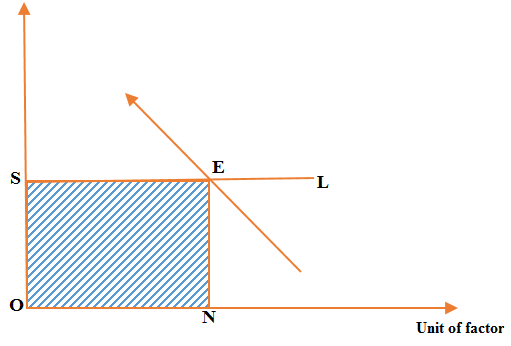
- Present earning = SENO
Transfer earning = SEON
Rent = 0
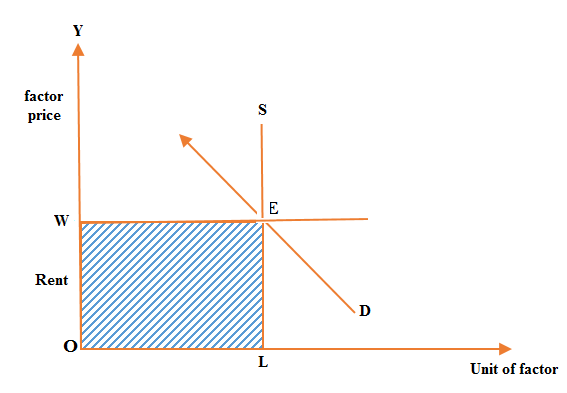
2. Rent under perfect inelastic. When the factor is completely specific or has only one specific use, change in price has no effect on its supply, i.e., even at zero price the supply of the factor will remain the same.
Thus this factor has no transfer earning. Therefore the whole actual earning is the economic rent.
This is illustrated under the diagram below:
From the diagram:
Transfer earning = 0
Present earning = WELO
Rent = actual earning – transfer earning
WELO – 0
- Actual earning = Rent
3. Rent under relatively elastic supply.
It is suggested that normally the supply of factors tends to increase with the increase in the factor price.
Thus the supply of the factor remains upward sloping from left to right.
If the supply curve slopes upwards, all units to the left for the one being considered have lower transfer earning. Thus the total transfer earning of the units is the area below the supply curve. And the total payment (present earning) is equal to the total area.
This is illustrated in the diagram below:
From the diagram we note that:
Rent = present earning – transfer earning
Rent = RES – SENO = RES
Thus the above analysis makes it clear that the more elastic the supply curve, the less the rent.
QUASI – RENT
The concept of quasi-rent was propounded and popularized by Prof. Marshall.
He used it to explain the return of man-made produced goods the supply of which is fixed in the short period.
PRODUCTION FUNCTION
In a technical expression that indicates the relationship between output and the factor inputs used to produce such output.
In short, production function can be written as:
Qx = f (K, L, E, etc.)
This can be simplified:
Qx = f (k, l) while l is variable and k is fixed.
TYPES OF PRODUCTION FUNCTION
- Short run production function. Some factors are fixed while others are variable, i.e., K (capital) is fixed, labour is variable.
Qy = f(k, l)
It is subjected to the law of diminishing returns.
- Long run production function.
All the factors of production are variable. It is subjected to the law of return to scale.
| Land | Labour | Total output |
|---|---|---|
| 1 | 0 | 0 |
| 1 | 1 | 16 |
| 1 | 2 | 48 |
| 1 | 3 | 108 |
| 1 | 4 | 164 |
| 1 | 5 | 194 |
| 1 | 6 | 200 |
| 1 | 7 | 180 |
| 1 | 8 | 150 |
FACTORS DETERMINING THE PRODUCTION FUNCTION
- Quality of resources available.
- State of technology.
- Size of a firm.
- Price of factors of production.
- Political stability.
- Infrastructural facilities.
- Political making a factor.
TOTAL PRODUCT, AVERAGE PRODUCT AND MARGINAL PRODUCT
TOTAL PRODUCT
Is the level of output which can be produced by a given amount of input.
Total product = Labor × Average product
Where L is labour.
AVERAGE PRODUCT (AP)
Is the output per unit of variable factors.
AP = TP / L
Where TP = Total Product, L = Labour quantity.
Given Q = 2L2 – L, find average product.
AP = TP / L
AP = (2L2 – L) / L
Divide L from the TP given.
Average product = 2L – 1
MARGINAL PRODUCT (MP)
Is the addition to the total product that results from unit factor inputs.
Is a change of total output as a result of unit change of a factor input.
MP = ΔTP / ΔL
Where ΔTP = Change of total product, ΔL = Change of labour, TP = Total product.

Example:
Find marginal product of the following economics equation:
Q = 2L2 – L
MP = ΔTP / ΔL = TP / L
MP = 2 × 2L2 – 1 × L
MP = 4L – 1
Assignment
The following table is demand from a production firm y.
| L | TP | MP | AP |
|---|---|---|---|
| 1 | 3 | 3 | 3 |
| 2 | 8 | 5 | 4 |
| 3 | 15 | 7 | 5 |
| 4 | 20 | 5 | 5 |
| 5 | 24 | 4 | 4.8 |
| 6 | 26 | 2 | 4.3 |
| 7 | 26 | 0 | 3.7 |
| 8 | 24 | -2 | 3 |
THE GRAPH MP, TP, AP

MP – Marginal Product
TP – Total Product
AP – Average Product
L – Labour Quantity
G – Point of Diminishing Returns. When quality labour employed are 3 and marginal product rising up to and start to diminish. Total product increases from 1 to 10. Average product increases until 5 men are employed, then it diminishes.
The Law of Variable Proportions (Law of Diminishing Returns)
According to Stigler: “As equal increments of one input are added, the inputs of other productive services being held constant, beyond a certain point, the resulting increments of produce will decrease, i.e., the marginal product will diminish.”
According to Paul Samuelson: “An increase in some inputs relative to other fixed inputs will in a given state of technology cause output to increase, but after a point, the extra output resulting from the same addition of extra inputs will become less.”
The law of variable proportions states that as the quantity of one factor is increased, keeping the other factors fixed, the marginal product of that factor will eventually decline. This means that up to the use of a certain amount of variable factor, marginal product of the factor may increase and after a certain stage it starts diminishing. When the variable factor becomes relatively abundant, the marginal product may become negative.
Law of Variable Proportions:
“In a given state of technology, when the units of variable factor of production (L) are increased within the units of other fixed factors, the marginal productivity increases at increasing rate up to a point, after this point it will become less and less.”
Assumptions:
- It is assumed that the technique of production should remain constant during production.
- It operates in the short-run because in the long run, fixed inputs become variable.
- Some inputs must be kept constant.
- The various factors are not to be used in rigidly fixed proportions but the law is based upon the possibility of varying proportions. It is also called the law of proportionality.
- It is assumed that all the units of variable factors of production are homogeneous in amount and quality.
- It is assumed that labor is a single variable factor.
Schedule:
The law of variable proportion is explained with the help of the following schedule:

In the above schedule, units of variable factor (labor) are employed with other fixed factors of production. The marginal productivity of labor goes on increasing up to the 3rd worker. This is so because the proportion of workers to other fixed factors was at first insufficient. After 3rd worker the marginal productivity goes on falling onwards till it drops down to zero at the 6th unit of labor. The 7th worker is only a cause of obstruction to the others and is responsible in making the marginal productivity negative. The marginal productivity (MPL) and the average productivity (APL) equalize at the 4th worker. Then the MPL falls more sharply.
Diagram:

The number of workers are measured on X-axis while TPL, APL and MPL are on Y-axis. The above diagram shows the three stages also obtained from the schedule.
Stage I:
At this stage MPL increases up to 3rd worker and its curve is higher than the average product, so that total product is increasing at increasing rate.
Stage II:
At this stage, MPL decreases up to 6th unit of labor where MPL curve intersects the X-axis. At 4th unit of labor MPL = APL. After this, MPL curve is lower than the APL. TPL increases at decreasing rate.
Stage III:
At 6th unit of labor the MPL becomes negative, the APL continues falling but remains positive. After the 6th unit, TPL declines with the employment of more units of variable factor (L).
Relationship Among Total, Average and Marginal Product:
The relationship among total, average and marginal product of labor in the light of the law of variable proportion is explained as under:
- The marginal productivity of labor increases, the TPL also increases at increasing rate. It is shown in the schedule up till 3rd unit of labor. The MPL curve has positive slope and TPL curve has rising tendency towards Y-axis.
- When the MPL decreases onwards till it drops to zero, the TPL increases at decreasing rate as shown in the stage II and the TPL curve has positive slope but has rising tendency towards X-axis.
- When the MPL is equal to zero, the TPL is maximum as shown on the 6th unit of labor.
- When the MPL becomes negative, the MPL curve falls below the X-axis, the TPL declines from its maximum position and its slope becomes negative as shown in the stage III in the above diagram.
- When the MPL increases, the APL also increases but at slow rate. The MPL curve becomes above the APL curve. Both have positive slopes.
- At some point, MPL = APL. At this point, MPL curve intersects the APL curve as shown at the 4th unit of labor in the above diagram.
- After intersecting point, MPL falls sharply. The MPL curve becomes below the APL curve. Both curves have negative slope.
- When MPL becomes negative, the APL never becomes negative because it is calculated from the TPL. So MPL curve is below the X-axis but APL curve is above the X-axis, having negative slope.
CAUSES FOR OPERATION OF THE LAW
- Fixed factor.
- Scarcity of a factor.
- Existence of imperfect substitutes. There is no way capital can be substituted to labour.
- Optimum combination of the inputs.
LIMITATIONS OF LAW OF VARIABLE PROPORTION (DIMINISHING RETURNS)
- Operates only in the short run.
- It is restricted to land only yet in reality it can apply to other factors when they are fixed.
- It is not applicable in case of virgin land because the land becomes productive for a long period.
- Variable factors are not homogeneous, that is they differ in efficiency and ability.
- It does not consider the influence of other factors such as health of a worker.
Thus the operation of law of returns to scale is mainly caused by two major means, which are:
- Very short run.
Refers to the period of time which is very short to make all factors variable, i.e., all factors are fixed.
- Short run.
Refers to the period of time where at least one factor is fixed and the other is variable.
- Long run.
Refers to the period of time that is long enough to make all factors variable.
- Very long run.
Refers to the period of time which is able to not only change factors of production but also the technology.
GRAPH

The law of return to scale operates in long run while the law of diminishing returns operates in the short run production function.
ASSIGNMENTS
Consider the following table and then answer the questions that follow:
| Labour (L) | TP | AP | MP |
|---|---|---|---|
| 1 | 4 | 4 | 4 |
| 2 | 14 | 7 | 10 |
| 3 | 27 | 9 | 13 |
| 4 | 40 | 10 | 13 |
| 5 | 60 | 12 | 20 |
| 6 | 72 | 12 | 12 |
| 7 | 77 | 11 | 5 |
| 8 | 80 | 10 | 3 |
| 9 | 80 | 9 | 0 |
| 10 | 75 | 7 | -5 |
SOLUTION
From TP = 2L2 – 20L
MP = 0 at maximum
MP = TP
0 = 4L – 20
20/20 = 4L/4
5 = L
The unit of labour which will maximize the output is 5.
MP, TP, and AP
TP = 2L2 – 20L
AP = TP / L
= (2L2 – 20L) / L
= 2L – 20
= (2(25) – 20(5)) / 5
= 50 – 100
= -50
The average product can’t be -10; it is +10.
TP = 2(25) – 20(5)
= 50 – 100
= -50
The product can’t be negative; therefore, ignore negative and TP = +50.
MP = ΔTP / ΔL
MP = 2L2 – 20L
= 4L – 20
Where L = 5
MP = 4(5) – 20
= 20 – 20
MP = 0
LAWS OF RETURNS TO SCALE
It states that:
- An increase in input may lead to more than proportionate increase in output.
- Decrease in inputs may lead to a proportionate decrease in output.
A GRAPH

Law of increasing returns to scale: If inputs are doubled then the output increases more than the double inputs.
- Law of decreasing returns to scale occurs if a production increase in inputs leads to less increase in outputs, i.e., if the inputs are doubled, the number of output is less than the double inputs.
CAUSES OF THE INCREASING RETURNS TO SCALE TO OPERATE
The reasons for the operation of increasing returns to scale are found in form of economies of scale.
- Labour economies of scale, that is, economies of specialization and division of labour are possible in large scale production.
- Technical economies of scale.
- Marketing economies of scale such as advertising through newspapers, TV, magazines.
- Managerial economies of



2 Comments