


POPULATION
Population refers to a group of people living in a particular geographical area at a specific period of time.
Population size refers to the total number of people living in a certain geographical area at a specific period of time.
As in the 2002 population census, Tanzania has a population size of 36 million people.
Population growth refers to an increase in the number of people living in a certain geographical area at a particular period of time.
It is divided into:
- National population growth – This is on the basis of birth rate and death rate and therefore it occurs when the birth rate exceeds the death rate.
- Artificial population growth – This is brought about by emigration and immigration. This exists when immigration exceeds emigration.
POPULATION CHANGE
It means increase or decrease in the number of people living in a certain geographical area at a specific period of time.
FACTORS WHICH INFLUENCE POPULATION CHANGE
- Change in birth rate
When the birth rate increases, population size also increases and when the birth rate decreases, population size also decreases.
- Change in death rate
When the death rate increases, population will also decrease and vice versa.
- Change in immigration
When the number of people entering the country increases, population will increase but when the number of people entering the country decreases, population will decrease.
- Change in emigration
When the number of people leaving the country increases, population will decrease but when the number of people leaving the country decreases, population will increase.
Birth rate and Death rates
Birth rate refers to the number of live births per thousand people.

Reasons for High birth rate in low developed countries
- Cultural factor: In many low developed countries, a big number of children is looked at as a source of wealth, prestige, and support during old age. In some cultures, it is also a sign of strength.
- Early marriage: In many low developed countries, there are many instances of early marriages, whereby girls and boys marry as early as 13 years, which creates a high possibility of giving birth.
- Polygamous tendency: Many men have a tendency of marrying more than one wife, which also contributes towards high birth rate.
- Gender preference: In many low developed countries, couples tend to target a certain gender and in the process have many children.
- Poverty: Children are looked at as a source of income through bride price.
Early school dropouts due to lack of school fees; families cannot afford family planning facilities such as pills.
- Ignorance: Many people in low developed countries are ignorant about the dangers of high birth rate and the different precautions to be taken against unwanted pregnancies.
- Idleness and lack of recreation facilities also contribute towards high birth rates since couples are together most of the time.
Measures that have been taken by the Tanzanian government to control Birth rate
- Family Planning: The government has introduced family planning programs that are offered by many health centers all over the country at a very low fee.
- Mass education: The government is also trying its level best to educate the masses about the dangers of high population and high birth rate through political gatherings, workshops, seminars, etc., under the concerned ministries.
- The education policy: More schools have been constructed.
School fees have been subsidized.
Sex education has been introduced.
- The government is also trying its level best to develop social and economic infrastructures in rural areas in order to reduce idleness among people in rural areas.
- The government has also used the law to reduce the birth rate as below:
The government set up sentences on rape and school pregnancies and has also discouraged early marriage.
DEATH RATE
This refers to the number of deaths per thousand people per annum.
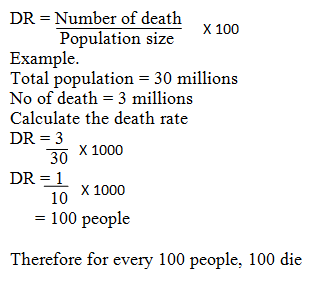
Reasons for high death rate in LDCs
- Poor or insufficient devices in many ways.
- Lack of enough food supplies which has created a high level of famine and many have died.
- Political Instability: Many LDCs are experiencing political instabilities through wars, tribal conflicts, religious conflicts, which have resulted in many killings.
- Disease: Many LDCs have chronic diseases such as AIDS, TB, and Malaria, which have claimed many lives.
- Lack of enough medical staff.
- Lack of enough health centers.
- Lack of enough hospital facilities.
- Poverty: Poor nutrition, inability to buy medicine.
- Poor sanitation and lack of clean water.
- Witchcraft.
Population Density and Distribution
Population density refers to the number of people per square kilometer.
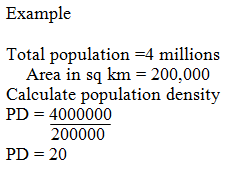
Effect of high Population Density
Negative effects
- High rate of crimes.
- Easy spread of diseases.
- Low standard of living because of lack of enough goods and services.
- Unemployment due to high supply of labor.
- More pressure on social services such as schools, hospitals, etc.
- High rent due to shortage of houses.
- Sanitation problems.
- More pressure on natural resources which results in environmental degradation.
Positive Effects
- High market which will stimulate economic activities.
- More labor supply.
- Production will tend to be more competitive.
- High government concern in areas with high population density.
Population Structure
This refers to the components of a certain population in a number of areas such as age, sex, occupation, education, etc.
Components of a Population Structure
- Age Structure: This is the distribution of population according to age. Here population is divided into children, adults, and the old. The children and the old are regarded as dependents (economically inactive) whereas the adults are regarded as economically active.

Effect of High Dependency Ratio
- High level of crime rate.
- It can result in an increase in street children.
- It can result in an increase in government expenditure.
- It results in a low labor force.
- It results in low savings and investment.
Expectancy
- Poor nutrition.
- Poor sanitation.
- High occurrence of diseases such as Malaria.
- Poor health services.
- Poverty.
- Low level of education.
Sex Structure
This refers to the distribution of population on a gender basis, i.e., males and females. From this, we can know how many males and females compare in the population of a certain country.
Sex Ratio

S:R = 1:3
This is the ratio between males and females.
Sex ratio = males : females
Assuming females are 6 and males are 2, calculate sex ratio.
For every 1 male, there are 3 females.
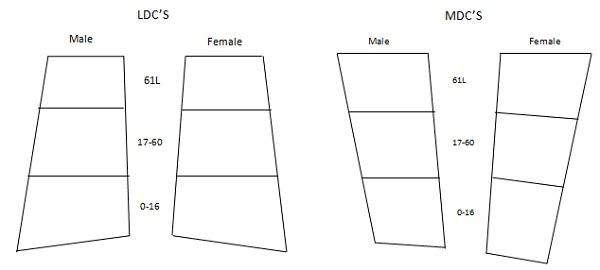

Education Structure
This shows the distribution of population according to the level of education, i.e., the educated, the uneducated, and the various levels of education. It is on the basis of this that we can determine the illiteracy rate and literacy rate.
Occupation Structure
This is the distribution of population according to different occupations. This helps to know the number of people employed in different professions, sectors, etc. It also helps to know the number of employed and the unemployed.
Income Structure
This shows the distribution of population according to different levels of income and it is from this that we can know the number of those who are low income earners, medium, and high income earners.
AGING POPULATION
This is a situation when there are more old people compared to adults and children.
This is a common feature for more developed countries due to high life expectancy.
EFFECTS OF AN AGING POPULATION
- It increases the burden to the government and society as such people become dependent; therefore, the government and society have to spend more in providing services to such people.
- Decline in the labor force which affects population.
- Decline in efficiency of work as old people are always less energetic, both mentally and physically.
- Increase in demand for goods demanded by the old, e.g., walking sticks, spectacles, etc., but decrease in demand for goods for children.
- Limited change in society as the old tend to be more conservative.
- Limited mobility of labor as many old people are not willing to move from one geographical area to another.
Spatial Population Distribution
This refers to how population is distributed in relation to the available resources.
There are three types of spatial population distribution:
i) Overpopulation
ii) Underpopulation
iii) Optimum population
Overpopulation
This is the situation when the number of people living in a certain geographical area is greater than the resources available. Therefore, under such situation, the labor force available is more than the resources available.
Indicators of Overpopulation
- Low standard of living.
- Food shortage.
- Housing shortage.
- High level of unemployment.
- High pressure on natural resources which tends to result in environmental degradation.
- Congestion on social and economic infrastructure, e.g., roads, schools, etc.
Optimum population
This is when the population of a certain country balances with the amount of resources that are available; therefore, the country’s labor force size can fully utilize the available resources.
Indicators of Optimum Population
- There is full employment.
- There is maximum standard of living.
- There is adequate provision of social services.
- There is maximum utilization of resources.
- There is maximum output.
Note: It is difficult to know that a country is at optimum population at a particular point because:
- The stock of resources cannot be accurately known.
- The population size may also not be accurately known.
- Time also affects the size of population and the stock of resources whereby they tend to change as time goes on.
Underpopulation
This is the situation when the number of people in a certain geographical area is less compared to the resources available; therefore, the available labor force is inadequate to maximize the utilization of the available resources.
Indicators of Underpopulation
- Small market size.
- Low standard of living.
- Shortage of labor force.
- Underutilization and idle resources.

EFFECTS OF A HIGH/BIG POPULATION SIZE
Positive Effects
- Big labor force which can be used in exploiting resources.
- Big market for goods and services.
- Big source of revenue to the government through taxes.
- High output produced in the economy and hence a high national income level.
- It will also result in more competition in society which will result in more creativity and inventiveness.
Negative Effects
- High level of unemployment due to excessive labor supply.
- High dependency ratio.
- Housing shortage.
- High rate of crimes.
- High government expenditure in provision of social and economic infrastructures.
- More pressure on social services such as hospitals, schools, etc.
- High pressure on natural resources which will result in environmental degradation.
- Excessive demand for goods and services which will result in demand-pull inflation.
Life expectancy
It is the average number of years a person can live in a given country at a specific period of time.
The life expectancy in LDCs such as Tanzania is low compared to MDCs due to the following factors:
a. Poor nutrition
b. Poor sanitation
c. High occurrence of diseases such as Malaria
d. Poor health services
e. Poverty
f. Low level of education
Population distribution
Population distribution refers to how people are spread in a certain geographical area; therefore, this can be even or uneven.
FACTORS THAT INFLUENCE POPULATION DENSITY
- Social and economic infrastructures: Population density is high in areas where there is availability of social services like hospitals, education, and economic services like roads, electricity, tap water, and telecommunication. While in areas with poor social services and economic infrastructure, the population density is very low.
- Climate: Population density is high in areas where climate is favorable for the cultivation of different crops. Examples of such areas in Tanzania are Kilimanjaro, Mbeya, and Victoria Basin. While in areas where climate is unfavorable for cultivation, the population density is low, e.g., central parts of Tanzania.
- Soil fertility: Fertile soil attracts human settlements for agricultural activities, while infertile soil discourages human settlement due to its inability to produce enough harvest; hence, in areas with fertile land, the population density is high.
- Political factor: Many people prefer to settle in areas with political stability and peace rather than in areas where there is political instability.
- Employment Opportunities: In areas where employment opportunities are easily available due to the presence of many economic activities such as manufacturing, the population density is high. While in areas with limited economic activities and employment opportunities, the population density is very low.
- Natural Hazards: Such as volcanic eruptions, floods, droughts, etc. Those areas with such problems usually have low population density and vice versa.
- Cultural Factors: Some tribes tend to live in areas left by their ancestors as their heritage and continue to produce in those areas to create clans, hence high population density.
Population Census
It is the complete process of collecting, comparing, and publishing demographic and socio-economic data regarding people living in a certain country at a certain period of time.
It is a systematic process of collecting, analyzing, and publishing the population data of people living in a certain geographic area at a specific period of time.
In Tanzania, the population census exercise is done every ten (10) years.
After such a period, fundamental changes are expected to take place regarding the population structure and socio-economic factors.
Importance of the National Population Census
- It is important to the government in the planning process in allocating funds for the provision of basic social services such as education and health.
- It helps to know the population distribution of people in a certain area and it is on this basis that it can be known which places are under or overpopulated.
- It helps to know the birth and death rates in the country which helps to establish the population growth rate.
- It helps to determine the dependency ratio in the country by knowing the number of the young and old.
- It is also important for political reasons, e.g., in determining comparisons over time regarding population size, birth rate, death rate, etc., between countries.
- Population census data is also important for international comparisons over time regarding population size, birth rate, death rate, etc., between countries.
- Population census is also important in knowing the population of the country, e.g., according to the 2002 population census, it was known that Tanzania has a population size of around 36 million people.
Problems encountered in conducting census in Tanzania and LDCs at large
- Lack of enough funds: Many LDCs, Tanzania inclusive, lack enough funds to carry out a smooth population census exercise. It is upon this that some countries at times postpone or carry out the exercise in an undesirable manner.
- Transport and communication, especially in rural areas, which results in failure to access some areas, delay in reporting data, and high transport costs.
- Unreliable data on issues such as level of income, education level, age, and so on due to the fact that some people at times are not willing to give the right information regarding those data.
- Lack of enough skilled manpower which normally results in employing unqualified people for the exercise, leading to mistakes and errors.
- Lack of enough cooperation from the public for the exercise, e.g., some refuse to be interviewed, others don’t allow access to their homes, and others give wrong information.
- Communication problems. There are some areas where people don’t know Swahili.
- At times, the government manipulates the population census data for its own political reasons. As a result, population data does not reflect what is actually on the ground.
Population Theory
- Malthusian Theory
- Optimum population theory
The Malthusian population theory
This theory was developed by Thomas Robert Malthus, a British economist in the 18th century.
In his essay “Principle of Population as it Affects the Future Improvement in Society” (1798), Malthus examined the relationship between population increase and increase in food production.
The main features of this theory are:
- Population increases according to geometric progression, i.e., 1, 2, 4, 8, whereas food production increases arithmetically.
- Population of a country increases at a higher rate compared to the increase in production of foodstuffs.
- If artificial methods are not adopted to control the population of a country, then it doubles in 25 years.
- If artificial methods are not adopted to control the population, then nature will take revenge and natural calamities like wars, floods, earthquakes will decrease the population.
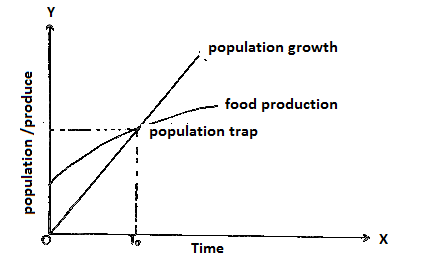
CRITICISM OF THE THEORY
- The area Malthus studied was very small to establish a theory which could be used worldwide.
- Malthus did not consider technical progress which can result in increased food production by applying better farming methods.
- He ignored the role of international trade which can help to import more food to cover shortages.
- He looked at people as just consumers without considering that a high population size will result in more labor supply and hence increase food supply.
- Malthus looked at food shortage as a result of high population growth rate ignoring other factors such as drought that contribute significantly to food shortage.
- Malthus also failed to consider the role of transport and communication which allows food to be transported from areas of surplus to areas of shortage.
Despite all the above criticism, the Malthusian Population Theory is of great application to many LDCs, especially in Africa, on the following grounds:
- In many LDCs, the population growth rates are very high due to high birth rates but their food supplies are very low, which has resulted in starvation.
- In some countries which are overpopulated, occurrence of natural calamities such as diseases, floods, and earthquakes have reduced the population size.
- It is also true that land has a fixed supply which is a big limitation in increasing food supply. It is also true that in many LDCs, availability of food has contributed a lot toward increase in birth rate, especially in rural areas.
Optimum Population Theory
After modern economists rejected the Malthusian population theory, the Optimum Population Theory was established. It states that the population of a country must be optimum.
Optimum population is that level of population which is most desirable in view of the natural resources of the country. Optimum population is a relative term and can be determined according to the resources available in the country.
The optimum population theory is more realistic and nearer to reality. This fact makes the Malthusian theory incompatible these days.
Although the Malthusian theory has been proved correct in some cases, it is not a comprehensive or reliable theory. The invention of new techniques of production and the development of atomic energy has made it possible to increase the population at a greater speed. The present population trends are not very encouraging but steps can be taken to control the population level and increase the production of different commodities to a great extent. Different countries have been very successful in solving this problem to a great extent.
Malthusian Theory vs Modern Theory
- Malthus focused his attention on food production, whereas the modern theory takes into consideration economic development in all aspects.
- Malthus seemed to think of a maximum number for a country which, if exceeded, would spell misery. According to the optimum theory, there is no fixed maximum.
- To Malthus, famine, war, and diseases were indices of overpopulation. But the optimum theory tells us that in the absence of such phenomena, there can be overpopulation. It can be shown when per capita income has gone down.
- The modern theory is optimistic, whereas the Malthusian theory is pessimistic in outlook. Malthus was haunted by the fear that population would outstrip food supply and spell misery.




1 Comment